If you could travel back a thousand years and tell a peasant that someday humans would be trading eggs and grain looking through OLED screens, let alone doing so in milliseconds with the help of AI, his prefrontal cortex would probably explode.
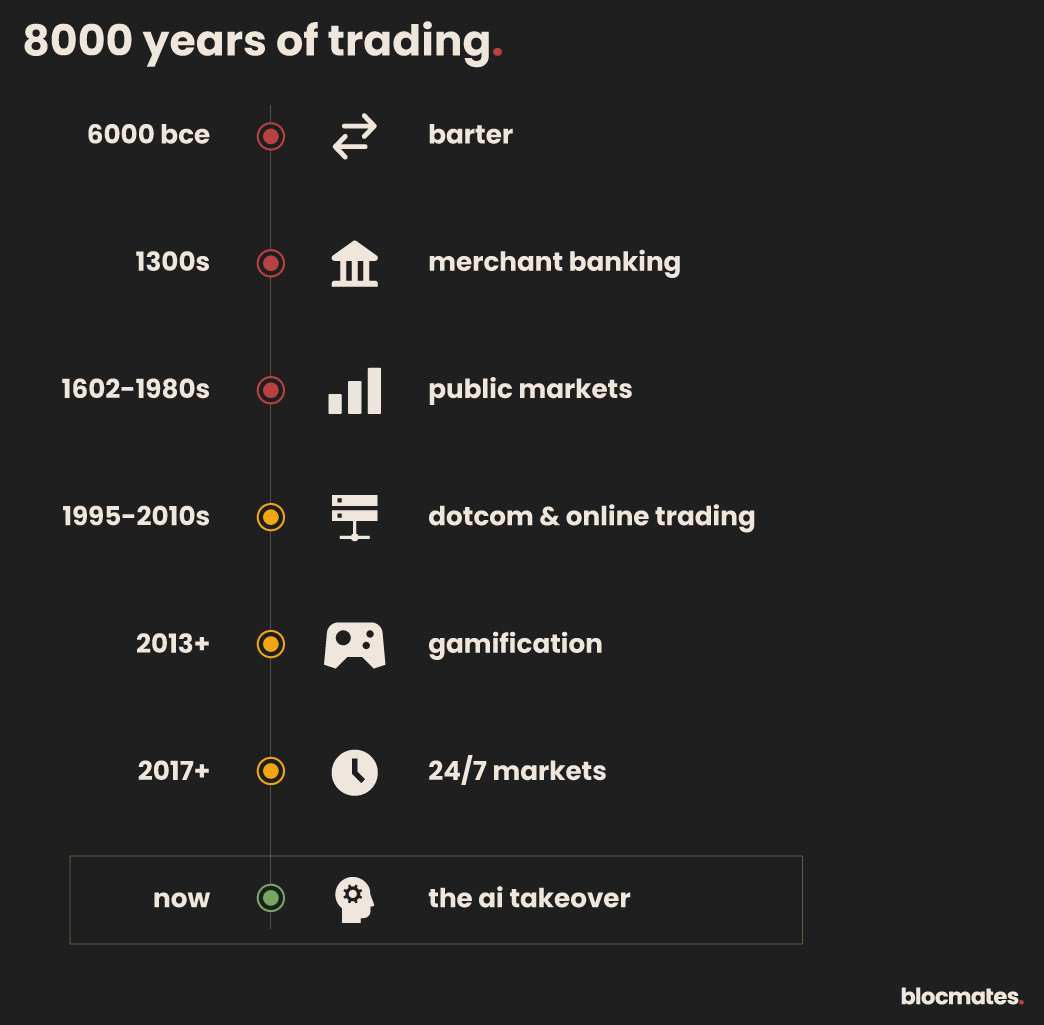
From the barter system to the modern era, a bunch of innovations have influenced how humans engage in trade.
While merchant banking, the creation of the first stock exchange in Amsterdam, and earlier developments were significant milestones, they primarily represented advances in intellectual, legal, and organizational frameworks rather than technological progress.
It was not until the introduction of the telegraph and Edison’s ticker tape that trading and money began to resemble what we have today. Humans had harnessed electricity and could move information at its speed.
Beyond the incredible fact that we literally took a rock, flattened it, zapped it with lightning, and tricked it into thinking, a benefit that’s evident across all technological advances is that markets become more accessible with each step.
What it does not change, however, are the underlying structural disadvantages that the average trader often does not account for. The explosion of mobile trading apps is an excellent example of this.
Though these apps provide unparalleled convenience and accessibility, every platform built to "help you trade" makes more money when you trade more frequently, understand your positions less clearly, and ultimately absorb fees you don't notice.
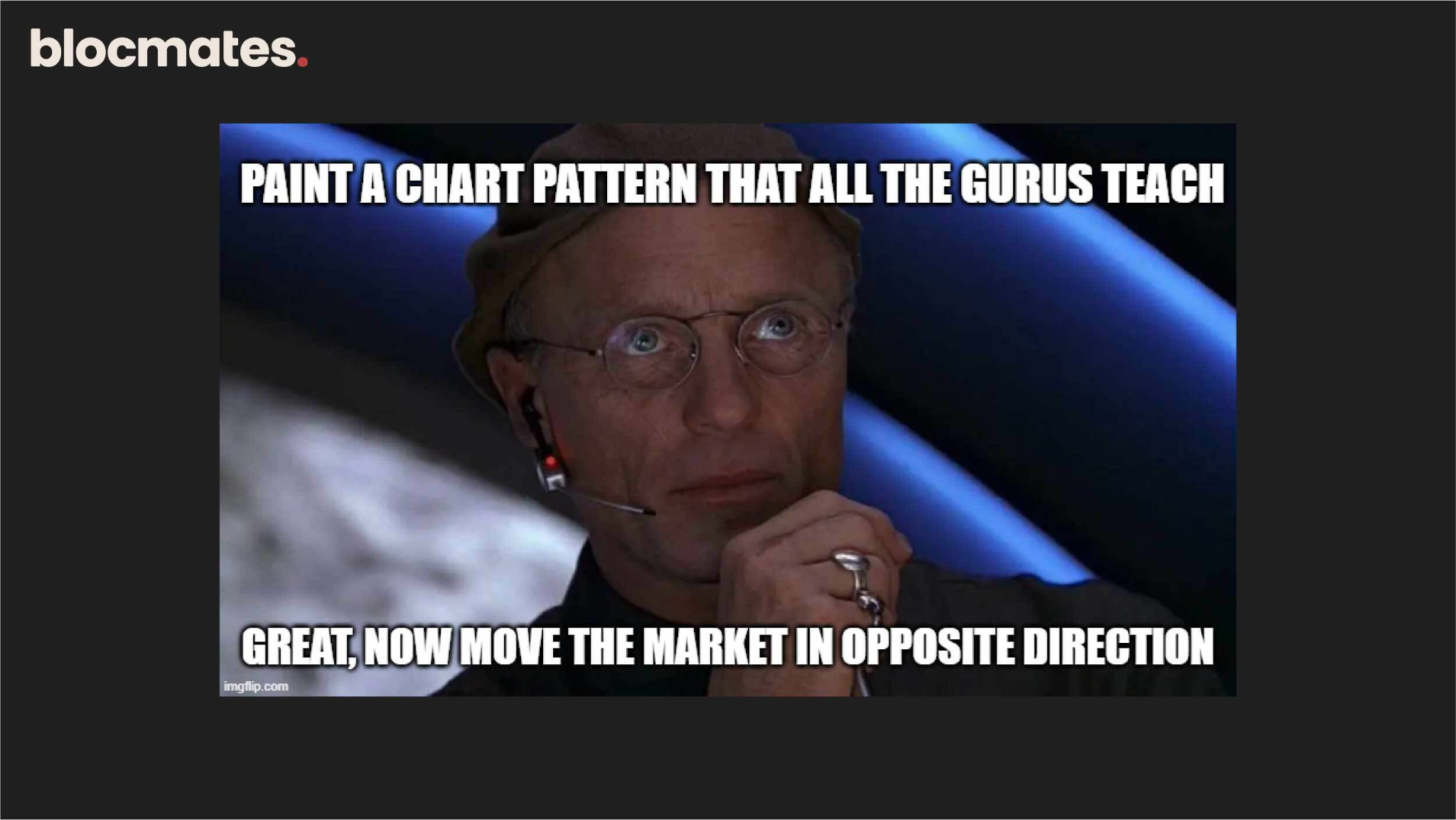
That’s the first invisible force working against you. The second is the competition, using these same rocks with electricity, only with powers that completely blow anything you have out of the water, making you play a game where the other player is effectively cheating.
The first lines in the article As Rocks May Think articulate this eloquently:
If we consider life to be a sort of open-ended MMO, the game server has just received a major update. All players take note: consider playing differently.
While firms like Renaissance Technologies, one of the most successful hedge funds, use machine learning to identify complex, nonlinear relationships in financial data, automate portfolio management, and analyze real-time information, such advanced capabilities are mere wet dreams for retail traders.
Yes, we are slowly seeing these technologies trickle down to the modern-day peasants, but it’s still light-years behind what the big dogs have had for years.
Having tested many AI trading companion apps, most of them focus on a single vertical. Some revolve around automated portfolio management, while others focus on research and analysis, leaving much to be desired in what trading actually involves.
The real problem is that trading at a high level requires compounding skills most humans can't retain at scale.
You train, you study, you build pattern recognition, only to forget, drift, or hesitate at the moment it matters.
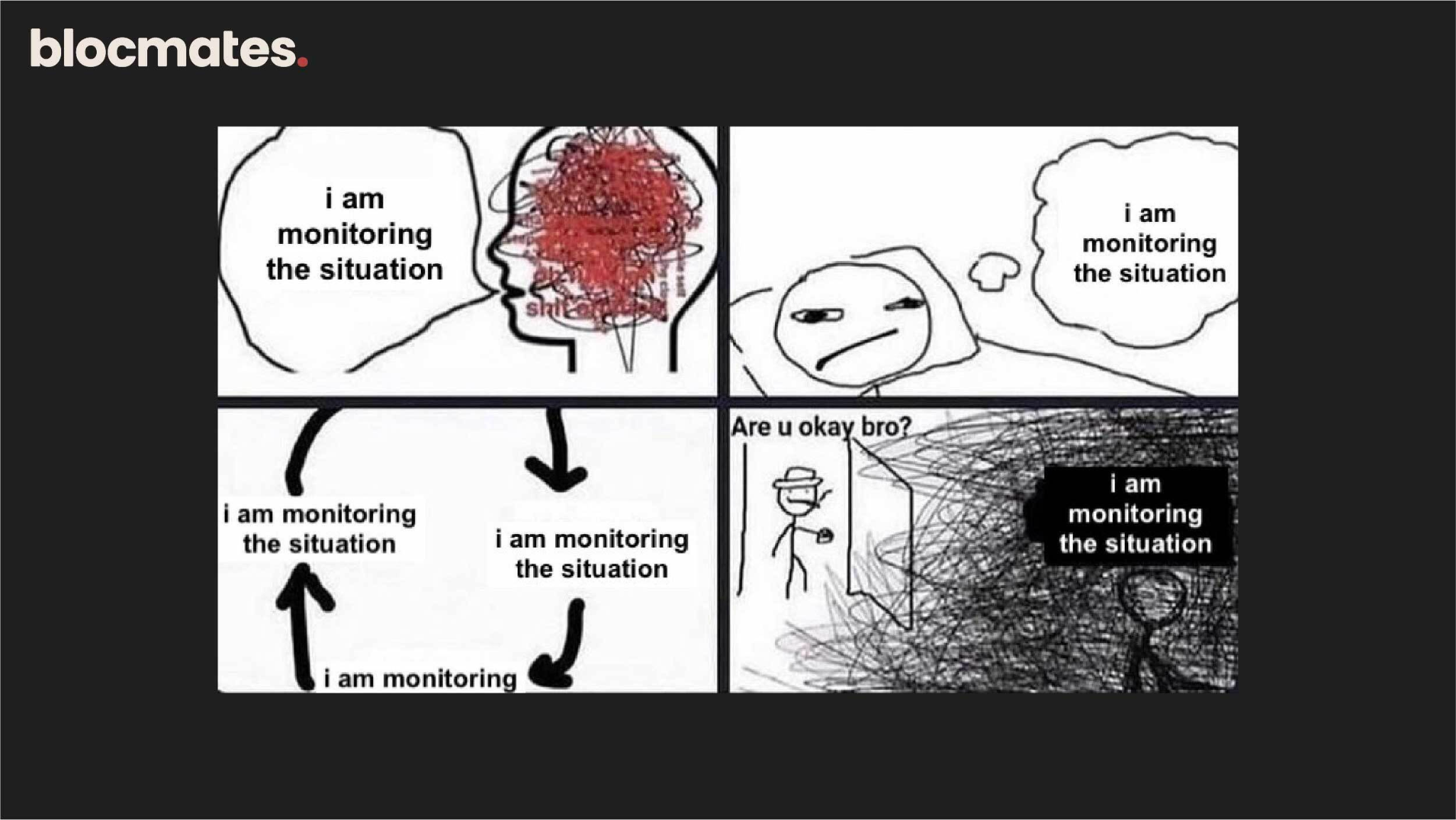
To curb this, the most savvy prosumer traders have already vibe-coded proprietary apps that help identify high-quality signals, simplify execution, and include additional tools such as journaling, risk management, and more, ultimately minimizing the cognitive load that comes from monitoring the situation.
As for the rest of us, we have three choices. Do nothing and continue trading against people with a far better information diet, tooling, and risk management; bite the bullet and build our own terminal, which can take a significant amount of time; or use something that was built to address this very conundrum.
I don’t know about you, but I’m going for the third option.
What is TrueNorth? The agentic brokerage
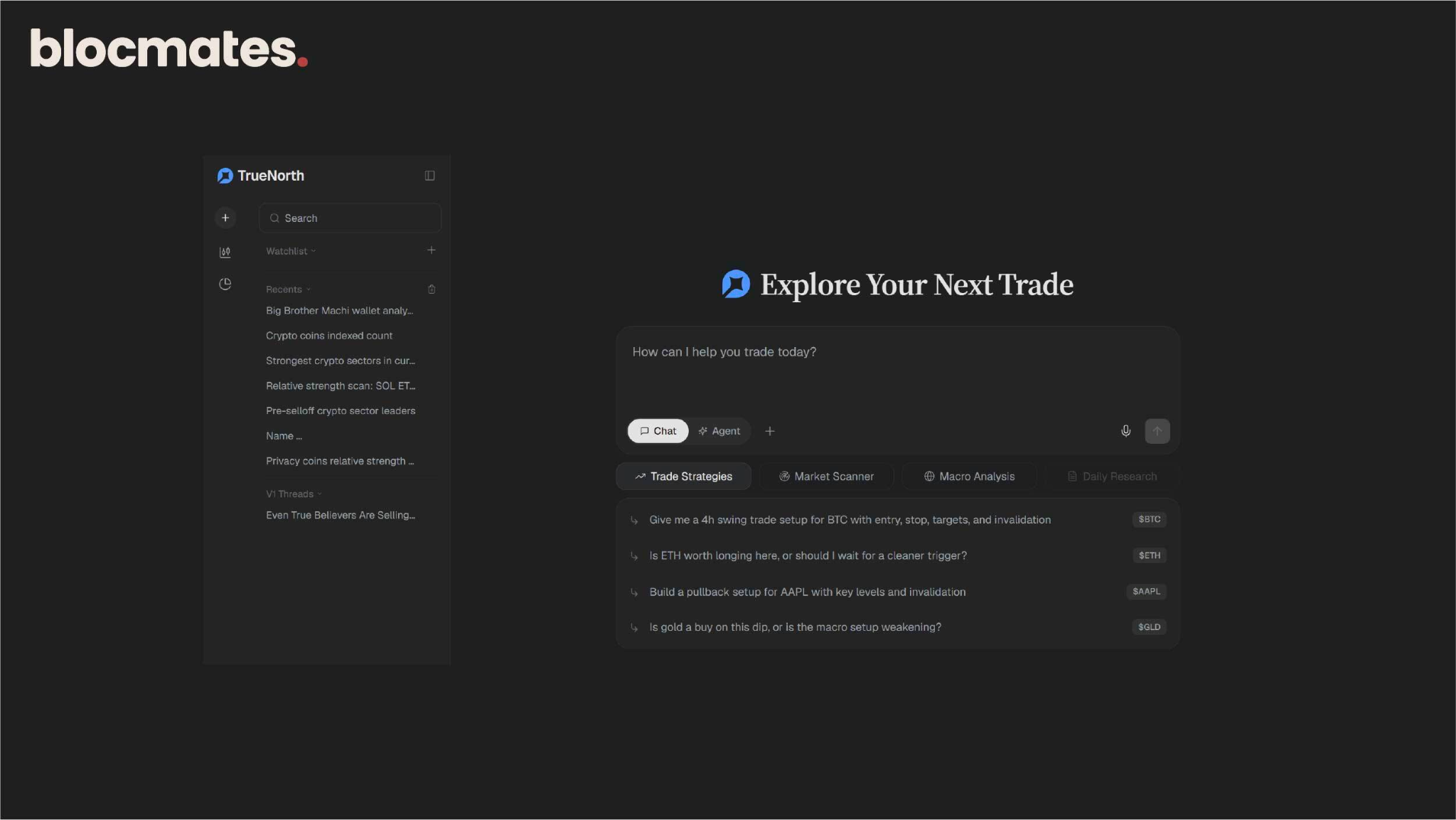
TrueNorth is a novel financial software that replaces traditional workflows for traders by bringing the full trade lifecycle, from research to execution to analysis, into a single agentic brokerage.
Wait, ain’t no way this pleb just tossed the words 'agentic' and 'brokerage' into one sentence. Bear with me here.
The agentic aspect comes from the AI capabilities, which, in TrueNorth’s case, are built to augment one’s trading system through a series of features that, when combined, push the envelope of what an AI trading assistant can do.
Thanks to a proprietary agent framework that combines long-term memory with a deterministic execution blueprint based on proven trading strategies, TrueNorth provides high-signal, multifaceted analysis that retail traders have long lacked.
But instead of delivering just a wall of text and static images or charts, TrueNorth supplements its text outputs with actionable trade ideas in the form of S/R lines, clear entry/TP/SL zones, and other technical indicators mapped onto a TradingView canvas.
A key aspect of making TrueNorth the go-to platform for traders is reducing the cognitive burden of managing dozens of open tabs and manually reviewing each source.
I mean, people are shipping all kinds of apps today, how hard could it be?
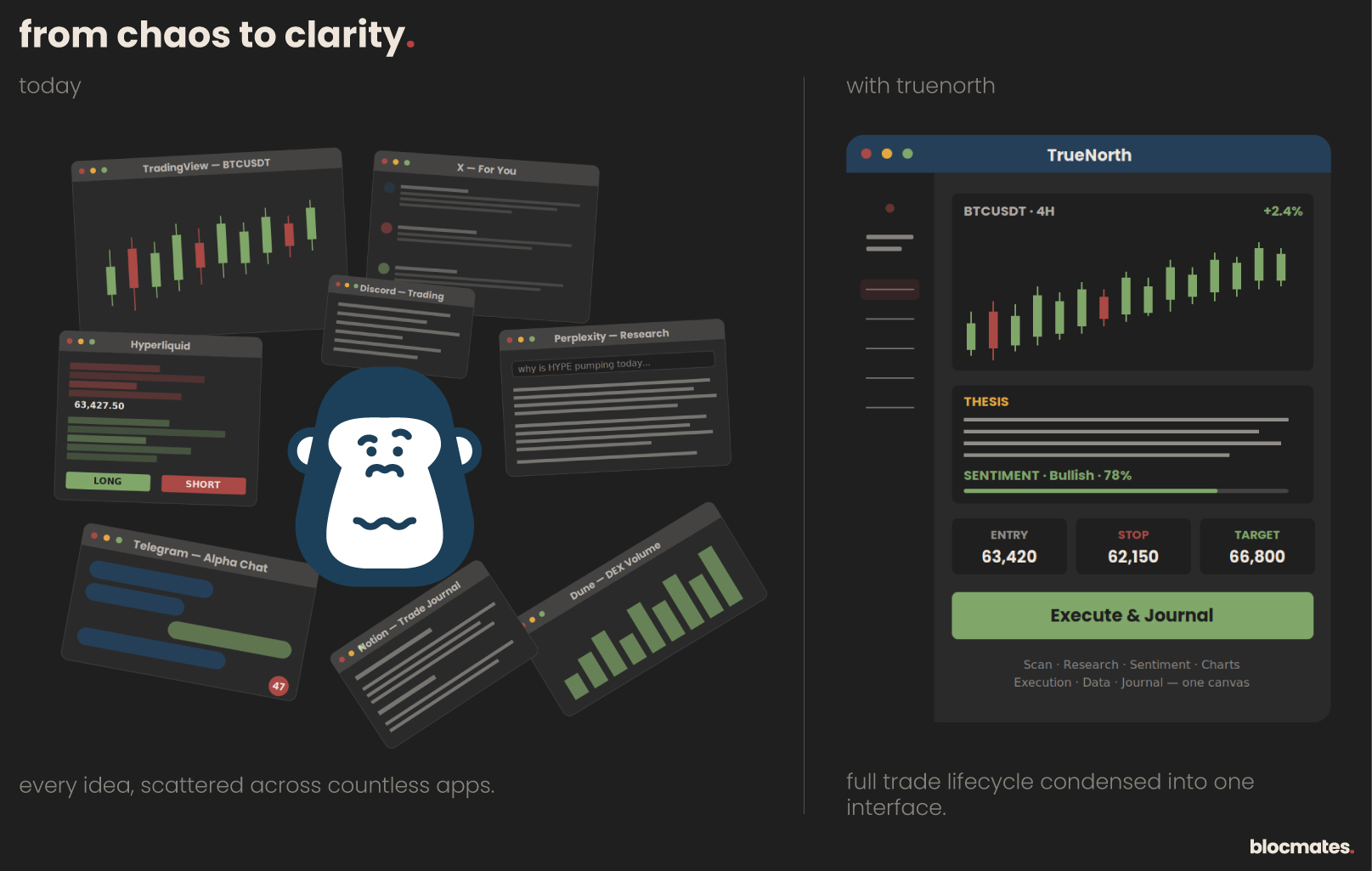
As we’ll discuss later, bringing this to scale and making it financially viable requires more than just wiring up a few APIs or MCPs.
For now, all you need to know is that TrueNorth aggregates data from over 40 real-time sources, such as CoinGecko, DeFiLlama, Hyperliquid, Polymarket, Alcapa, CoinAnk, various CEXs, Deribit, Derive, and others.
This means TrueNorth has access to real-time data across a broad range of assets, including:
- Crypto
- US equities
- Commodities (industrial metals, oil, natural gas)
- Macro indices
- Prediction markets
But research is just one part of the equation. The second is, of course, execution, where the brokerage aspect comes into play.
On TrueNorth, by linking wallets and exchange APIs, you can execute the suggested trade ideas directly on the platform.
But perhaps the most interesting thing is what happens when the trades start accumulating. Then, TrueNorth has the potential to truly reimagine how traders operate, turning a simple, rather forgetful assistant into your own personal quant.
Personal quant
The best way to describe what TrueNorth hopes to achieve is to replicate the setup of large-scale quant desks and VC firms. The Citadel / Jane Street for the average Joe, if you will.
The modern-day peasants, aka retail traders, finally get to build their own professional trading desk that not only delivers fresh, context-rich data but also serves as a personal quant, learning, adapting, and improving the more you use it.
When you first launch TrueNorth, you’ll encounter a series of questions. These are designed to evaluate your character and trading style, whether you’re a beginner just starting to develop a trading approach or an experienced trader looking to refine existing strategies and habits.
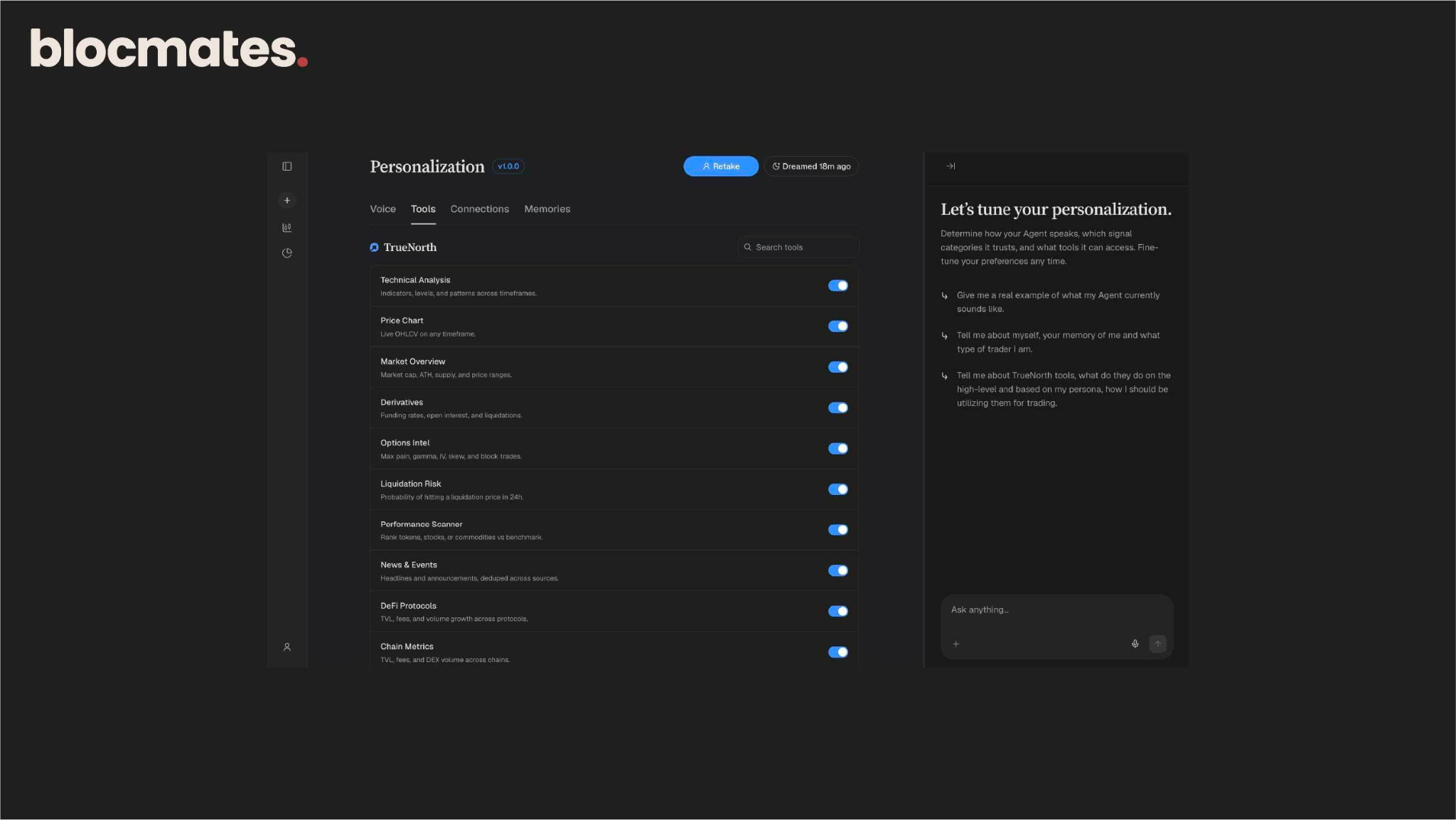
This will dictate the language the AI responds in, the length of the answers, and other parameters. Regardless of what preferences you pick, the nice thing is you can always change that later.
Now that we’ve tamed our quant, we can start firing away questions. What kind of questions? The chatbox is your oyster.
Thesis mode
Before making a trade, I’d hope some of you at least pretend to form a thesis. If not, TrueNorth’s clanker has got your back.
Here are a few prompts to get you started:
- Scan the market and give me a summary of what's trending, top gainers, and any notable sector rotations
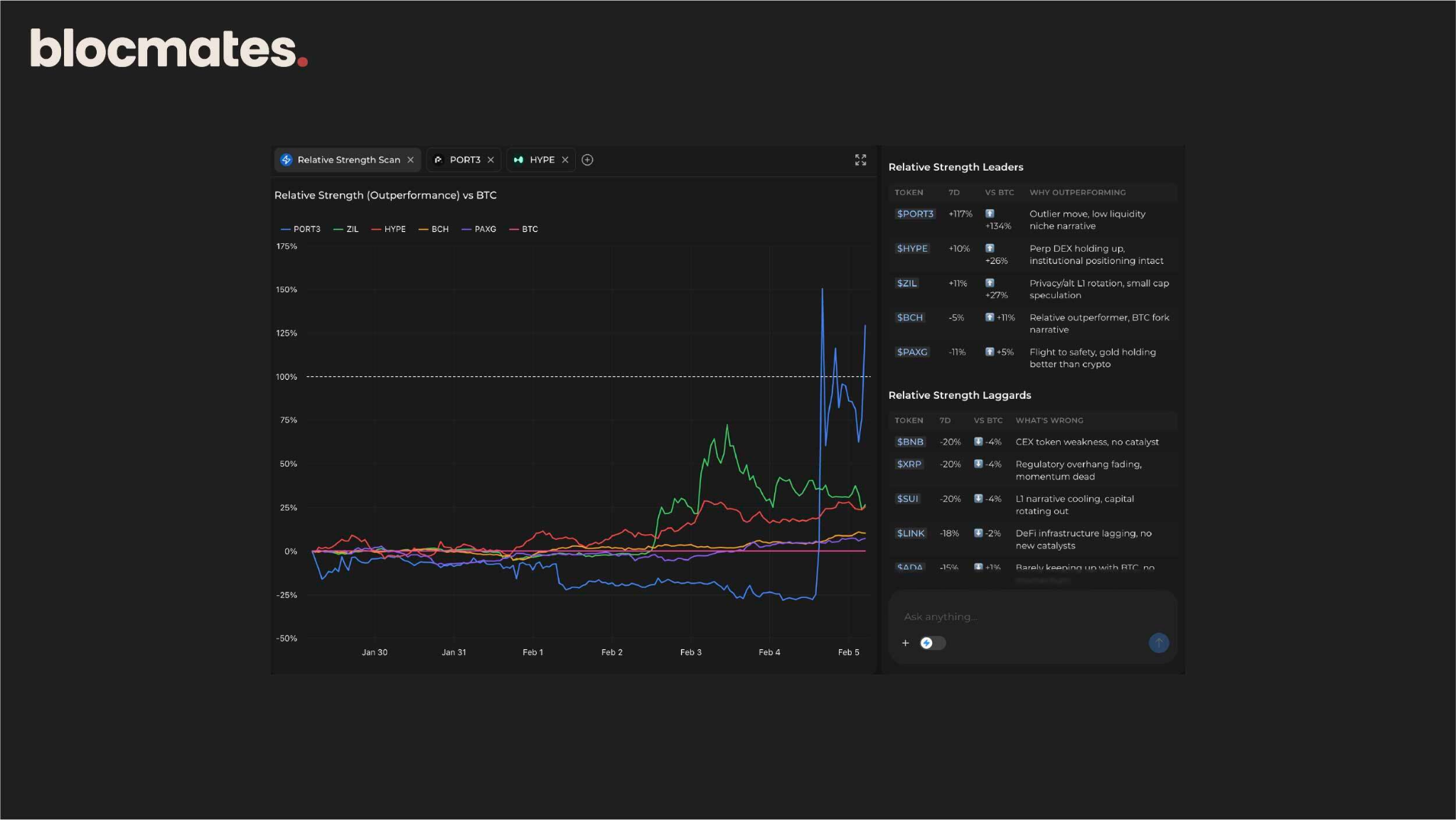
- Show me a relative strength comparison of the top 15 tokens vs. BTC over the past 7 days, and highlight which ones are showing strength
- Compare two major tokens: technical setup, derivatives positioning, and recent catalysts. Which one looks better for a swing trade?
As markets increasingly shift toward outperformance in individual assets rather than entire sectors, my favorite is the spaghetti (relative strength) chart, which lets you scan assets and filter them into a basket of outperformers and laggards.
In this new paradigm, even if you're highly skilled at keeping a manual watch list, you'll inevitably overlook some assets and opportunities without a tool like this.
Execution
You’ve scanned the market, digested the latest news cycle, and feel ready to jump into a trade.
Considering everyone and their Chihuahua wants exposure to HYPE, I’ve asked it to give me a long setup. Key support and resistance levels, long and short entry points, SL, and TP zones, the funding rate, liquidation heatmap, and volume profile. It’s all there.
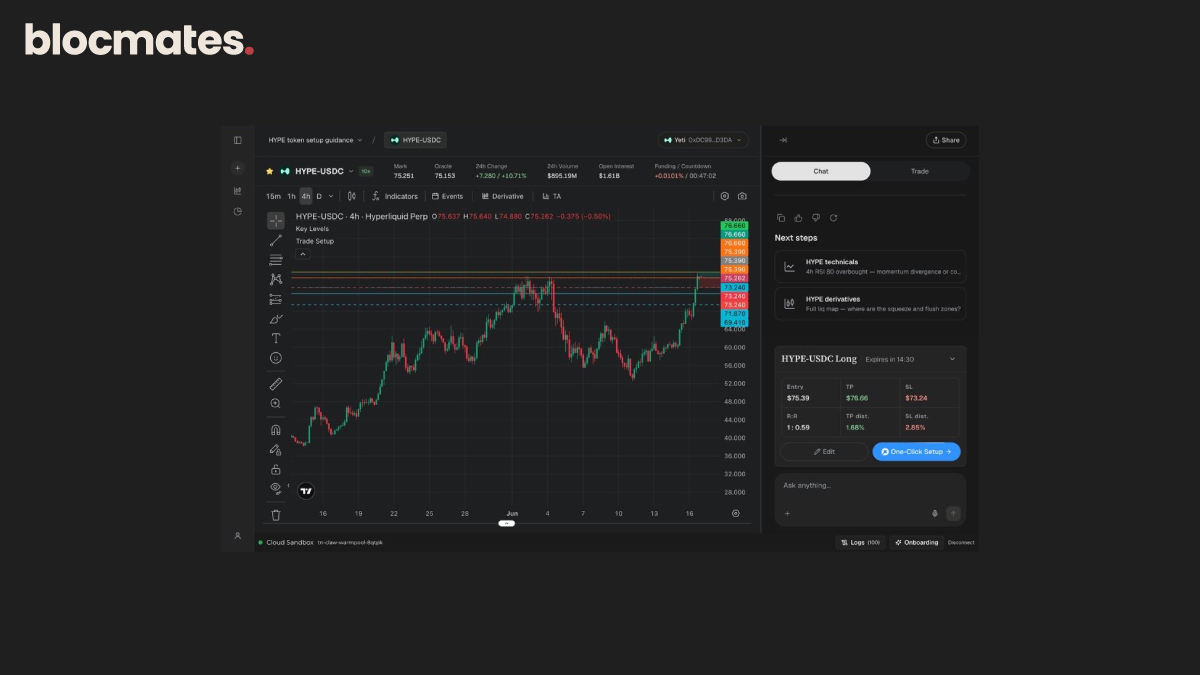
Plus, over time, it will learn your preferred indicators and highlight only those, minimizing the number of squiggly lines on the chart and helping reduce some of the cognitive load and noise.
And once you’ve actually opened a trade, the quant will read your open positions on Hyperliquid and unpack live trades to determine whether to TP, SL, or make any adjustments.
For the best results, the general rule of thumb is to follow this formula:
[Asset] + [Action] + [Context/Constraints] + [Timeframe]
But the more you use it, the less precise your prompts can become simply because it’ll start noticing the type of assets you trade, preferred timeframes, and other nuances.
Analysis
Most traders are unaware of what truly works in their strategies, often relying on an arbitrary gut feeling, even though such instincts can only come from years of repetition and, most importantly, analysis.
I hate to break it to you, but if you’re not journaling and dissecting every trade, you’ll never even know what constitutes a “good trade.”
And if you happen to be the exception, consider the edge you’d gain from a little bit of objective self-reflection, which in this case is done for you by AI.
The upcoming AI trade journaling feature will alleviate the most tedious yet important aspect of trading.
If you are consistently losing money, having a deep understanding of your trading patterns and allowing your quant to rectify your future trades is a game-changer.
If you go on tilt or overtrade after a big win or loss, if you revenge trade, or are just terrible at sizing, this can and will be used as evidence against you.
As the famous trader Machi Big Brother said about his success in the markets:
“It ain’t what you don’t know that gets you into trouble. It’s what you know for sure that just ain’t so.“
Though the journaling feature has yet to be released, we can already start dissecting individual wallets (including our own) and gain insight into each wallet’s trading behavior.
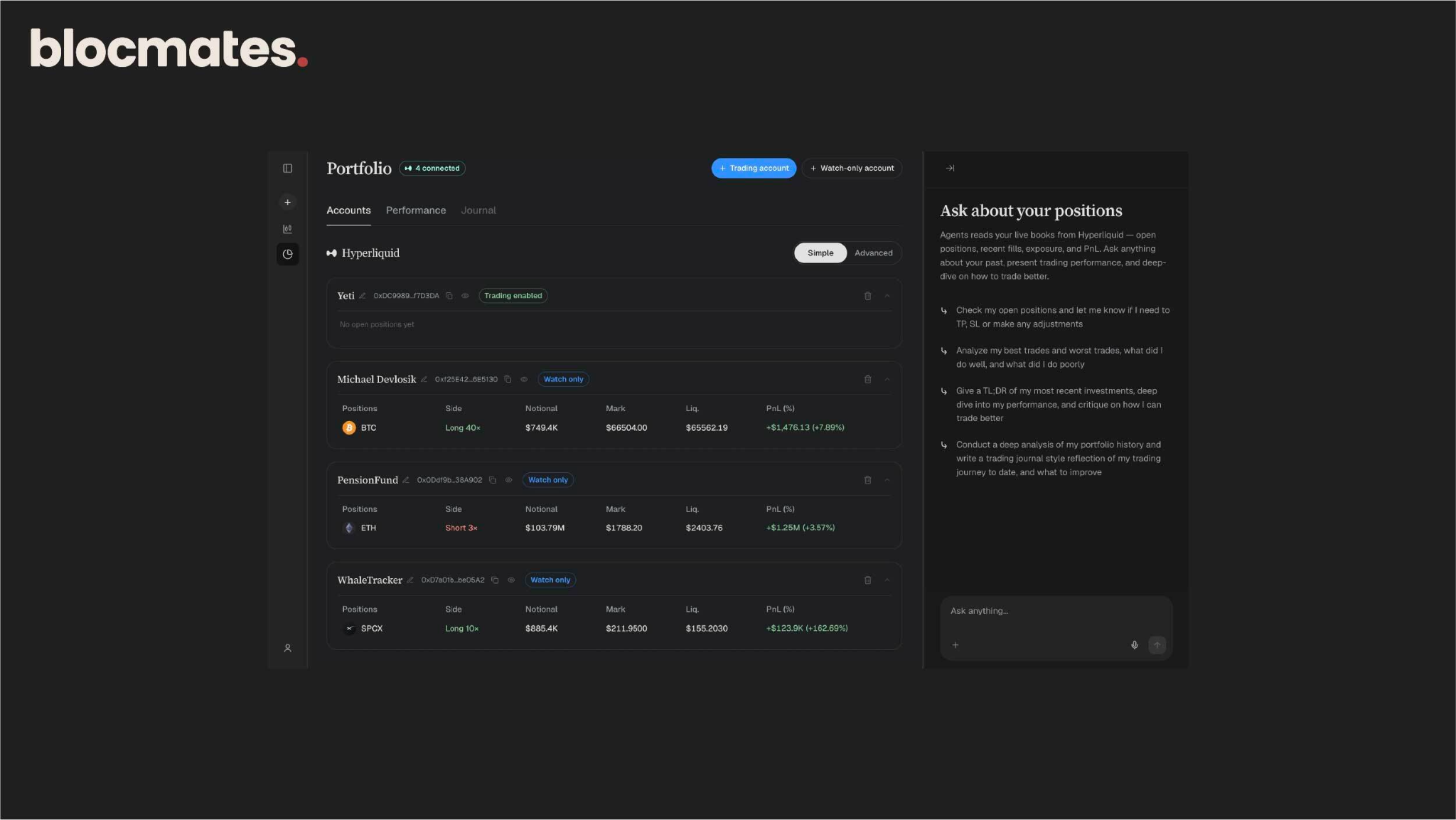
Considering the quality and breadth of features, it got me thinking: how on earth have they made this financially viable?
Turns out it requires quite a bit of architectural finesse.
What’s the stuffing made of?
Beneath the neat interface and quick responses, TrueNorth is built on a clever architecture featuring a predictable data pipeline and self-learning feedback loops, tied together into a cohesive system that cuts costs by up to 80% compared to traditional setups.
TrueNorth CLI: The data highway
The TrueNorth CLI is an open-source crypto intelligence sandbox that lets developers fetch live market data within the terminal, including news, DeFi analytics (TVL, fees, revenue, growth), token info (ATH, market cap), derivatives data (funding rates, open interest, liquidation heatmaps), HIP-4 outcome markets, options intelligence, technical analysis, and more.
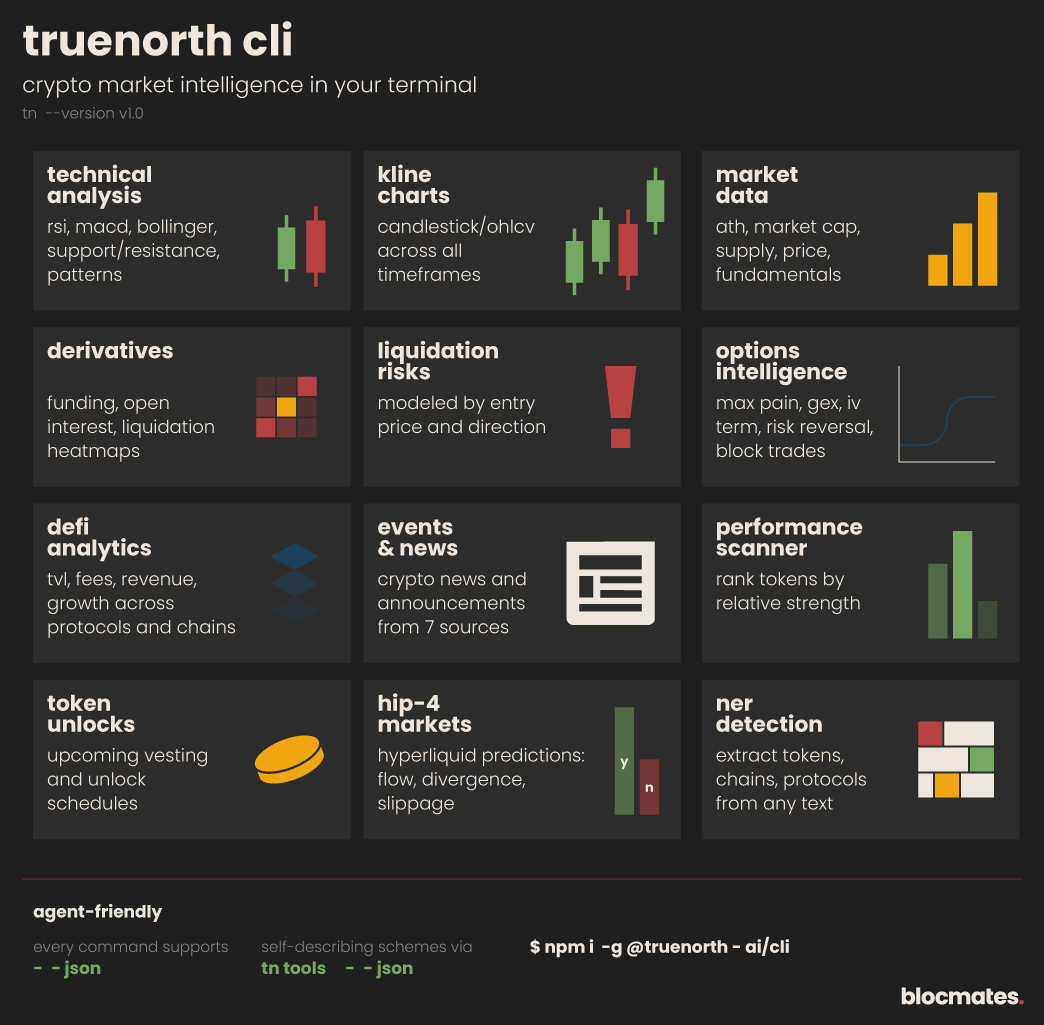
These capabilities are discoverable by the LLM through a Dynamic Discovery mechanism via the tn tools -- json command.
More specifically, tn tools lists the names, descriptions, and required/optional input parameters for all available tools, while --json ensures the data is structured in that particular format and nothing else.
For even greater accuracy, instead of guessing the exact ticker or action, the agent first uses a technique called Named-Entity Recognition (NER) to extract token, chain, and protocol entities from the text, eliminating any guessing on the LLM's part.
For users, the lean design ensures quick and accurate responses. For TrueNorth, this approach delivers savings of up to 80% compared with conventional, prompt-heavy setups that force the LLM to process raw, unstructured data streams.
In fact, these cost savings can be attributed to LJ, a TrueNorth founding dev, whose recent paper, "Schema Discoverability, Not Locality, Drives Agent Cost Savings," was accepted to ICML, a top-3 Machine Learning conference globally.
Though the contents of the paper are beyond my pay grade, the core principle is to make the right tool visible at the right time, with the smallest useful schema, and to remove unnecessary reasoning from the agent loop.
In human language, the less the AI has to reason about trivial things like figuring out the exact token or market the user is inquiring about, or even performing calculations, the more it can focus on synthesizing the data into cohesive analysis and trade setups.
But what about TrueNorth’s memory capabilities? How is that provided without bloating the system prompt and burning through tokens like there’s no tomorrow?
Adaptive agent
The key to making your TrueNorth quant uniquely yours lies in strategically leveraging a three-layer architecture that mimics Hermes's persistent memory capabilities.
This boils down to using three Markdown files: memory, skills, and the master file, or claude.md. Yes, those are the same MD files that we’ve all tried to optimize or hack with different content, though I’m sure not at this level.
On TrueNorth, the agent constantly revises its skills.md and memory.md files with user behavior and key “gotcha” moments, such as common user patterns or past errors, enabling the AI to avoid repetitive issues and adapt to the particular user.
Not only that, but the two files feed each other, meaning that if a skill fails, the lesson flows back into the skill AND into memory.
The third layer actively builds and maintains a user profile in the agent's memory system. On TrueNorth, this is where the personalization preferences you’re asked about during first boot-up come into play.
Together with the CLI, the adaptive agent architecture delivers more context-aware, quick, and personalized responses to users while achieving significant cost savings for the company, boosting its bottom line.
Win-win.
Conclusion
Our daily routines consist of habits and behaviors, most of which involve a constant onslaught of micro-decisions.
Over time, the sheer volume of decisions we make, from what to check first thing in the morning to which notification to respond to, ends up creating decision fatigue.
To combat this, Mark Zuckerberg wears the same outfit every day, whereas Jeff Bezos makes only about three good business decisions a day, prioritizing quality over quantity.
We are not, of course, either of those two, but we can definitely translate that same thought process into trading, eliminating the need to make decisions about trivial matters, like which news column to read first, what chart to check, and ultimately what to trade.
In other sectors, the rise of niche, use-case-specific apps, whether vibe-coded or not, has been refreshing, providing blueprints for repeatable workflows. The one sector that’s arguably falling behind is financial markets.
Whether that’s due to a lack of trust in AI’s capabilities to actively manage funds or something else, we can at least start incorporating AI into everything BUT the execution.
And TrueNorth does exactly that, i.e., delivering AI intelligence and structure to areas like research, trade setups, and journaling, leaving the action of pressing the buy button to the human.
If the AI can condense a long research session into a few paragraphs, offering actionable trade setups and personalized analysis for each trader, it establishes a strong feedback loop that motivates users to keep coming back.
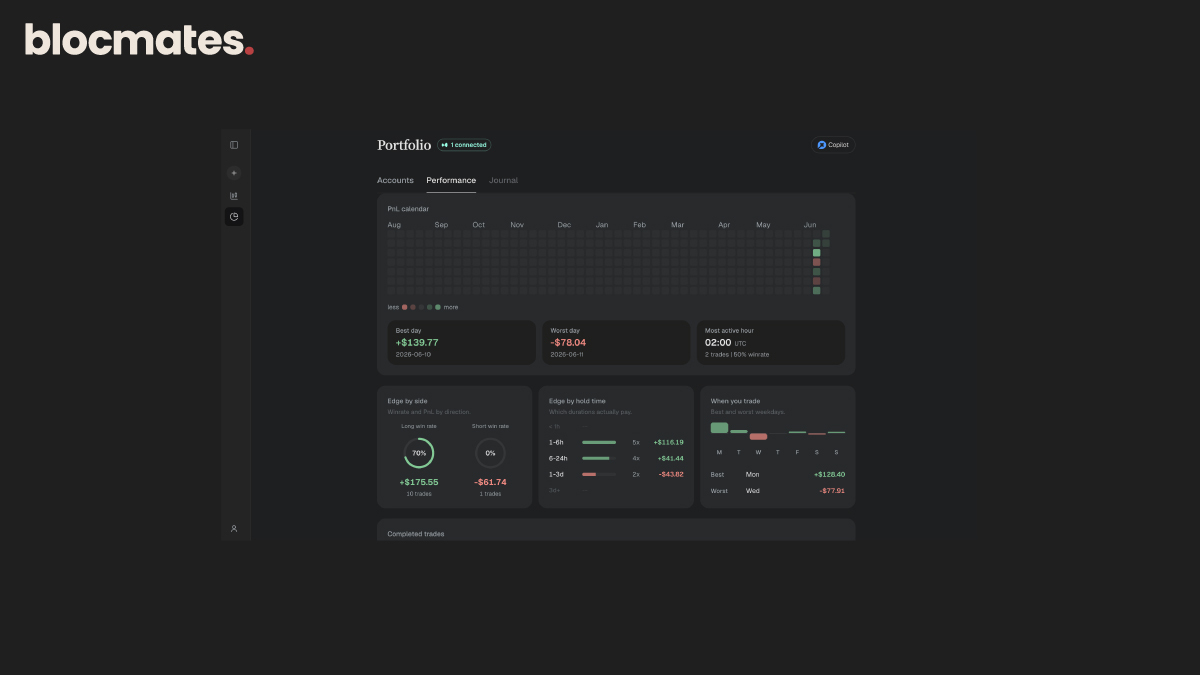
When you think about it that way, everything hinges on two things: the quality of AI’s responses and an acute understanding of how a trader operates and what features are most needed.
Given the co-founders' extensive backgrounds, with Alex Lee holding a PhD in AI and computing and having served as a VP of product, strategy, and operations at Enflame, and Willy Chuang being a serial entrepreneur who founded Series-B SaaS Prefuture Technology (which secured $100 million in funding), who has also served as COO and acting CEO at WOO, it's likely they know how to scratch a trader’s itch.
And that applies to both ends of the spectrum.
If you’re a beginner chud who keeps buying tops and selling bottoms, unsure what to tweak in the first place, TrueNorth can help you uncover the unknowns and build good habits.
For the pros, TrueNorth is like a peptide that supercharges your already well-developed physique and alleviates the mental effort required for mundane tasks like tracking calories.
And if you’re part of the latter, I sincerely hope you don’t find this tool, so I can at least catch up.
Here's an early access code for you to get going - click here.
Thanks to the TrueNorth team for unlocking this article. All of our research and references are based on public information available in documents, etc., and are presented by blocmates for constructive discussion and analysis. To read more about our editorial policy and disclosures at blocmates, head here.





.webp)
.webp)

.webp)

.png)

.webp)



.webp)
.webp)
.webp)
.webp)










.webp)
.webp)


.webp)


.webp)
.webp)


.webp)

.webp)












.webp)

.webp)
.webp)

.webp)
.webp)

.webp)
.webp)
.webp)


.webp)
.webp)


.webp)


.webp)




.webp)


.webp)


.webp)




















.webp)







.webp)












.webp)

.webp)
.webp)

.webp)











.webp)

.webp)


.webp)






.webp)