Take a look at this chart and tell me what you think it tracks. People, unique wallet addresses, number of transactions, or something else?
To cut to the chase, the chart tracks the total number of cryptocurrencies.
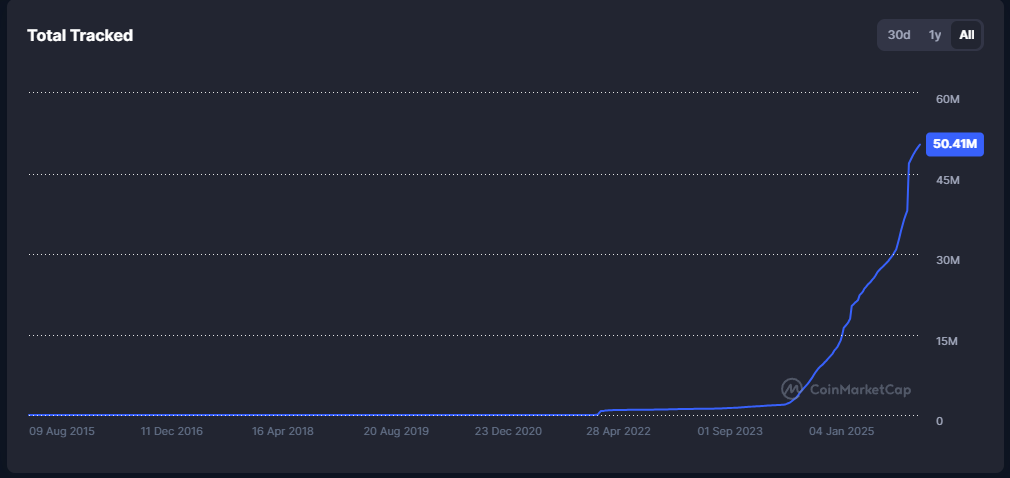
Some might say that it's a clear sign of adoption, with more projects, RWAs, and other assets coming onchain, and that the "tokenization of everything” is taking place right before our eyes.
What the chart doesn’t tell you, and what we all know by heart, is that there are simply too many tokens, all thanks to the glorious proliferation of permissionless token launchpads.
What’s even more amusing is that from October 2024 onward, as the parabolic hockey stick started to emerge, the total altcoin market cap remains the same. After two years and the addition of tens of millions of tokens, the chart hasn’t budged at all.

This means two things. First, no fresh funds have entered the altcoin market in over two years. Second, there are probably 1000 coins for every active crypto participant. A wild guess, but probably not far from the truth.
One could argue that the permissionless nature is exactly what we should strive for, and that people can simply choose not to buy the 198th iteration of Pepe. I’d wholeheartedly agree with this notion.
But people just can’t seem to help themselves, even though the odds are clearly stacked against them.
The Pump.fun era
Ten years from now, the zoomers will be looking back at the previous bull run as a golden era. A time of abundance, opportunity, and success.
At the height of this era, Pump.fun was dishing out 70,000+ tokens per day, with 260,000+ daily active addresses participating in the madness. How many of those were actual users, and how many of those were the same wallet bundlers sniping launches? The historians still have no clue.
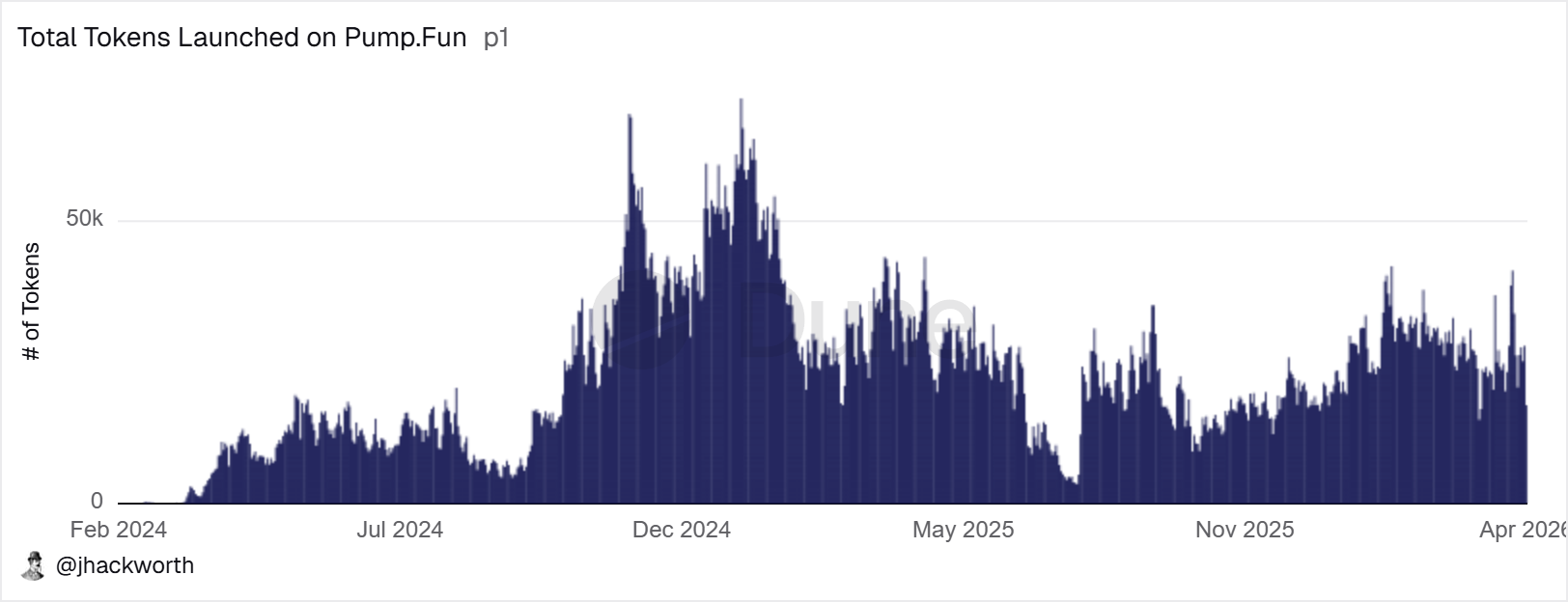
While the hopeful and desperate were battling it out in the trenches, the orchestrator of war was consistently raking in millions of dollars.
Why? Because the greatest trick the devil pulled was making people believe they had the chance to win.
The timeline was filled with KOLs consistently minting hundreds of thousands of dollars in profit every day. If your profile appeared at the top of KOLscan, you were practically a god walking among men. And so, people willingly went to the slaughter, day after day, thinking they had a chance.
But as we know, history is written by the victors.

Between April 2024 and April 2026, over half of the participants exited with losses. About 40% made a profit, but only up to $500. Not bad, but definitely not even close to what the cabal made you believe was possible.
Meanwhile, the top earners (those who made over $1,000) constitute only about 2.2%.
What the data also doesn’t show is that most of the winning wallets belong to an even smaller set of people who deployed wallet bundles, further skewing the winner/loser ratio.
Call it the Pareto distribution, a power law, or any other fancy name to justify why that’s the case, but the reality is that you can’t outrun crime in Vice City. The statistics just don’t work in your favor.
But I get why people did it, as this era was also marked by another, larger revelation, not so much rooted in our disposition to gamble as in the tokens themselves.
Token problem
Conveniently for me, the next part of the problem can also be exemplified with Pump.fun. Only this time, it relates to their token.
From July 2025, the company raked in an average of $5 million per month, remaining fairly consistent even as we entered a bear market. During that same period, Pump.fun has been aggressively executing a buyback program for its token, cumulatively totaling over $1.1 billion in USD. The result?
A token that’s been practically down-only, clocking in at -65% from peak to the recent trough.
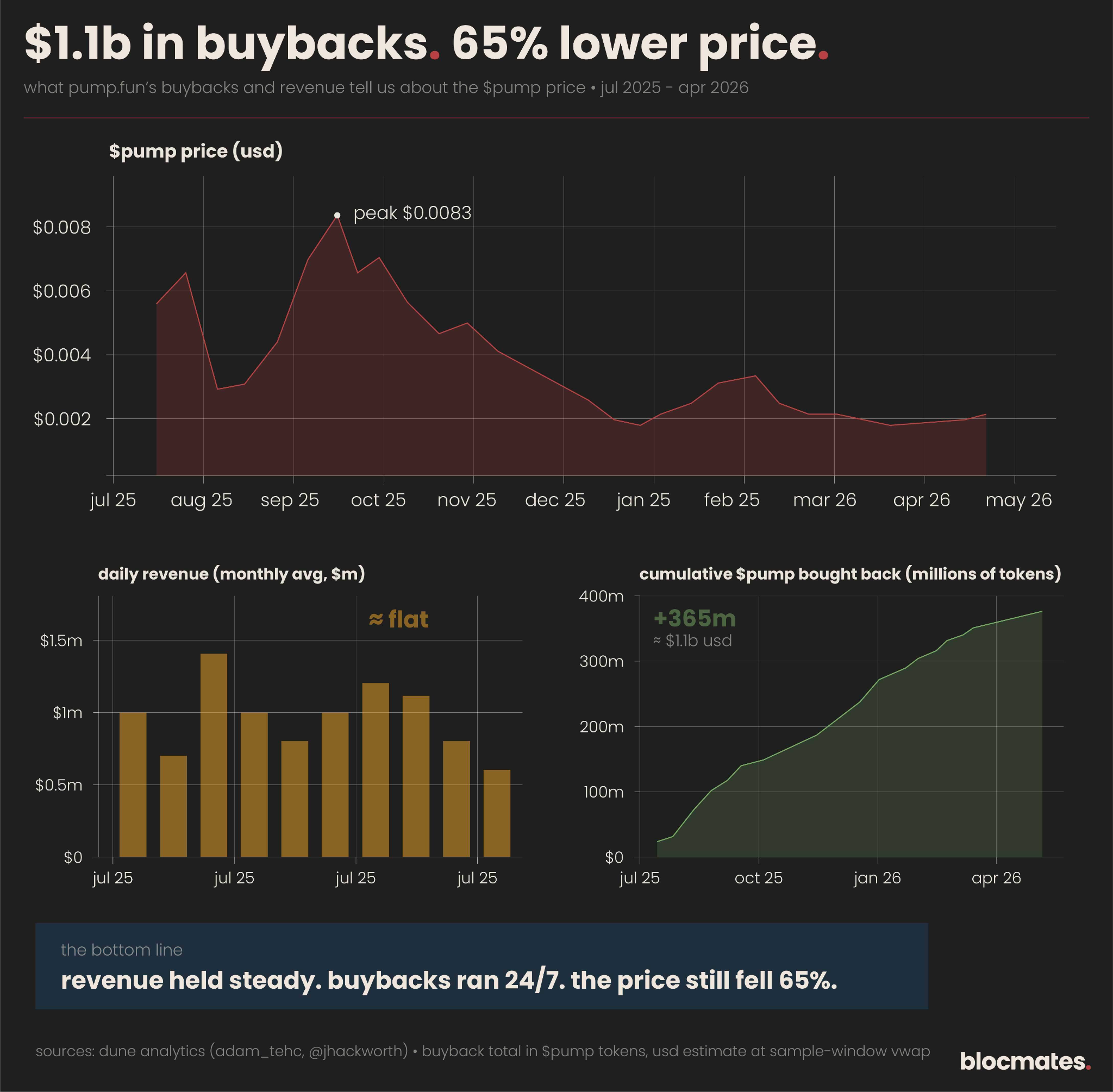
To truly grasp how dire the situation is for tokens, if Pump.fun were a typical fintech firm with a revenue multiplier of 7x to 12x, money-twitter folks would be raving about it as the biggest opportunity of 2026.
But since it's a crypto token, that figure is just around 2.3x to 3.5x, despite featuring one of the largest buyback programs in the industry.
A big reason for this is what most coins represent. I’ll give you a hint: in most cases, literally nothing. Nada. Zilch.
See, most onchain organizations today operate with fragmented structures. Projects typically form both a DAO and a foundation at launch: the DAO manages onchain governance for tokenholders, while the foundation serves as the offchain legal entity for hiring, payroll, and fundraising.
Tokenholders have no legal claim to the organization’s profits or treasury. Instead, the foundation controls assets, IP, and strategic direction, with decisions usually favoring VCs and shareholders over the DAO.
The fact that a company employs a “fee-switch” means jack shit, because owning the token gives you no rights to the underlying revenue, IP, or, let alone, dividends.
Admittedly, in Pump’s case, the buybacks seem to provide a valuation floor thanks to the constant buy pressure, but the situation for most companies and their tokens is far worse.
So what’s the solution?
Well, for the more serious operators who want to launch a token, MetaDAO has proven to be a viable option, granting tokenholders rights to the underlying IP and providing certain protections that can be invoked via Futarchy votes.
But MetaDAO functions as much of an enabling entity that grants founders the necessary structure to fulfill the ownership coin promise, as it does a curator. Naturally, not every project will make the cut.
What about the smaller teams, perhaps with a less strong track record, that still present viable ideas worthy of funding that did not cut MetaDAO’s standards at face value?
For that, Proph3t has blessed us with Futardio, granting many of the same protections and launch mechanisms as MetaDAO, with the added benefit of permissionless access, striking what I think is perhaps the most elegant design of internet capital markets.
What is Futardio?
Launched by the team behind MetaDAO, Futardio is a permissionless launchpad that features many of the same mechanics as its big sibling, with a few minor tweaks to the launch mechanism.
If you’re familiar with how MetaDAO raises occur, this will all sound familiar, but stick around, as there is one noteworthy change aimed at enticing early participation.
The overarching distinction of Futardio from other launchpads is that it provides participants with certain protections and guarantees, while founders receive a turnkey DAO with treasury controls and a Cayman Islands legal entity.
Regarding the actual launch mechanism, you won’t find the bonding curve like on Pump. Instead, the raise occurs via an ICO, with an optional duration of 1 hour to 7 days, set by the team. Here, the team also establishes a raise goal that, when achieved, grants participants their token allocation pro rata; if not, results in a full refund.
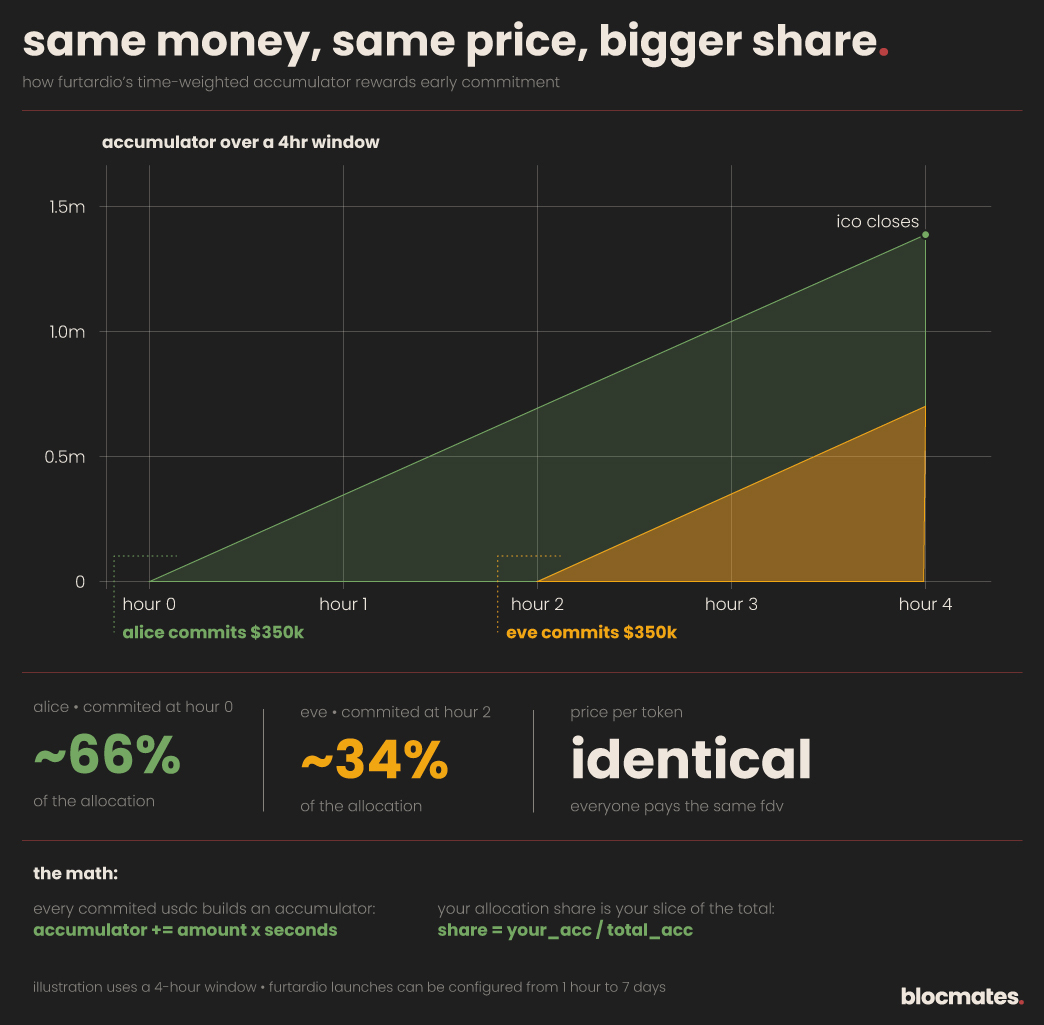
Unlike its sibling, which doesn’t feature any benefits to early participation, on Futardio, the earlier you bid, the higher your accumulator multiplier will be, thus ultimately boosting your allocation.
For all of this to make sense, let’s look at a recent raise: Jurassic Finance (@JurassicFi), raised over $12 million, more than 6,000% above its original $200,000 goal.
When opening an individual raise, you’ll find a lot of text and information. To those only familiar with candlesticks and a chat window with people shouting “wen DEX paid,” it might seem a tad confusing, but trust me, it’s really not.
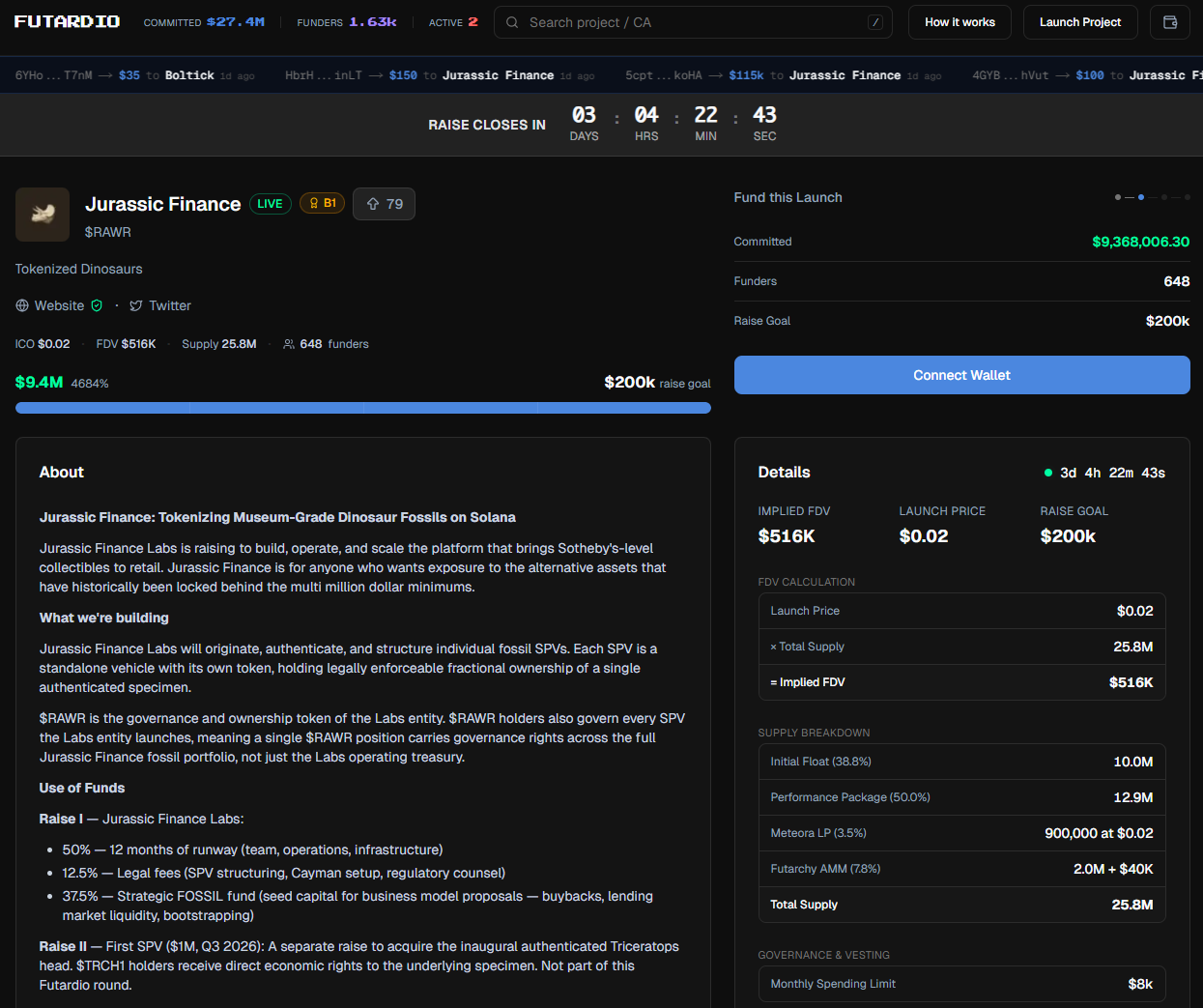
The large wall of text outlines the project, its purpose, roadmap, team members, and other important information. At the bottom, information about the legal setup is provided.
If you're not inclined to read all the details, focus on the right side where the token, its supply, initial FDV, launch price, and other information are displayed. Below that, you'll find the team’s monthly allowance and the conditions for receiving token tranches.
Why? Because the team doesn’t get all the money up front. Instead, those funds are sent to the treasury, where a smart contract disburses them programmatically each month based on the set allowance, which, in Jurassic’s case, is $8,000.
Additionally, teams are not required to keep all the funds raised and often choose to refund most of it. This strategy helps keep the valuation low and allows the chart to paint an up-and-to-the-right pattern. Something we’re all longing for nowadays.
The team physically cannot withdraw more money from the treasury unless they initiate a governance vote. On Futardio, that’s called Futarchy. Perhaps the project’s name makes more sense now.
In short, Futarchy-based voting involves individuals wagering real money when casting their votes, which, according to the theory, motivates more knowledgeable actors to participate, leading to objectively better outcomes.
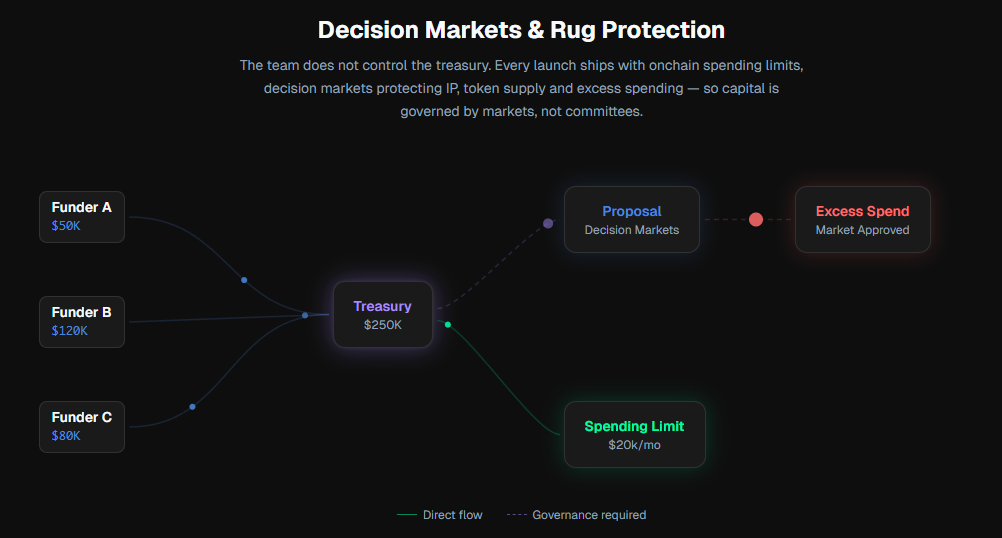
The best part is that if the community feels a project fails to meet its promises, anyone can propose a vote to liquidate the treasury and distribute tokens back to the community.
And it has been exercised on several occasions on MetaDAO, proving that the project's fate ultimately lies in the DAO's hands.
Ownership era
The surge in memecoin trading resulted from multiple factors happening simultaneously, rather than a single cause.
First, the realization that 99% of coins are inherently useless and overvalued by orders of magnitude right from the start, sidelining the everyday speculator from any meaningful gains.
The second was the proliferation of permissionless launchpads, which at first felt “fair.” A sort of antithesis to the status quo, where VCs reap most of the benefits at our expense.
But one problem persisted: Coins were still useless, even when launched at relatively low valuations via vanilla ICO launchpads.
The project that first captured the ownership coin zeitgeist was MetaDAO, proposing a solution to a problem that’s plagued the industry since the beginning.
And still, they faced a problem with scaling the internet capital markets, since vetting every single applicant one by one is not feasible, and many community members (including me) felt it would erode the “high-quality” aspect of the platform if they went the permissionless route.
The solution is elegant. Launch an adjacent platform that inherits the core of what makes a coin an “ownership coin” while still retaining the quality of launches on MetaDAO.
And so, Futardio is perhaps the perfect middle ground between the fully permissionless chaos of Pump.fun and the slower, more methodical raises on MetaDAO, blending both sides of the spectrum into what could become the capital formation layer of the internet.
And I can’t wait to see what this era brings.






.webp)
.webp)
.webp)

.png)


.webp)


.webp)
.webp)
.webp)
.webp)










.webp)
.webp)


.webp)
.webp)
.webp)

.webp)
.webp)
















.webp)
.webp)
.webp)

.webp)
.webp)
.webp)


.webp)
.webp)


.webp)


.webp)




.webp)


.webp)


.webp)

















.webp)






.webp)










.webp)
.webp)
.webp)

.webp)











.webp)

.webp)


.webp)





.webp)