
Fully Homomorphic Encryption (FHE). Is this another one of those acronyms that’s here today and gone tomorrow? Or is it genuine tech with staying power?
We’d lean toward the latter, but this article will teach you everything you need to know about FHE, so you can make your own decision.
Before we dive into what FHE is, let’s set the stage by going over the current issues around privacy that make this technology important.

Why is FHE important?
Privacy in crypto has been all the rage over the past few months. Despite this, we have yet to see effective implementations of privacy without some significant drawback in efficiency, performance, security, or general blockchain functionality.
Here are the major issues as they stand:
Institutional and mainstream adoption - Despite the benefits that come from the transparent nature of blockchains, they also act as a major hurdle for adoption.
For individuals who may eventually use crypto rails for their day-to-day finances, I do not think they will be comfortable with their financial accounts, balances, transaction history, preferences, tax records, and so on being completely out in the open for everyone to scrutinize.
It doesn’t mean that they’re doing something wrong; it’s just about not wanting strangers prying on your business.
For institutional involvement in crypto, they have to adhere to strict privacy standards from a compliance standpoint, but also from a competitive standpoint.
Institutional capital operates on very minor alpha; why would they want that information to be available to the public for everyone to emulate, thereby completely eliminating their edge?
Privacy is a necessity.
Government infrastructure - Blockchains can act as the perfect digital rails for government systems. Things like taxes, healthcare, identity verification, pension plans, and similar stuff can be made much more efficient by leveraging blockchains.
However, all of this data is highly sensitive, and governments can only begin to consider this possibility if blockchains include built-in privacy. Once that’s achieved, onchain digital implementations of government infrastructure can become a reality.
Composability - The crypto industry already has privacy solutions like zk proofs, but these break interoperability and composability. Current privacy technology leads to protocols that can only operate in silos rather than interact with the entire crypto ecosystem.
What the industry needs is privacy technology that can be easily integrated into the existing interoperability and composability, so we can still have the money lego nature of DeFi with seamless interoperability across networks to prevent siloed/fragmented ecosystems.
Quantum computing - A future with quantum computing has long been considered the end of crypto, as it is believed that quantum computing can break the public-key cryptography that blockchains rely on.
Companies in the industry have been working on potential solutions for this, but now you also have to add the privacy element. So infratsurtucre with built-in privacy that’s also quantum resistant.
Data leaks - Existing privacy technologies in crypto all have certain attack vectors/vulnerabilities when it comes to data leaks/breaches. This is because at some point in the data processing life cycle, the plaintext must be exposed, it must go through a trusted third party, or there’s a hardware vulnerability.
Data security is of utmost importance, especially in a blockchain setting. Therefore, privacy technology with a near-airtight security model is needed to propel the industry forward.
FHE is considered the holy grail of privacy in crypto because it solves all of these problems with minimal compromise.
So in the rest of this article, we will show you exactly how FHE works, why it’s important for the future of this industry. Also, stay tuned for some alpha at the end, where we cover a couple of the leading protocols in this sector.
What is FHE?
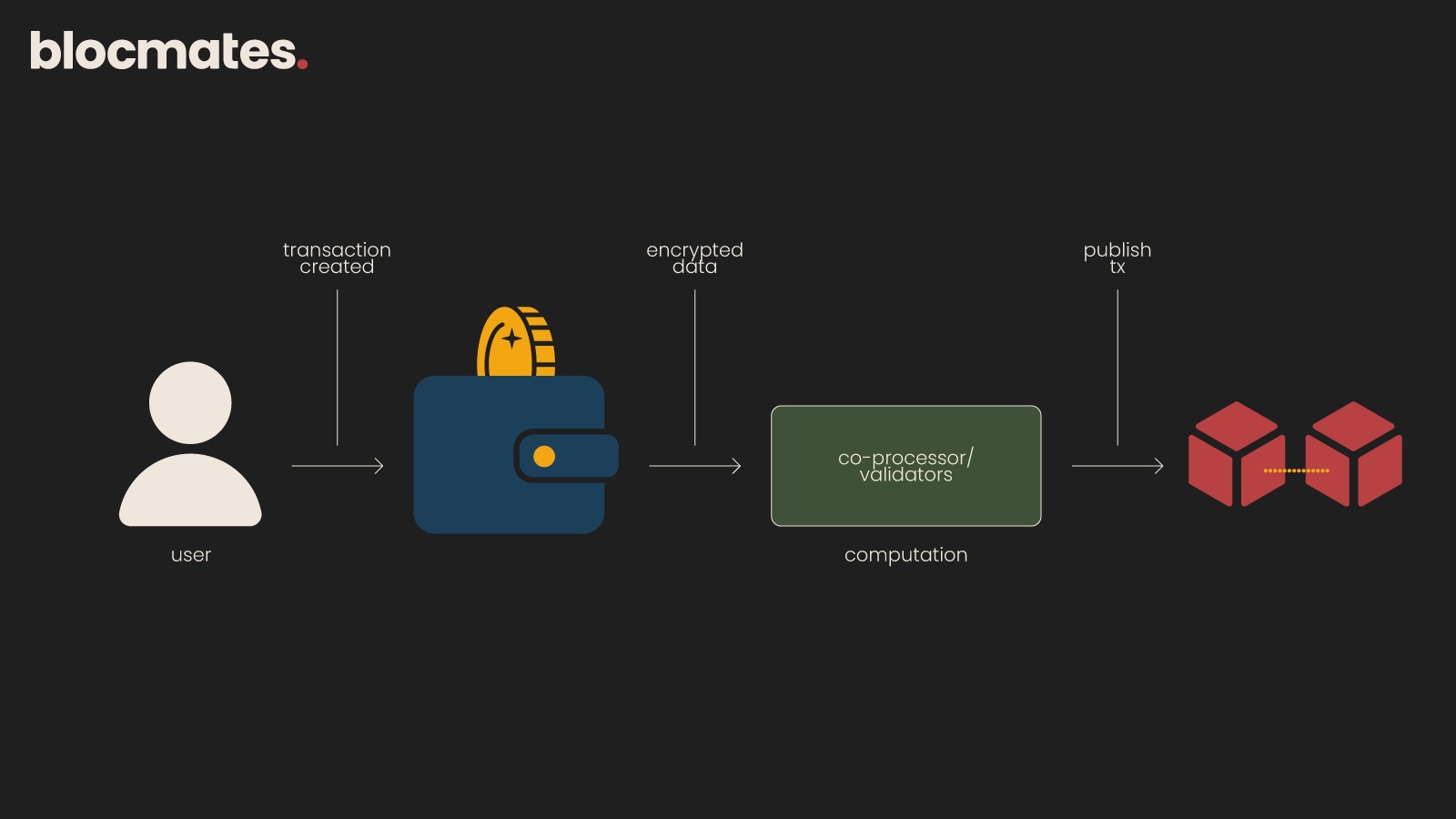
Fully Homomorphic Encryption is an advanced cryptographic technique. It allows complex computations, such as additions, subtractions, or, in the case of crypto, smart contract logic, to be performed directly on encrypted data without decrypting it at any stage.
So how does FHE actually work, I hear you ask.
Well, traditionally, all blockchain transactions happen in plaintext. Plaintext is essentially the raw transaction data. Things like account balances, transfer amounts, and other transaction details.
When a transaction is created, all of this plaintext data is directly published and visible on a public blockchain. Translation: ZERO FINANCIAL PRIVACY.
The purpose of privacy tools is to encrypt the plaintext into ciphertext, which is just a bunch of numbers and letters mashed together that looks like gibberish without a decryption key.
Therefore, only the holder of the decryption key can see the raw data, which means there is now financial privacy onchain.
Unfortunately, most crypto-specific privacy technology has an element of decryption at some point in the transaction data’s life cycle:
- Zero-Knowledge proofs (ZKPs) - The “prover” or the entity generating the ZK proof must decrypt and access the plaintext to generate the proof. This is a vulnerability point for data privacy.
- Trusted execution environments (TEEs) - The data is encrypted throughout, but decrypted within the TEE's enclave. So, if the hardware is flawed, all the data is effectively vulnerable to leaks.
- Multi-party computation (MPC) - MPC is often considered a secure privacy technology, but it operates on the assumption that there will be no collusion between the parties that have the split/shared data. In the event of collusion, the data is at risk.
With FHE, the transaction data is encrypted at the source and at every stage, from creation to execution to validation to finalization; all the computations take place on this encrypted data.
The cryptography is also lattice-based, which not only makes it more secure but also quantum-resistant.
It is never decrypted at any point, has no trust assumptions, does not require any third parties handling the data, and does not rely on third-party hardware to secure the data.
The only real concern for FHE is that it is very compute-intensive. So, scalability in terms of FHE-enabled blockchains handling a lot of transactions per second might be limited by hardware, but that can always be solved for in the future.
The most important thing is that it is true privacy end-to-end, with the ability for complex computations to be performed on encrypted data, making it the perfect privacy solution for crypto.
Let’s better understand FHE through the life cycle of an average DeFi transaction:
- You want to deposit 1,000 USDC into a lending pool
- You place the order, and your wallet encrypts the sensitive data (transaction amount, account balances, etc.) at the source
- The transaction, which includes the encrypted ciphertext, is broadcasted to the chain
- The validators then fetch the encrypted input and perform the FHE operations on this encrypted data
- Once the transaction is deemed valid, it is finalized and then settled onchain. Fully encrypted throughout
Use cases for FHE
Institutional adoption
Institutional adoption in crypto has been spoken about for a long time as an inevitability.
The underlying infrastructure is already good enough to support institutional involvement, and we’ve already seen many traditional financial institutions begin to dabble in crypto, with roughly $44 billion being put in crypto by institutions.
That amount, however, is still a drop in the bucket compared to what it could be in the future.
There have always been two major hurdles for institutions. Privacy and compliance.
Institutions need their data to be private to preserve their alpha and also to preserve their clients' privacy. This goes hand in hand with regulations, as institutions are required to adhere to strong regulations when it comes to privacy.
Blockchains with FHE effectively kill two birds with one stone for institutions, thereby opening the floodgates for a lot of TradFi capital to come pouring in.
Mainstream adoption
The ultimate vision with crypto is to have every person managing their finances onchain simply because it's a better system than TradFi.
Things like scalable blockchains, secure wallet infrastructure, and consumer-friendly financial applications already exist. There’s just one more piece to the puzzle. Privacy.
FHE gives people privacy without sacrificing the composability that already exists in crypto.
Once FHE reaches a stage where scalability is no longer an issue, all the hurdles have effectively been solved, and now the average person can transact onchain knowing that all their data is not public for the world to scrutinize.
DeFi with privacy
DeFi applications already serve as the financial pillar of the onchain economy.
With FHE, its utility and usability get taken to the next level. Whether it's AMMs for trades, lending markets for borrowing/lending, or structured products for yield, all the transactions made on DeFi protocols will become private and shielded.
All the key data about a user's transactions will be encrypted. This keeps the prying eyes of hackers/exploiters who have been plaguing the industry for years at bay.
It’s also great because it removes a major thorn in the side of DeFi. The MEV bots and frontrunners are always making sure you get horrible execution and lose money.
This sets the stage where anyone in the world, regardless of how savvy they are with crypto, can comfortably interact with DeFi applications.
Compliant tokenization
Tokenization is one of crypto’s best weapons when it comes to bringing the world onchain. The tokenization of stocks, bonds, real-world assets, and pretty much any tradable asset is simply a more efficient system than the incumbent system.
However, tokenization of things in the real world comes with a lot of tricky compliance.
FHE will do wonders in terms of taking a lot of that regulatory headache away from institutions and other protocols.
Estimates suggest that the total addressable market for tokenization goes well into the tens of trillions. With that much capital waiting on the sidelines, FHE-enabled blockchains could be the catalyst that finally properly opens those floodgates.
Digital identity and verification
Digital identity is already a norm in the traditional world. As crypto adoption increases, digital identity verification will also become a necessity for interacting with certain onchain protocols and institutions.
However, having KYC’d data available in a public setting, such as a blockchain, is incredibly risky and dangerous.
With FHE ensuring end-to-end encryption of all data, users can comfortably verify their identity digitally, knowing that their data will be private and secure.
This not only benefits institutions, but it also allows governments to gradually bring their infrastructure onchain, opening up a completely new market.
Cross-chain composability with privacy
One of the biggest benefits of FHE over other privacy solutions is that it provides superior privacy without compromising any of crypto's existing functionalities.
Cross-chain transactions, multi-protocol transactions, or any other complex transactions can be executed in exactly the same way people execute them now; the only difference is that all the data will be encrypted throughout.
This way, there is no worry of siloed ecosystems or fragmented liquidity across networks. Functionality stays the same, but privacy is enhanced.
Top FHE protocols in crypto
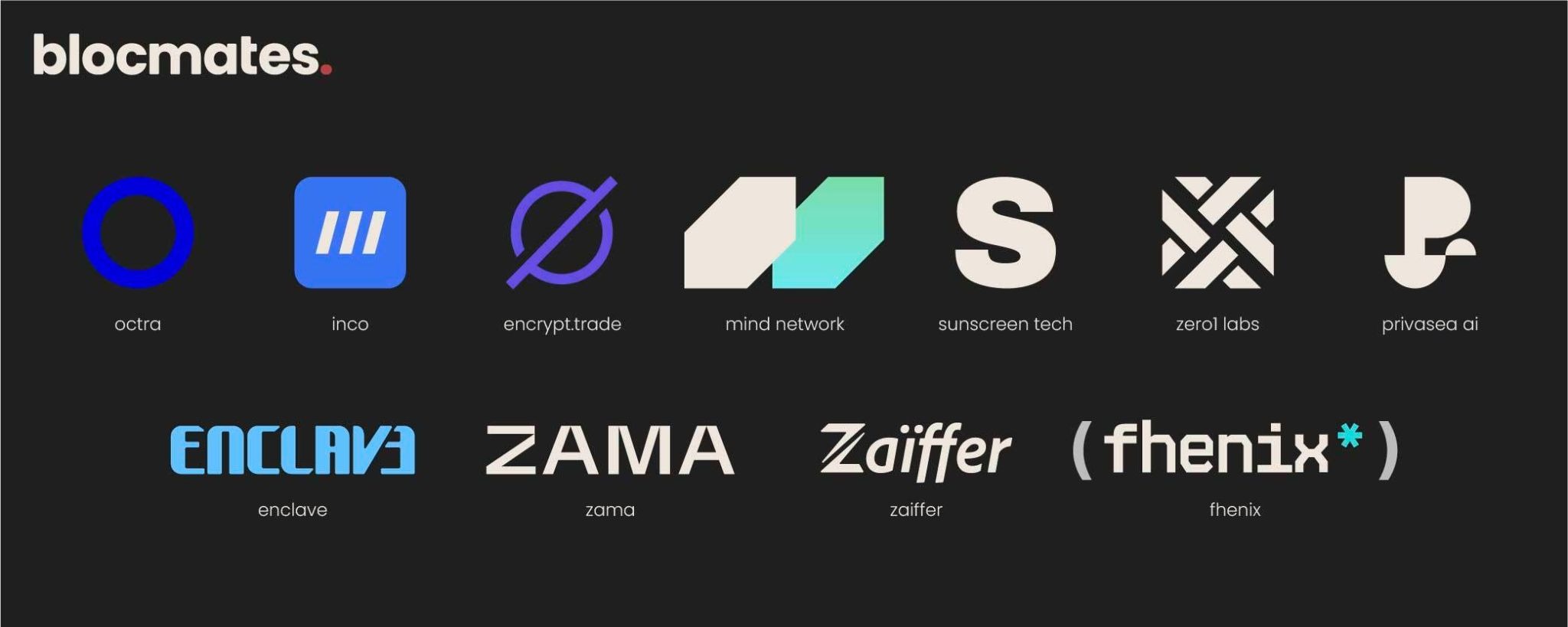
So now that you understand why FHE is important and how it works, let’s take a look at some of the protocols that are already working in the FHE sector.
Zama

Zama offers the Zama protocol. The Zama protocol is a framework that sits atop existing layer-1 and layer-2 blockchains.
The protocol can be easily integrated into any network, which then unlocks Zama’s FHE-enabled privacy layer, giving all integrated end-to-end encryption while maintaining the same composability and functionality.
A better way to understand is through the internet. The internet first used the HTTP standard and then shifted to the HTTPS standard for encryption. Well, Zama’s encryption for blockchains creates a new standard for the internet, which they call HTTPZ.
Having raised over $150 million with a $1 billion valuation, they are among the top players in this space.
Fhenix
Fhenix is an infrastructure provider that makes it easy to bring privacy to DeFi.
Fhenix’s fhEVM is designed such that FHE technology can easily be integrated into any EVM-compatible environment with just a few lines of code.
Nothing changes for the developers or the application's functionality. The only change is that there is now FHE-enabled privacy.
They recently launched coFHE, their off-chain processor, and have also raised roughly $22 million, making them a noteworthy player in this space.
If you weren’t already sold on Fhenix, here’s another thing to keep in mind.
The founder of Fhenix, Guy Zyskind, who holds a PhD in cryptography from MIT, was responsible for a major breakthrough in FHE technology.
FHE was always considered slow and unusable for privacy scaling compared to ZKproofs. But he authored a research paper outlining a theoretical breakthough that would make it 20,000x better in throughput and make scalable FHE technology a reality.
Here’s the paper for those interested in reading, and if that doesn’t turn your head, I don’t know what will.
Mind Network

Mind Network provides a wide range of products focused on providing quantum-resistant FHE infrastructure.
Just a few of the examples include:
- Mind Chain - a FHE-powered blockchain for AI agents
- X402z - A confidential AI agent-to-agent payment protocol for encrypted micro-payments
- AgenticWorld - An FHE-based consensus framework for autonomous AI
- Mind Bridge - tools for secure cross-chain interoperability and encrypted transfers
Inco Network

Inco is a full-stack privacy provider for blockchains.
Although FHE is at the core of most of their designs, they also leverage other privacy technologies like TEEs and MPCs.
At its core is Inco’s fhEVM that allows solidity developers to add FHE to their application's functionality with minimal changes to the smart contract code.
They also have two new protocols called Inco Atlas and Inco Lightning, which serve different roles in providing privacy for existing public blockchains.
Most impressively, they’ve collaborated with Circle (the issuer of USDC) to create a confidential ERC-20 framework for confidential tokens on public blockchains.
Privasea

Privasea integrates FHE’s privacy decentralized AI and DePIN.
It leverages FHEML (FHE machine learning) to solve core problems with AI data privacy, such as breaches during model training, inference, or sharing. It also leverages Zama technology to enable AI to operate on encrypted data and be built on encrypted data.
They have a bunch of cool products like FheID for digital identity and biometric verification that is fully encrypted. They also have the DeepSea AI network, which is a distributed compute platform for AI inference, allowing models to run purely on ciphertext.
It might be early and experimental, but it is very impressive technology.
Zero1 Labs (Cypher)

A lot of you may read Zero1 Labs and instantly get PTSD from DEAI (iykyk).
Well, Zero1 Labs is actually leveraging FHE technology to build a really cool AI-focused blockchain.
Zero1’s flagship product, called Cypher, is an FHE-native blockchain for AI and LLMs, allowing computations on encrypted data. It will also have an FHEVM integration so that EVM-compatible applications can be built on the network.
To go with this, they have a bunch of cool products like Keymaker and the Zero Construct Program. Definitely one to keep an eye on.
Octra

Octra is a general-purpose peer-to-peer network that allows anyone to securely store and process data with FHE.
It is currently live and fully operational with a bunch of cool features, such as the HFHE (Hypergraph FHE), which is essentially technology that enables parallel computations to allow for complex data processing to be done faster.
To go with this, they also have a novel machine-learning-based consensus mechanism.
Again, the product is a lot more technical than this and is worth diving deeper into, given the head start they have over the competition.
Zaiffer protocol

Zaiffer is a joint venture between Zama and PyratzLabs with a focus on enabling privacy-preserving DeFi on EVM-compatible blockchains through FHE.
Zaiffer leverages Zama’s FHE technology to create confidential tokens that can be used for regular DeFi activities such as trading and yield farming.
An example of a product from Zaiffer is ZaifferYields, which is a platform for different types of yield farming strategies that are entirely private.
In the future, you can expect to see a bunch of other cool privacy-focused DeFi applications come from the Zaiffer camp.
Sunscreen

Sunscreen is a technology provider that focuses on abstracting away the complexities of integrating FHE into developers' applications.
They have a bunch of tools, frameworks, and compilers that any developer can leverage to easily integrate FHE into their applications within minutes without it being a technical lift. Their reach for their products spans across AI, crypto, data processing, and finance.
They’re already active with a bunch of cool offerings, including the Paraosl compiler, a secure processing framework, and a ZKP compiler, to name a few.
Although there may not be any actionable alpha for us, mere plebs when it comes to Sunscreen, it will probably be fruitful to keep an eye on the protocols leveraging their technology.
Enclave

Developed by Gnosis Build, Enclave offers something called Encrypted Execution Environments (E3).
This is an open-source, confidential protocol for collaborative computations. Essentially, any developer can run programs on encrypted inputs using Enclave’s E3.
The use cases for this are vast. It can benefit DAO governance, DeFi applications, AI research, fraud detection, and risk modelling, just to name a few things.
Encrypt.trade
Encrypt runs under the Encipher brand and is a protocol focused on cross-chain bridging with encrypted swaps leveraging FHE.
Currently, the app allows you to privately bridge assets across multiple networks, but eventually, users will also be able to make private swaps on chains like Solana through aggregators like Jupiter.
As time goes on, you can expect a lot more applications, but Encrypt is a practical example of what DeFi through FHE will look like and how scalability should not be a major concern.
Conclusion
That wraps up our coverage of the FHE sector in crypto. It’s definitely a sector that we think will see a massive rise in importance over the coming months, and we believe it will be worth your while to keep close tabs on it.
Do let us know if we missed anything, and we’ll make sure to include it in our future coverage.
Until then, stay safe and happy trading.














.webp)

.webp)

.webp)

.png)



.webp)



.webp)
.webp)

.webp)
.webp)




















.webp)

.webp)


.webp)





.webp)
.webp)





.webp)

.webp)

























.webp)
.webp)

.webp)
.webp)
.webp)


.webp)
.webp)


.webp)


.webp)




.webp)


.webp)



.webp)






















.webp)







.webp)














.webp)

.webp)
.webp)

.webp)














.webp)

.webp)


.webp)








.webp)