Reading time: 7m 36s
Folks, we’re clearly past the skepticism phase, the weird Will Smith spaghetti era, and have long progressed into a period where AI is now as efficient as the smartest humans on the planet.
OpenClaw, for example, lets humans delegate tasks on the internet (scheduling, emails, research) to agents, with anyone being able to spin up their own agents that can function better than human personal assistants, in minutes.
On the other hand, Giza is doing the same thing, letting humans delegate financial tasks onchain (yield optimization, rebalancing, monitoring) through its flagship agent, ARMA, which we introduced to you last year.
ARMA’s success as a personal onchain strategist with capabilities to:
- automatically scan and monitor lending protocols across supported chains
- continuously evaluate real-time yields, incentives, gas costs, and risks from protocols like Aave, Compound, Morpho, Moonwell, Seamless, Euler, Fluid, and more
- autonomously rebalances users’ deposited stablecoins to capture the highest risk-adjusted returns
- and move funds between opportunities, compounding rewards, and optimizing without any manual input from users after initial setup
are signs of what AI agents can achieve onchain without humans losing the ability to exercise oversight.
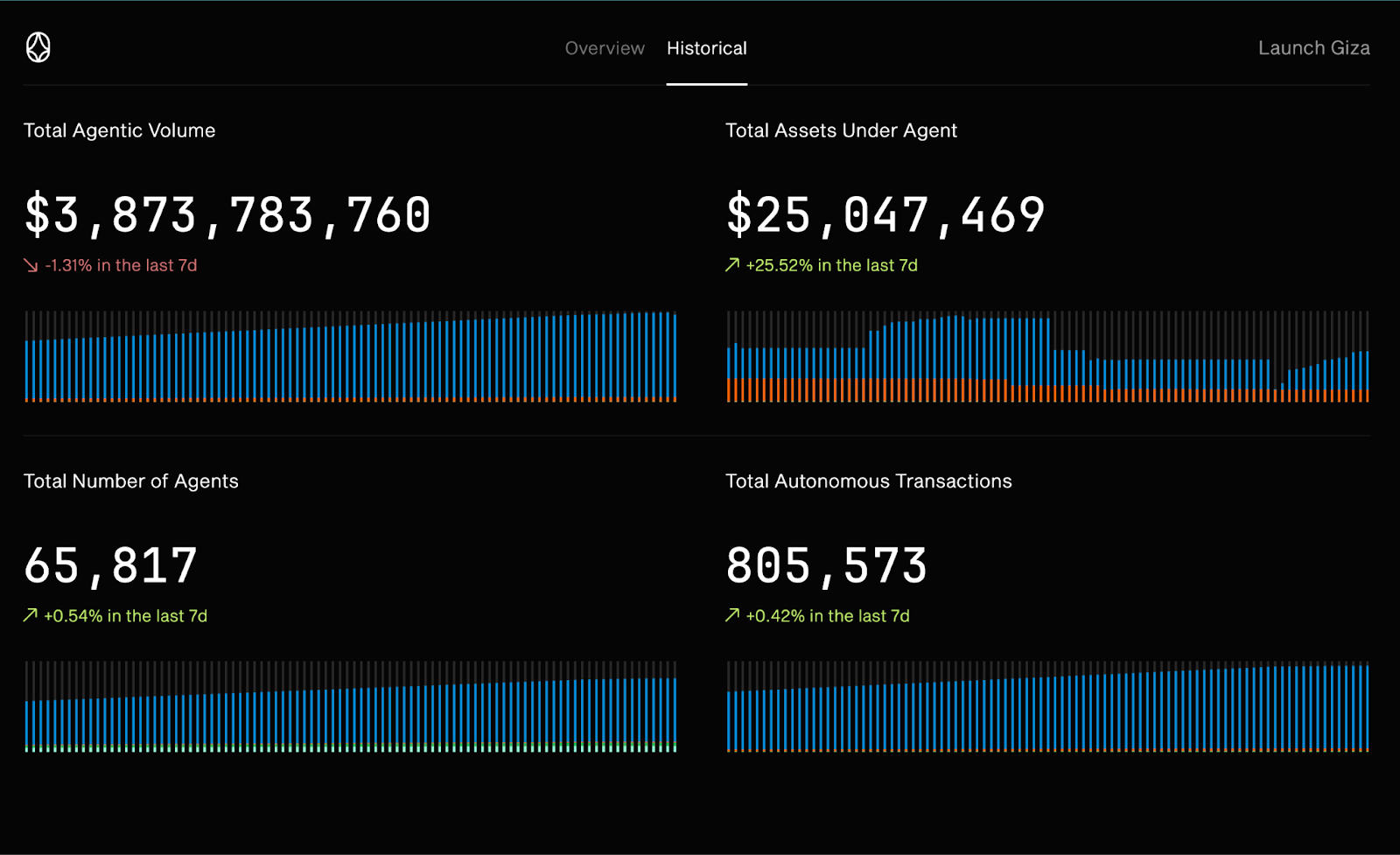
Users have deployed 60,000+ ARMA personal agents, contributing to over $40 million in AUA (assets under agent) and over 800k autonomous transactions.
However, like frontier AI models (Grok, Claude, etc) are upgraded to be a lot more powerful, ARMA has to improve beyond its current capabilities.
In today’s piece, we look into Giza’s new model following ARMA - the Giza Agent. We will examine improvements to the Giza Agent and juxtapose them with the differences between these new additions and ARMA.
What is the Giza Agent?
The Giza Agent operates as an autonomous financial mind that thinks, optimizes, explains, and protects - a significant upgrade from a personal onchain strategist that allocates your capital to lending pools.
These four core capabilities mentioned above define the Giza Agent. Together, they enable it to go beyond simply optimizing for yield and instead perform more efficient functions, including actively safeguarding user capital.
The Giza Agent is built to be more sentient than ARMA, possessing advanced reasoning abilities that resemble complete financial intelligence.
It can understand and navigate the full spectrum of onchain products, from simple mechanisms to complex financial structures.
And, by aligning with industry standards for intelligent agents beyond crypto, we believe that The Giza Agent establishes itself as a frontier model for onchain AI.
In the next few paragraphs, we will examine what new features make up the Giza Agent that backs up this claim.
What’s new about the Giza Agent?
The capabilities of the Giza Agent to think, optimize, explain, and protect are espoused in a couple of standout features, such as:
The Giza Optimizer
The Giza Agent is designed to optimize user capital more efficiently by enabling multi-protocol deposits rather than parking capital in a single protocol.
This choice stems from the observation that single-protocol deposits often result in a dampened APR due to capital velocity.
To counter this, the Giza Agent will be able to split capital across two or more protocols, optimizing not just for higher yield but also for risk through portfolio diversification.
This will work by constructing a model of the protocols’ yield curve by querying multiple deposit levels, after which it will determine the splitting formula that maximizes the user’s portfolio APR.
It is expected that users with larger portfolios will see the most change due to this enhancement by the Giza Agent.
Giza Thoughts: Agent explainability
The Giza Agent edges ARMA in the area of explainability. ARMA was able to show when a transaction occurred and display the details of withdrawals, deposits, and amounts in raw data, without context or insight into the agent’s decision-making process.
On the other hand, the Giza Agent stretches the capabilities of ARMA, enabling it to provide a daily log of its activities in human-readable language.
What this means is that the agent shows its activities daily, even when there’s no transaction made, explains the reasons behind its actions or inaction, and does all of this in human-readable language with context, showing the thinking process behind each decision.
This allows users to fully trust the Giza Agent with their capital, while also gaining a verifiable record of every decision, tracing each step of the logic, and even learning from the agent's activities.
This basically sets the Giza Agent apart from other onchain agents in terms of transparency.
Giza World: Visualize your agent’s universe
One of the most important aspects of agent-human interaction is the user experience. While autonomy is the end goal for most agents, humans don’t want to be in the dark.
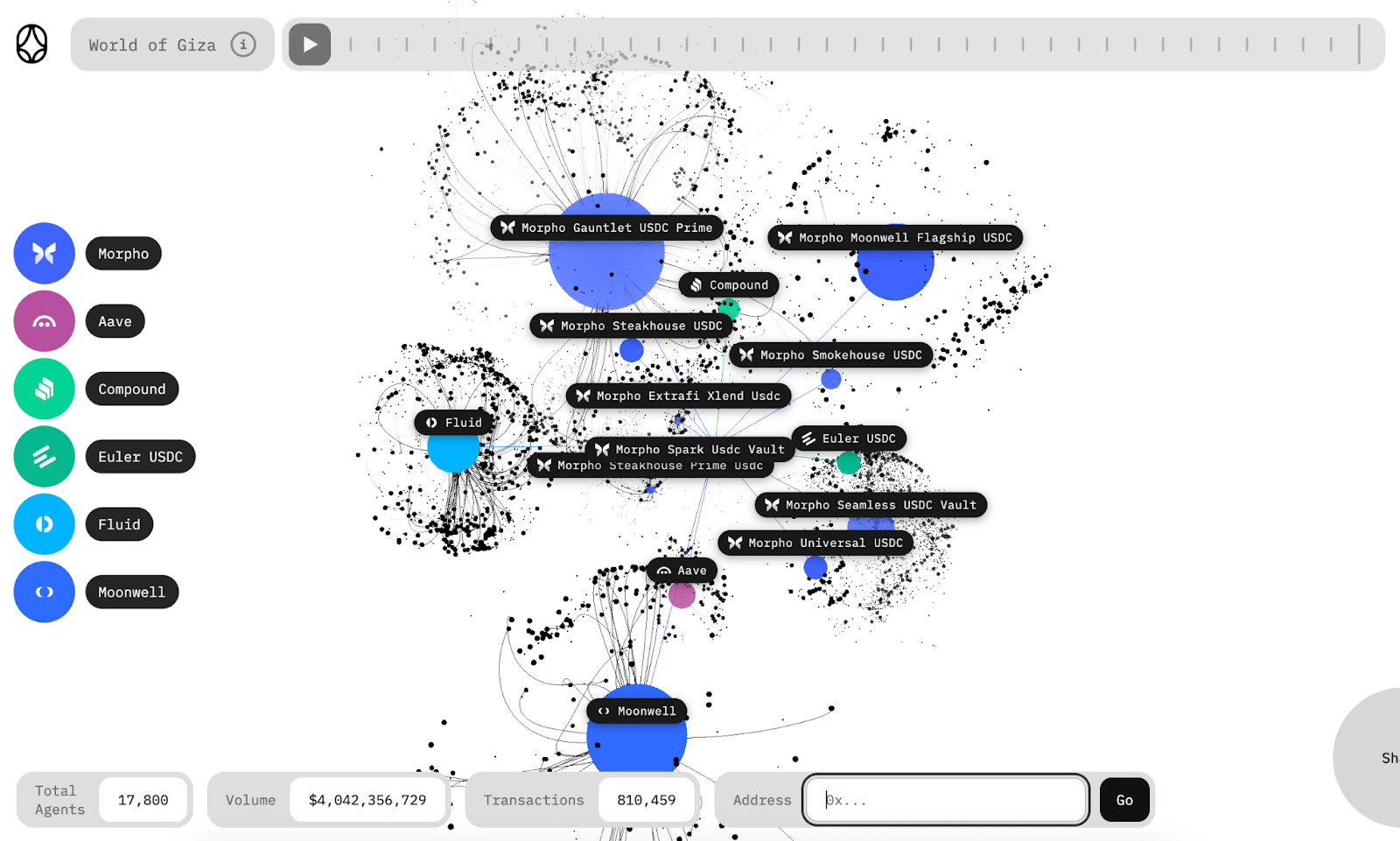
The Giza Agent fixes this by allowing users to have a real-time visual experience of the entire Giza ecosystem.
Users will be able to see their own agent’s specific journey, decisions, and destinations with the markets rendered as nodes, where larger nodes will mean more liquidity or activity.
In this agent universe, the users’ agent movements will be visualized as paths between protocols, allowing users to see how their capital moves onchain - proving the “magic” taking place under the hood.
With such user experience, Giza will unlock new entertainment and content opportunities for observers - allowing them to visibly track and create content on agent activities, pretty much like how onchain quants rummage blockchain scans and play around with the data.
Personalization through constraints
Humans thrive in contextual scenarios, meaning that at the core of human-AI agent interaction, users should be able to set parameters that work best for them. The Giza Agent is defined to ensure that this is the case.
For example, a user could want the Giza Agent not to allocate to a specific protocol for specific reasons, or a user might also want to set concentration limits while the agent diversifies (e.g., maximum 25% deployed to a single protocol).
This allows the agent to operate within defined boundaries of constraints, thereby ensuring that the user is satisfied with the execution.
Beyond personalization, the Giza Agent’s constraint feature is a better approach to risk management, as users can define the scope of interaction for the agent, setting constraints that keep it in check.
Auto-compounding of rewards
In a scenario where a protocol distributes rewards to LPs or governance token holders, the Giza Agent is designed to claim these rewards and reinvest them to generate higher returns and improve portfolio performance.
The Giza Agent executes this by querying protocols before each optimization cycle to detect unclaimed rewards. It then calculates the market value of the reward tokens and estimates the associated costs.
Once done, it proceeds to claim, convert to USDC, and automatically reinvest the rewards. Consequently, users end up earning the base APR from lending yield and the reward APR from incentive tokens received. And compound APR from the incremental yield generated by the agent through reward reinvestment.
UX improvements
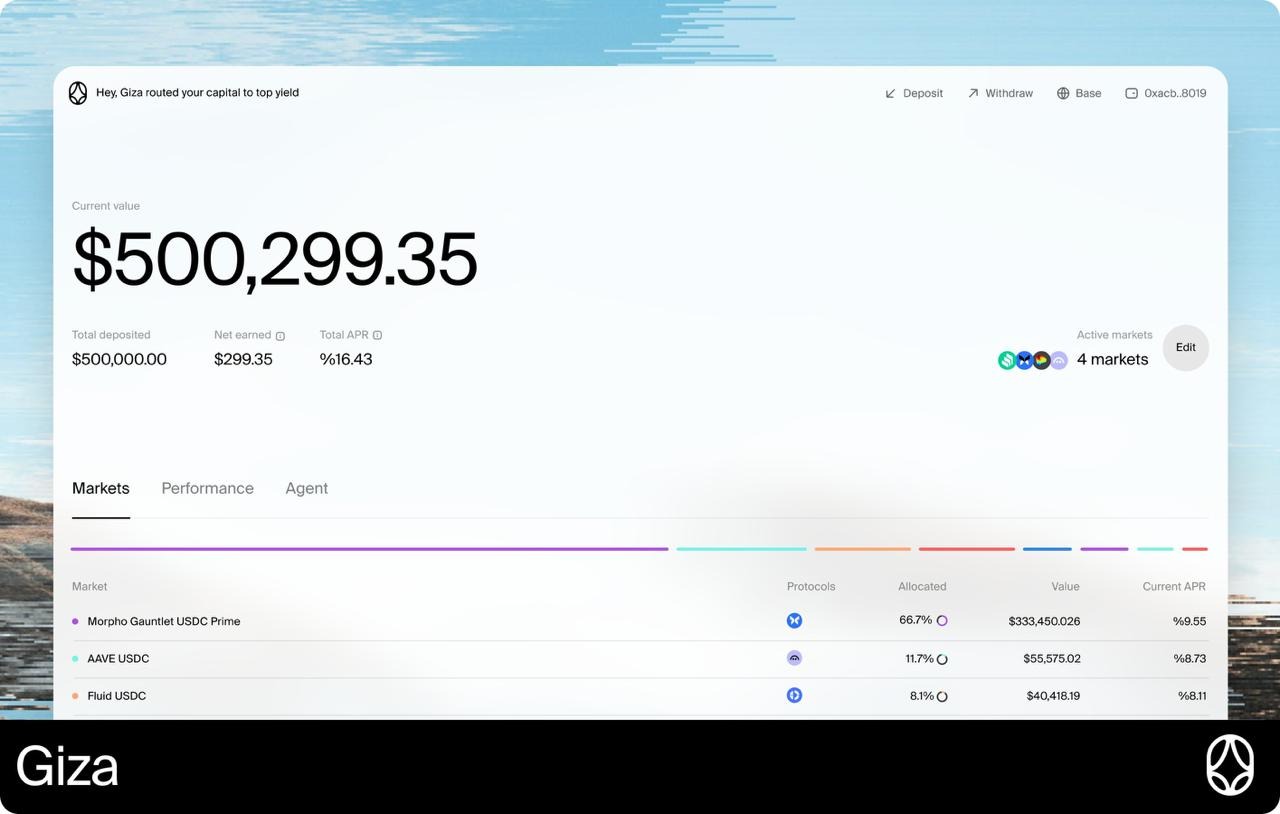
Following these improvements, the Giza Agent's interface is completely redesigned.
These changes reflect the advancements made, providing users with a new feel and an experience that’s secure, transparent, and futuristic.
Dynamic liquidity management for large wallets
In addition to the features mentioned above, the Giza Agent dynamically manages liquidity, most especially for large wallets, meaningfully helpful for deposits above $100k in deposit capital (but still helpful for every deposit size, just less noticeable for smaller ones).
The Giza Agent is capable of checking real-time liquidity across protocols before optimization, and also using liquidity information to determine position sizing.
This allows for easier exits where capital doesn’t have to struggle to leave or become a victim of slippage due to poor liquidity conditions.
The Giza Agent is also designed in this regard to continuously monitor the liquidity conditions in case something changes while a deposit has been made. If the pool’s liquidity conditions change, the agent adapts to this change dynamically.
Giza Agent vs. ARMA and others
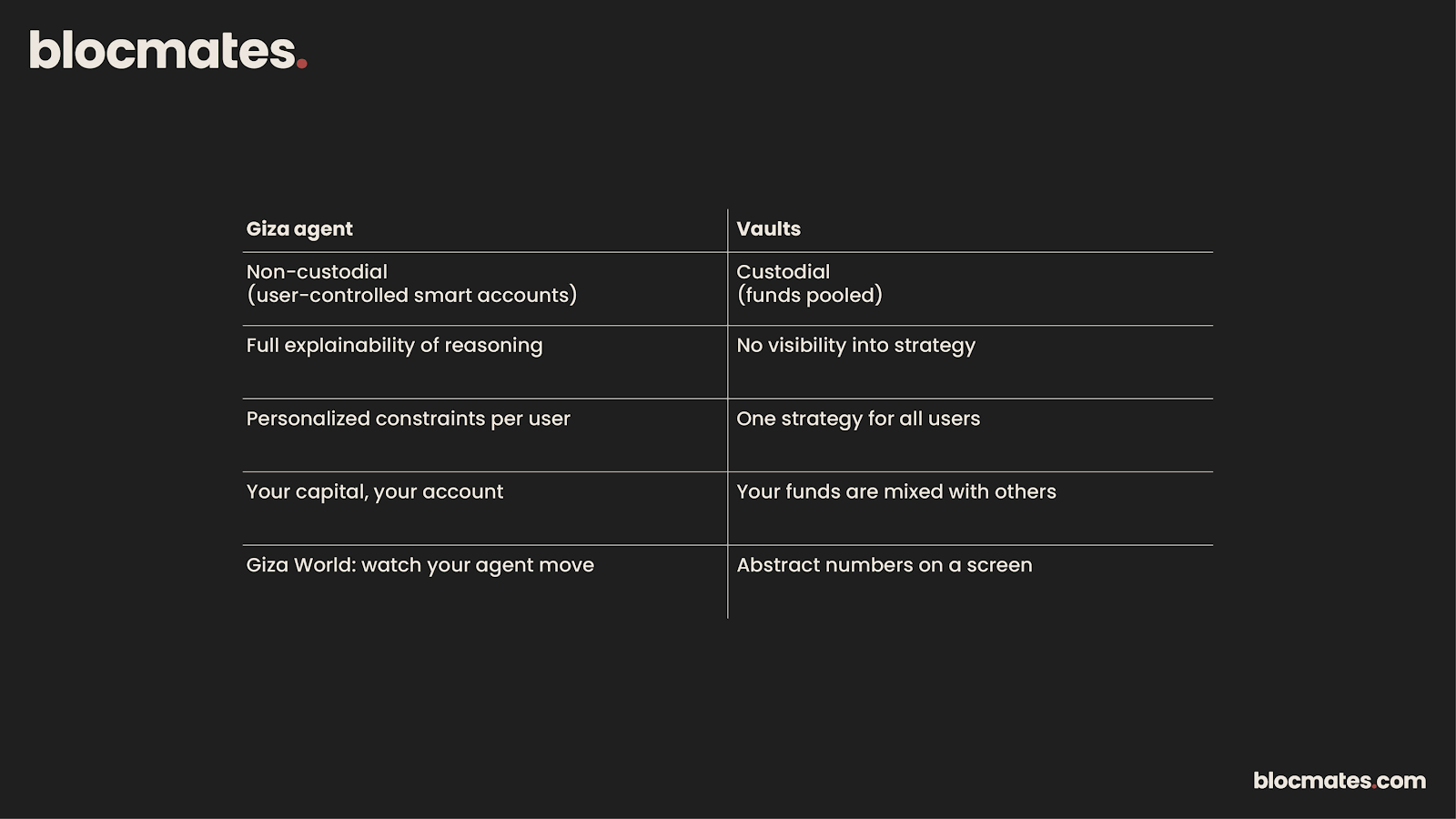
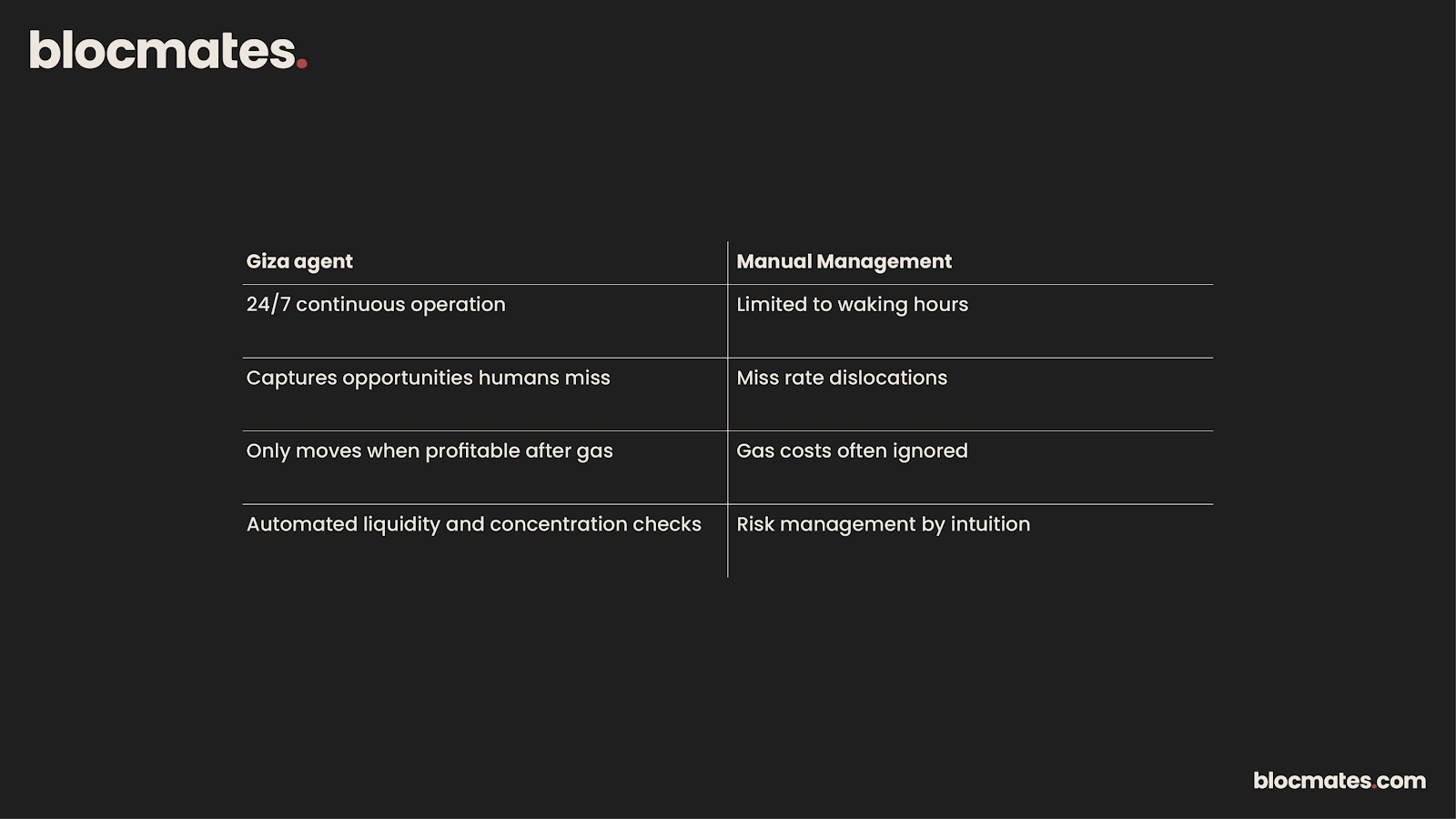
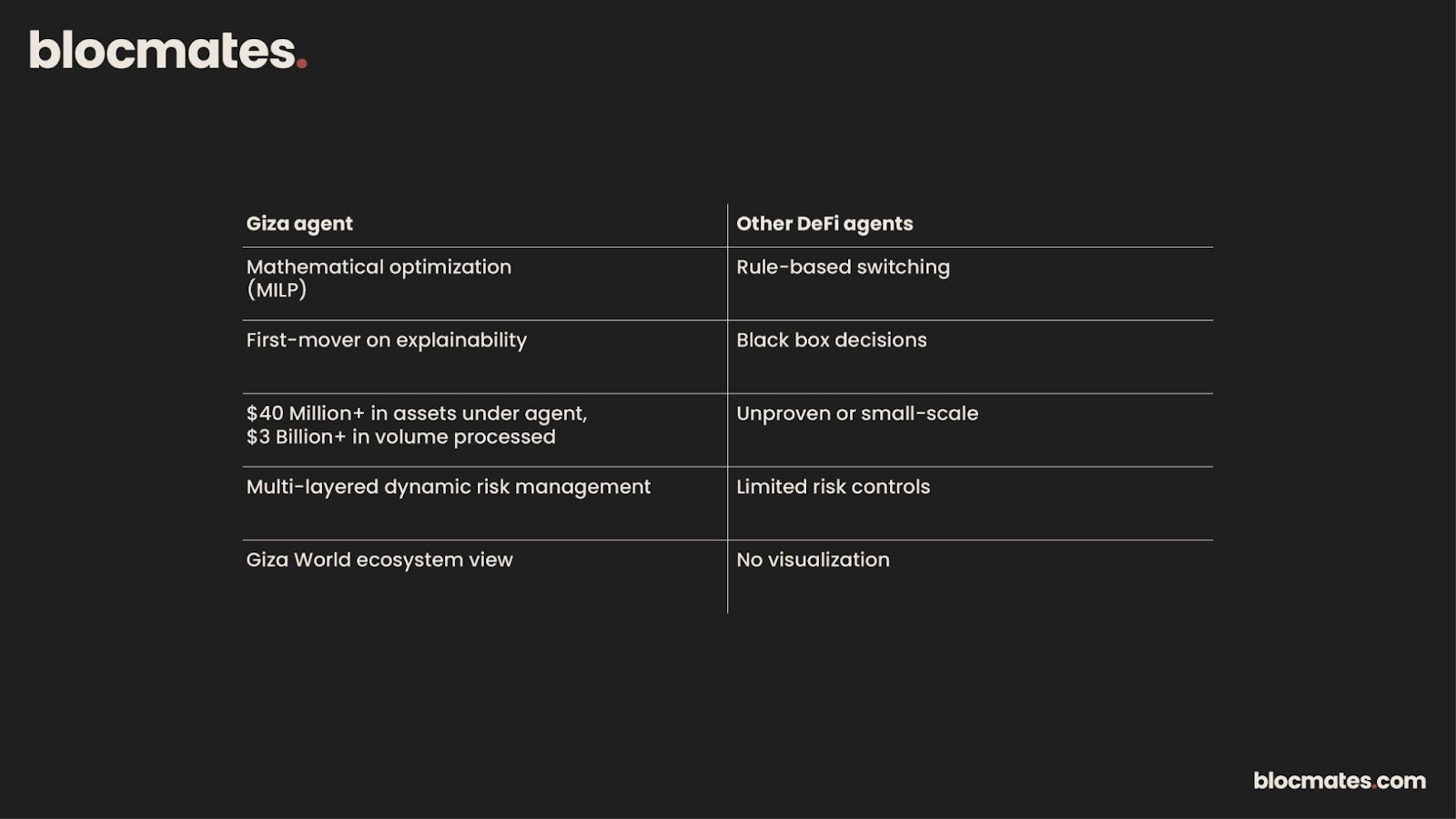
To make the differences between the Giza Agent and its predecessor ARMA clearer, and to show how it stacks up against other agents and non-agentic approaches like vaults or manual management, here’s a visual breakdown.
Versus ARMA:

Versus vaults:
Versus manual management:
Versus other DeFi agents:
What the Giza Agent unlocks
Two things are happening simultaneously: millions are being onboarded onchain, with more financial instruments coming on board via tokenization and favorable onchain policies, and secondly, the rapid adoption of AI agents.
At the center of these two things is trust, security, and risk management. The Giza Agent unlocks the onchain world for human users, leveraging agents that are not just efficient but also designed with guardrails that effectively manage risk, making the onchain economy a million times better than before.
Furthermore, for new users, this encourages them to put their capital to work. With a single deposit, their agent begins to work, optimizing across protocols, compounding rewards they might miss, and managing risks so effectively through constraints and diversification.
At the tail end of this is visibility and transparency knitted perfectly with a visually appealing user interface. Users can monitor and learn from what their agent is doing.
On the other hand, those who are not new to Giza’s products, ARMA and Pulse, are being supercharged with the upgrades in the Giza Agent.
This set of users will have to migrate to the Giza agent (as Arma and Pulse will sunset one month after the launch of Giza agent) to enjoy smarter optimization across multiple protocols with full transparency into the agent’s reasoning.
In a situation where an existing Arma or Pulse user fails to migrate, their funds will be automatically returned to their wallet.
Concluding thoughts
In the long run, protocols will stop being built for human interaction and instead be tailored (via APIs) for agentic interaction. We are already seeing signs of this, as protocols are being upgraded to optimize for AI agents.
This trend puts Giza in the driver's seat. The protocol’s ARMA agent was a tremendous success and, with the upgrades, has unlocked greater transparency, risk management, and efficiency.
On the risk side, the Giza Agent can verify liquidity in real time before each optimization cycle.
As we mentioned earlier, the Giza Agent can also split capital dynamically, with personalized constraints, to better size for users with significant capital.
These abilities give Giza an edge in the race to be the most used and deployed agent across the onchain economy.
What’s even more interesting is that as the world comes onchain, the adoption of agents such as the Giza Agent is literally inevitable.
PS: we also have it on good authority that this is the first of many launches rolling out in the coming weeks. Exciting days ahead, init?
Thanks to the Giza team for unlocking this article. All of our research and references are based on public information available in documents, etc., and are presented by blocmates for constructive discussion and analysis. To read more about our editorial policy and disclosures at blocmates, head here.









.webp)
.webp)

.webp)
.png)


.webp)



.webp)
.webp)
.webp)
.webp)










.webp)

.webp)

.webp)


.webp)
.webp)



.webp)

.webp)














.webp)
.webp)
.webp)
.webp)
.webp)


.webp)
.webp)


.webp)


.webp)




.webp)


.webp)


.webp)




















.webp)





.webp)









.webp)

.webp)
.webp)

.webp)












.webp)

.webp)


.webp)






.webp)