Reading time: 4m 50s
“What’s the point of financial freedom if you don’t have true freedom of speech?”
The above statement perfectly sums up the current state of affairs. Regardless of what you have to say about the crypto industry’s legitimacy, you can’t deny that it does, to an extent, grant you financial freedom outside of the traditional financial rails.
We’re in the digital age where all important infrastructure is controlled by a handful of entities, and surveillance of regular people is reaching astronomical levels.

Most of us don’t even realize just how much these companies know about us.
Despite all the companies that claim to be “encrypted messaging” platforms. Nothing is truly safe.
- The NSO Group is using its Pegasus Spyware to exploit WhatsApp and spy on users
- Hacker groups are obtaining data through impersonation and targeting users of Signal and WhatsApp
- Spyware was embedded in images and sent across WhatsApp to compromise users in The Landfall Campaign
- A hacker exploited TeleMessage - a Signal clone used by US officials
- Telegram switched its privacy policy to comply with governments/law enforcement upon data requests. They have fulfilled over 900 requests
- A leaked FBI training document says they can access data from LINE, iMessage, and WhatsApp
Even without direct hacks or surveillance, a lot of crucial data can be obtained by circumventing all of this and simply accessing the metadata. This is easy to obtain through legal loopholes for governments, and even easier for hackers.
We have only three constants in the digital age: Death, taxes, and you being surveilled 24/7.
Whether it's sensitive financial details, important business transactions, or simply personal messages that you would like to keep private, everyone deserves the right to absolute privacy.
Why should it be okay for governments, agencies, and hackers to spy on us constantly without consent?
And to the people saying, “Oh, but if you’re not doing anything wrong, why do you care?”
Great point, sir. So why do you lock your door when you leave your house? Why do you not publish your financial details for the world to see? Have you never whispered a secret to a close friend? Why do you draw the curtains at home? Are you doing drugs 24/7?
Privacy is a basic right, and we are all entitled to it.
After playing his part in the financial freedom movement with Tether, Paolo has now turned his attention to true freedom of speech with Keet.
What is Keet?
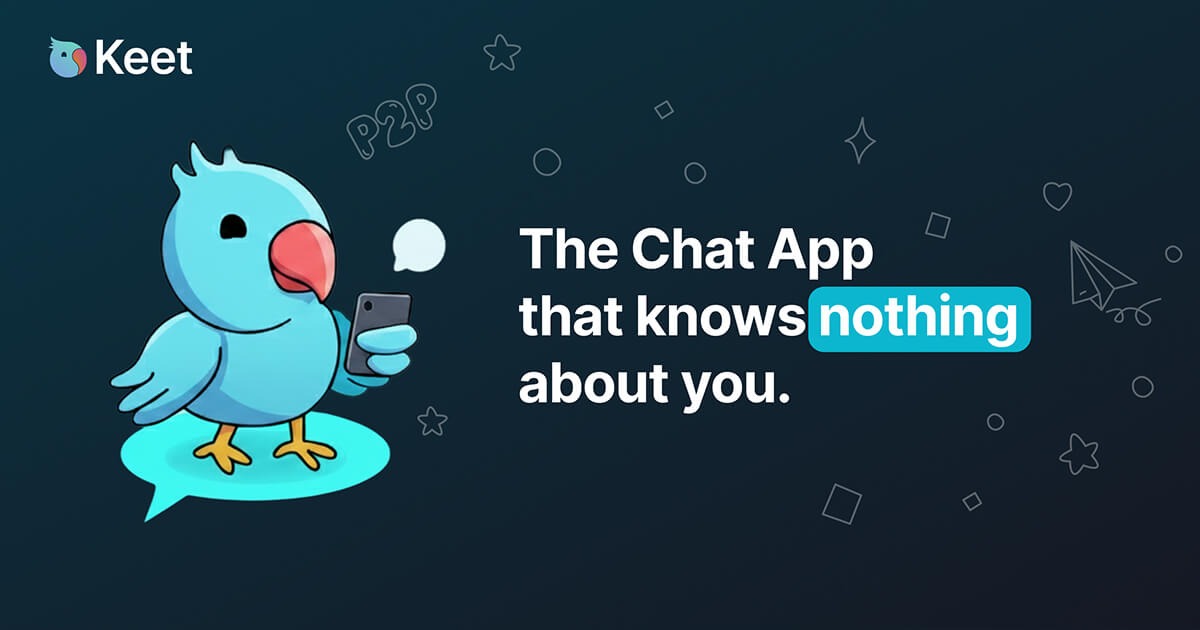
Keet is a P2P (peer-to-peer) messaging app that allows anyone to send fully encrypted messages to any other contact. No data goes to any backend servers, there’s no metadata, there’s no middlemen.
When you send a message, it goes directly from your device to the receiver's device, so it’s encrypted by default. There is literally no data to hack, surveil, or hand over to the government.
Now I know what you’re thinking. If I have to connect with a mobile number or an email address, doesn't that defeat the purpose?
Well, you don’t. You create an account with a 24-word seed phrase, much like a crypto wallet. You can then create your account and add any contact you like directly on the platform.
What’s better is that it’s not restricted to just messaging. You can share files of any size, conduct one-to-one or group video calls, and they’re also going to introduce features like native BTC transfers and auto-translation via AI.
It is the true definition of privacy with no chance of surveillance.
But I understand that this all sounds too good to be true. So let’s take a peek under the hood and see how things actually work.
Keet under the hood
Keet is developed by Holepunch, a platform designed for the creation of true peer-to-peer apps that don’t use any servers whatsoever.
Holepunch was created by Tether, Bitfinex, and the peer-to-peer infrastructure team Hypercore (unrelated to Hyperliquid’s HyperCore).
It is Hypercore’s infrastructure that ultimately enables this technology, so let’s get into it. It’s fairly complicated, but let me simplify it to the best of my abilities.
There are four modules to the Hypercore protocol:
1. Hypercore - This is the base of the protocol. It’s an append-only log that lives on each device.
Think of it like a ledger to which you can only make additions. Each message you send is added to the bottom as a new entry, and each entry is encrypted with a cryptographic hash to prevent tampering.
When you add your entry (message) to your own ledger, the receiver is directly connected to your ledger and pulls every new entry straight from your device.
2. Hyperswarm - This is the discovery engine of the Hypercore protocol.
It uses a technology called HyperDHT (distributed hash table) that helps your device find your peer's device and connect via discovery keys.
You can think of it as a postal service that takes your message and figures out where it needs to be delivered without actually having a central post office.
3. Hyperbee - Hyperbee can be thought of as a sorting index built atop the Hypercore ledger.
It’s the engine responsible for managing the state of the application.
All the UI/UX details, like sorting contact lists, user settings, and any other sort of indexing that will actually make the app convenient to use is handled here.
4. Hyperdrive - This module allows for peer-to-peer sharing of files of any size.
It’s a torrent-based file sharing protocol that turns your device into a mini-file server, chunks the files up, and allows them to be distributed in a style similar to BitTorrent. Direct P2P sharing.
Now, of course, there are a lot more technical nitty-gritties that we haven’t gotten into, so if you would like to know more, check this out.
Concluding thoughts
Privacy isn't a feature. It's a right that got quietly traded away, one "I Agree" button at a time.
The apps we use every day - the ones we trust with our most private conversations - have spent years monetizing that trust, handing over metadata to governments, and building surveillance infrastructure so polished it doesn't even feel like surveillance anymore. It just feels like the internet.
Keet is a genuine technical departure from all of that. Not because of a promise, not because of a terms of service update, but because of how it's built.
When there's no server in the middle, there's nothing to subpoena. When your identity is a keypair only you hold, there's no company that can be pressured into handing you over. The math does what the policies never could.
Whether Keet becomes the communication layer of a more privacy-native internet, or just the thing that proves it's actually possible to build this way, both outcomes matter. Because once people understand what P2P communication actually feels like, going back to being a product starts feeling a lot less acceptable.









.webp)
.webp)

.webp)

.png)


.webp)



.webp)
.webp)

.webp)
.webp)














.webp)

.webp)

.webp)


.webp)
.webp)


.webp)
.webp)
















.webp)
.webp)
.webp)
.webp)
.webp)


.webp)
.webp)


.webp)


.webp)




.webp)


.webp)


.webp)






















.webp)







.webp)













.webp)

.webp)
.webp)

.webp)













.webp)

.webp)


.webp)





.webp)