Reading time: 6m 27s
Quantum computing risks are a level-1 threat, and we’ve sounded the alarms a few times now with quality articles on the threat it poses to crypto.
The good news is that people are building solutions. Some are spinning up brand-new quantum-safe chains from scratch. Others are retrofitting the layer-1s (L1s) we already use.
A few are making wallets and migration toolkits so the rest of the industry doesn't have to scramble at the last minute.
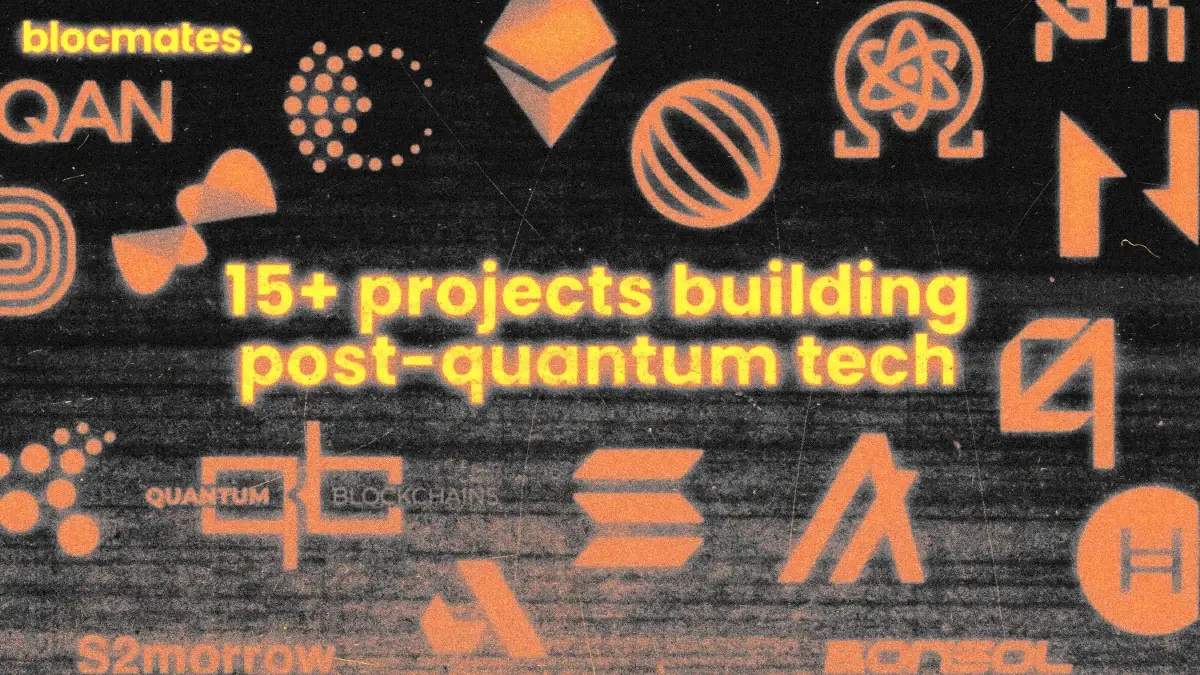
Here are some of the tools, projects, and tech solutions on our radar:
Migration and security tooling
Project Eleven
Project Eleven is building post-quantum migration tooling for the chains that matter most. The flagship product, Yellowpages, is an open-source registry that lets you link your existing BTC addresses to fresh post-quantum keys without waiting for a protocol upgrade.
They raised $26 million in total, and they're working directly with the Solana Foundation on readiness planning. Project Eleven launched the Q-Day Prize - 1 BTC to whoever can break an ECC key using Shor's algorithm on a real quantum computer.
Tectonic Labs
Tectonic Labs is building defense-grade blockchain infrastructure aligned with NIST post-quantum standards.
The team includes a PhD student of Peter Shor (the guy who invented the algorithm that threatens crypto), as well as engineers from IBM Quantum, Google Quantum AI, the Ethereum Foundation, and Polygon.
They've shipped PQ wallet, a post-quantum EVM wallet extension using Falcon-512 signatures that works without any L1 changes, plus PQ audits for teams that want to assess their quantum exposure.
Bonsol Labs
Bonsol Labs demonstrated the first NIST-standardized post-quantum signature verification on Solana, in partnership with BTQ Technologies.
PQC signatures are 50x+ larger than current ECDSA signatures, which is a problem on a chain optimized for speed.
In other words, if you’re signing a transaction today on Solana, it’s designed to be tiny and fast, allowing for a smoother and faster experience.
On the contrary, quantum-proof signatures (PQC) are huge, often 50 times larger than what is obtainable today.
Bonsol's solution moves the heavy PQC operations offchain via their verifiable computation network, while keeping onchain verification intact.
This allows Solana to do a quick, lightweight check to verify transactions, keeping it fast and smooth while being quantum-proof.
qLabs
qLABS calls itself the "world's first quantum-native crypto foundation." Instead of building a new chain, they're adding a quantum-resistant layer on top of existing ones like Ethereum, Solana, and Hyperliquid.
The approach uses a dual-signature model - transactions need the standard blockchain signature and a second quantum-resistant one, built on 01 Quantum's patented IronCAP cryptographic engine.
The $qONE token is already live on HyperEVM, and its L1 Migration Toolkit provides blockchains with a phased upgrade path that avoids hard forks.
Wallets and asset protection
S2morrow by Starknet
Starknet is quantum-ready with the launch of S2morrow, a Falcon-512, lattice-based, NIST-standardized wallet. Users will be able to deploy their own PQ wallets directly on Starknet.
S2morrow functions like any regular wallet, but with a new verification logic built under. Users can migrate at their own pace and decision. Starknet, through the s2morrow deployment, opts for a gradual upgrade process to enable full post-quantum security for users.
Quip Network
Quip Network is a decentralized platform combining a quantum compute marketplace with a post-quantum security layer for existing wallets.
Their core primitive, the QUIP vault, wraps your current wallet (EVM, hardware, multisig, whatever) with a post-quantum firewall contract using WOTS+ hash-based signatures.
They're also running a quantum computing network where node operators can contribute CPU, GPU, or QPU power. Backed by Portal Ventures and Orange DAO, the mainnet launch is targeted for Q2 2026.
Native post-quantum blockchains
Quantum Resistant Ledger (QRL)
QRL is the OG. Launched in 2018, it's the first public chain secured by hash-based XMSS signatures. Basically, every address has been quantum-safe from day one.
QRL 2.0 is now in testnet with an EVM-compatible layer and stateless SPHINCS+ signatures, which unlock DeFi on a quantum-safe foundation. The token just surged 45% in a single day amid renewed quantum computing concerns.
QuStream
QuStream is a L1 blockchain claiming the highest quantum resistance in the world at 504 bits of quantum hardness.
The patent-pending encryption eliminates fixed private keys entirely, using ephemeral, fragmented keys distributed across validator and encryption nodes.
The project was founded by Adrian Neal, a two-time NATO Defense Innovation Challenge winner and Senior Director for post-quantum cryptography at Capgemini.
Being built as a Polkadot Rollup with Asphere, with QRNG hardware for true randomness. The QST token launched on Solana ahead of a 1:1 migration to the native chain.
QANplatform
QANplatform is a quantum-resistant L1 with a clever two-key approach: every account stores both a standard ECDSA key and a lattice-based Dilithium key.
The network checks both signatures simultaneously. If quantum machines eventually break elliptic curves, nodes simply ignore the legacy half.
Developers can deploy in Solidity, Python, or Go, and an EU government ministry started piloting the stack in 2025 for critical infrastructure.
Cellframe
Cellframe is a third-generation L0 protocol designed for quantum safety from the ground up, written in pure C for maximum performance.
Cellframe supports multiple post-quantum algorithms (Crystal-Dilithium, NewHope, NTRU, Frodo) and lets new signature schemes be added without hard forks.
The architecture includes multi-level sharding and a service-oriented design where sub-chains can spin up for specific applications. Recently, it surged 50% alongside QRL.
Abelian
Abelian pairs lattice-based cryptography with privacy layers. It’s basically like Monero, but post-quantum.
Transaction details stay hidden via zero-knowledge proofs while the underlying signatures remain quantum-resistant.
It addresses the dual challenge that most privacy coins still face: maintaining anonymity features that quantum computers could eventually unravel.
Quantum Blockchains
Quantum Blockchains Inc. takes a hardware-first approach. Their patented pQKD device emulates quantum key distribution protocols while integrating NIST post-quantum algorithms, making quantum-grade security deployable on existing networking hardware.
They've demonstrated a live QKD link between two cities using standard Fortinet routers, proving this works without specialized optical gear.
The device includes an onboard quantum random number generator for high-entropy randomness.
Existing chains going post-quantum
Algorand
Algorand activated post-quantum protection on mainnet back in September 2022 with "State Proofs" - compact certificates signed using FALCON, one of NIST's approved lattice-based algorithms.
Every 256 blocks, the chain cryptographically signs its history, securing past transactions against quantum attacks. Blocks still finalize in about 3.3 seconds at up to 6,000 TPS.
The 2026 roadmap includes native FALCON verification at the consensus layer and an onchain vote to toggle quantum-safe accounts without a hard fork.
Solana
Solana is tackling quantum risk from multiple angles. The Solana Foundation partnered with Project Eleven for readiness assessments, and, in December 2025, opened a public testnet, replacing Ed25519 with CRYSTALS-Dilithium.
A Winternitz Vault mechanism has also been proposed for quantum-resistant key rotation. Between Bonsol Labs' offchain proving work and the Foundation's direct efforts, Solana is arguably the most active high-performance chain in the PQ migration space right now.
Ethereum
The Ethereum Foundation designated post-quantum cryptography as a "top strategic priority" in January 2026, alongside a $2 million research prize for practical migration solutions.
Vitalik has warned about a 20% chance that quantum computers will break modern encryption before 2030.
The likely path involves STARK-based signatures, which use hash functions naturally resistant to Shor's algorithm, combined with a hybrid approach allowing gradual migration from ECDSA.
StarkNet, as an L2, already benefits from quantum-resistant proof verification by default.
Hedera
Hedera uses SHA-384 cryptography, which is expected to remain secure against quantum attacks. Governed by a council of major global organizations, the network processes billions of transactions for enterprise applications.
The council has prioritized post-quantum security research focused on state proofs and quantum-safe signatures. For enterprises that need decades-long data assurance, Hedera's governance model allows fast security upgrades when needed.
Nervos Network (CKB)
Nervos took a different approach: its L1 is built with flexible, modular cryptographic primitives that can be upgraded without a hard fork.
Most blockchains hardcode their signature schemes into the protocol.
CKB's RISC-V-based virtual machine lets developers add new cryptographic methods cleanly, making it one of the most "crypto-agile" blockchains in existence.
When the time comes, post-quantum algorithms slot in without drama.
Concluding thoughts
The quantum threat went from background noise to something really scary, especially after Google’s recent update.
But beyond the fear, there’s been a positive reaction to PQC tech tokens, showing market readiness to bet on those building towards post-quantum crypto.
The projects above represent different bets on how crypto will survive Q-day. Some are building new chains from scratch, others are developing new standards, and building products around them.
However, not every project mentioned or out there will make it or might become a major play. But the ones that do would have solved the actual hard problems, like making migration practical and no longer theoretical for their users.
The most important thing is paying attention to those actually shipping and not just iterating. The timeline has shortened and might shorten even more, but rather than give in to fear, stay glued to what’s happening in the PQC space. We believe a post-quantum world is a much better place to be.
As always, do your own research on the projects mentioned and don’t just take our word for it.







.webp)
.webp)

.webp)
.png)
.webp)

.webp)
.webp)
.webp)
.webp)








.webp)

.webp)

.webp)

.webp)
.webp)

.webp)
.webp)










.webp)
.webp)
.webp)
.webp)
.webp)
.webp)


.webp)
.webp)


.webp)


.webp)




.webp)


.webp)


.webp)















.webp)



.webp)







.webp)

.webp)
.webp)

.webp)











.webp)

.webp)

.webp)





.webp)