Reading time: 10m 26s
Ape-tizers:
- Surf is the first crypto-native AI platform that completely replaces traditional data collection workflows
- The 2.0 release allows non-technical analysts to build custom dashboards without writing a single line of code
- Surf’s knowledge graph encompasses more than 40 chains, over 200 sources, and more than 120,000 X accounts, allowing industry and context-aware responses
Research, from Middle French 'rechercher', combines re (again or intensively) and cerchier (to search). It emphasizes that research is a thorough, detailed investigation to uncover information, verify facts, or gain understanding.
Indeed, it used to require a person a great deal of effort to scour the internet for information, deal with multiple data sources, manage dozens of tabs, craft a compelling story, and then carefully write that piece in hopes that someone would find their ideas interesting.
Now? We’re one prompt away from a full-blown bachelor's thesis.
So where does the edge lie? As always, the edge lies in YOUR own voice and approach.
You see, LLMs are a mix of countless lines of text scraped from the internet. What they’re effectively doing is predicting the sequence of words based on the hordes of data they've been trained on.
Importantly, this data doesn’t have clear labels for what qualifies as “great content” or what’s considered “bad”. It’s just content.
This means the text it spits out follows the common denominator, and therefore, mediocrity is inherent to LLMs.
To better explain why this is true, I’ll let the renowned distributed systems expert and Large Language Model pioneer, Gandhi, share his own words:

What Gandhi is saying is that just because something is written by a human, it doesn't suddenly make it a masterpiece. Most human-created work is also average, which is why LLMs often produce only average-at-best copy.
Since AI mirrors the average, it's not a substitute for your thinking. You need to inject your taste, perspective, and story. When you do, AI shifts from a mediocrity generator to a productivity booster.
And so, if by any chance you’re currently in a strange and misguided state of mind where you intentionally avoid AI when doing research, you’re missing out and wasting precious time.
At the end of the day, our expertise has always been synthesizing information and crafting a compelling narrative/story. With AI, our job simply got easier, and we get to focus on the one vertical that matters the most- storytelling.
The goal of today’s article is to show how to effectively use a specific AI tool for crypto research, without losing your voice and becoming too reliant on it in the process.
What is SurfAI?
Surf is a crypto-native AI platform that collapses traditional data collection and analysis workflows into a single interface.
Surf's strength lies in its frontier LLM and agent orchestration, which draw on a wide array of onchain databases and sources to provide users with comprehensive and relevant answers that its vanilla counterparts simply cannot.
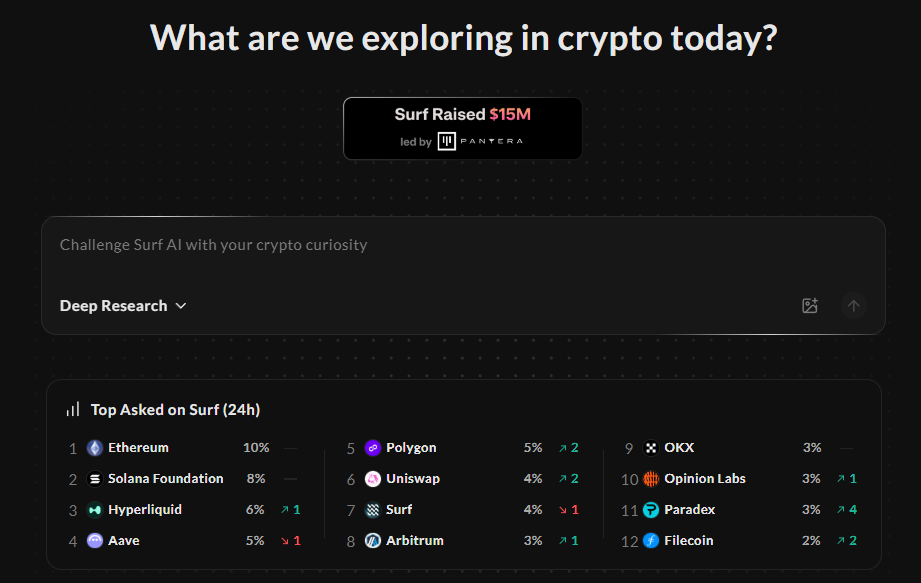
Think of it as having a crypto research analyst available 24/7, one who can pull live market data, read the blockchain, scan social sentiment, and synthesize it all into a clear answer.
Rather than juggling multiple apps such as DeFiLlama, tokenterminal, onchain explorers, DEX Screener, CryptoRank, ICODrops, or other data sources, you can just ask this analyst a relevant question.
Surf then references 200+ sources simultaneously, collapsing that entire workflow into a single prompt. Pretty neat, right? But how does it achieve that?
Developed by its parent company, Cyber, it’s a crypto-specific multi-model and API suite that combines onchain data with offchain intelligence.
Surf maintains a comprehensive knowledge graph (a database) of the crypto ecosystem: projects, tokens, teams, investors, social accounts, and their relationships, offering clear, context-aware responses.
With the introduction of their 2.0 model, which shows a roughly 10% increase in accuracy while reducing research times by an average of 50% compared to v1.0, Surf can now handle queries it previously struggled with and do so more quickly.
In practice, Surf’s answers are drawn from a dynamically assembled crypto database (40+ chains, 200+ sources, 120k+ Twitter accounts ), which is injected into the major foundational models during inference, depending on the task's complexity.
Alright, enough with the theory, let’s explore the different ways to use Surf.
Core capabilities
The app's design is straightforward and mimics the UX of ChatGPT, Claude, or any other user-facing AI app. Taking centre stage is the chatbox, which offers three distinct modes: Auto, Instant, and Deep Research.
Auto is an adaptive model that automatically selects between Instant and Deep Research based on the request parameters and problem complexity.
Instant is a lightweight model optimized for fast responses to simple queries, while Deep Research is more powerful, with deeper reasoning capabilities, designed to handle complex problems that require thorough analysis and multi-step reasoning. No surprises there.
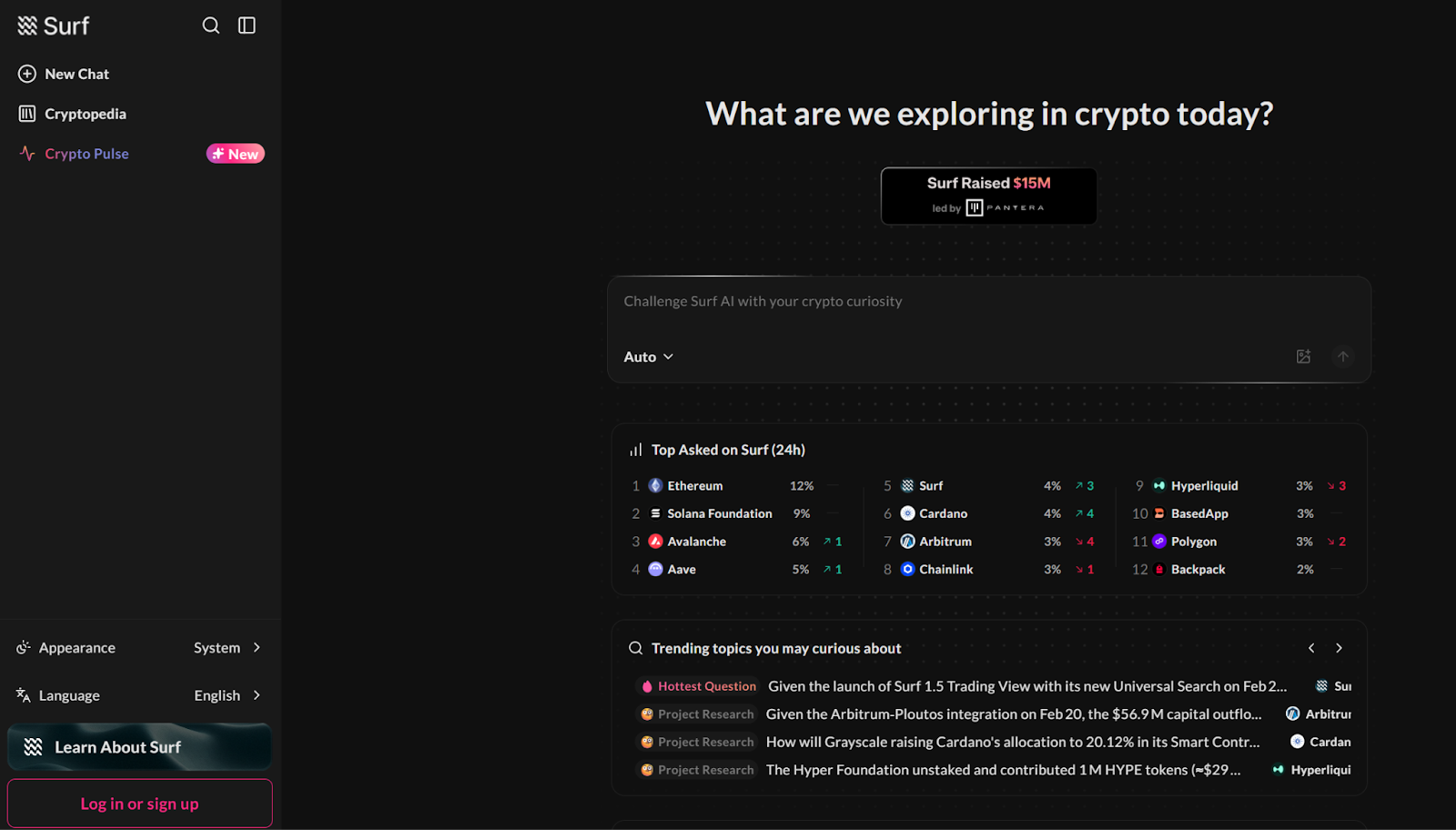
What is surprising, however, is the sheer volume of information and data points you can gather from this app.
Let’s break them down in crude, pitch-deck format first, and then we’ll jump into examples of how to leverage this toolset for specific queries.
- Tracks live token prices, volume, market cap, futures data (funding rates, open interest, liquidations), and DeFi metrics (TVL, fees, yields).
- Tracks trending crypto tokens, projects, and narratives using onchain activity, social engagement, and trading signals.
- Reads blockchain data from EVM-compatible chains and Solana. Analyze wallets, track fund flows, see holder distributions, and understand smart contracts via natural language.
- Provides tokenomics breakdowns with unlock schedules, allocations, and vesting timelines, showing when tokens unlock, supply changes, and market implications.
- Tracks crypto-active VC firms, portfolios, recent investments, fund sizes, and backed projects.
- Aggregates news and social media, linking mentions to projects and tokens with named entity recognition in Surf's knowledge graph.
While these capabilities are embedded in the model and surfaced with the right prompt, Surf also offers a more immediate, at-a-glance view of the market with Crypto Pulse.
Crypto Pulse
Since writing relies heavily on staying updated with current events and using comparisons and analogies to make the topic relevant to the reader, in practice, with the overwhelming noise we face daily, this can be quite challenging.
With that notion in mind, unfortunately, I couldn't find a way to work the word OpenClaw into this article, so if you’re still here, comment your cortisol level below.
What I can work out, though, is a general assumption on how your morning routine looks:
Open Twitter, scroll for god knows how long, thinking you’re staying up to speed with what’s going on in the world and which coin rugged while you were sleeping.
Many moments later, you finally stumble upon a supposed runner. You proceed to open DEX Screener to check what’s up. For the more advanced apes, you might poke around to try and find if the coin’s a bundle. Spoiler: they all are.
After seeing green candles, your neurons begin to fire, which prompts you to share the ticker in your group chat, in hopes of finding confirmation bias that you should indeed jump on the wagon, only to end up buying the pico top. Sound familiar?
Sorry to be the bearer of bad news, but more time is spent mindlessly scrolling and chatting than doing actual research. Not to mention the fact that you’re not getting the full picture or context of what’s happening.
If you’re a NEETmaxxing chud with an esoteric income source, then by all means, proceed with the above strategy.
But if you cherish every minute of your day and simply want the highest signal-to-noise ratio possible, checking Crypto Pulse at the start of your day will get you up to speed the fastest:
- News: Provides daily summaries of top topics, trends, and market-moving news. Skim for a quick overview or click through for detailed insights.
- Real-time feed: Tracks 12,000+ accounts and media sources instantly. Shows you what's happening now, as it happens.
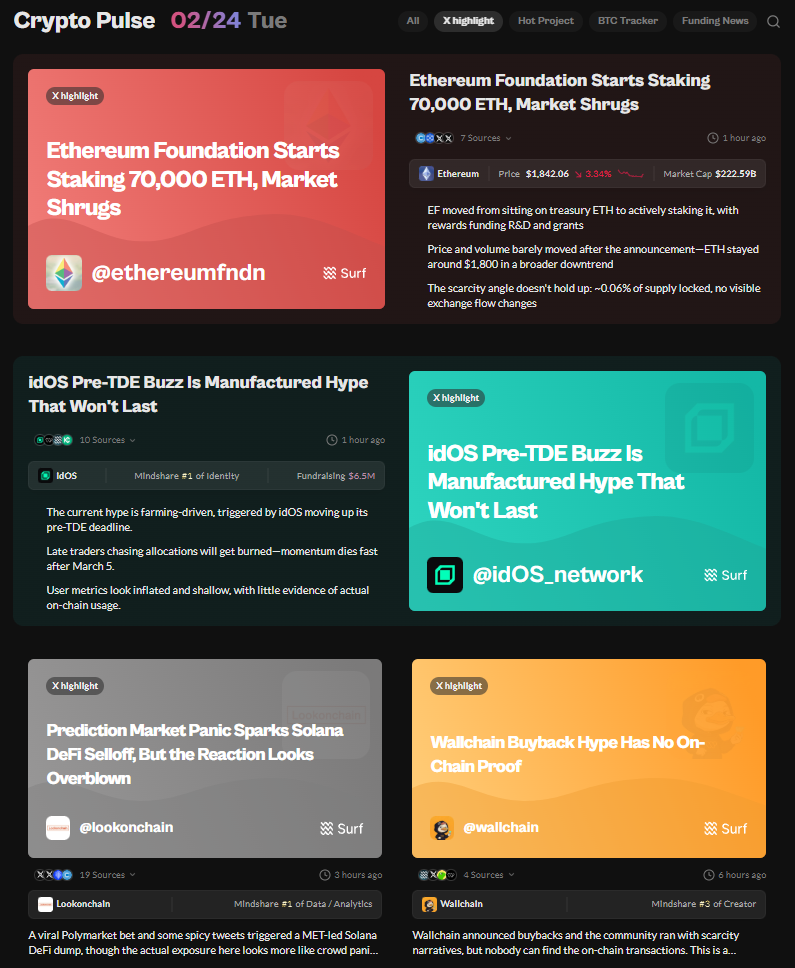
After checking out Crypto Pulse, inevitably succumbing to the Twitter algorithm, and indulging in two sugary macchiatos on top of several doses of nootropics, you should be caught up on world events. Now is the moment to begin writing.
How to leverage Surf as a researcher
Step 1:
When given the task of writing a piece on a particular project or sector, the first step is to get a broad overview. Here, I usually employ the Deep Research mode and give a general prompt such as: “What is project X?”
While it may seem straightforward, this query already addresses a few pain points right out of the gate.
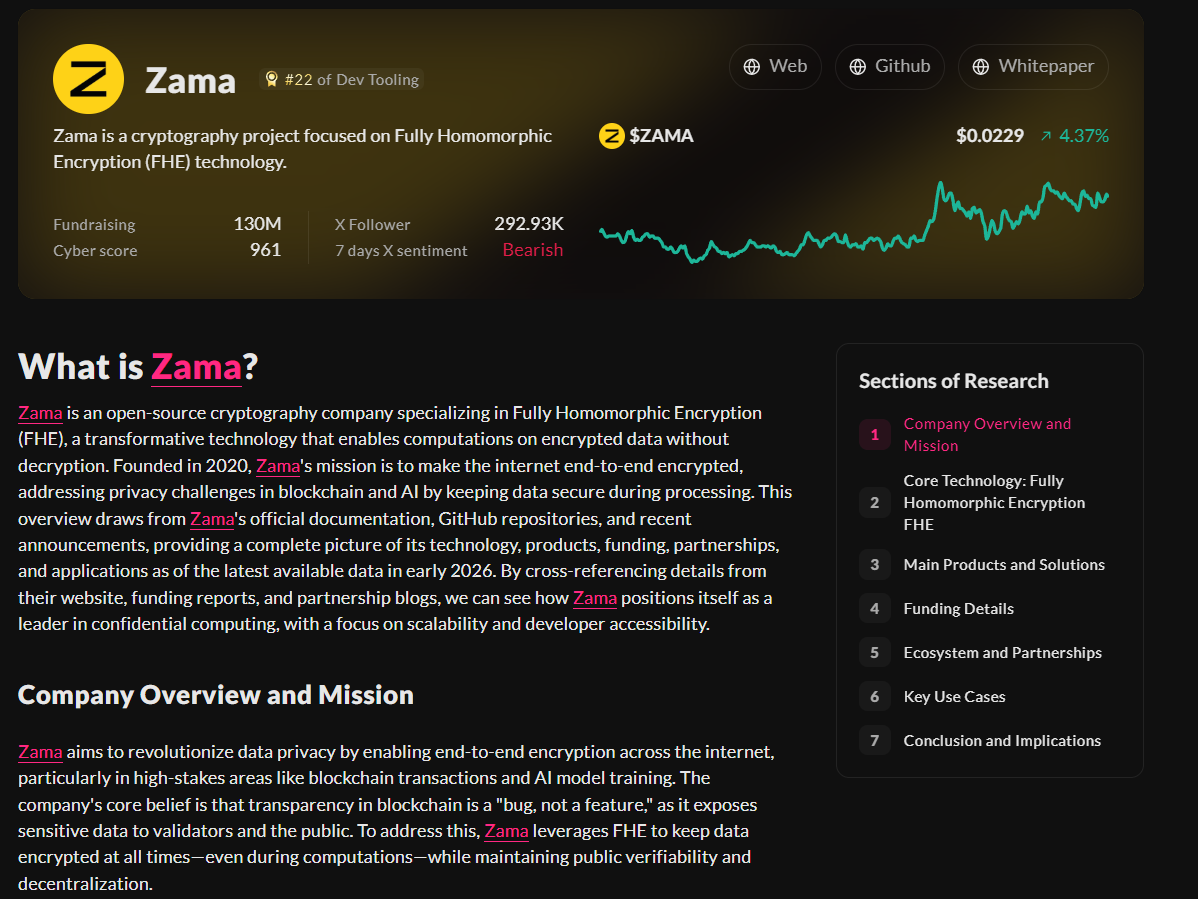
Immediately at the top, Surf generates a project card with an explanatory one-liner, token price, fundraising amount, and links to the website, docs, and whitepaper, replacing the manual labour of gathering the most basic project information.
Since projects are stored in Surf’s database, clicking the project card opens a pop-up with detailed information. This includes real-time data such as a TradingView window, the latest news, a volume heatmap, mindshare broken down by X accounts, and more.
Instead of dealing with the anxiety of seeing 10+ tabs in my window, I treat this query as my main reference point that I can always return to when I later explore a specific part of the project, just as Surf also references different sources and links used for research.
Step 2:
As I read the research that would have taken me a solid hour to gather, but only took Surf a minute, my neurons surprisingly start firing as my brain begins to connect vectors within the carbon-based RAG, linking similar projects, technologies, price patterns, and other related knowledge I’ve built up from the painstaking years I’ve spent in this industry.
Alongside that, several immediate questions arise, such as what the main competitors are or what the tokenomics look like. For the latter, I simply ask Surf to create a graphic with the project’s vesting schedule.
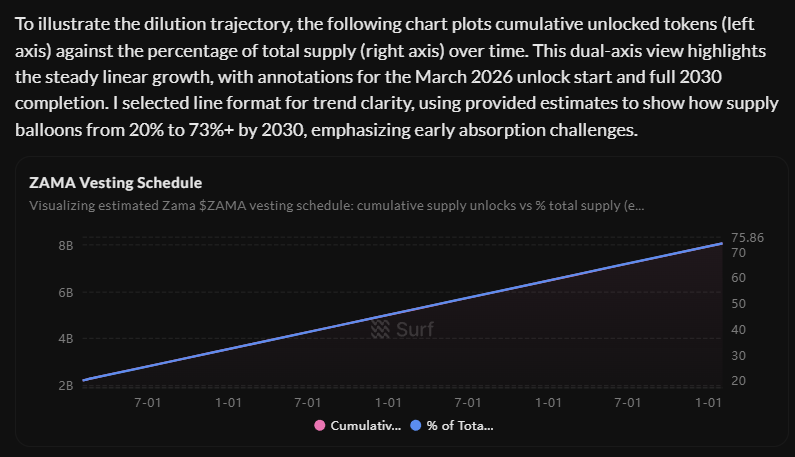
The point is, whatever question I have, Surf can answer it faster than I can search it up, so there's no reason for me to “fight” against it. If you’re not doing it, your peers definitely are.
Step 3:
As it is in our nature to dig for information, I inevitably end up manually searching for specific details. When a project is technically complex and exceeds my pay grade, its documentation often raises more questions than it provides answers.
With Surf, I can simply copy a specific section or an image I don’t understand and let Surf explain its meaning in layman’s terms (my kind of terms).
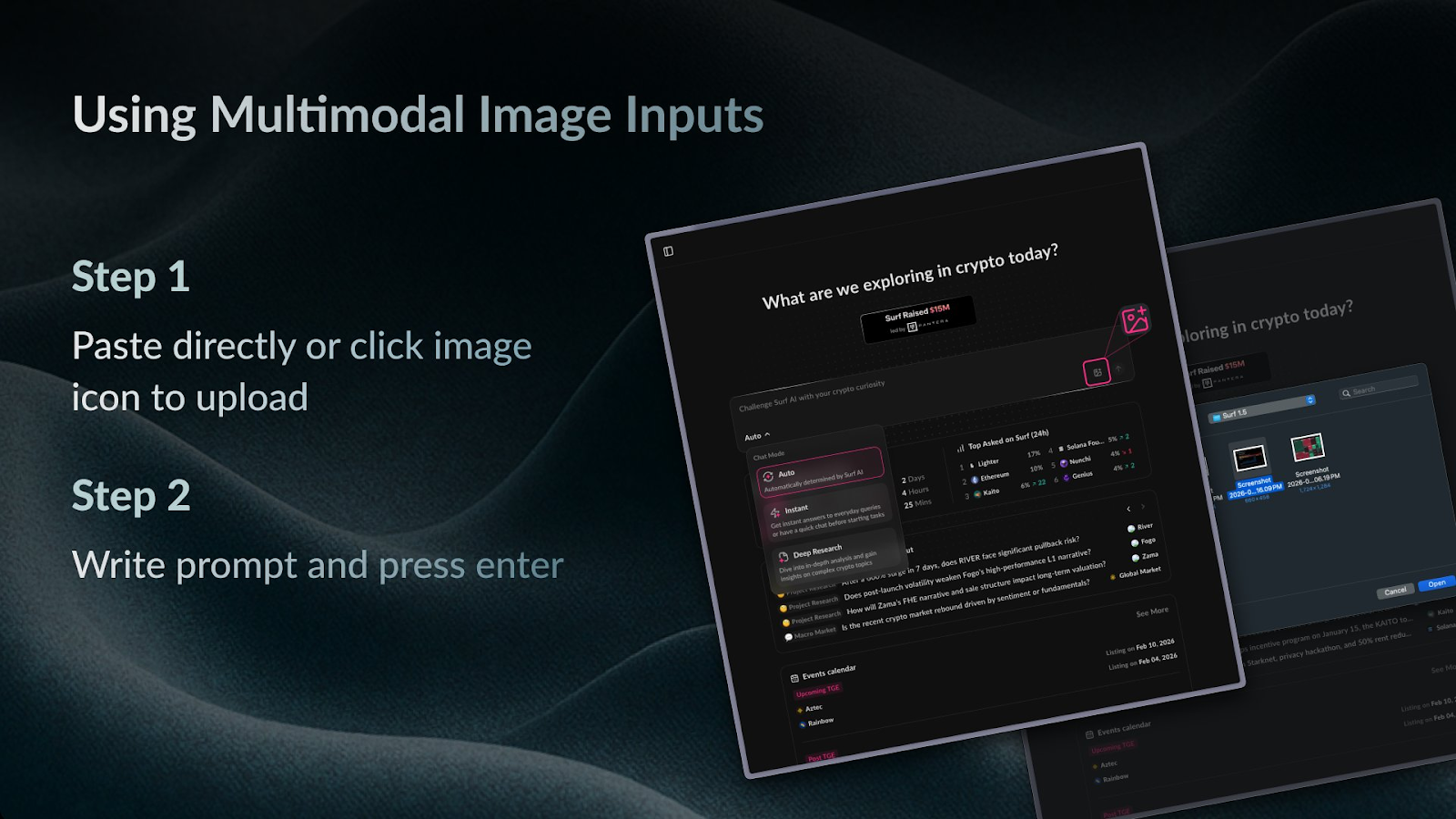
Step 4:
Quickly looking up numbers is also possible with Surf. However, remember rule number 1 for using LLMs: the output is only as good as your input. When looking up numbers and stats, be specific about what you’re asking. State the exact type of metric you’re looking for, the period, etc.
LLMs can’t read the exact idea that’s in your mind, so don’t start blaming it for not doing that.
Step 5:
And finally, this tool can also be used to fact-check any statements I'm unsure about or not fully informed about.
For example, I recently wrote an article on Ink and was exploring the CEX-backed blockchains that came before Ink. Naturally, Base is the clear standout in this regard, but I also wanted to explore the pioneer of this setup, Binance.
I simply pasted the paragraph where I felt I lacked understanding, and sure enough, Surf highlighted where both products are similar and where their designs differ, and even offered additional insights.
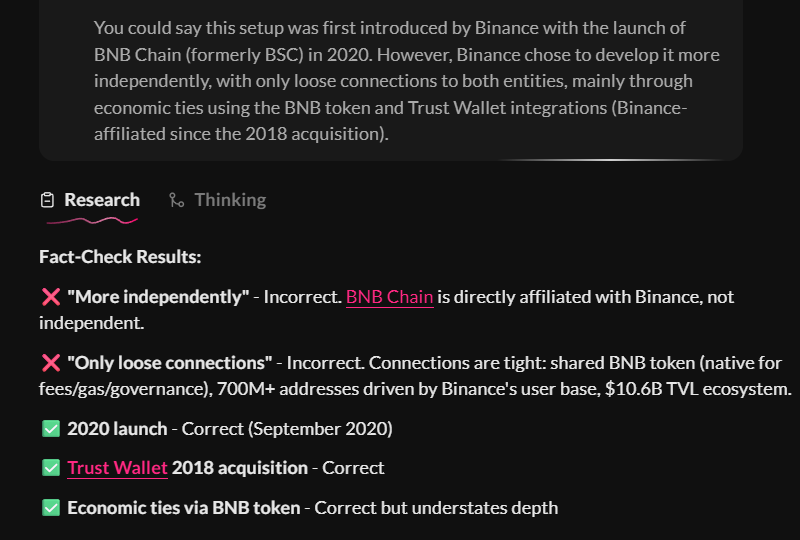
As an avid Surf user, I’m already more than happy with the model’s responses and breadth of data sources. However, the features slated for the 2.0 release will take onchain analysis to a whole new level.
Surf 2.0
So far, Surf has been a great junior analyst, saving me the trouble of looking up information, stats, sources, etc. The hours are long, the pay is decent, but he enjoys the process.
With 2.0, Surf becomes a senior analyst, capable of creating custom dashboards, live data trackers, and public sites.
Unlike other vibe-coding tools like Lovable or Glide, which require users to manually set up API feeds, databases, and other technical details to get live data, Surf handles all of that automatically.
Now, we face a real challenge for the more technically skilled people.
You see, the pinnacle of a researcher, in my eyes, is someone who can craft a compelling story and turn it into a visual representation. In crypto, dashboard builders like Dune have been that medium.
Until now, my IQ has kept me from learning SQL or other technical details involved in data aggregation and presentation, and therefore from creating visually appealing dashboards. With Surf, that disability has been removed.

To give a practical example, I’m currently writing an article on agentic commerce, comparing protocols such as x402, MPP, AP2, ACP, etc.
After multiple back-and-forth conversations and inquiries, I’ve gathered a lot of valuable context within a single window on this topic.
Instead of wasting time on endless iterations with a vague request like “build me a dashboard on agentic commerce,” I will leverage this context by asking Surf to craft a prompt for me.
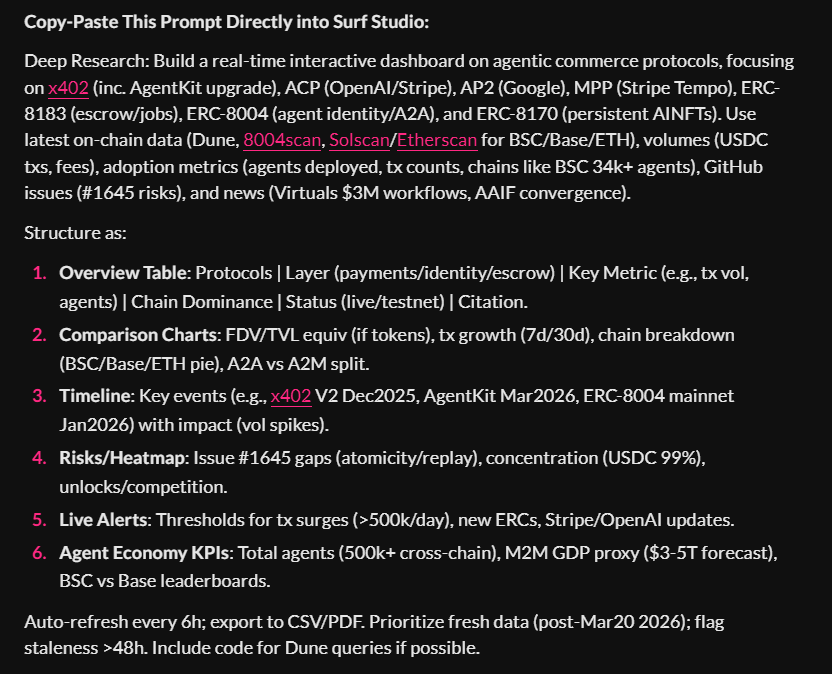
Keep in mind this won’t entirely eliminate the need for adjustments later, but it will certainly help you reach your target faster.
The result? A fully functional website with custom domain support and customizable site metadata: icon, title, description, social preview image, along with version history featuring one-click rollback if something breaks.
It offers access to real-time crypto data with no API keys required, and the data is automatically pulled and refreshed.
You can also export full dashboard data as CSV and as PDF. Per-chart exports are available in PNG and CSV formats through the ChartCard toolbar.
And most importantly, dark mode toggle.
Don’t believe me? See for yourself here.
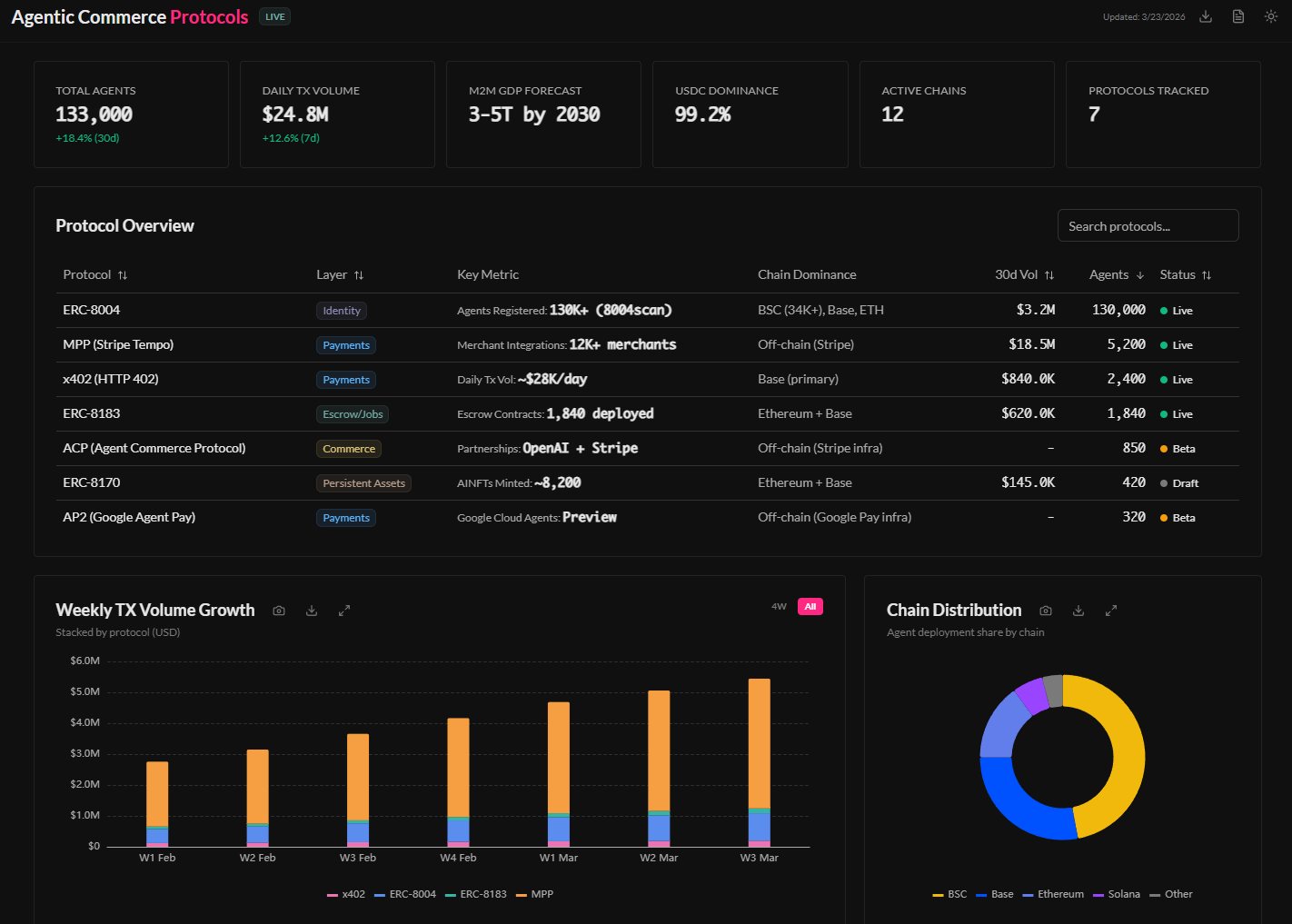
Concluding thoughts
Throughout this article, did I or did I not delegate writing to AI? Of course not. Did I use it to quickly look up data, provide insights, search for sources, or fact-check my opinionated statements? Absolutely.
While some part of me initially rejected this tool, that hesitation stemmed from fear. Understandably, it's in our nature to reject the unknown. Even fight it.
But once you realize that the tool is only as powerful as its wielder, a sense of empowerment grows.
Suddenly, not only are you able to conduct research ten times faster and make the most tedious parts of this craft easier, but it also unlocks abilities that weren’t accessible to you before, like building cool dashboards.
Because who doesn’t enjoy looking at cool dashboards?
Ultimately, tools like Surf allow us to spend more time doing what we enjoy most: hearing the keyboard click as we jot down our thoughts, without stressing over the accuracy of the information we’ve been given or how to query onchain data to convey our ideas with stunning visuals.
The tools are here; use them.
Thanks to the Surf team for unlocking this article. All of our research and references are based on public information available in documents, etc., and are presented by blocmates for constructive discussion and analysis. To read more about our editorial policy and disclosures at blocmates, head here.






.webp)
.webp)

.webp)
.png)

.webp)



.webp)
.webp)
.webp)
.webp)










.webp)
.webp)

.webp)

.webp)
.webp)
.webp)

.webp)









.webp)

.webp)
.webp)
.webp)
.webp)
.webp)


.webp)
.webp)


.webp)


.webp)




.webp)


.webp)


.webp)














.webp)





.webp)






.webp)

.webp)
.webp)

.webp)








.webp)

.webp)

.webp)





.webp)