The truth isn’t told anymore, it’s traded.
Despite how poor 2025 was for the crypto markets, there was one beacon of light amidst the darkness. That beacon was prediction markets.
Major prediction market platforms, such as Polymarket and Kalshi, recorded a cumulative volume of approximately $44 billion in 2025, with the platforms now consistently averaging over $1 billion in monthly volume.
User activity has grown from just a couple of hundred to a couple of thousand users in early 2024 to over 600k monthly users towards the end of 2025.
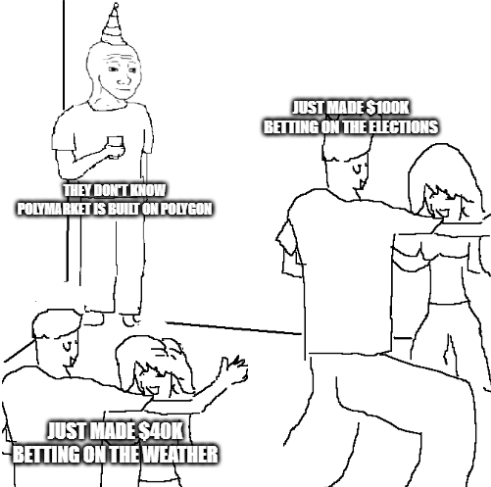
It’s one of the few crypto products that has gone mainstream without anyone even knowing that it utilizes crypto rails on the backend. Ask any average person who uses Polymarket if they have any idea what Polygon is, and I can guarantee that the majority don’t.
The market opportunity
Prediction markets are more than just a way to make money (making money is great btw, don’t get me wrong), they’re a source of truth.
It’s an open market that can coordinate distributed knowledge with price acting as the real indicator of what’s happening on the ground.
Blockchains have enabled this product to flourish globally with minimal friction, and the opportunity is now very clear.
The technology works, and there is an obvious product-market fit, signified by the extremely high demand for these products.
But there are some prevalent pain points with the current state of prediction markets:
1. Liquidity - Prediction markets offer a wide variety of markets. A market can be made for literally anything. However, the majority of the markets are very illiquid. Only popular markets, such as elections or sports, are liquid.
In any of the other, more niche markets, a mere $10k bet could swing the odds massively. A major pain point.
2. Capital efficiency - Users are required to lock funds until resolution, with most markets being long-term (for example, election results). That’s a lot of capital locked up for long periods of time.
Beyond this, returns are capped (0 to 1), and users can’t provide liquidity across multiple outcomes on most major platforms.
3. User experience - Most of the current major platforms keep 100% of the fees they charge, with no incentive structures to keep users beyond a single trade.
Even the smaller details like daily tasks, streaks, points, and ranks are absent, which can often act as great user retention tools.
4. Expert involvement - Prediction markets are meant to act as a raw signal of truth. However, due to the lack of liquidity, most experts with the most information on a particular market are exempt from participating by default.
That means the participants who would act as the best signal and source of insight are not involved, thereby making current prediction markets inefficient.
5. Market resolution - Resolutions take time and are often contentious, which means traders can’t frequently enter and exit a certain market to properly manage risk, even if the information they have indicates they’d be more profitable executing their trades in that manner.
With this in mind, we would like to introduce you to a new competitor in the prediction markets realm. A competitor that solves all these problems while sprinkling in some additional features to create the most complete prediction market platform out there.
Allow us to introduce you to Space, the leveraged prediction market.
What is Space?
Space is a prediction market platform built on Solana that allows you to trade real-world outcomes with leverage. Yes, you heard that right. You don’t need to keep sliding the leverage bar to the right on perps anymore; you might just have a better chance with Space.
Now I know what you’re thinking. “Seriously? Another prediction market, but this time with leverage?”
Just hear us out for a second. Yes, it is another prediction market, but the vision with Space is much bigger than being just another prediction market platform. It’s building a true scalable leverage infrastructure for any real-world outcome market.
Standout features
Let’s run through some of the features so you understand just how impressive Space is.
1. Leverage
Ah, good ol’ leverage.
Most of you reading this are probably familiar with the concept. It may have made some of you, and it may have hurt some of you, but nonetheless, it's hard to deny that leverage is a great tool.
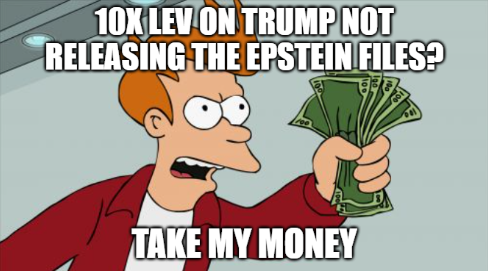
Space is one of the first onchain prediction markets to offer up to 10x leverage. It’s a great way to gain exposure to a specific market without needing to commit a significant amount of capital upfront.
Imagine the market: “Will ETH go above $10k in 2026?”
If you wanted to buy 1000 NO shares at $0.75, instead of paying $750 upfront, you could utilize 10x leverage and simply put $75 upfront.
But obviously, as is always the case, there’s a catch. The higher the leverage you use, the more likely you are to get liquidated (i.e., lose all collateral put up for the trade).
So, with 10x leverage, a small change in probabilities could put your position at risk. So trade accordingly.
The introduction of leverage is a great tool, specifically on Space, because it’s a continuous market.
Users can act more like traders with leverage serving as a great addition to the tools in their arsenal. This, in turn, will help manage risk better, trade across multiple markets, and hedge more effectively if needed.
2. Central limit orderbook (CLOB)
Space uses a CLOB for the different markets on the platform.
CLOBs are the same model used in traditional markets, as it’s the most efficient mechanism to match orders.
Since Space is built on the Solana blockchain, speed and latency will not be an issue. Order execution will be rapid. Most importantly, all transactions will be recorded onchain.
The CLOB is very simple. There is an order-matching engine that simply matches compatible buy orders with compatible sell orders to fulfil trades.
The liquidity for the books is made by makers (we’ll get to them in a bit).
Beyond the pricing efficiency and fast order execution benefits, CLOBs also allow Space to make the markets continuous.
Continuous markets mean that users can continuously trade in and out without needing to wait for expiry.
Traditionally, with prediction markets, a user buys shares and waits for the market to resolve, then receives payment (or loses).
It’s inefficient and sub-optimal. With Space’s continuous markets, users can enter and exit markets at any time, however often they want.
This allows prediction market users to go from bettors to traders. Users can manage positions, manage risk, lock in profits at any time, and cut losses if needed.
3. Dynamic fees
Another major differentiator for Space is its various incentivization features. One of them is the dynamic fee structure.
Usually, prediction markets have a standard fixed fee, like 0.5% (for example) attached to all orders, which is collected by the platform, and that’s that. While this is fine, it is far from optimal.
The dynamic fee feature is used by Space to:
- Align incentives across makers and takers
- Prevent market manipulation
- Reward early participation and conviction
- Reward makers for providing liquidity
- Incentivize long-term participation
This is how it works.
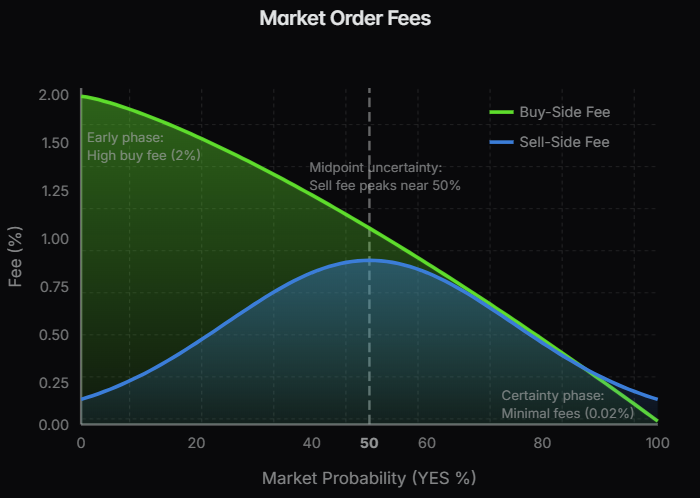
As you can see, the fees are based on certainty levels. When markets are at peak uncertainty, around the 50% mark, which is typically when it opens, there tends to be a lot of manipulation attempts and short-term trades, so the fees will be higher here.
Based on this, there are two different fee structures:
1. Buy fee - When buying with market orders, fees start high, especially during uncertain phases of the market, and start to decrease over time as the market probabilities become more certain.
2. Sell fee - On the sell side, if a user waits until the market is resolved, they pay no fee; if a user places limit orders (making them a maker), there’s no fee. The only time a fee is paid is when a user wants to close their position early. In that case, the same uncertainty-based fee applies.
As you can probably decipher, the general idea here is to incentivize long-term participation and being a maker, while manipulation through short-term trades is discouraged.
4. Multi-outcome markets
Prediction markets can theoretically cover any and everything under the sun. This means there are a lot of potential markets out there that don’t simply have binary YES/NO outcomes. It’s more multiple choice.
For example, “Who will win the 2026 FIFA World Cup?” You can’t have a YES/NO; instead, you have a choice between multiple countries.
Space’s multi-outcome market is different from others due to its shared conversion mechanism. Let’s continue with this example so you can understand better.
Each country in the World Cup will have its own binary YES/NO market, but behind the scenes, they are all connected as a shared liquidity pool of sorts.
So, for example, you initially buy 1000 NO shares for Portugal because you believe Ronaldo is washed.
This effectively means that you think any country other than Portugal has a chance of winning. So your 1000 NO shares can directly be converted into 1000 YES shares for any other country (Brazil, Argentina, England, USA etc.).
So now the tournament is ongoing, and your initial position might be true, Portugal won’t win, but it’s looking very likely that Brazil will win. You can immediately convert your 1000 NO Portugal to 1000 YES Brazil with no additional capital required.
But wait, things get even better because you can hedge across multiple outcomes.
Suppose Portugal is in the semi-final and you already know who the other finalist is (France, for example). Portugal is in the semi-final and losing to Brazil. What you can do is convert your 1000 NO Portugal into 500 YES Brazil and 500 YES France if you want to hedge your outcomes.
Space is truly the most capital-efficient platform available.
5. Retention and rewards
As mentioned earlier in the article, a big part of Space’s plans is to actively reward users and offer incentive programs to help retain more users than the current major prediction market platforms.
There are three main facets to this:
a) Liquidity rewards - Makers on Space are automatically eligible for liquidity rewards. The rewards are:
- Duration-based - The longer-dated markets will see makers receive higher rewards.
- Quality-based - Order at the balance price ($0.50) receive higher rewards, while limit orders placed at the edges ($0.05 or $0.95) receive minimal rewards. The liquidity should be more likely to be used.
- The size of the order relative to market depth also affects the rewards for makers.
b) Airdrop and points - Space will have multiple seasonal airdrops of SPACE to reward active users of the platform. The airdrop is based on points; the more points you accumulate, the larger the airdrop you receive.
Points can be earned in the following ways:
- Trading activity
- Providing limit-order liquidity
- Referrals
- Task completion in-app
- Daily logins and streak bonuses
- Community participation
- Engagement on socials
c) In-app tasks - Something that a lot of the major prediction platforms lack at the moment is a gamification element that acts as a user retention loop.
Space does this by implementing things like in-app tasks to complete daily, a points program for airdrops, unlocking different achievements based on user activity, which translates to rewards, ranks for users (competition and leaderboard element), and daily login streaks.
Small things like this play a massive role in ensuring that users keep coming back to the platform.
6. Pricing
Space employs a minting and burning mechanism to ensure fair pricing and deep liquidity.
How does that work?.
Well, most markets have two outcomes: “YES” and “NO”. Depending on the odds of the outcome, you can buy YES and NO shares. For example, if YES is priced at $0.40 (40% chance) and you buy $400 worth, you get 1,000 YES shares.
In Space, you can deposit 1 USDC to get (mint) 1 YES and 1 NO share. When you return (burn) the 1 YES and 1 NO share, you get that 1 USDC back.
Now, the concept of makers and takers comes into play.
A taker is someone who buys a share at the current market price through a market order. A maker is someone who places orders at different prices through limit orders, building liquidity depth in the orderbooks.
Let’s continue with the same “Will ETH go above $10K in 2026?” example.
The price of both YES and NO shares should always equate to $1. So YES might be priced at $0.25, and NO will be priced at $0.75. When the market is just created, the books are empty, so nobody can execute a trade. This is where makers step in.
On Space, anybody can be a maker. Say you want to step in as a maker. You deposit 100 USDC to receive 100 YES and 100 NO shares. You can now place limit orders to create depth in the books.
You place limit orders of “Sell NO shares at $0.80” and “Buy YES shares at $0.20”. This has now added liquidity to the books. Now other traders can buy your NO shares from you and sell you their YES shares, and vice versa. This is how the market ultimately finds a fair price.
Now is where the importance of the burn and mint comes in.
When you extrapolate this example and consider thousands of traders placing limit orders, it creates spreads that may result in a scenario where YES is priced at $0.30, and NO is priced at $0.75, totalling $1.05.
However, the combined price of the two shares must always equal $1. So, arbitrageurs can come in and simply buy both YES and NO shares, then redeem (or burn) them for 1 USDC, equivalent to 1 YES and 1 NO share, netting them a decent profit. This ultimately brings the price back to parity.
In addition, the burn and mint mechanism also ensures that traders are never “stuck” in a position.
It effectively allows you to become your own counterparty in a way. Let’s continue with the above example.
In a regular market, imagine you held NO shares on the “ETH above $10k in 2026” market. Trump goes into “money printer goes brrr” mode, and suddenly, your trades are not looking so hot. You want to exit, but nobody is buying them, leaving you stuck.
Space allows you to become your own counterparty as an emergency exit of sorts.
Say you have 1000 NO shares that you bought earlier at $0.75 that are now at $0.40. Now, with prices going against you and nobody willing to buy your shares, you can deposit $1000 to mint a new 1000 YES and 1000 NO shares.
You can then sell your 1000 NO shares at whatever market price is available, in this case, getting you back $400. Now, you still have the 1000 YES shares that you minted for $1000.
This effectively means that you have sold your NO position and converted it to a YES position completely by yourself for the cost of $600 ($1000 - $400 received for selling).
With Space, you will never be stuck. It’s capital efficient and fluid.
The SPACE token
The public sale for the SPACE token is currently ongoing and will end on January 16, 2026, at 23:59 UTC. The SPACE TGE will be the following week.
So why should you care about the token?
Well, if you’ve read this far into the article, chances are that you’re bullish on Space as a product. Well, the SPACE token is designed to give holders direct access to the platform's success through revenue share.
As the platform gets more volume, it earns more through fees. 50% of the fees collected are allocated to a buyback and burn mechanism, directly benefiting holders as the platform grows.
The other 50% is allocated to the treasury for purposes such as reward distribution, partnerships, ecosystem growth, and other related expenses.
Another thing to keep in mind is that the Space platform will also have specialized markets. These specialized markets will be exclusively accessible to SPACE holders/stakers.
In case you’re reading this late and have missed the TGE, don’t fear. All you have to do is get active and use the platform actively because there are plenty of rewards paid in SPACE tokens to come.
What’s coming up?
Beyond the TGE, there’s a lot more in the pipeline for Space.
Over the next 3-6 months, the competitions and seasons will begin. There will be platform-wide leaderboards and an airdrop season. Both will depend on the user's trading activity, and the rewards can take the form of an airdrop or other onchain incentives.
They also plan to introduce a battle royale-style market for special events. Those who join this event will all be focused on one market, featuring a chat/trollbox feature. One big topic of focus with active traders and spectators, giving it high social energy.
Beyond that, over the next 7 months, we’ll see the grander vision unfold. The vision is to become the leverage infrastructure layer for prediction markets.
The expectation is that, in the near future, all trades for prediction markets will either be routed through terminals/aggregators or via LLM/NLP interfaces.
Space will eventually offer a fixed leverage market for major events (example: US election), which can be embedded and traded via third-party platforms; you don’t have to go through Space’s platform.
On top of this, Space will continue to integrate with and partner with existing protocols further to improve the app's capabilities and user experience.
A great example is the recent partnership with Kamino, which allows users to earn yield on every prediction.
The end result is that with Space already having a successful leverage layer for prediction markets, it simply makes sense to embed Space as the underlying infrastructure and leverage that for user activity.
This ultimately acts as one of the biggest differentiators for Space.
Concluding thoughts
It’s clear that prediction markets are going to be a prevalent consumer-facing application in the near future.
Despite all the regulatory uncertainty, the demand to use these platforms has not slowed down. However, despite all the positives, we’re still in a glass-half-full scenario with prediction markets.
Yes, there is demand, yes, there is product-market fit, and yes, there is a massive opportunity. However, the current products in the market still fall short on several levels.
Space has noticed this gap in the market and has aggressively pushed to fill it. Over the next few months, as they continue to roll out their entire product, it will become increasingly clear that their leverage layer infrastructure will grow the prediction market pie.
They will benefit along with third-party platforms while offering users a more holistic trading experience.
So far, we’ve still been on the launchpad; the liftoff for Space is just beginning, and we believe it’s going to be a long and successful ride to the top.
Thanks to the Space team for unlocking this article. All of our research and references are based on public information available in documents, etc., and are presented by blocmates for constructive discussion and analysis. To read more about our editorial policy and disclosures at blocmates, head here.





.webp)
.webp)
.webp)
.png)
.webp)


.webp)
.webp)
.webp)
.webp)





.webp)
.webp)

.webp)
.webp)
.webp)

.webp)
.webp)




.webp)
.webp)
.webp)
.webp)
.webp)


.webp)
.webp)


.webp)


.webp)




.webp)


.webp)


.webp)













.webp)



.webp)





.webp)
.webp)
.webp)

.webp)






.webp)

.webp)

.webp)





.webp)