Reading time: 6m 50s
Ape-tizers:
- Kraken’s layer-2 network, Ink, has experienced explosive growth in recent months, with its TVL rising from $7 million in October 2025 to almost $450 million today
- By integrating Ink apps on Kraken, the exchange will effectively turn its 10 million CEX users into DeFi power users
- With the $INK token confirmed and airdrop points live for Nado and Tydro, the race is on to secure a piece of Kraken’s onchain future
Since launching back in December 2024, Ink has quietly amassed over $400 million in TVL, positioning it among the fastest-growing networks on the Optimism Superchain.
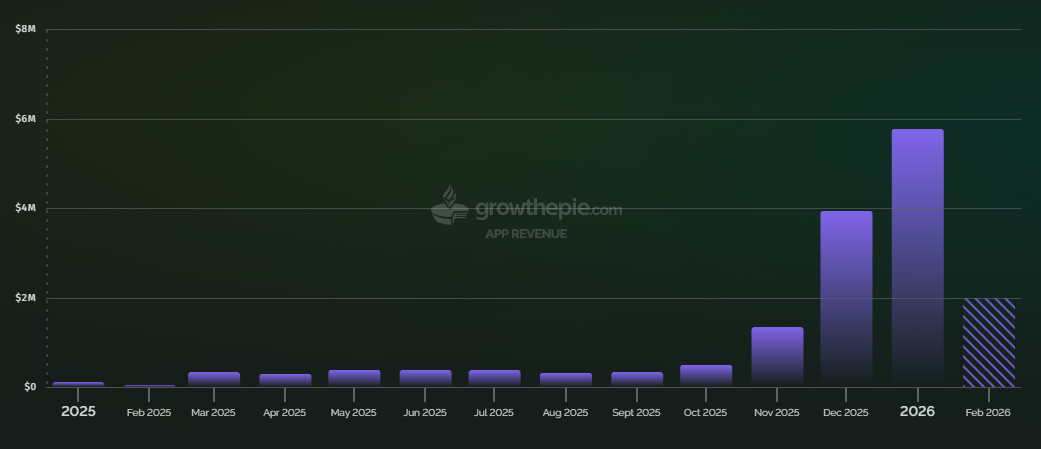
Key applications like Nado and Tydro, the official perp DEX and money market of Ink, have fueled a sharp rise in app revenue, growing from $500,000 last October to $5.77 million in January 2026.
As the exchange prepares to introduce DeFi to its 10+ million users and embrace the onchain world, we have the chance to play in the sandbox and potentially get rewarded for it.
If you want to stay ahead of the curve, that is, before all the airdrop farmoors come in hordes, I suggest you read on.
What is Ink?
Ink is an L2 blockchain created by Kraken, designed to connect its 10 million+ users to decentralized finance (DeFi) and provide easy access to DEXs, lending, and yield protocols.
Built on Optimism’s OP Stack, Ink features 200ms block times (thanks to the Fireblocks integration), with an average transaction fee below 1 cent, and connects seamlessly to the wider EVM ecosystem through unified token and interoperability standards.
Beyond stats and tech jargon, Ink serves as a strategic step toward Kraken’s vision of bringing the DeFi world closer to its wider consumer base.
I hear you say, “What do you mean by bringing DeFi closer? It’s right there on the internet, you moron!”
Hold up, let me explain.
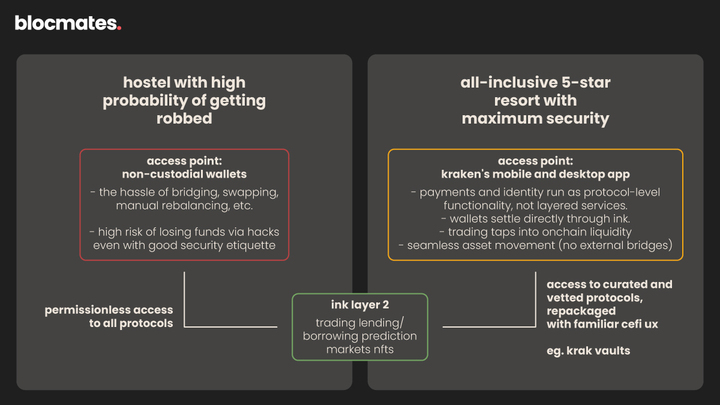
To understand Ink, imagine it as a database. While anyone in the world can read from and write to it, this database has two distinct APIs.
The first API is for crypto natives seeking permissionless access and boundless possibilities to trade products of all flavors, or, more realistically, to lose their life savings trading perps with obscene leverage.
Just load up Rabby with some ETH, and the world becomes your oyster.
The other group is for everyday people who don’t necessarily prioritize self-custody and, instead, find it more reassuring to have a reputable exchange hold their assets.
This API can only be accessed through Kraken and offers the reassurance that at least someone reviewed the protocol before you, showing only vetted and audited protocols.
Both APIs tap into the same database, just with different access points and frontends. And since the majority of users still use CEXs, it's only natural that Kraken is appealing to this crowd.
By now, your last remaining neurons are probably firing as you begin to realize this setup already exists out there in the wild.
The CEX + blockchain setup
Kraken's Ink joins a growing cohort of exchange-backed blockchains.
This setup was initially introduced by Binance with the launch of BNB Chain (formerly BSC) in September 2020.
Although pioneering, this model kept the exchange and onchain operations largely separate, leaving opportunities for closer product integration.
The exchange that perfected this setup is Coinbase with its L2, Base.
Today, Coinbase provides several products on its platform, powered by Base on the backend.
For example, it offers lending and Bitcoin-backed loans that leverage Morpho, as well as DEX trading supported by 1inch and 0x pools.
Closely following in Coinbase’s footsteps, in June 2025, Robinhood announced that it had begun developing its own Ethereum L2, using Arbitrum’s Orbit stack, specifically focusing on tokenized real-world assets (RWAs).
In fact, its public testnet was just rolled out a day back.
While Robinhood already offers nearly 2,000 tokenized assets on Arbitrum One, launching its own chain will enable the exchange to customize the network to its specific needs, providing greater control over its features and ecosystem growth.
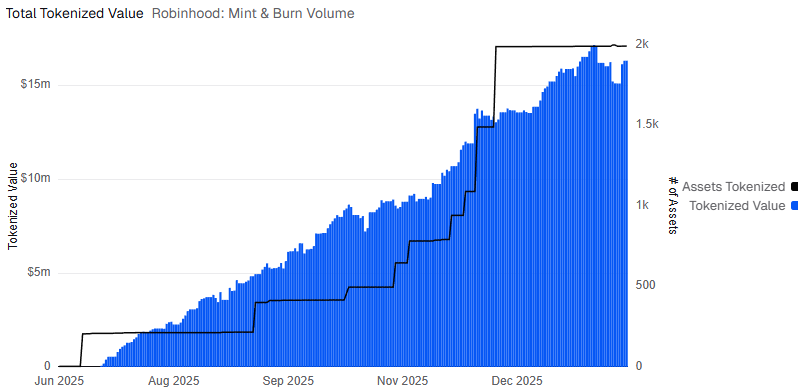
This leads us to the Kraken and Ink combination, which essentially has the same setup: a tier-1 exchange with its own Ethereum L2 serving as a core element to expand the exchange’s product offerings.
From a business perspective, it makes perfect sense since, as an operator of Ink's L2 sequencer, Kraken will capture sequencer fees from onchain activity, a model that generated Coinbase $75 million in revenue in 2025 from Base.
But before Ink comes close to that, genuine onchain activity must be kick-started.
The Kraken-Ink ecosystem
While still a young ecosystem, Ink features everything an onchain sleuth would want.
A quick glance at Defillama reveals several household names, including Velodrome, Curve, Jumper, Morpho, Securitize, and Uniswap.
But when looking at the activity, two protocols stand out.
The most used protocol on Ink is Nado, a central-limit orderbook (CLOB) DEX developed in-house by Kraken, with an annualized revenue of $48 million. The perp volume on the platform reached $17 billion in January.
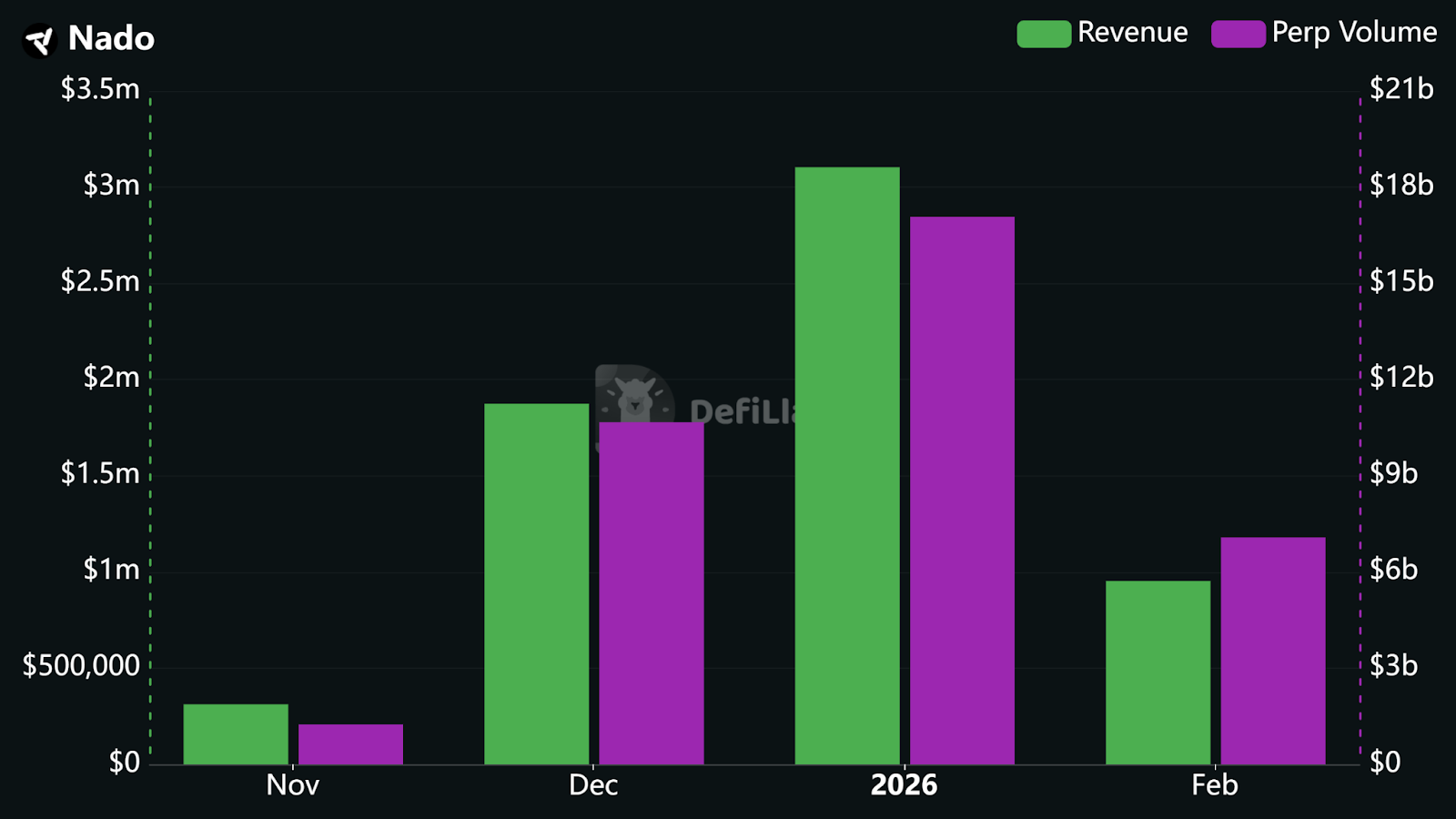
Considering Nado was in Private Alpha up until January 16, that’s quite impressive.
With the open Beta launched on January 30, we can expect these numbers to continue rising once the market turns around.
But there’s much more to the Nado story, so stay tuned for a deep dive into the protocol next month.
The chain’s leader in TVL is naturally a money market. Incubated by Kraken, Tydro is a white-label instance of Aave v3 that launched in October 2025.
In the first 24 hours after launch, Tydro amassed $124 million in deposits. Today, that number sits at roughly $380 million, with the top assets supplied: USDT0, ETH, and kBTC.
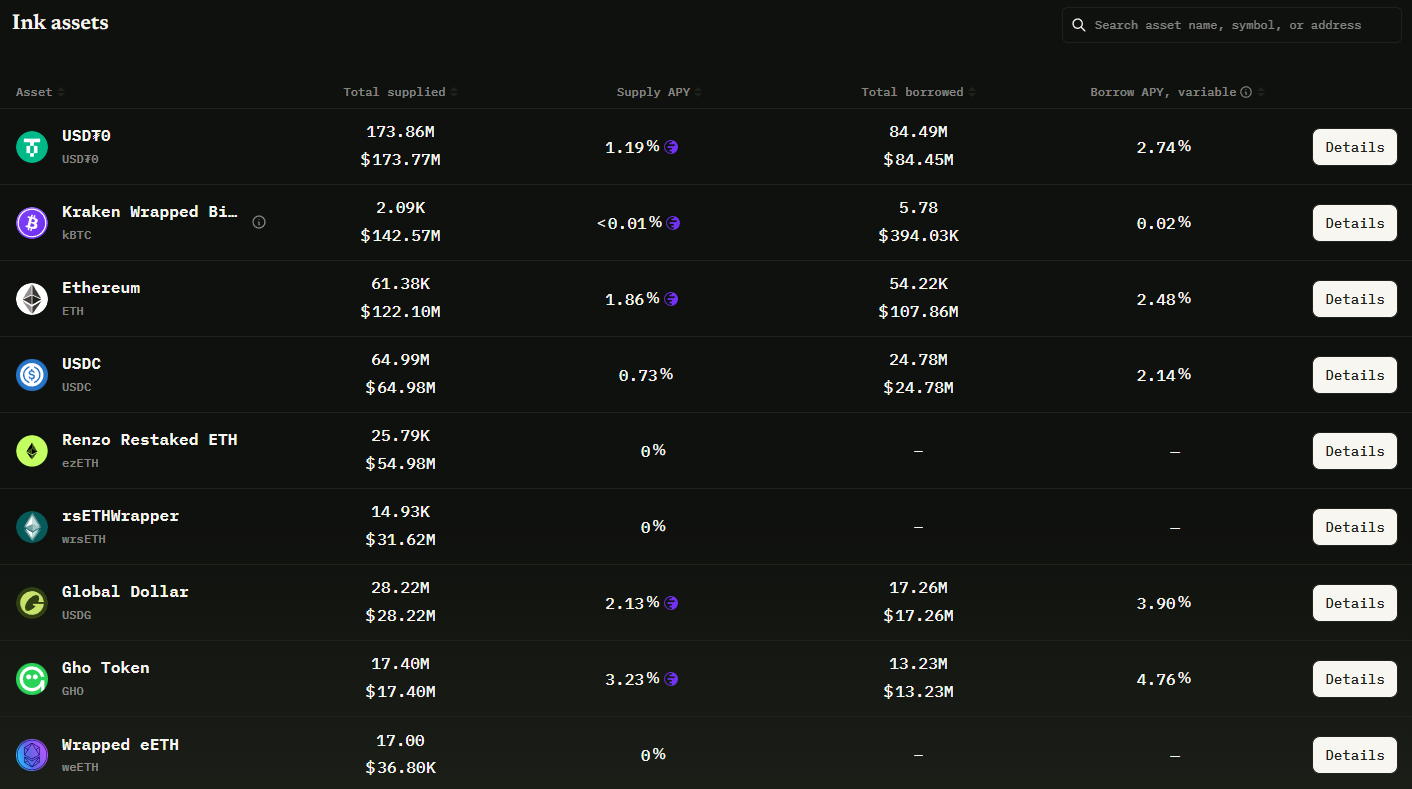
The goal with Tydro is to let other protocols integrate directly with its liquidity layer, tackling the chicken-and-egg problem new entrants face. Instead of each protocol having to fight over liquidity, Tydro will function as the tide that lifts all boats.
The third protocol worth keeping an eye out for is Rails, a hybrid perpetual trading platform that secured funding from Kraken last summer.
Where Nado’s target audience is DeFi-native power users seeking capital efficiency through unified margin, Rails focuses on institutional traders requiring CEX-grade execution and regulatory compliance while maintaining custody of funds.
Unlike Nado, Rails is registered with CIMA under both the VASP and SIBA regimes, and so, its users must complete KYC or KYB checks before they can start trading.
Since Phase 2 of their points program ended on February 1, the opportunity to earn points for the protocol’s governance token is now closed.
But since you’re here for another reason, it's still worth paying attention to, considering the protocol’s link to Kraken Ventures.
All in all, there are currently just a handful of projects live and kicking with any meaningful activity. But that’s a good thing. It means you’re here before the crowd.
In pursuit of $INK
Tokens as incentives work like magic in attracting users and developers. You might say that they’re just there to farm an airdrop. Sure, but it’s a mutually beneficial situation: farmers get an airdrop, Kraken gets the initial wave of test bunnies.
As of this article’s publication, only Nado and Tydro are confirmed to contribute to airdrop points. However, rumors suggest that additional methods to earn ze points may soon be available, including opportunities to acquire the token before the TGE.
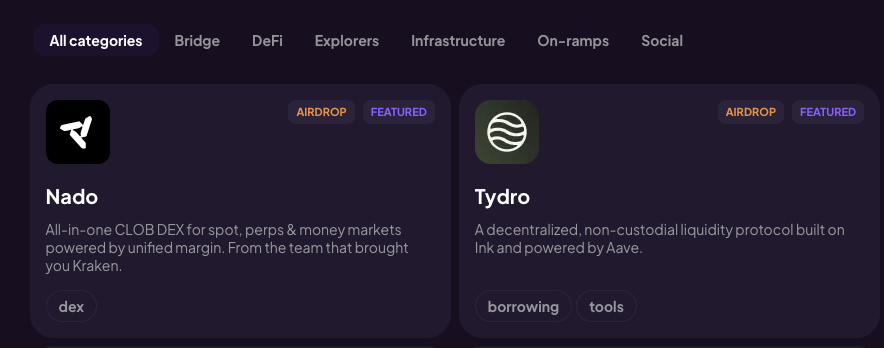
As a proud member of the shrimp gang, I believe Nado is our best chance to rack up points, since it’s relatively easy to accumulate volume if you’re actively trading.
If you’re not good at trading, use a tight stop-loss and show up every day. Who knows, you might get good at it. Spoiler: you won’t, but at least you’ll be accumulating points.
When it comes to Tydro, unless you have a huge size, it doesn’t make sense to deploy capital there. Whales will take the vast majority of the allocation, making the opportunity cost simply too high.
Then there are, of course, the less obvious options, such as minting an Ink Pass NFT, deploying smart contracts or NFTs, and participating in Kraken token launches.
Also, keeping a close eye on Kraken Ventures' investments could prove to be valuable, as I believe they will eventually go on a spending spree, acquiring and incubating projects to drive more activity on Ink.
And you can be sure they’ll support their own horses, both through social backing and through $INK allocation.
Road ahead
In a landscape filled with undifferentiated L2s, creating another generic EVM chain might appear unwise. However, for centralized exchanges like Kraken, this approach is entirely logical.
Kraken already has 10 million verified customers who trust the exchange with billions in assets, and navigate KYC/compliance without friction.
And so, Ink doesn't need to invent new cryptography or consensus mechanisms. It just needs to convert that latent demand into onchain activity.
Coinbase proved the effectiveness of this model with Base, generating $75 million in sequencer revenue through 2025 (roughly 60% of all L2 revenue), keeping users coming back and even enticing new ones to join.
Kraken follows this playbook: collect fees from every transaction in a growing DeFi ecosystem, diversify income beyond volatile trading volumes, and own the entire value chain from fiat onboarding to onchain settlement.
Add the Krak Card to the mix with upcoming yield products, crypto/stablecoin, transfers, salary deposits, and you’ve built an ecosystem that users never need to leave.
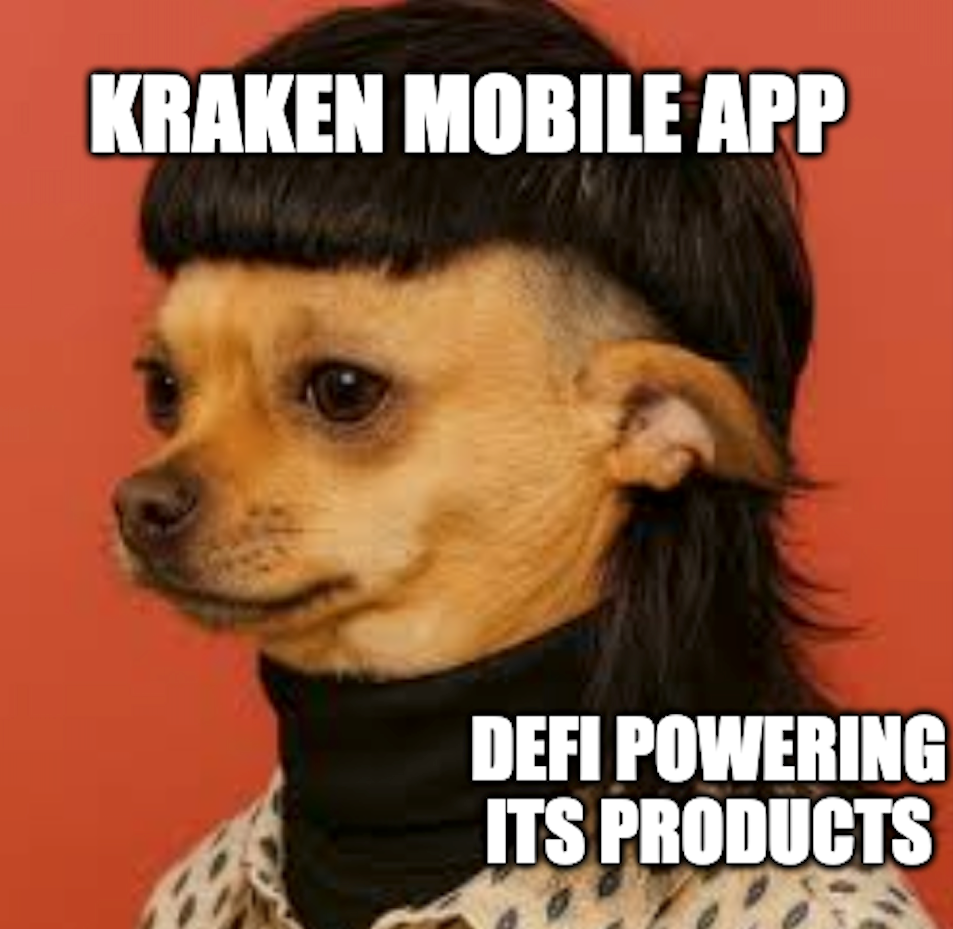
Some call it the DeFi mullet strategy. Personally, I think neo-finance is a term Kraken will find more appealing.
But no matter what you call it, Kraken is moving onchain, and we get to test the products before they reach consumers. Hopefully, by the end, we’ll get something in return.
Thanks to the Ink team for unlocking this article. All of our research and references are based on public information available in documents, etc., and are presented by blocmates for constructive discussion and analysis. To read more about our editorial policy and disclosures at blocmates, head here.






.webp)
.webp)
.webp)
.png)
.webp)


.webp)
.webp)
.webp)
.webp)









.webp)
.webp)

.webp)
.webp)
.webp)

.webp)
.webp)







.webp)
.webp)
.webp)
.webp)
.webp)
.webp)


.webp)
.webp)


.webp)


.webp)




.webp)


.webp)


.webp)











.webp)




.webp)




.webp)
.webp)
.webp)

.webp)






.webp)
.webp)
.webp)





.webp)