
Reading time: 4m 8s
In a market that has been filled with nothing other than doom and despair, Hyperliquid has been the only beacon of light, giving an otherwise exhausted crypto audience a sliver of hope.

Bitcoin continues to tank, ETH continues to go down, and Tom Lee’s blood pressure keeps rising, while the onchain alts are nothing but an extractive wasteland filled with scammers trying to draw blood from a stone.
Despite all of this, HYPE continues to print one green candle after another. This begs the question: what’s going on with Hyperliquid that has made it essentially the only investable alt in the market?
Well, today, we’ll break that down for you.
Why is HYPE so strong?
Well, let’s start with the basics.
Despite the market being, for lack of a better way to put it, absolutely dogshit, Hyperliquid continues to see strong usage.
Over the last two months, Hyperliquid has done $370 billion in cumulative volume and seen over 112k new users join the platform in the same period of time.
Hyperliquid has proven that an onchain exchange can operate with the same efficiency as a CEX, even under high volume. It has been stress-tested numerous times and has survived, giving users sufficient confidence that it is here to stay.
But beyond the basics, there are two updates that are propelling Hyperliquid to the next level. That’s HIP-3 and the newly released HIP-4.
HIP-3: Builder-deployed perpetuals
HIP-3 marked a huge step forward for Hyperliquid as it was an early sign of how Hyperliquid was going to be more than just a “CEX but onchain.”
It showed that Hyperliquid is actually an infrastructure layer that can be built upon to eventually become the house of all open finance.
The main outcome from HIP-3 is that it enabled anyone to permissionlessly create a perpetuals market on Hyperliquid.
This opened a huge golden door with boatloads of capital pressing against it. We’re talking $45 billion+ type of capital.
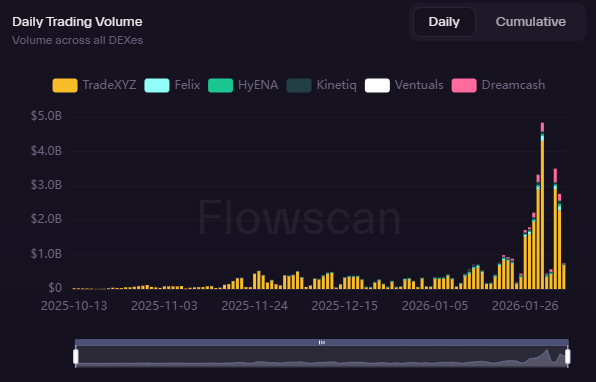
But why?
Well, because all of a sudden, you have assets like stocks, indices, foreign exchange markets, commodities, and so on readily available to trade on Hyperliquid.
Just about a week ago, amid the metals market frenzy, traders could trade perps on Hyperliquid for gold, silver, and copper.
On one of the days, metals accounted for a cumulative $1.7 billion in 24h trading volume on Hyperliquid, with Silver accounting for $1.2 billion of that.
In comparison, ETFs tracking silver saw the highest trading day ever, with $25 billion in volume.
Yes, the gap may seem big, but when you take into account that Hyperliquid is a novel onchain exchange that’s only been live for around 3 years, compared to the mature, well-developed TradFi infrastructure, the gap really ain’t that big.
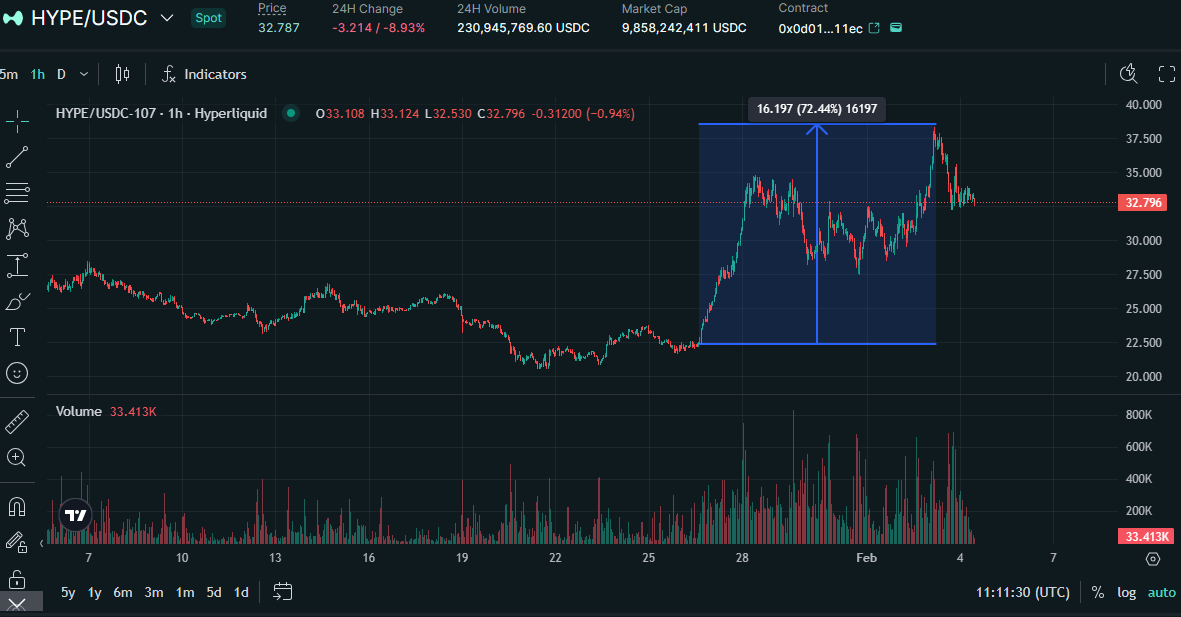
This saw HYPE’s price jump 72% in about 3-4 days.
HIP-4: Outcome trading

What we’ve seen over the past few weeks is just stage one of Hyperliquid becoming the house of all open finance.
On February 2, news about HIP-4 hit the timeline.
So what does this HIP entail?
The crux of it is that it allows binary outcome markets to be traded on Hyperliquid.
The translation here is that Hyperliquid has already proved its infrastructure can comfortably support any type of perps trading, it’s now time to take the next leap.
The support for outcome markets means you will now see things like prediction markets and options become a reality on Hyperliquid.
The two biggest prediction markets at the moment, Polymarket and Kalshi, recorded cumulative monthly volumes of $10 billion in November, $12 billion in December, and $18 billion in January.
Let’s look at options. The volume done on options markets just on BTC and ETH is pretty insane. $192.5 billion cumulative volume in November, $117.6 billion in December, and $112.9 billion in January.
Mind you, this is just BTC and ETH. The other crypto assets haven't been included, and we haven’t even begun looking at the TradFi numbers.
Now it’s time for all the HYPE holders to start licking their lips because there are comparisons to be made and numbers to be run.
If Hyperliquid can capture 4%-5% of the volume of TradFi ETFs on an asset like metals, just imagine the market share it will steal with more crypto-adjacent instruments like prediction markets and options.
Even if you take the more conservative estimate and say Hyperliquid probably captures 30%-50% of the volume that these current platforms generate, the amount of revenue being generated is still staggering.
If my toilet paper math is correct, based on comparisons with January numbers, Hyperliquid could generate $1.5-$3 million in monthly revenue through prediction markets and an additional $11-$15 million through options.
Don't quote me on this - very rough, handwavy math.
This is just the conservative side.
But wait, there’s another aspect of HIP-4 worth noting.
The unique position Hyperliquid is in is that these products are being launched into an ecosystem of active builders who can build upon these applications.
Things like DeFi strategies, structured products, and so on can be easily built and implemented directly on top of Hyperliquid’s infrastructure to offer a user experience that no centralized counterparty has.
Binance, Deribit, or Polymarket are not composable and open, which limits their product offerings. With Hyperliquid, the possibilities are endless.
So now, take all of this into account and just try to extrapolate how much additional revenue Hyperliquid will generate and how much more will be injected back into HYPE.
Bottom line
As we said at the start, in a sea of blood and dead bodies, Hyperliquid is the one Phoenix rising from the ashes.
HIP-4 only further confirms that this Phoenix will likely continue to rise as it stays in its own lane, building products and taking the industry forward.
The only question is, will it continue its ascendence alone, or will a couple of others be pulled along for the ride?









.webp)

.webp)

.webp)

.png)



.webp)



.webp)
.webp)

.webp)
.webp)




















.webp)

.webp)


.webp)





.webp)
.webp)





.webp)

.webp)



























.webp)

.webp)
.webp)

.webp)
.webp)
.webp)


.webp)
.webp)


.webp)


.webp)





.webp)


.webp)



.webp)






















.webp)







.webp)















.webp)

.webp)
.webp)

.webp)














.webp)

.webp)


.webp)







.webp)