
Staking pools are a crucial component of Solana’s infrastructure, ensuring the network remains sufficiently decentralized and therefore resilient to consensus attacks.
Stake pools are just another term for liquid staking protocols. Any user who holds SOL can pool their assets into a stake pool. This protocol then delegates the SOL across a diverse group of validators (The more diverse, the better for the network).
The validators earn a yield in the form of block rewards for validating the blockchain, and the stake pool receives a portion of those rewards for the delegated SOL that was contributed.
The user who deposits SOL into these stake pools receives a liquid staking token. It’s a receipt token representing their deposit into the pool.
Each protocol has a different token, and these tokens are liquid and tradable across DeFi and other onchain sectors.
The essence of Solana staking pools
So why are we talking about stake pools towards the end of 2025? This is not something particularly new.
Well, each stake pool has a distinct delegation strategy to set it apart from the competition. As more people get burned in the trenches and opt for a more conservative approach to building their portfolio, we thought it would be beneficial to review all the available options and their respective strategies.
Based on this information, you should be able to formulate your own staking strategy for your longer-term SOL bags.
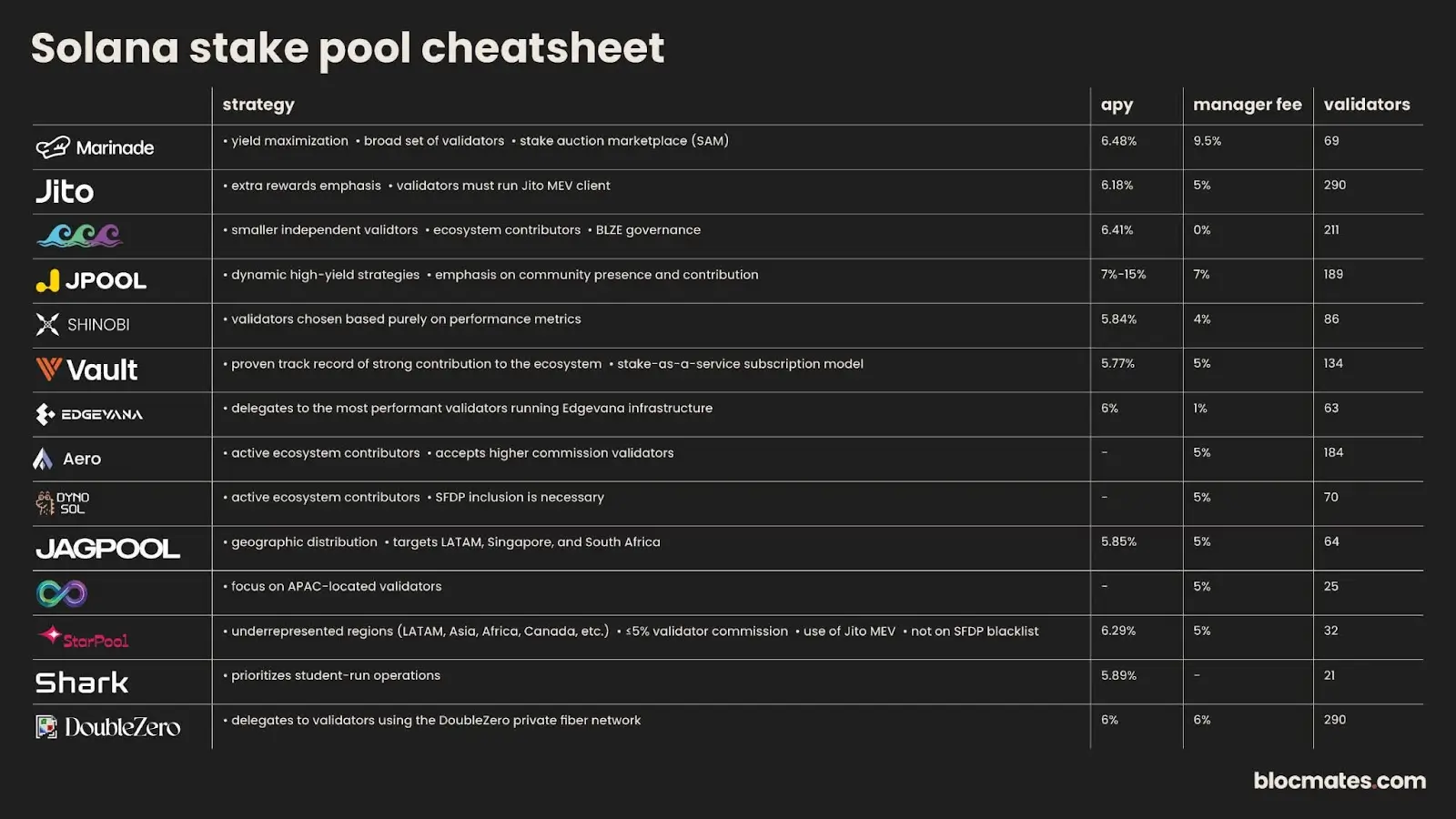
Top Solana staking pools
1. Marinade
@MarinadeFinance was the first liquid staking protocol on Solana. With a TVL of $1.47 billion (at the time of writing), an APY of 6.48%, and stake spread across a broad range of active validators, it’s one of the top dogs in the space.
Marinade offers staking strategies for all types of users. If you’re simply seeking the highest yield possible, you can use the “Max Yield” strategy. If you’re looking for something a little safer, you can use “Marinade Select,” which delegates your SOL to a set of validators with verified identities curated by Marinade.
Its key innovation is the Stake Auction Marketplace (SAM), where validators can bid for stake. Validators can offer services such as sharing revenue on proprietary fees or MEV strategies that may not have been otherwise accessible to the average user.
2. Jito
@jito_sol is currently the biggest player amongst the Solana stake pools. With a TVL of $2.05 billion (at the time of writing), a 6.18% APY, and the largest diversification of delegation across active validators, Jito firmly commands pole position.
Jito’s strategy is all about “extra rewards” and maximizing efficiency for stakers. They do this by delegating to validators that are running the Jito MEV client with the lowest commissions. Staking rewards combined with MEV rewards.
3. SolBlaze
@solblaze_org is a popular staking pool with a TVL of roughly $164 million (at the time of writing).
SolBlaze takes a slightly different approach with its delegation strategy. The general idea is to distribute the stake across a wider set of (smaller) validators to help with decentralization, but not sacrifice APY or security at the same time.
To do this, SolBlaze has an automated system that finds the right balance between high-staking rewards, high-scoring validators, and smaller validators. Based on that, the delegations are made.
Eventually, SolBlaze will enable BLZE holders to vote on a delegation strategy while continuing to expand the validators delegated to as the staking pool grows.
SolBlaze also aims to set up a program that makes it easy for new validators to get bootstrapped, furthering the network's decentralization. And, bSOL holders will also be eligible for certain airdrops within the Solana ecosystem, which further boosts rewards.
4. JPool
@JPoolSolana has a TVL of $179 million (at the time of writing) but offers varying APY, anywhere from 7% to 15%, depending on the strategy chosen.
As you can see, even at the lower end of the spectrum, JPool offers really high APY. This is because their entire delegation strategy is centered around high yields and community-centric validator selection.
JPool uses an algorithm to smartly delegate to only the top-performing nodes on Solana. Interestingly enough, JPool’s delegation strategy also takes into account the validators’ community presence and contributions.
JPool offers classic liquid staking, high-yield staking, leveraged staking, as well as direct staking (you choose the validators): maximum optionality and really high returns.
5. Shinobi Performance Pool
@xShinPerfPool has a TVL of $149 million (at the time of writing) and currently offers a 5.84% APY.
As the name suggests, Shinobi’s delegation strategy is purely performance-based. There is no preferential treatment based on status, commissions, or payments of any kind.
The protocol constantly looks at metrics such as latency, consensus vote success, uptime, block skip rate, and other such performance metrics.
Those who consistently rank the highest on these metrics over multiple epochs based on verifiable onchain analysis are included in Shinobi’s delegation strategy.
This way, it doesn’t matter if the validator is newer or more established. It is purely performance-driven, making it a fair yet well-distributed strategy.
6. The Vault
@thevaultfinance currently has a TVL of $227.5 million with over 8k vSOL holders.
The Vault is a “validator first” stake pool, and this is made very evident with their delegation strategy. The Vault pools support validators that are strong contributors and good stewards of the Solana ecosystem.
Not only do they always support smaller validators, but they also require their validators to have some form of proven track record of helping the Solana ecosystem with things like tooling and community work.
The Vault also introduces a Stake-as-a-Service model where their validators can utilize undirected stake by agreeing to a 25% revenue share subscription with The Vault stake pool.
7. Edgevana Liquid Staking
@edgevana has a TVL of $117 million with edgeSOL holders earning a 6% APY.
Edgevana is a little different from the other players in the Solana stake pool sector as it’s an infrastructure provider.
It’s a bare metal provider for Solana validators, and to be eligible for delegation from the stake pool, validators have to be using Edgevana’s infrastructure.
Beyond this, Edgevana has a complex algorithm to determine who of the eligible validators receive the stake. At a high level, the algorithm looks at the following metrics:
- Performance and reliability
- Reputability
- Commission adjusted voting
- MEV rewards
- Decentralization
8. AeroPool
@AeroPool_ has a TVL of $151 million and is a growing contender within this sector.
AeroPool’s delegation strategy is centred around ecosystem contributors. Those who support and actively contribute to the Solana ecosystem, especially smaller validators, are favoured for delegation.
Beyond this, the criterion is also a little more lax, with validators charging a higher commission. Most stake pools tend to omit these from delegation strategies, but AeroPool widens its validator base by including them.
9. DynoSOL
@DynoSolPool is a newer entrant into this market.
Its delegation strategy is centered around more subjective metrics like ecosystem contributions, as most other auto-delegate models prioritize raw stake, uptime, and vote credits.
DynoSOL contributes based on metrics like open-source tooling, community contributions, and educational work.
It also takes into account the SVD scoring of a validator. The SVD is basically the validator stake growth over time. There is also a hard requirement to be part of the Solana Foundation Delegation Program (SFDP)
The philosophy is to back validators that aren’t just validating blocks, but also actively contributing to pushing the network/ecosystem forward.
10. Jagpool
@JagPool_xyz has a TVL of $105 million and offers a 5.85% APY.
JagPool takes a slightly different approach and focuses on geographic decentralization. JagPool delegates to validators based in Latin America, Singapore, or South Africa.
The requirements to be eligible for delegation from JagPool include a strong presence in the region, SFDP inclusion or over 40k SOL staked, and active public profiles.
Validators are penalized/not included for malicious MEV, long downtime, and commission spikes.
11. Definity Staked SOL
@RealDefinity is another rising contender in this space.
Their strategy, somewhat like JagPool, is to focus on regional decentralization, specifically in the Asia–Pacific region.
The strategy chooses validators in this region based on pure performance metrics like skip rate, credit score, and MEV.
The general philosophy here is to play a role in further decentralizing Solana’s stake.
12. StarPool
@starpoolglobal is another player whose focus is to delegate stake to underrepresented regions to further the decentralization and strength of the Solana network.
StarPool delegates to validators across Latin America, Asia, Africa, Canada, and beyond. Within these regions, there are some stricter core requirements to be included in the strategy. These include:
- A validator commissions that’s ≤5%
- Use of Jito MEV
- Staying clear of the SFDP blacklist
- Total stake between 50k-250k SOL
13. SharkPool
@SharkPoolSol has by far the most unique approach. Amassing a TVL of $28.8 million at the time of writing, the focus here is very much on supporting the next generation.
SharkPool delegates stake to validators run by US and Canadian universities. The idea here is to combine funding with training to promote student-run operations and campus teams.
This not only promotes decentralization by supporting smaller validators, but it also ensures student teams are increasingly involved in the Solana ecosystem and will continue to help it grow into the future.
14. DoubleZero Delegation Program
@doublezero is currently the second-largest stake pool protocol by TVL, with an impressive $1.84 billion locked within its ecosystem.
As some of you know, DoubleZero is a bit different from the other competitors as it runs its own private fibre network infrastructure.
So, in terms of delegation strategy, DoubleZero delegates to validators that utilize this private fibre network, helping grow both DoubleZero as well as Solana staking participation.
Concluding thoughts on Solana staking pools
The Solana network is only going to continue to grow. Per DeFillama, the TVL across all Solana stake pools is roughly $10.1 billion.
Compare that to Ethereum’s $44.6 billion. There’s a lot of room for growth, not to mention the fact that the general growth of the crypto industry as a whole will only make the pie bigger.
Therefore, we put together this little cheatsheet for you (scroll up) so you can decide the optimal staking strategy that aligns with your beliefs and risk tolerance to steadily grow your SOL stack while also contributing to the Solana network's decentralization and security.
On a sidenote, we recently launched a validator on the Solana mainnet, in partnership with our good friends at @firstset_.
If you believe in what we’re building - from educational content to high-quality validation and everything else in between - consider delegating your SOL to the blocmates validator. You can do it from your wallet of choice.
It’s the best way to support our Solana coverage and help us show the wider crypto space what community-first validation looks like.
Stake with blocmates, secure Solana, and let’s keep building together.





.webp)

.webp)

.webp)

.png)



.webp)



.webp)
.webp)
.webp)
.webp)















.webp)

.webp)


.webp)





.webp)
.webp)



.webp)

.webp)






















.webp)

.webp)
.webp)
.webp)
.webp)

.webp)
.webp)
.webp)


.webp)
.webp)


.webp)


.webp)




.webp)


.webp)


.webp)






















.webp)







.webp)












.webp)

.webp)
.webp)

.webp)













.webp)

.webp)


.webp)






.webp)