Reading time: 6m 11s
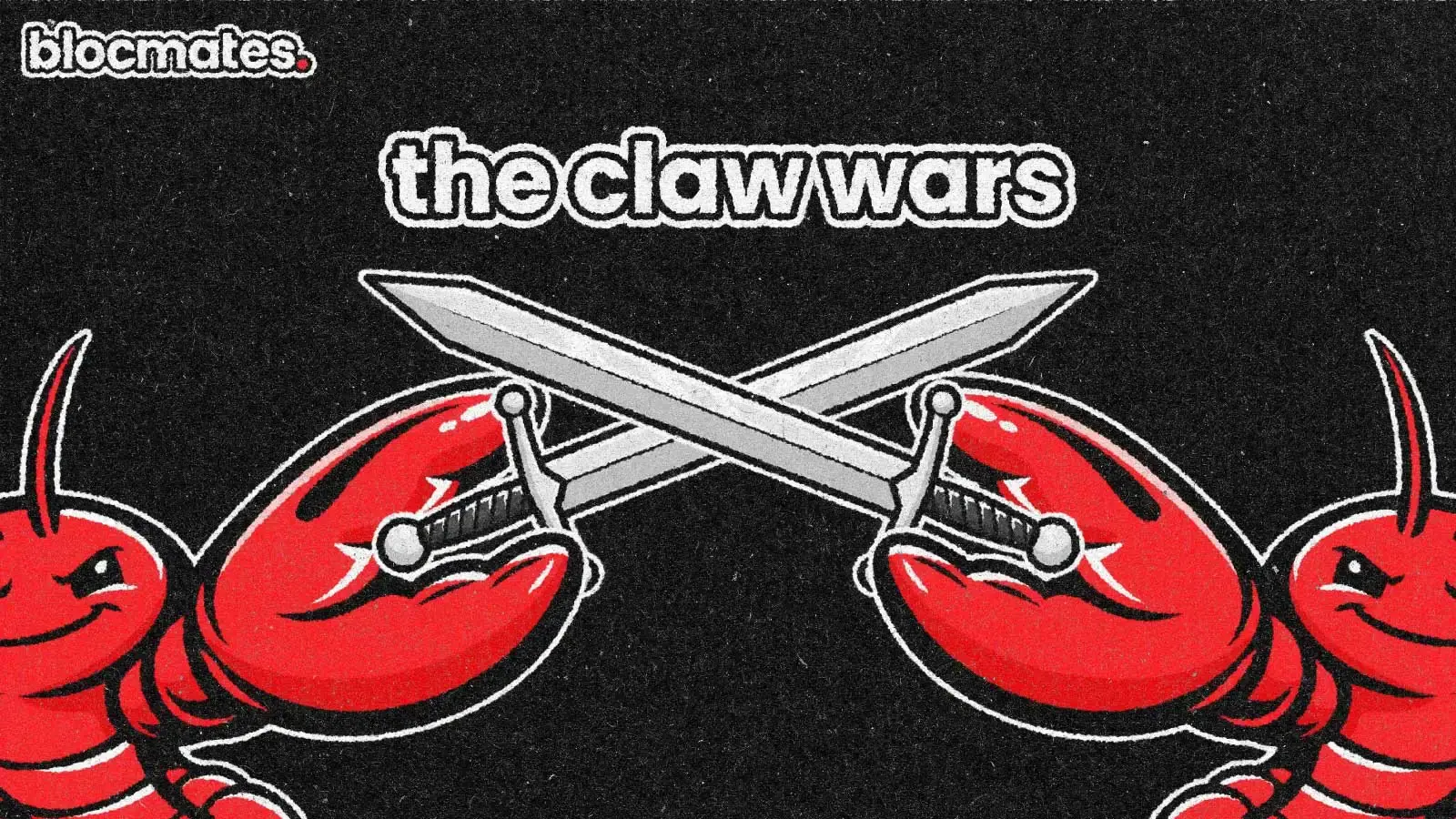
OpenClaw has quickly taken the world by storm and now has an interesting developer-led subculture forming around it. With 430,000 lines of code as the battleground, let’s take a look at ‘The Claw Wars.’
What is OpenClaw
For those of you who have been living under a rock, OpenClaw is an agent that connects all the popular AI models like Claude, GPT, DeepSeek, and so on to your local files and connects them to apps like emails, Slack, Discord, Telegram, WhatsApp, etc., enabling anyone to create agents to automate daily tasks.
The “agents are now my employees” discourse you’ve been seeing stems from OpenClaw.
It’s basically a server software that passes information between external software and an AI model of choice through external code called “skills.”
Recently, the founder of OpenClaw, Peter Steinberger, joined OpenAI to focus on the growth of personal agents. Despite this, Sam Altman said that OpenClaw will continue to function as an open-source protocol supported by OpenAI.
The roots of the Claw Wars
Despite it being a viral sensation, OpenClaw is riddled with problems, as highlighted by users, developers, and security researchers alike.
So, what problems started this little subculture?
Security concerns
OpenClaw is an incredibly big system.
50+ modules, 400k+ lines of code, 8 config management files, and 45+ dependencies.
In layman's terms, for those who don’t speak computer, that’s basically a lot of surface area. It is very hard to audit such a large system, and it also means there’s a lot of surface area for potential attack vectors.
As a user who is unable to audit the code being used, there is no way to feel safe running it on your computer. An attack could happen from any number of points at any time, and there would be nothing you could do about it.
Additionally, OpenClaw has near-unlimited permissions on the host machine. This essentially means it has access to everything and can perform any sort of task with that access.
The possibility of an agent running wild on a device or being hacked/manipulated to go rogue on a host device is simply too great a risk for anyone and everyone.
Unless you’re very technically savvy, running OpenClaw on your device is a MAJOR risk.
Hardware costs
Hardware costs also pose a significant barrier to entry.
There’s a requirement to have a Mac mini or equivalent server for OpenClaw to run smoothly, which is simply not feasible for most people.
Given the security implications, many people will have to buy a separate device just to run this, which makes it even less feasible.
There’s even the alternative of running it on a VPS. But that’s really difficult to set up.
For it to reach true scale, the hardware requirements might need to be reduced.
Production readiness
Despite the virality, there are still a lot of potential use cases that OpenClaw isn’t technically built for.
Since it’s a single-machine assistant, it's not suitable for enterprise-level solutions or multi-tenant use.
This effectively leaves out a massive potential user base from the platform.
With this as the backdrop, let’s dive into the subculture being formed around OpenClaw.
Projects in the Claw Wars
1. NanoClaw
Created by Gavriel Cohen, NanoClaw is a security-first rewrite of OpenClaw.
Turning 430k lines of code into just 500 lines, the main focus of NanoClaw was to make a version that doesn’t give an AI agent unrestricted access to everything on your machine, opening it up to a whole host of potential vulnerabilities/attacks.
NanoClaw runs every agent inside isolated Linux containers, so it only has access to folders that you (the creator of the agent) explicitly allow it to.
It’s WhatsApp-first, but other channels can be added easily.
The product is already in use by the creator in his company, Qwibit, for the sales pipeline. The agent is called ‘Andy’ in case you were interested.
2. PicoClaw
PicoClaw was built with the idea of speed and cost-efficiency.
It’s created by the hardware company Sipeed and written in Go. It allows users to run agents on a $10 RISC-V with less than 10MB of RAM.
It boots in less than a second and supports all major channels like Discord and Telegram, with 95% of the code actually being written by AI itself.
It’s already proven to be a great success with 5k+ GitHub stars in just a couple of days.
3. MimiClaw
MimiClaw can be thought of as OpenClaw running on a $5 microcontroller.
It is designed to be an ESP23-S3 board and needs just 10 MB of spare RAM. It’s a lightweight assistant that’s written in C and is 99% smaller than OpenClaw in terms of code.
It acts as a gateway between channels like Telegram and the Claude LLM.
4. MiniClaw
MiniClaw is a lightweight AI agent infrastructure designed for smaller models while still offering enterprise-grade features.
It’s a production-oriented version of OpenClaw and features things like a web dashboard, plugin system, sandboxing, and monitoring.
5. Mini-Claw
Yes, you’re reading that right, there are two “minis” with a hyphen to differentiate them.
Mini-Claw is a telegram bot that connects with your existing Claude Pro/Max or ChatGPT Plus subscriptions for your agents.
The idea here is to take away API costs and remove technical headaches, as no separate keys are needed.
6. ZeroClaw
Created by ZeroClaw Labs and built using Rust, ZeroClaw takes a security-first approach.
It boots near instantly and requires less than 5 MB of RAM. It can operate on hardware like RISC-V, ARM, and ESP23, among others.
It supports more than 22 AI models and has a bunch of security-first features that help set it apart:
- Localhost-only binding
- One-time pairing codes
- Filesystem sandboxing
- Import existing OpenClaw memory with a single command
7. ZeptoClaw
ZeptoClaw is an ultra-lightweight AI agent framework written in 5MB of Rust.
It’s superfast and requires only 6MB of RAM. The main focus of ZeptoClaw is multi-tenant deployments for production.
8. TinyClaw
Created by Jian Liao and having already amassed well over 1.3k GitHub stars, TinyClaw is essentially OpenClaw in 400 lines of Shell script.
It supports multiple agents that can be addressed by name across a wide variety of channels and models. It can be installed with two lines, and you’re live.
One of the cooler features of TinyClaw, as pointed out by the creator, is that it is self-healing. In the event of an issue, it fixes and restarts itself. There was one agent that ran for 3 days straight without any human intervention for maintenance.
9. Kimi Claw
This is an agent that will live in the browser on Kimi and be available for use 24/7.
It has:
- Access to ClawHub
- 40GB cloud storage
- Pro-grade search to fetch data directly from Yahoo Finance
- The Claw can be connected to Kimi.com or bridged to other apps like Telegram
10. Supermemory
Supermemeory is a context engine for LLMs. The general premise is to add a layer where LLMs or agents have memory, so they retain the user's context and iterate based on it for a better experience.
OpenClaw, in itself, has a major memory issue for the agents built on it. This ultimately hampers it from giving users the optimal experience when using agents for all their tasks.
Supermemory offers an OpenClaw plugin so your agents made with OpenClaw also have context and memory to constantly adapt, evolve, and be more catered to your preferences.
11. Larry Skill
Larry Skill is an agent built using OpenClaw solely for marketing purposes.
It can do things like write viral captions, create TikTok slideshows, post to TikTok as drafts, write X articles, learn from performance, and give you business feedback. It’s basically a one-man (or should I say agent) marketing team.
The Larry Skill is available for everyone to use and iterate upon, so don’t be surprised if your favourite project is soon Larry-fied.
The Claw Wars
Mind you, this is just the beginning.
It’s been less than a month since OpenClaw has really been the talk of the town, and you’re already starting to see it become the baseplate for a whole suite of agentic applications.
Could it be a fad that dies by next month? Potentially. But when you see such strong developer activity organically built around something, you simply must have your head turned and pay attention.
We’ll certainly be keeping tabs on things, and we’ve also possibly missed a couple.
So be sure to tell us which ones we missed and then answer the ever-looming question. Who comes out on top in the Claw Wars?
NOTE: This technology is still very nascent and not battle-tested at all. Using OpenClaw or any of its derivatives or associated tools comes with major risks. So if you have no idea what you’re doing, be careful. Always make sure you’re doing things on a separate device and NOT your personal machine. STAY SAFE.






.webp)

.webp)

.webp)
.png)



.webp)



.webp)
.webp)
.webp)
.webp)












.webp)

.webp)


.webp)


.webp)
.webp)
.webp)

.webp)

















.webp)
.webp)
.webp)

.webp)
.webp)
.webp)


.webp)
.webp)


.webp)


.webp)




.webp)


.webp)


.webp)





















.webp)







.webp)














.webp)

.webp)
.webp)

.webp)














.webp)

.webp)


.webp)







.webp)