Derivatives have, without a doubt, been one of the biggest metas this cycle.
The platforms that operate in this space attract everyone from skilled traders who want to place bets with leverage, to investors looking to hedge their positions, and big-brained fundamentalists who look for protocols that can be valued based on metrics such as revenue, fees, and total value locked.
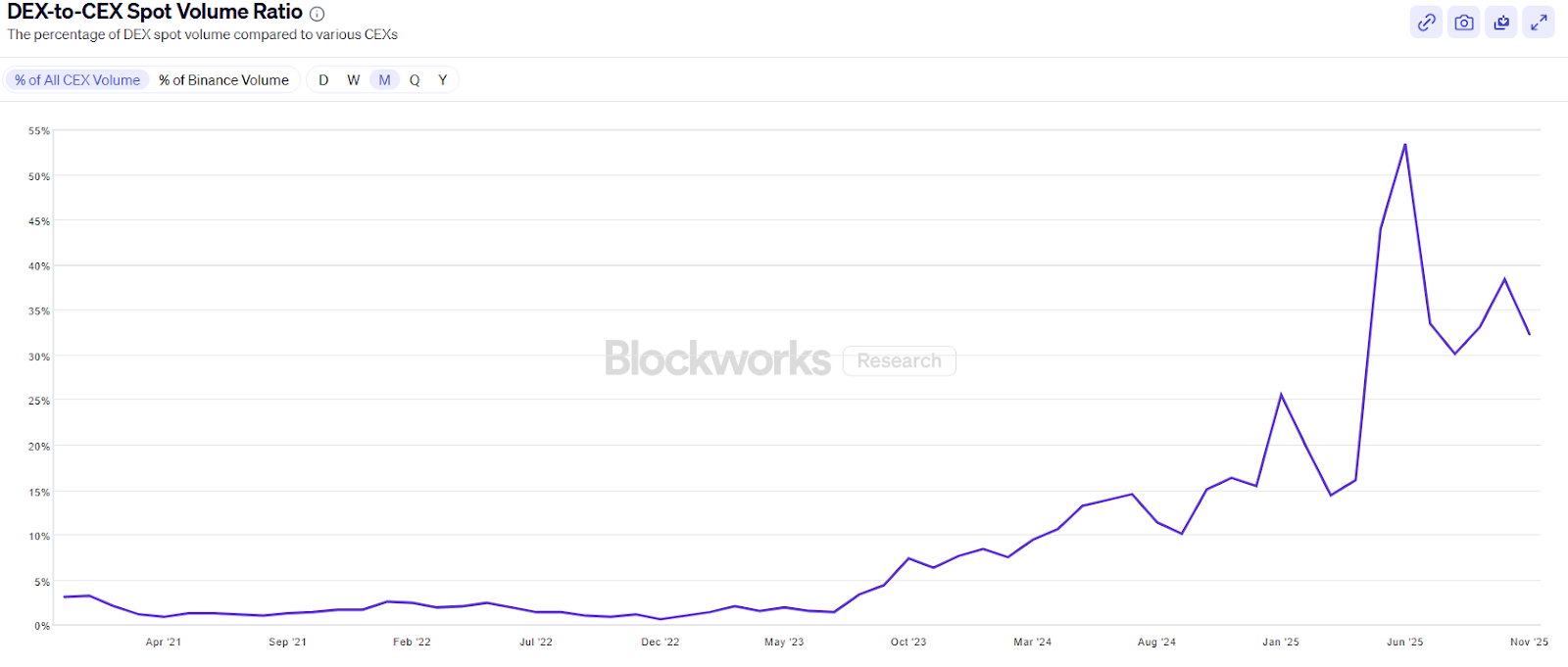
Of late, DeFi derivatives have been gaining some serious product market fit. They’re slowly eating away the market share of the big boys, as can be seen in the DEX:CEX ratio chart.
When we look closer at what makes a decentralized trading platform stand out from its peers, there are really only a few factors that matter.
Execution speed, liquidity, self-custody, low fees, professional yet intuitive UI, a strong security architecture, and a mobile application are paramount for attracting professionals and the masses alike.
Today, we have an interesting project on our radar that stands out - edgeX.
A quick TLDR: edgeX is quietly redefining what’s possible in the derivatives space. Its mobile-first approach helps users open a trade in seconds and manage their positions on the go.
The platform’s liquidity depth makes it suitable for both retail and institutional traders. Plus, by expanding into stock and prediction markets, this platform intends to evolve into an all-in-one trading app.
What is edgeX?
At its core, edgeX is a high-speed, low-fee, self-custodial, central-limit orderbook (CLOB), decentralized perpetuals exchange that took to the chain back in November 2024 with its first version rollout.
Its launch featured both a web app and a mobile application, something that set it apart from its competition from the very get-go.
In the time since then, it has climbed its way up to becoming a major player in the world of onchain perps trading and currently boasts the highest revenue generation of any pre-TGE perp DEX in the market.
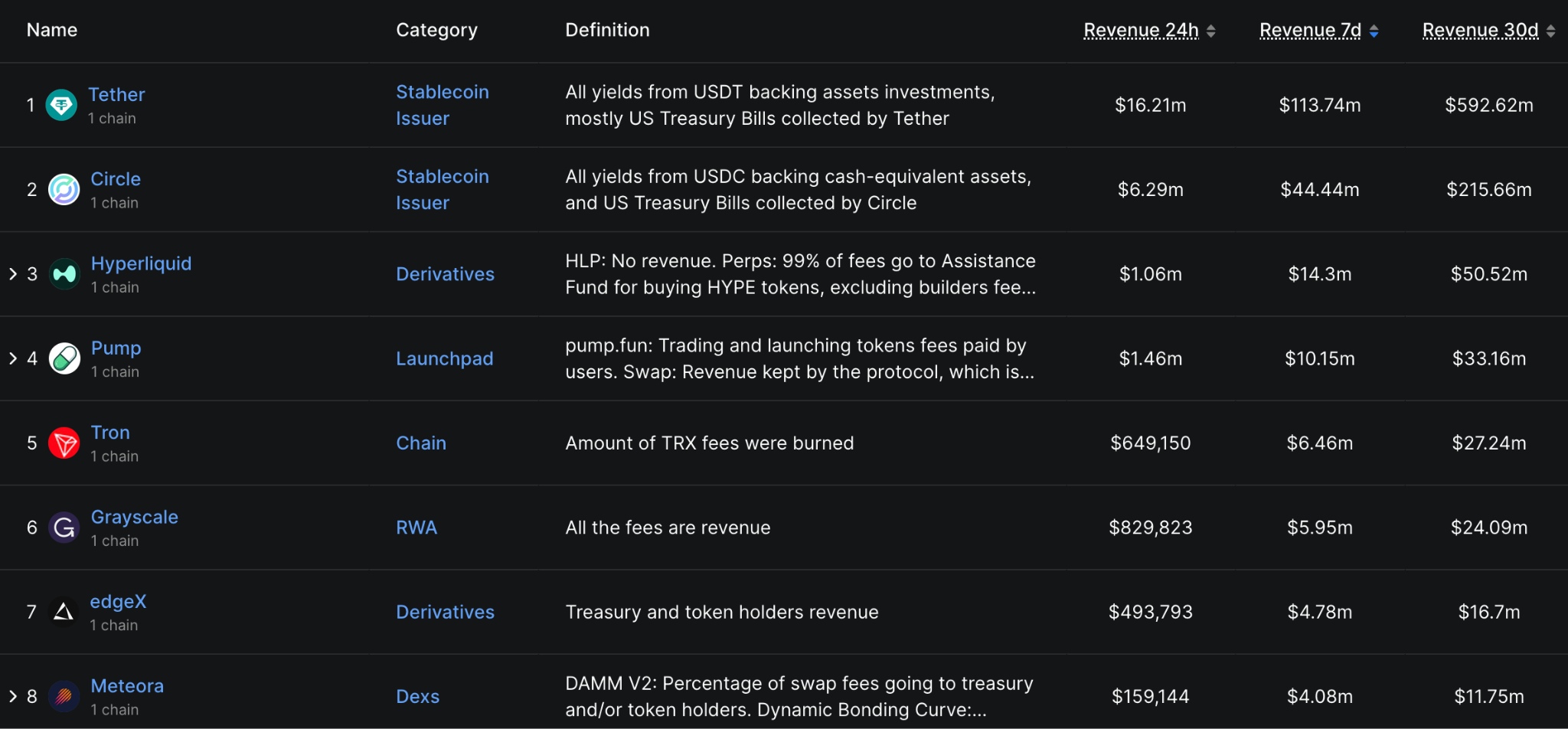
Latest data from DefiLlama points that edgeX has catapulted up the 30-day revenue scales and is currently sitting comfortably in the top-10.
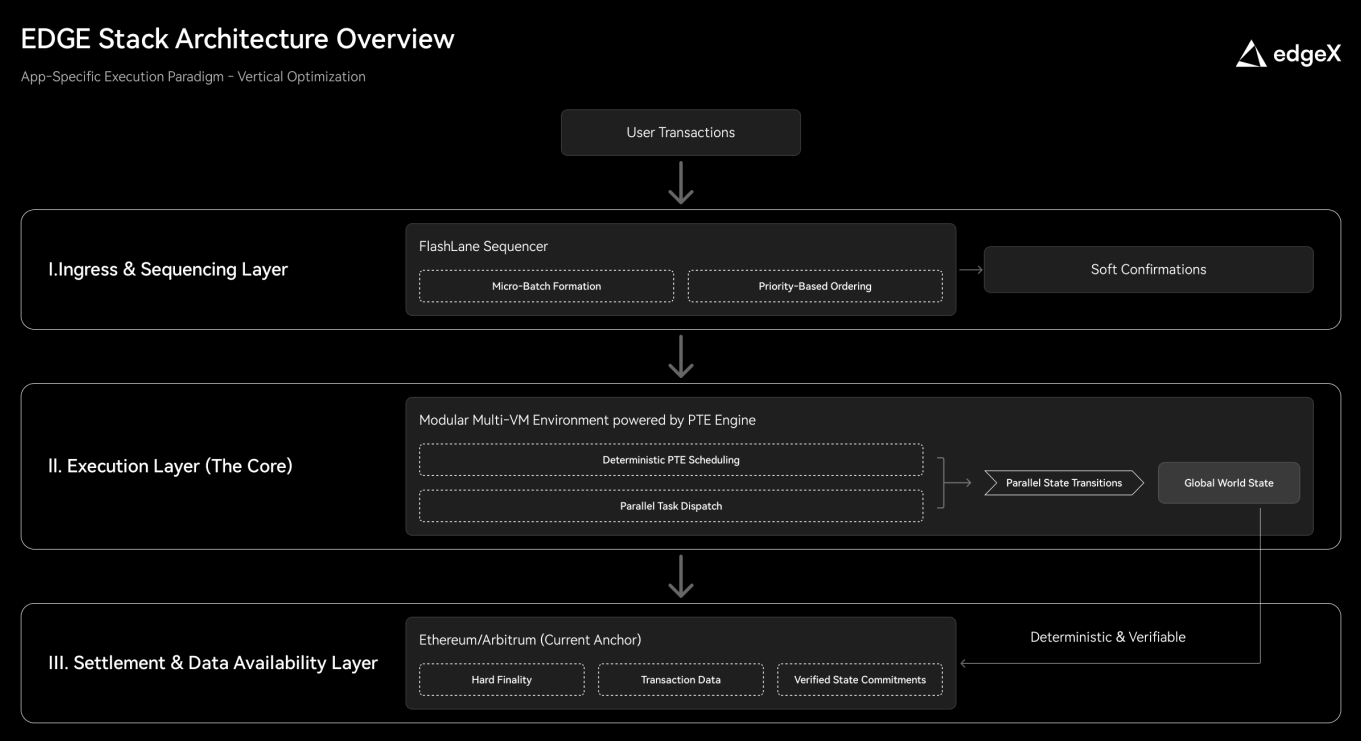
edgeX version 1 is an app-specific, zero-knowledge (ZK) rollup platform built on Ethereum; its soon-to-be-released V2 platform boasts an underlying design architecture known as the EDGE stack.
The EDGE stack has been built out fresh from the execution layer itself and features a modular multi-Virtual Machine (VM) design with Deterministic Parallel Transaction Execution (PTE).
This design allows edgeX to provide an incredibly low-latency, deeply liquid trading experience to its users.
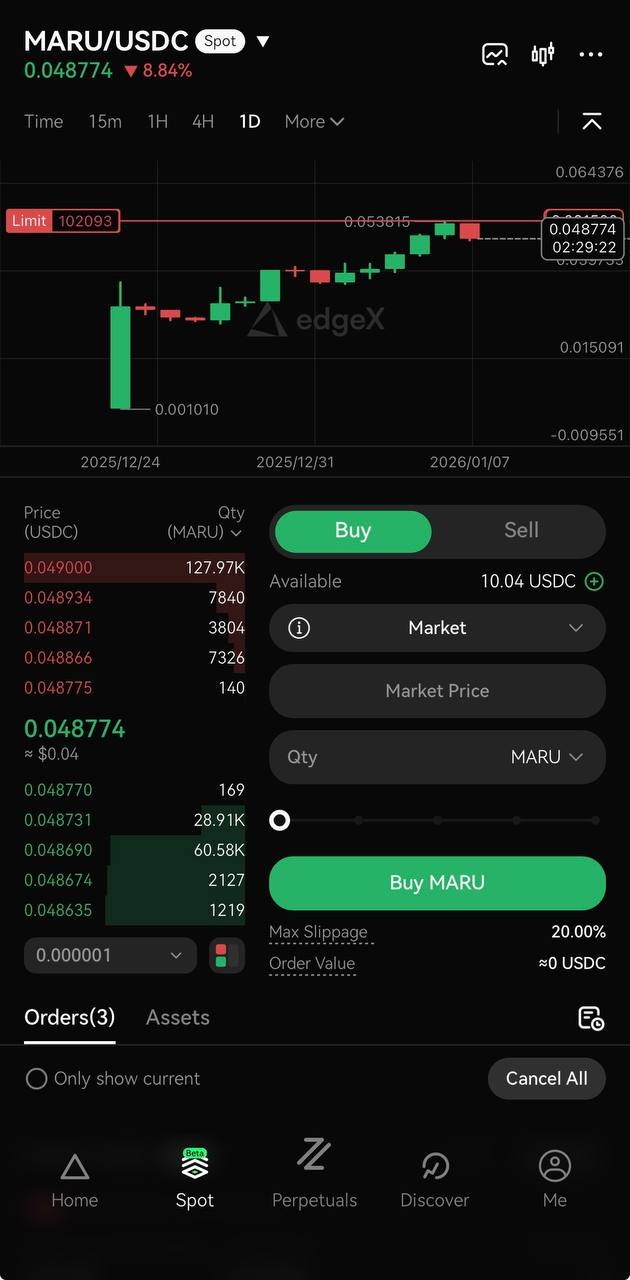
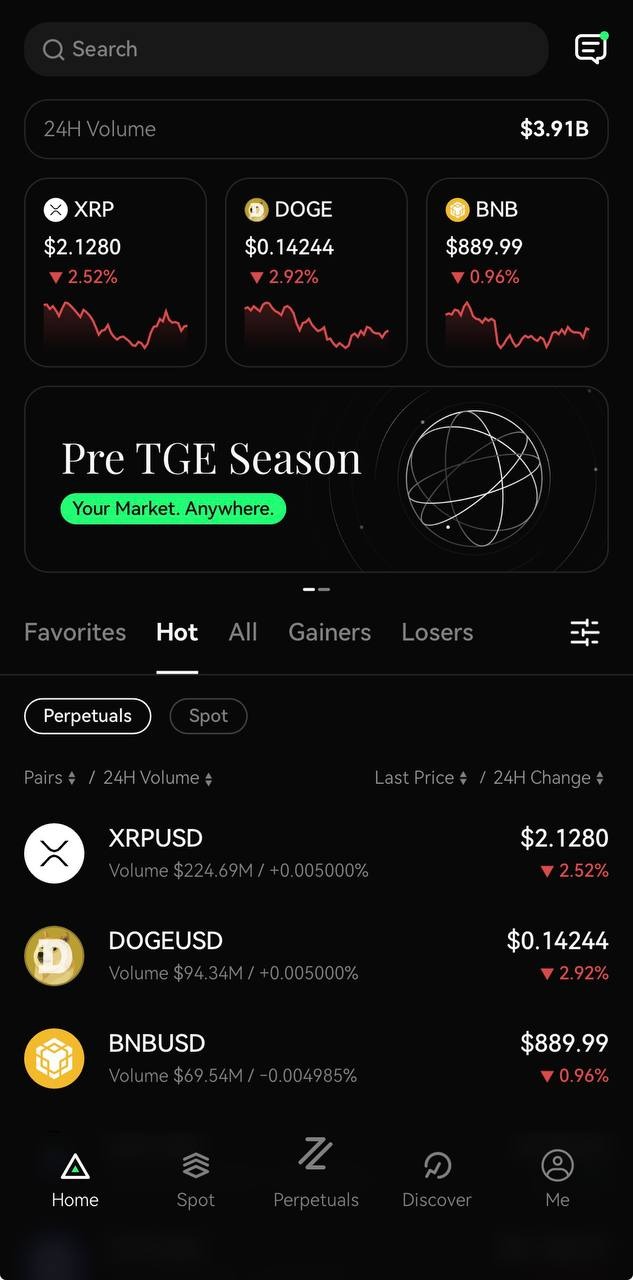
The team at edgeX has done an excellent job of developing not only an impressive web application but has also led the way by focusing heavily on making their platform mobile-friendly.
Their mobile application has already grown to be the number one used app of its kind in Japan and number two on the same rankings in Korea, where it also holds the number one spot by volume traded.
A major reason for edgeX’s rapid ascent is its trader-first focus.
The team members themselves are long-time derivatives traders and builders who operate on the sole guiding principle of “build something traders want to use.”
edgeX’s edge
It’s no secret that the perps space is a highly competitive sector, and edgeX has made some major moves to differentiate itself from the rest of the pack.
Mobile application
The design of their mobile application is nothing short of exceptional and is clearly aimed towards active traders who need access to the markets on the go.
The metrics in Asia clearly reflect the success of this approach.
As mentioned earlier, the edgeX mobile app is the number 1 of its kind in Japan and is quickly climbing the ranks in Korea, where it sits at number 2, with the most volume of any perp DEX application on the market.
The goal of edgeX’s mobile application is to make leveraged perp trading as accessible as slinging AI stocks and options on Robinhood.
You will literally be able to trade perps anywhere, in the subway, your local coffee shop, or on the toilet in your office while you're supposed to be working for the man.
Liquidity
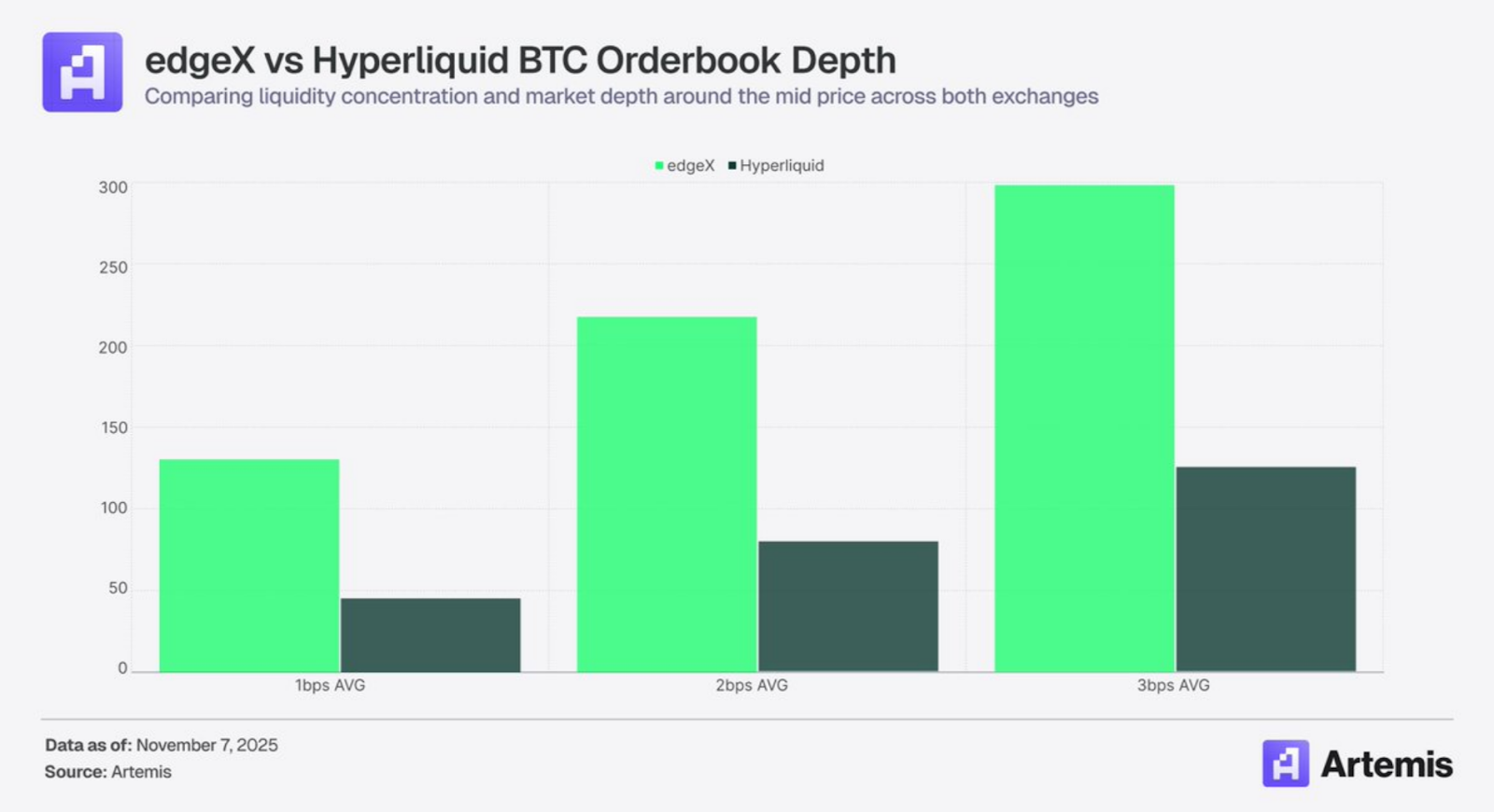
One of the most important factors that separates edgeX from the rest of its competition is its seriously deep liquidity.
This depth of liquidity means superior execution for its users and is one of the core elements that make edgeX the go-to venue for both retail traders and whales.
As can be seen in the image below, edgeX shows consistent BTC orderbook depth across 1bps, 2bps, and 3bps bands that leave Hyperliquid in the dust.
Polymarket partnership
In late November, edgeX announced its partnership with prediction market giant Polymarket and will soon bring prediction markets to its mobile application.
The scale of this announcement cannot be overstated, as the popularity of Polymarket is skyrocketing. Its addition to the edgeX platform will be a huge growth driver for the protocol.
Community focus
Being the trader-centric platform that edgeX is, they have really made a solid effort to build a community around their protocol.
edgeX sponsors a number of live trading competitions in Korea that have rapidly gone viral in the online trading community.
A recent “trading-as-esport” event in NYC, hosted by edgeX core team member Rui, saw more than 200 people in attendance.
The edgeX team has a future vision where trading becomes a spectator sport, and the traders themselves become the professional athletes who are idolized by so many today.
edgeX also recently wrapped up its 27-week-long “Open Season” points program, which distributed a total of more than 7 million points to users who contributed to the growth of the platform over the 27-week period.
Over 13,000 addresses received points in the last week alone.
Number talk
The metrics surrounding edgeX speak for themselves and show with real clarity just how much of a powerhouse this platform is quickly becoming.
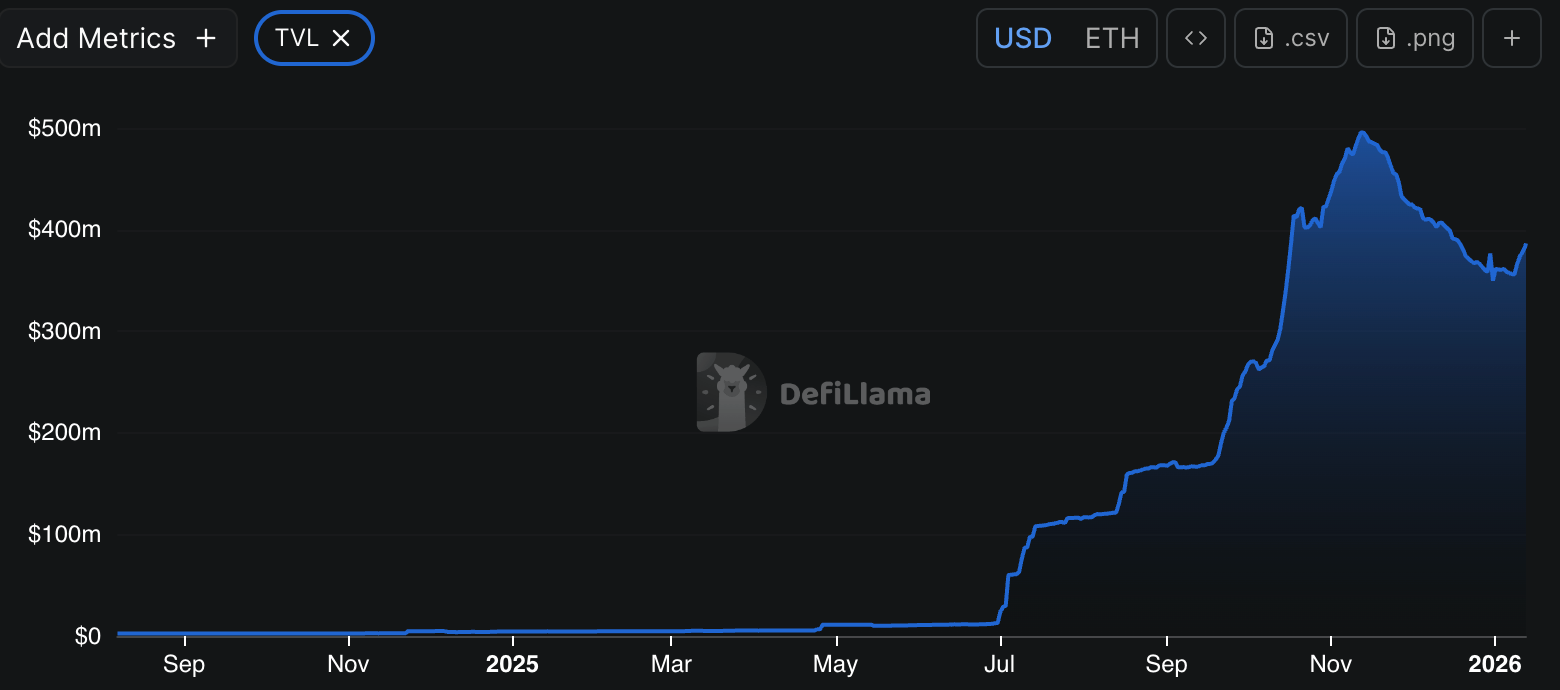
According to the latest data from DefiLlama, edgeX boasts an impressive $409.7 million in Total Value Locked (TVL), which peaked at around $500 million in mid-November.
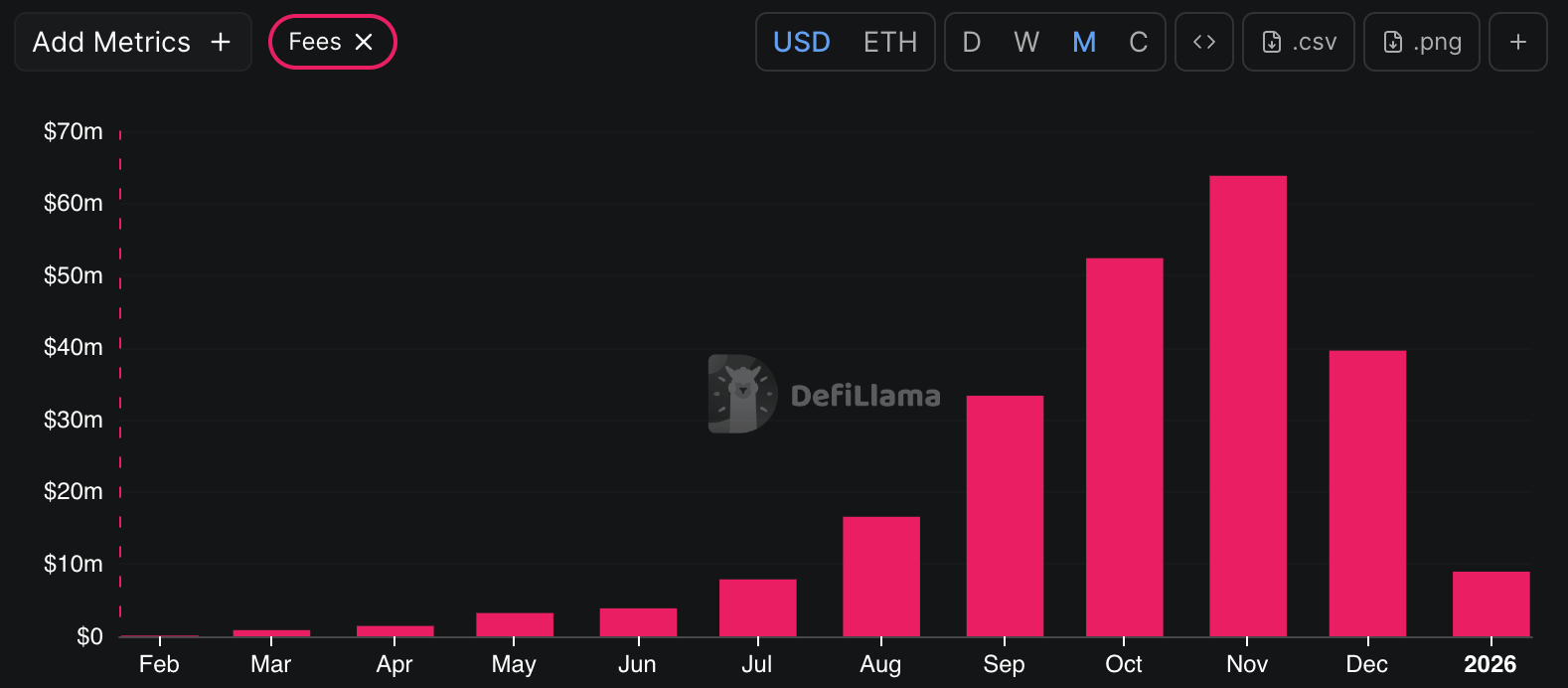
The platform's fee generation also looks promising, hitting an all-time high of $63.83 million in the month of November.
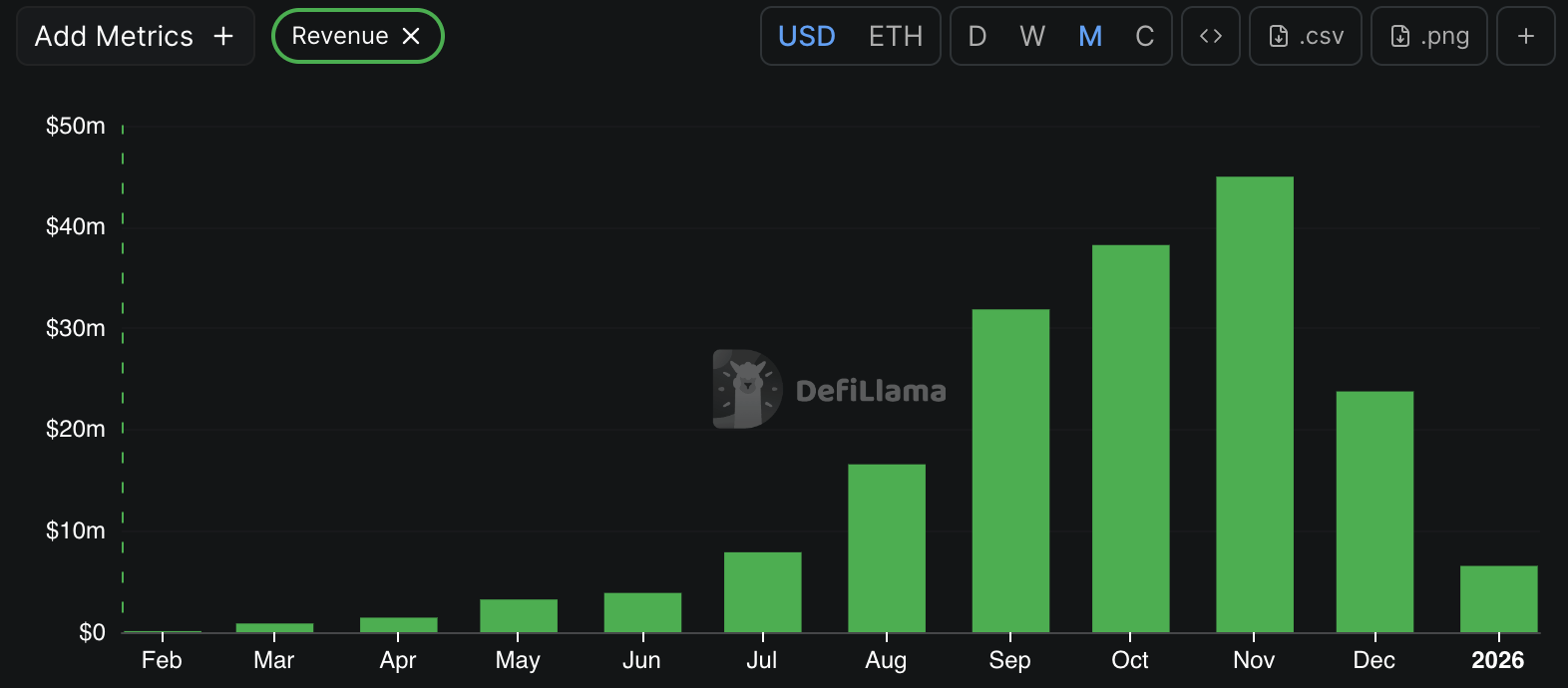
Revenues are looking much the same, with November being their best month yet at $44.96 million.
This has edgeX sitting comfortably in the seventh place across all monthly application revenue generation, above the likes of Base, BSC, Sui, and Avalanche.
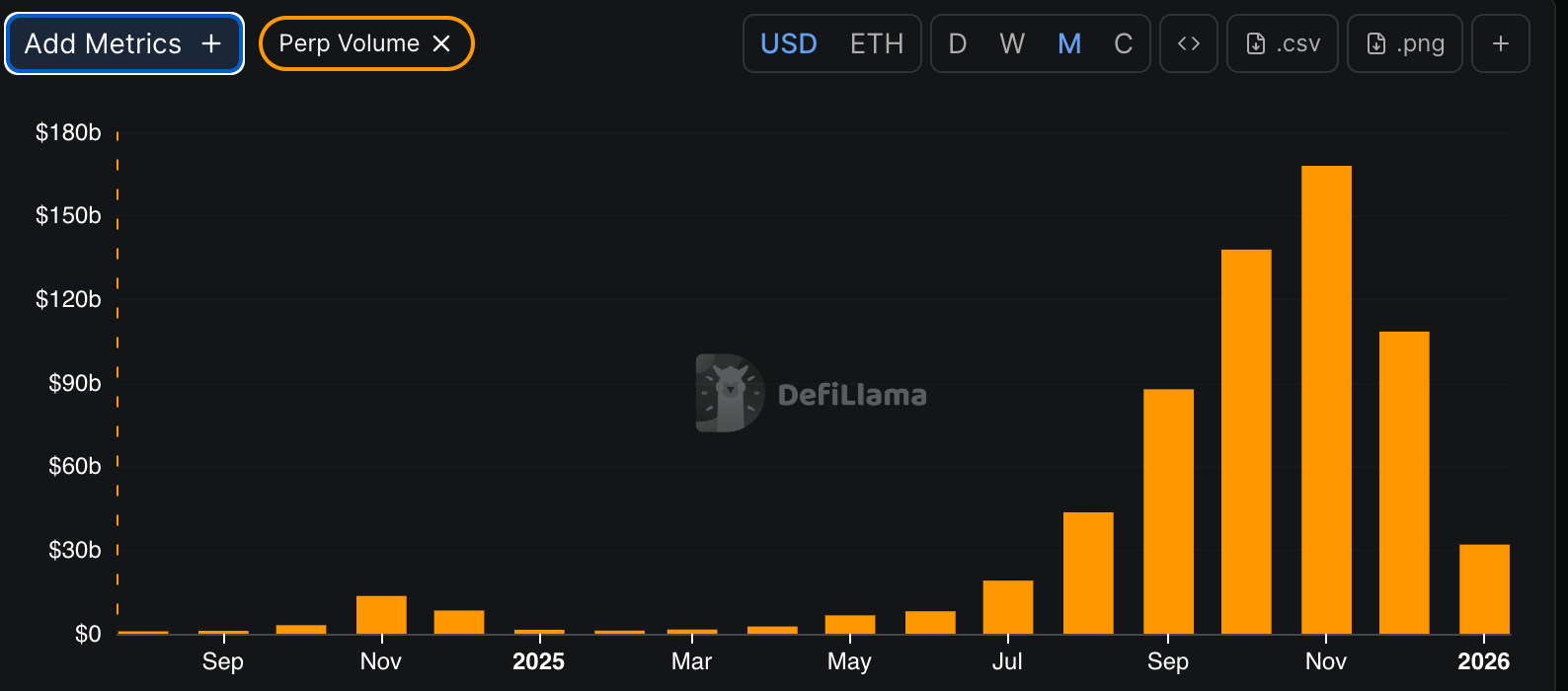
The aggregate volume on edgeX has also been making the same ascent as fees and revenue, breaking the $100 billion mark back in October, and doesn’t seem to be slowing down anytime soon.
November saw $167.96 billion in volume on the platform, an impressive figure considering the bearish sentiment that we have been seeing around the crypto markets of late.
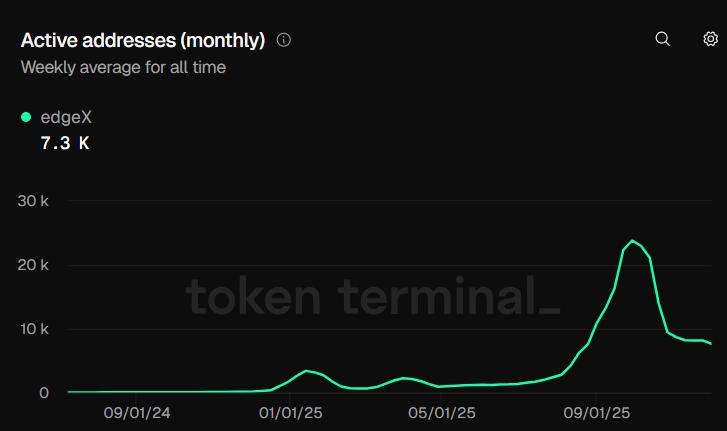
These metrics are truly impressive, especially when we look at the active addresses data on Token Terminal, which shows a peak back in September at 23,800 for the month.
This goes to show that edgeX is attracting the real power users who are pushing large amounts of volume through the protocol and, in turn, generating massive fees and revenue for the platform.
Under the hood: Trading and architecture
If you're not a full-blown crypto tech nerd, then you are probably already wondering what in the world all these fancy buzzwords are when describing the edgeX platform.
As with most things in the cryptoverse, it generally sounds more complex than it really is.
Let’s break it down.
V2 EDGE Stack architecture
edgeX’s V1 platform is thought of by the team as their minimal viable product (MVP) before the launch of V2 around Q1 2026.
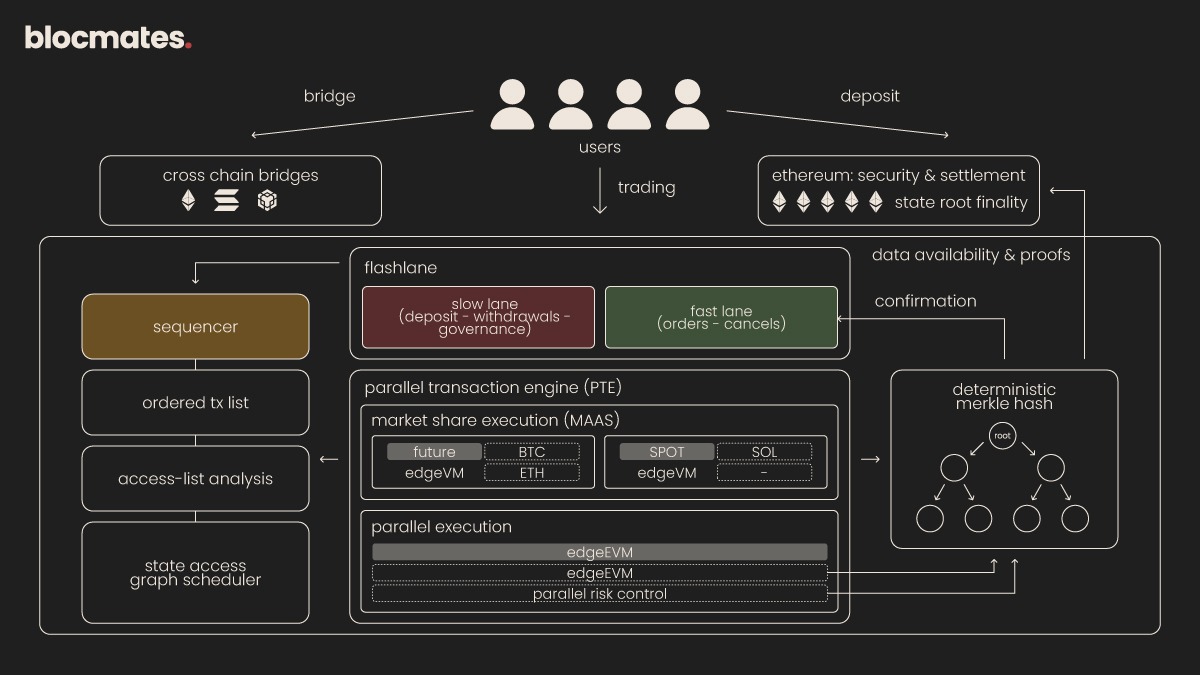
V2 will be built on top of the EDGE stack with a design based around their three core technical pillars.
- Modular Multi-VM, with the ability to add more VM environments in the future.
- Deterministic Parallel Transaction Execution, providing the ability to execute transactions in parallel, meaning faster trade execution for users.
- Flashlane, multi-lane execution, and Quality of Service (QoS) scheduling.
Modular multi-VM
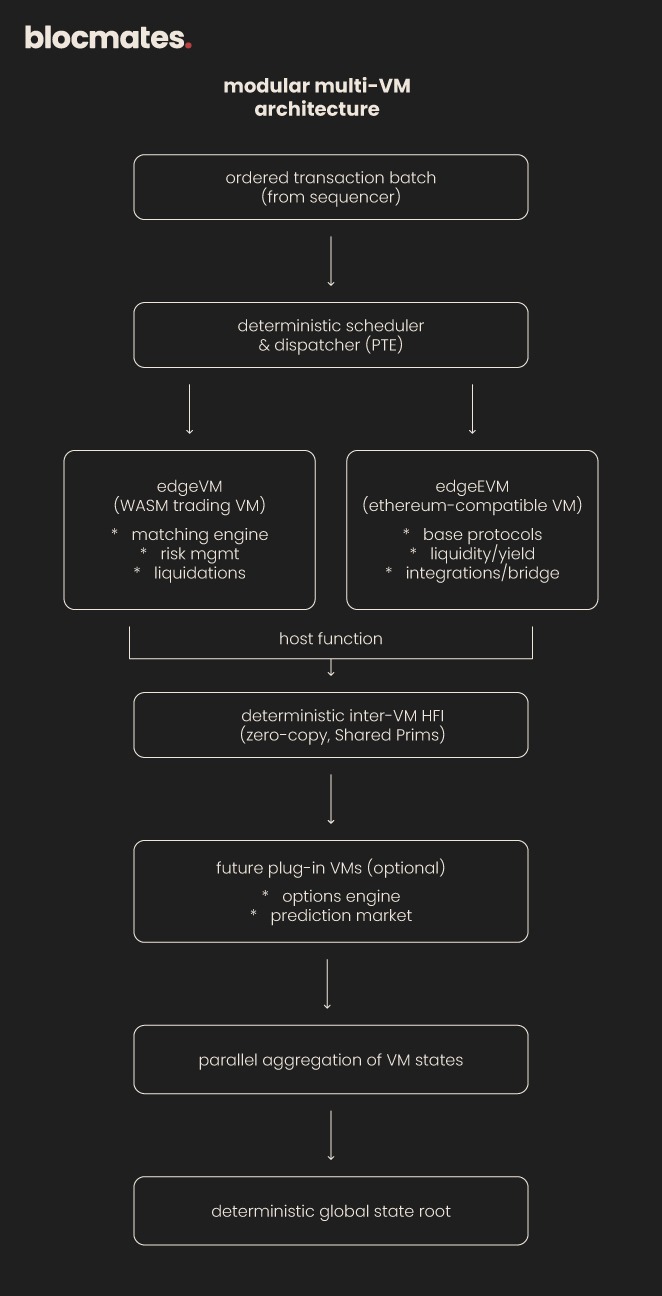
The simplest way to picture this Modular multi-VM is as a series of separate virtual machines whose task is to split up different types of work into their own optimized lanes. Instead of everything competing for the same resources, it ensures heavy trading activity gets its own dedicated fast lane and never gets stuck behind regular smart contract traffic.
The core logic that the edgeX platform has to process is done via their edgeVM, and this has its own compute resources dedicated to it.
At present, the edgeVM takes care of all the more complex tasks needed for a perpetual exchange to function efficiently.
Tasks such as order matching, liquidation, risk logic, and the execution of precompiled contracts are all handled by the edgeVM.
It also handles lower-complexity tasks, such as asset issuance and governance, which are standard to any DeFi protocol.
Due to its design, new product lines can be easily added to the edgeX platform by either creating new virtual machines or reusing existing ones.
This creates a plug-and-play style option for expanding the edgeX ecosystem without having to make any changes to the underlying infrastructure.
Deterministic Parallel Transaction Execution (PTE)
In order to understand the advantages of Deterministic PTE, it pays to compare it to the commonly used Optimistic model.
The Optimistic model is ‘Optimistic’ in the sense that it presumes that all transactions that run through the sequencer are valid and then corrects any faults it finds later via methods like roll-backs and re-execution.
This slows things down and is expensive to do.
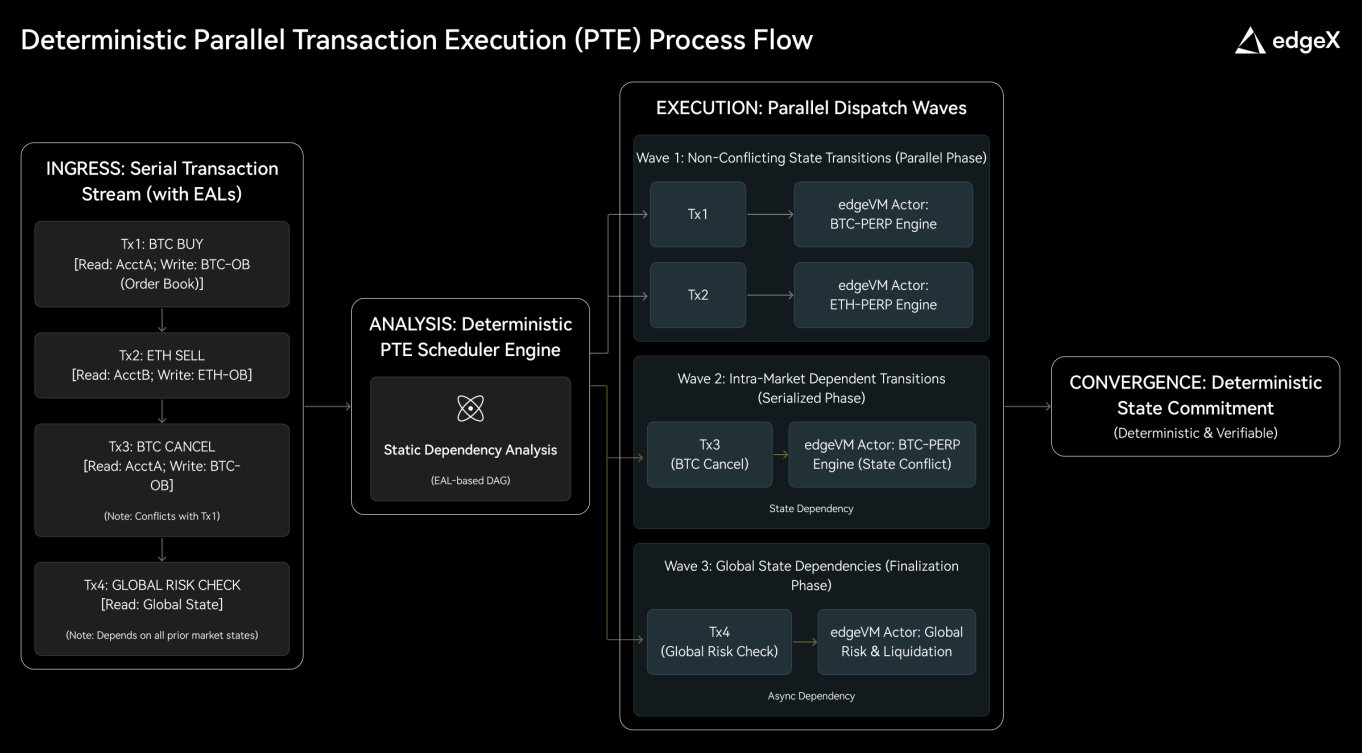
By using a Deterministic PTE design, the engine that manages all transaction data already knows how a derivatives transaction should appear before any execution process begins.
This means that all transactions are guaranteed to be valid before they are processed, removing the need for expensive rollbacks and time-consuming re-executions.
EDGE Stack uses a market-sharded execution design, which is just a fancy way of saying it breaks down different transaction types by market or derivative type and then processes them with different VM actors at the same time.
Markets that are experiencing unusually elevated transaction levels can then be broken down even further into sub-categories of transaction type to ensure throughput speeds are not negatively affected.
Within each different market, the PTE design uses a series of access lists to define the parameters for a successful transaction and then executes them at the same time, otherwise known as in ‘parallel’ fashion.
The big takeaway here is that the Deterministic PTE design, combined with the modular multi-VM, makes edgeX fast, really fast.
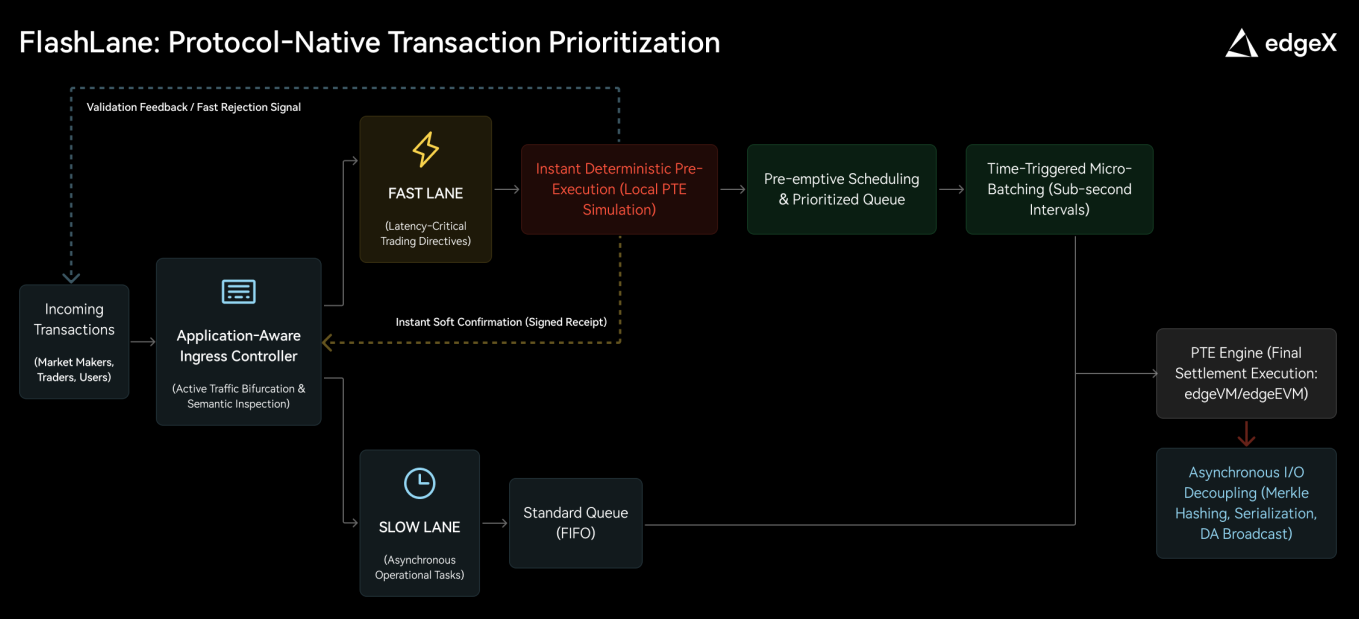
Flashlane
Flashlane is another concept that is best understood by looking at what most other protocols are doing, using a First-In, First-Out (FIFO) transaction queue.
This means that high-priority transactions compete for the same block space as your grandma buying $20 worth of XRP to rescue her retirement after watching a scammy TikTok video.
This FIFO design makes high-frequency trading operations very hard to perform, so edgeX has an answer they call Flashlane.
Flashlane is a protocol-native transaction prioritization mechanism that can inspect incoming transaction data and then funnel it into lanes based on urgency.
For example, deposits, withdrawals, and governance-related operations will fall into the slow lane and therefore not prevent fast lane operations like order placement and cancellation from taking place.
This creates an environment where trading efficiency is never compromised by other platform users and makes a clear statement that edgeX is truly a platform built for traders first.
As previously mentioned, edgeX is currently in its version-1 phase, with V2 set to roll out sometime in Q1 2026.
V2 will feature more advanced trading options, the addition of third-party applications, and many additional marketplaces to trade.
For a deeper dive into all the technical infrastructure underlying the edgeX platform, check out their Whitepaper and documentation.
Roadmap
Going forward, edgeX is firmly focused on the launch of its V2 platform.
The launch of V2 will see the native EDGE token go live, along with new marketplaces, spot trading, a ‘hyper-leveraged’ perps product, and a longer-term goal of bringing stock market perps trading to the platform.
V2 will also bring the introduction of unified accounts that allow for collateralization of positions across different products and markets.
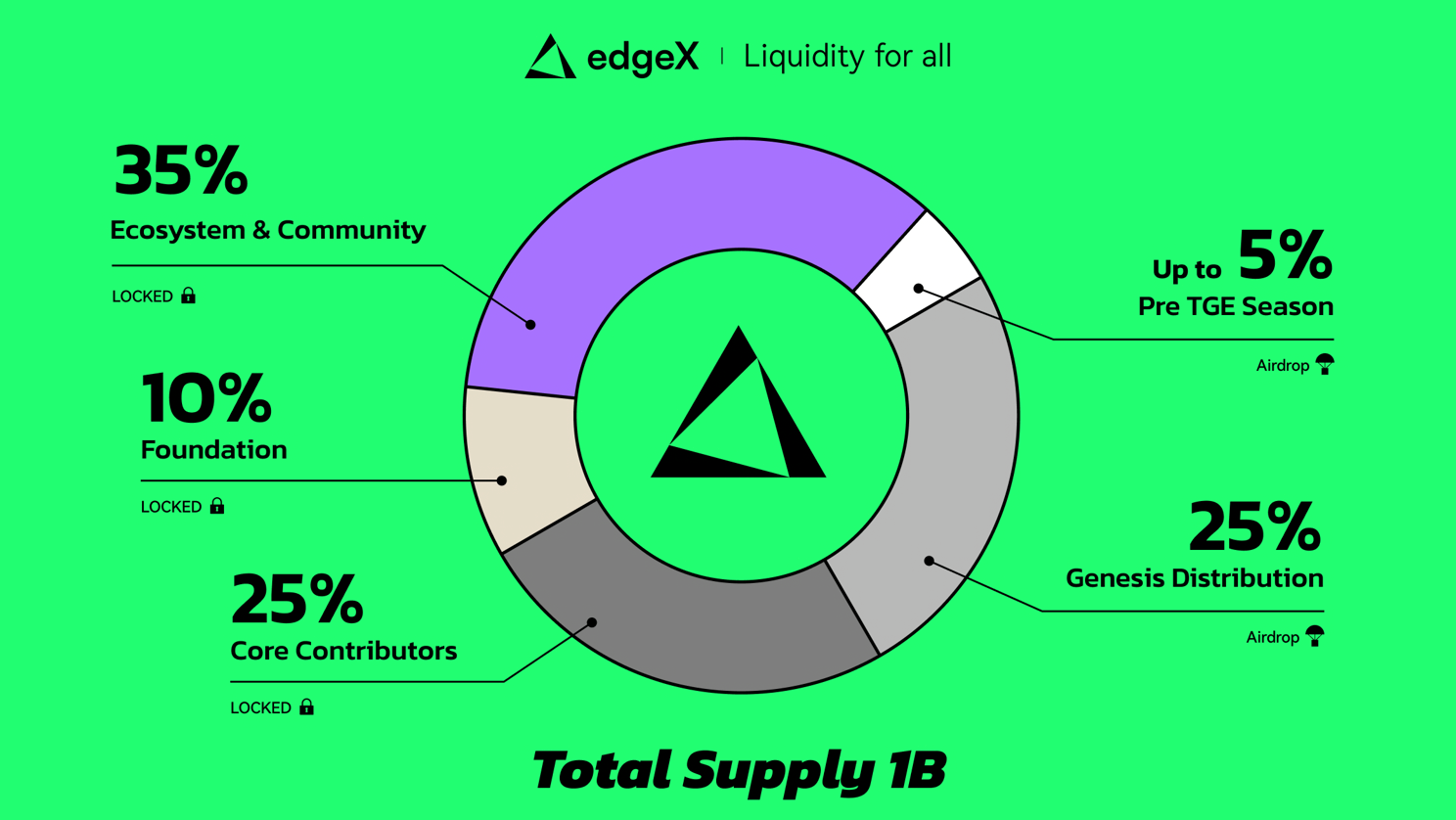
The EDGE token will have a maximum supply of 1 billion tokens distributed as follows:
- 25% to genesis distribution
- 25% to core contributors
- 10% to the foundation
- 35% to the future ecosystem and community
- The remaining 5% is set aside for the pre-TGE season
In the short term, the edgeX team is focusing on its native memecoin, MARU.
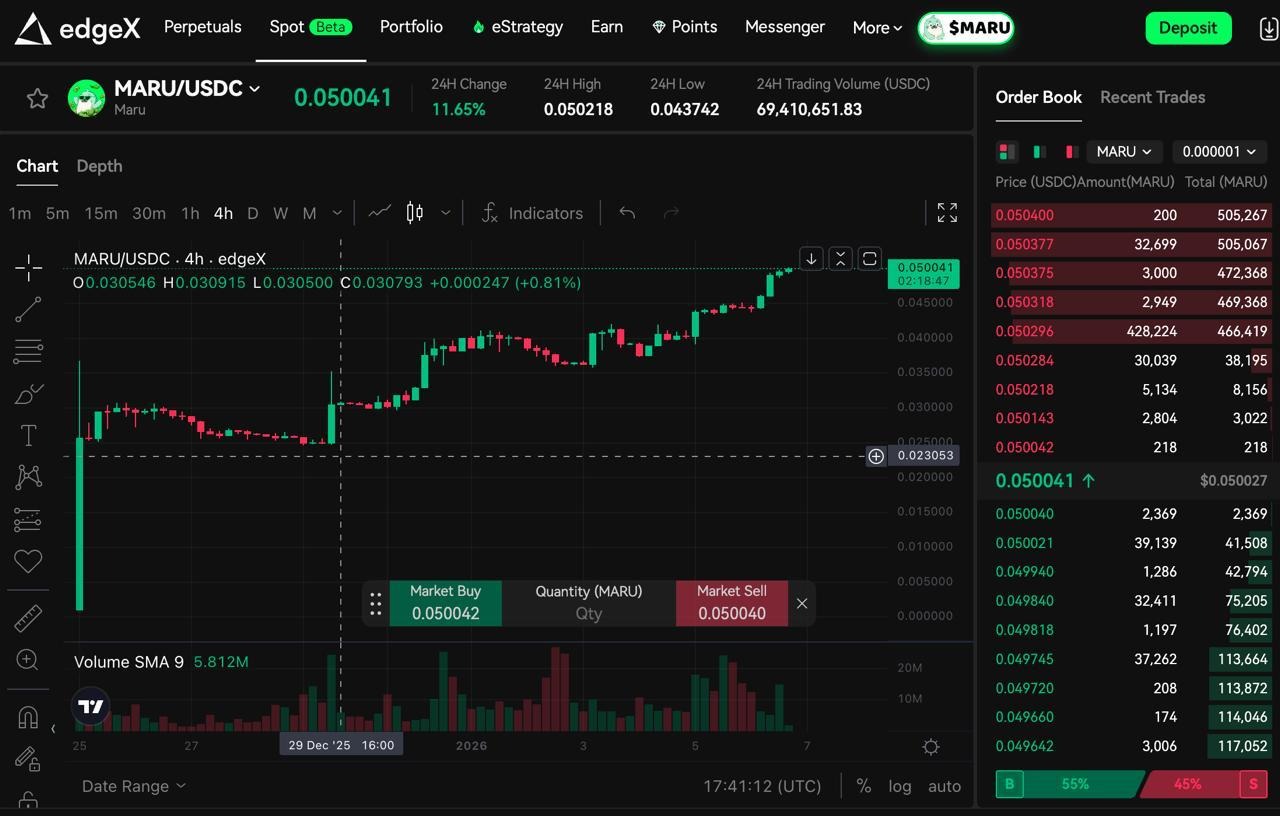
MARU represents the trader in motion, the guy who trades in the coffee shop, at the bus stop, or at the Christmas dinner table while the relatives talk politics and the latest celebrity drivel.
The initial MARU airdrop has just been completed, and saw early users and contributors rewarded for their efforts.
edgeX currently has no VC involvement, which many will see as a major bonus, but rumor has it there could be a major strategic investor coming to the cap table soon, so keep your ears to the ground and eyes peeled for any upcoming announcements.
Unlocking your edge
Getting involved in the edgeX action is simple.
Anyone can trade on edgeX V1 with a standard EVM-compatible wallet connection or by using the MPC option and logging into the platform via email.
The wallet connection option is the same as most other platforms you may have interacted with in the past.
Click connect, select your EVM wallet of choice, complete the signature, and you’re good to go.
Be sure to have some USDT and ETH in your wallet, as USDT is needed as collateral for your trading and ETH is used to cover the gas fees when making USDT deposits.
If logging in with the MPC option, you will be prompted to enter your email address after clicking on ‘Connect.’
Once your email has been submitted, a 6-digit code will be sent, allowing you to log in to the platform, where a wallet will be created, awaiting the uploading of USDT.
Uploading USDT to the MPC wallet can be done via the Arbitrum network and can be achieved from any other wallet or centralized exchange.
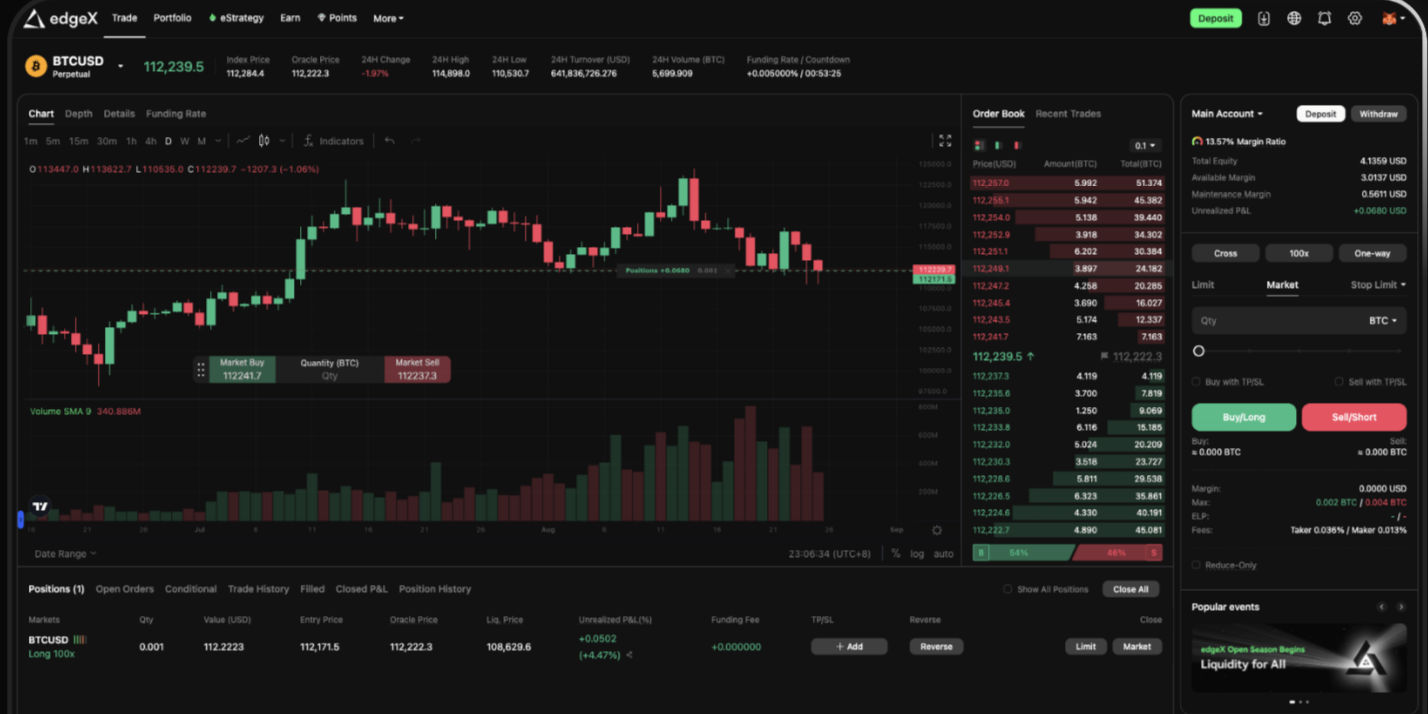
Once away and trading, it is important to note that edgeX works in a cross-collateral mode by default.
This allows for multiple positions to share the same collateral from a single trading account.
Users have the ability to create up to 20 trading accounts with their own independent margins, meaning liquidation on one account will not affect the others.
Trading fees
Trading fees on edgeX are updated at 00:00 (UTC) and are calculated based on the rolling trading volume in the past 30 days.
This means that the fees you pay will depend on how much volume you have put through the platform in the past 30 days, and are represented in a tiered structure.
Any volume done on sub-accounts will be aggregated to the main account, so that your overall volume is taken into consideration when calculating the fees you pay.
Gas fees for settlements are covered by edgeX on behalf of the users.
Order types
edgeX features three main order types:
- Limit orders, allowing users to set an order at a specific price. Limit orders will have advanced options like Fill-or-Kill (filled immediately or cancelled) and Good-Till-Time (if the desired price isn’t hit, then the order will be cancelled within a specific time period).
- Market orders, filled at the best available price at the time the order is made.
- Conditional orders, can be market or limit orders with specific conditions added to them.
Stop losses and take profit orders can also be made once a position is opened and are executed in the same fashion as market orders.
Pre-TGE season
As edgeX evolves from a perpetual DEX into the EDGE Chain, the network is opening its doors by transitioning from its closed beta to open beta phase.
The team kicked off the pre-TGE season on January 7.
Using the platform organically will fetch you incentives in the form of XP. Rewards will be distributed on a weekly basis until the TGE, which is slated for Q1 2026.
Final thoughts
Having seen the recent success and attention the perps narrative has received over the course of this cycle, and looking at the metrics and products that edgeX has produced, it seems clear as day that this is one to really keep an eye on.
As the crypto markets mature, products that can find real PMF and generate large amounts of revenue will surely rise to the top as fundamentals actually start to matter.
edgeX has managed to establish itself, in a rapid time, as a top location for traders to flock to.
The product is clean, revenue-driven, allows for the development of third-party applications, and has several significant catalysts in the pipeline.
Just when everyone started to think it was all over, the devs behind edgeX seem to have produced something that makes both the degenerate and fundamentalist in me want to roll the dice again.

Thanks to the edgeX team for unlocking this article. All of our research and references are based on public information available in documents, etc., and are presented by blocmates for constructive discussion and analysis. To read more about our editorial policy and disclosures at blocmates, head here.








.webp)

.webp)

.webp)

.png)


.webp)



.webp)
.webp)

.webp)
.webp)
















.webp)

.webp)

.webp)





.webp)
.webp)




.webp)

.webp)





















.webp)
.webp)
.webp)

.webp)
.webp)
.webp)


.webp)
.webp)


.webp)


.webp)




.webp)


.webp)


.webp)






















.webp)







.webp)













.webp)

.webp)
.webp)

.webp)














.webp)

.webp)


.webp)






.webp)