It’s been a little over a month since Monad went live, and all things considered, it was a pretty successful launch.
We hope all the hours you spent grinding on Discord and testnets were worth it, anon.
Now that it’s finally live, the fun part begins - interacting with different products in the ecosystem.
I know most of y’all are waiting to be fed the Pump.fun of Monad and the FARTCOIN of Monad.
Unfortunately, we do not have that for you today. It’s still early days for the ecosystem, and you’re more likely to find a rug rather than the next big thing.
What you’re better off doing, especially in the early days of a new ecosystem, is taking a look at the foundational elements of the ecosystem. The so-called baseplates.
The applications that build the foundational layer upon which a whole suite of other applications is built.
These are the DEXs, the lending protocols, the aggregators, the launchpads, and the focus of this article, liquid staking protocols.
Today, we will be going through Kintsu, a composable liquid staking protocol that’s been live on Monad since day one.
But before we dive into Kintsu, let’s have a quick refresher on what liquid staking is.
What is liquid staking? A primer
Most modern blockchains operate on a consensus system called proof-of-stake.
Essentially, blockchains rely on independent third parties, known as validators, to verify the integrity of transactions made on a blockchain and record them in the ledger.
To ensure that validators remain honest, they are required to stake some capital as collateral.
If they are found to be malicious, that stake gets slashed. If they operate honestly, they earn a reward in the form of the blockchain's native token for validating transactions on the network.
Regular staking like this has issues.
- It’s often a closed garden. There tends to be a high minimum stake requirement that most people cannot afford.
- Staking involves locking up capital, which means stakers face opportunity cost by not having that money active in investments or any other yield-generating instrument.
- Some people want the rewards from staking without having to manage the technical load of validating a blockchain.
This is exactly where liquid staking comes in.
Users can pool their assets with a liquid staking protocol that delegates these assets to different validators and then takes a portion of the yield earned by these validators and redistributes it to the users who staked their assets.
Let’s use Monad as an example.
Users who own MON and want to earn the staking reward can stake their MON on a liquid staking protocol for sMON.
The sMON they receive is a liquid receipt token. So now, their money is earning yield, but at the same time, they have a liquid token in the form of sMON, which they can use for swapping, lending, yield farming, buying NFTs, gaming, or anything else.
This way, the barriers to staking have been removed (no minimum requirements or technological burden), and users earn yield while remaining liquid, so there’s no opportunity cost.
This is why liquid staking protocols tend to be foundational protocols. The receipt token often becomes the de facto asset that most people use for onchain activity.
With that being said, let’s look at Kintsu, the candidate that we believe will be Monad’s foundational liquid staking protocol.
What is Kintsu?
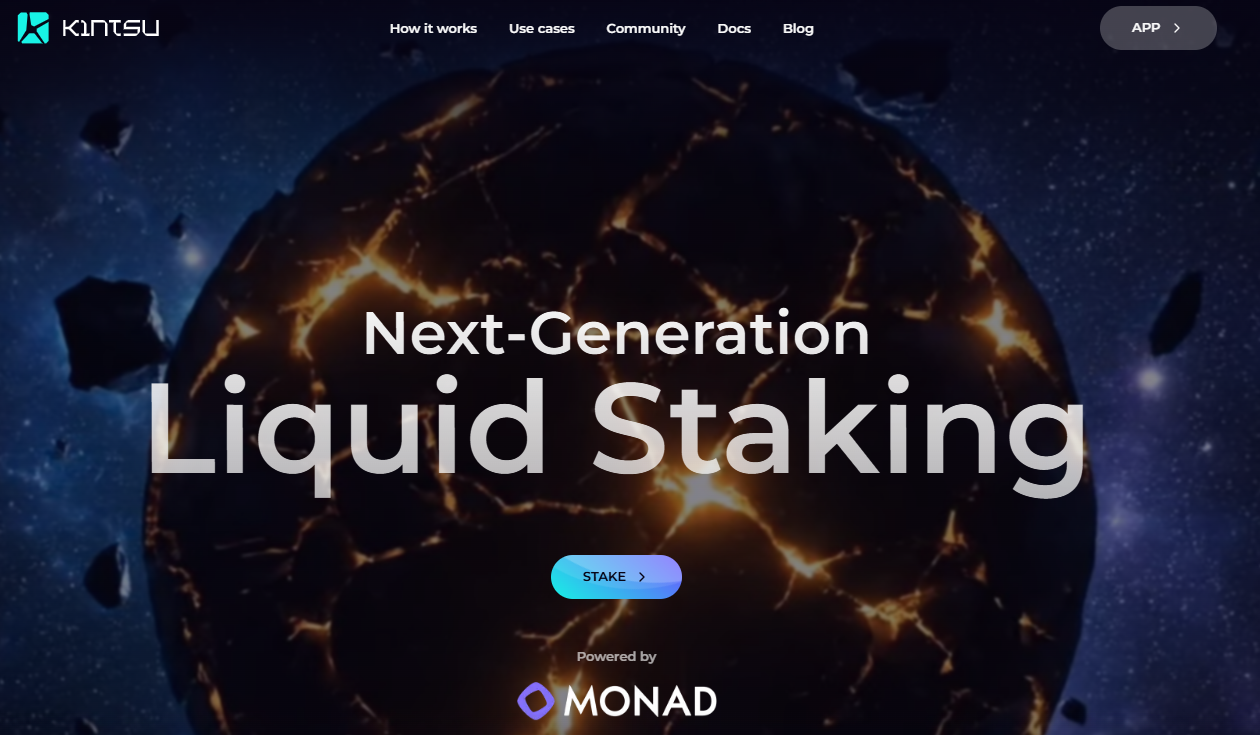
Kintsu is a credibly neutral liquid staking protocol for the Monad network. It is engineered to incentivize community engagement while still maximizing capital efficiency.
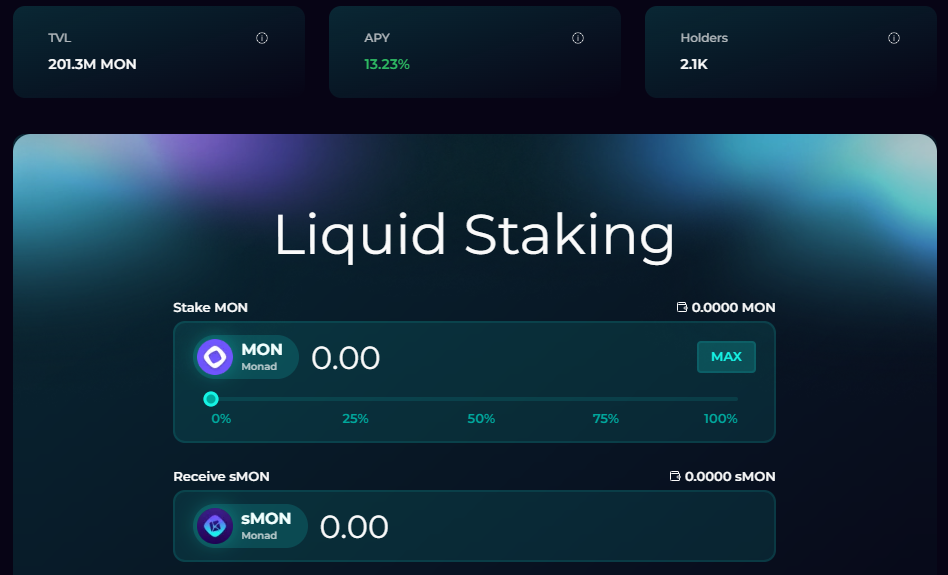
In just the first three weeks after the Monad launch, Kintsu has accumulated a total value locked (TVL) of 201.3 million MON (~$5.6 million at the time of writing) with 2.1K sMON holders and the stake being delegated across 22 validators.
Remember, if you take into account the context of the broader crypto market, Monad launched at a difficult time, with the market trending downwards and user activity slowly dissipating.
With that in mind, Kintsu has had an impressive start.
Now, with the market looking like it’s picking back up in 2026, things start to look a little more interesting. Stakers on Kintsu can get a 13% APY on their MON while staying liquid and interacting with other Monad protocols. It’s a no-brainer that users will choose Kintsu.
How does Kintsu work?
At a high level, it works just like any other liquid staking protocol that you might’ve interacted with. As a user, you connect your Monad wallet to the Kinstu app, select the amount of MON you would like to stake, and stake it to receive sMON, Kinstu’s liquid staking token.
The amount sMON a user has represents their share of Kintsu’s MON staking pool. So the user’s sMON balance won’t change (unless they stake more), but since the pool keeps earning yield, the amount of MON in the pool keeps increasing. Once a user unstakes, they will receive more MON for their sMON.
Let’s further simplify it. When you first stake, the ratio might be 1:1, so if you stake 10 MON, it gets you 10 sMON. After the yield earned in the Kintsu pool, the ratio will change to 1:1.1. When you unstake the 10 sMON, you will get 11 MON, and that’s the yield earned.
Alright, so you now understand the basics of Kintsu, but why should you care about it?
What sets Kintsu apart from the competition?
1. DAO-controlled voting - Typically, the validator curation process is controlled by the team that has built the liquid staking protocol. This brings in an element of bias and a lack of transparency to the process.
With Kintsu, the curation process is controlled by the DAO. Holders of the KSU token can vote and participate in selecting which validators deserve to receive stake delegated to them from the Kintsu pool.
Over time, as Monad and Kintsu grow, they will create an onchain competition where validators compete against each other on performance to win delegation.
(Note: This will happen only once governance is live. More on this later)
2. MEV-agnostic design - Another issue with liquid staking protocols is that they have strict requirements on what infrastructure validators use, often due to affiliations with that infrastructure provider.
Kintsu is fully flexible. Validators can run any MEV client or underlying infrastructure that they believe will generate the highest additional rewards. If the validator performs well, they will naturally receive more delegated stake through DAO voting.
3. Validator inclusion - Validator inclusion into delegation strategies is another issue in this sector. Often, a game of cliques using whitelists to dominate market share.
Kintsu takes a truly decentralized, focused approach. The only requirement to be included in the delegation strategy is for the validator to fulfill the basic technical requirements of running a Monad validator.
After that, it’s purely based on performance and convincing the Kintsu DAO that the validator is worth delegating stake to.
4. superMON - superMON is Kintsu’s vault for curated DeFi rewards centered around sMON.
It is designed by Upshift and curated by Qualia.
Users simply deposit MON into this vault and receive superMON. The vault allocates the MON to multiple DeFi strategies like lending, LP’ing, liquid staking, and looping across some of the top Monad protocols like Kintsu, Euler, Curvance, Morpho, LFJ, Uniswap, Kuru.
Put everything together, and users who deposit into superMON will receive a plethora of rewards:
- sMON staking yield
- Protocol rewards from integrated partners
- Kintsu points
- Upshift points
- Aggregate APY across strategies on all the integrated protocols
It’s automated, it’s optimized, and it’s built to supercharge your MON yield.
Another way to earn even more rewards is through the Kintsu Points Program, which is now live.
Kintsu adopts a dynamic points program designed to delegate more points to where more value is being created in sMON liquidity.
A fixed number of points are released every day. The points are distributed based on:
- TVL/usage across approved integrations
- MON deposits
- sMON adjacent stablecoins (liquidity)
The distribution of points automatically readjusts based on where there’s more liquidity and activity for sMON.
Essentially, whoever plays a bigger role in helping bootstrap Kintsu’s network will get more points allocated.
As a user, the earlier you are, the more points you earn, which means you receive more KSU, allowing you to have a greater say in the validator delegation strategy.
Beyond this, there are three more ways to boost your points earned:
1. Referrals - Any user can give a Kintsu referral code to anyone in their network, and both parties earn 10% bonus points on the amount of points earned by the referred user.
So, for example, Alex gives Tim a referral. Tim earns 100K points in a month. Both Alex and Tim get 10K additional points.
2. Trait-based NFTs - Staying true to the Monad ecosystems' collaborative nature, Kintsu has integrated with multiple Monad NFT collections to give holders of those NFTs a 1.25x multiplier on points earned for simply holding the NFT.
You can find the list of the partnered NFT collections here.
3. Booster NFTs - Kintsu will also have its own NFTs, called Booster NFTs, which will give holders a 1.5x multiplier on their points.
The purpose of this collection is to reward early Kintsu contributors. These NFTs will be distributed to Kintsu OGs, early ambassadors, community giveaways, and partner giveaways.
Use cases for sMON
The ultimate aim is for sMON to become the de facto token used across the Monad ecosystem, while the native MON of users earns yield in the Kintsu staking pool.
To achieve this, sMON needs to achieve maximum market penetration across the entire Monad ecosystem to build out a strong liquidity network. Despite it still being relatively early days for the Monad ecosystem, Kintsu has set itself up very well to achieve this.
1. Swapping and trading - Users can swap/trade multiple assets on Monad using sMON as the base asset on popular DEXs like Uniswap, Pancakeswap, or LFJ, as well as Monad native exchanges like CloberDEX, Bean, and Kuru.
Kintsu has also partnered with some exchanges, like Bean, to support instant swaps between MON and sMON, as well as other liquidity incentives.
Users can also provide liquidity using sMON across all of the aforementioned decentralized exchanges on Monad.
There’ll be a variety of yield farms to choose from with varying risk profiles. Alongside, you’ll have curated yield strategies as well as the ability to deploy across different primitives like options.
So, depending on your view of the market (and what you know best), you have a lot of options when it comes to deciding how to deploy your sMON.
2. Lending and borrowing - Users can double up on the staking yield they’re already receiving by depositing sMON on lending platforms like Euler, Curvance, Neverland, and Folks Finance to earn the interest paid by borrowers.
Kintsu has integrations with certain protocols like Euler, where sMON can be used as collateral for leverage strategies. Users can also deposit sMON on Neverland, which is one of the most capital-efficient ways to borrow on Monad.
3. Hedging and yield-stacking - DeFi also has a lot of structured product protocols. These are protocols that allow you to earn yield through different financial primitives.
Examples on Monad include Pendle, Covenant, and Enjoyooor.
Currently, Kintsu already has an integration live with Enjoyooors, where users can stake sMON through the protocol to earn boosted rewards. You can also expect Covenant and Pendle integrations in the very near future.
4. ICM auctions - The Internet Capital Markets (ICM) meta took the crypto market by storm in 2025. Naturally, Monad will have its own ICM platforms.
Platforms like Alloca are currently bearing the torch for ICM on Monad. Although nothing is live yet, it would be interesting to see sMON get integrated into this ICM sector and become an almost pseudo-foundational asset for a sector that might breed transformational applications.
5. NFTs - Just like every other ecosystem, Monad also has a strong NFT sector.
Although sMON is currently not integrated on any NFT platforms, one can expect integrations to occur soon, further growing sMON’s liquidity network and increasing its importance in Monads' NFT ecosystem.
6. Gaming - Given how fast and cheap Monad is as a network, gaming is a sector that can truly flourish fully onchain on Monad.
Similar to NFTs, there are currently no live integrations of sMON within gaming. However, as sMON establishes its roots deeper within the Monad ecosystem, we could see a variety of cool integrations with multiple gaming products.
7. In-app transactions - With a variety of integrations across multiple popular dApps in the Monad ecosystem, Kintsu has set up sMON to become a sort of programmable dollar for Monad.
Kintsu has integrated with the likes of Euler and Neverland for lending markets, Enjoyooor and Curvance for yield strategies (with more potentially on the way), Folks Finance for cross-chain strategies, and sMON can be used to LP on top exchanges like Uniswap, Pancakeswap, and LFJ.
Additionally, there are integrations with Bean, where LPs receive boosted point rewards.
There are a whole lot more, and you can find all the details here.
In summary, sMON is establishing a deep foundation within the Monad ecosystem, with additional integrations on the way to expand its market penetration further.
Eventually, its importance will grow to a point where sMON does become the sort of programmable dollar for Monad.
Looking ahead
With a successful mainnet launch of Kintsu on Monad, all attention now turns to the next stage of development.
The first thing is the launch of Kintsu governance. This refers to setting up the Kintsu DAO that will ultimately be in charge of curating the validator delegation strategy.
This is ultimately one of the biggest differentiators for Kintsu, and once live, it should really propel Kintsu to the top of the Monad liquid staking sector.
The process has already begun.
As mentioned earlier, Kintsu has an ongoing points program. As a user, the earlier you are, the better, for you get better multipliers and a higher points allocation. This will ultimately give you a larger KSU airdrop, giving you more influence in the DAO.
More influence can then translate to more returns.
Going hand in hand with the launch of Kintsu governance is to further the market penetration of sMON. As we’ve already stated above, sMON has already been entrenched across all sectors in the Monad ecosystem with a wide variety of partnerships and integrations.
Over time, this will only continue to grow as there will be more partnerships and integrations to further build out sMON’s liquidity network. It’s more of a slow and steady process of entrenching sMON across the ecosystem, but eventually, the idea is to sMON the de facto transactional currency of Monad.
Consequently, as Monad grows over time, so will the importance of Kintsu, thereby benefiting KSU holders who vote in the DAO.
Concluding thoughts
It’s still early days for the Monad ecosystem. Yes, after such a long wait, it may not have been the glamorous launch that most people had hoped for, but patience pays.
The Monad ecosystem will eventually begin to grow as liquidity returns and applications gain momentum. When that happens, Kintsu will be among the best-positioned protocols to benefit from it.
As sMON continues to become more deeply entrenched in the Monad ecosystem, it will give KSU holders even more power. At the same time, Kintsu will continue to expand its validator set, which will further enhance the level of decentralization and security of the network.
Ultimately, Kintsu has positioned itself to become a core foundational baseplate of the Monad ecosystem. Kintsu will not only grow with Monad, but it will also play a big part in helping the network grow and expand.
We’re just getting started, so stay locked in. You'd not wanna miss out on this one.
Thanks to the Kintsu team for unlocking this article. All of our research and references are based on public information available in documents, etc., and are presented by blocmates for constructive discussion and analysis. To read more about our editorial policy and disclosures at blocmates, head here.





.webp)
.webp)

.webp)
.png)

.webp)


.webp)
.webp)
.webp)
.webp)








.webp)

.webp)

.webp)
.webp)
.webp)
.webp)
.webp)







.webp)
.webp)
.webp)
.webp)
.webp)
.webp)


.webp)
.webp)


.webp)


.webp)




.webp)


.webp)


.webp)











.webp)



.webp)





.webp)
.webp)
.webp)

.webp)








.webp)

.webp)
.webp)




.webp)