Reading time: 15m 5s
It is now abundantly clear that the world is coming onchain. Slowly, then all at once.
As of December 2025, we had over $40 billion in institutional involvement through RWAs. US Treasuries onchain have reached a market size of roughly $10 billion, driven by the likes of BlackRock and Franklin Templeton.
Equities can now be traded onchain through platforms like Hyperliquid, and we’ve even seen the rise of commodities like gold, oil, and silver trading onchain.
All of this is just in the proverbial ‘testing phase.’
A survey conducted in early 2025 by EY Parthenon and Coinbase showed that over 75% of traditional institutions believe they will be ramping up investments in tokenized assets from 2026 onwards, with the CEO of BlackRock, Larry Fink, stating that he believes all assets will be tokenized over the next 5-10 years.
So yes, everything is slowly but surely coming onchain.
But why? I hear you ask.
Well, the simple answer is that onchain infrastructure is just superior to traditional financial rails. It offers a level of dynamism that is not achievable elsewhere.
- Global liquidity
- Instant borderless settlements with no limits
- Cross-chain transactions
- Composable applications
- 24/7 markets
- Truly internet-native financial rails
- Programmable financial instruments
This level of flexibility, customizability, composability, and programmability is unparalleled. We’ve already seen this system in action, albeit on a smaller scale, with DeFi. It simply works.
But for how dynamic the onchain economy is, innovation is stifled by something that’s in many ways the backbone of the system. Oracles.
Oracles, in a crypto context, are a data-delivery technology that connects external sources to blockchains, allowing onchain applications to leverage any sort of data from the real world or other networks to incorporate into the app's functionality.
Oracles, in their current state, are static.
For example, imagine a protocol offering stocks onchain. One of the most popular tickers being traded is $TSLA.
Using regular oracles (i.e., the ones we have right now), the onchain price of TSLA will reflect the actual price during the normal 9:30 am - 4 pm trading hours.
However, the onchain market is 24/7, how does the protocol reflect the price when the US market is closed?
Currently, developers create their own custom pricing algorithms to keep the markets going. This, however, comes with a host of issues, like price discrepancies across protocols and potential security vulnerabilities.
The easy answer is that oracles need to become more dynamic to suit the needs of onchain finance.
Smart contracts unlocked a completely new design space for blockchains by changing them from simple vehicles that can only transfer value to infrastructure that supports a plethora of programmable applications.
Similarly, oracles need to be made programmable to unlock a completely new design space that future-proofs the onchain economy.
The protocol spearheading this shift is none other than SEDA.
What is SEDA?
SEDA is a layer-one (L1) blockchain designed for programmable oracle infrastructure. Similar to how Ethereum hosts smart contract logic for applications, SEDA hosts data feed logic for applications.
Here’s a good way to think of it: SEDA is to oracles what AI agents are to search.
Much like search engines, traditional oracles are static, manual, and limited. You request data and receive some results; that’s it. Much like AI agents, SEDA makes things more dynamic with more flexibility, control, and customizability.
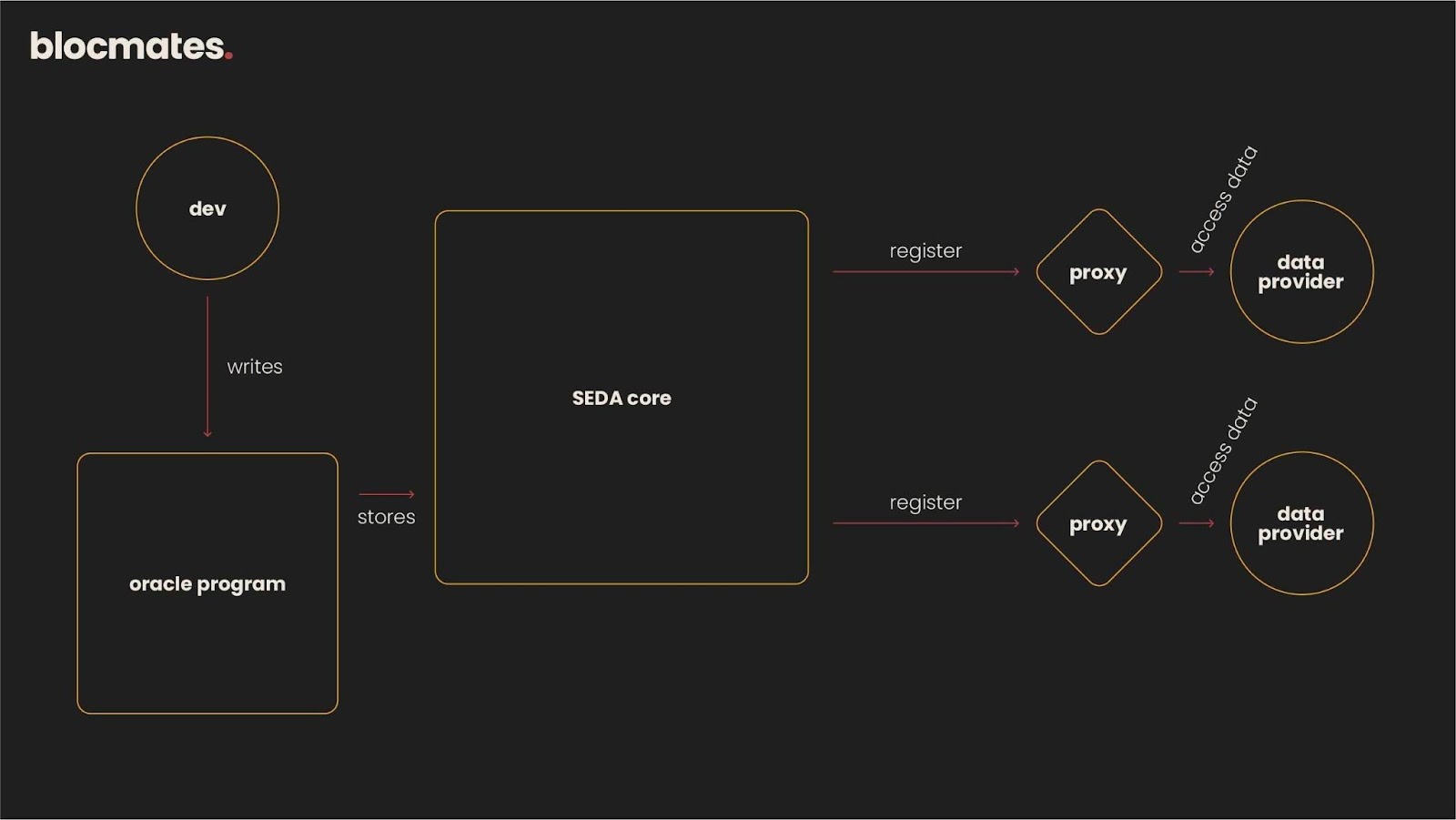
At the heart of SEDA is its core innovation called Oracle Programs (OPs).
Oracle Programs are smart contracts that hold custom logic for a data feed. It can be thought of as the customizable brain for the Oracle feed that an application receives.
Oracle Programs will ultimately be the game-changer that opens up a completely new design space for onchain applications.
It works like this:
- A developer must define what data they want to access (prices, weather, election results, etc.). The options are virtually unlimited as SEDA can query any public API point on the internet, as well as large suites of private data via data providers.
- Then, developers decide which sources to query for their data:
- Public APIs via HTTP-fetch
- Private providers via data proxies
- Websockets
- Developers must then define how to filter, aggregate, and return the data. This is where the oracle turns from static to dynamic.
Protocols can completely customize the data filtration and aggregation parameters to perfectly suit the needs of their application-specific functionality.
It’s kinda like ordering from a custom pizza shop. Would you want to settle for whatever's on the fixed menu or be able to mix and match your toppings, cheese, and sauce to suit your taste buds?
Once the Oracle Program is created, it is published to SEDA’s proof of stake blockchain as a transaction. From here, it operates as a shared module that can be used and iterated upon by other developers.
On top of this are two distinct products:
- SEDA Core
- SEDA Fast
SEDA Core is the default method for data delivery. This is a fully onchain, trustless way to query any data source and deliver the results to any chain.
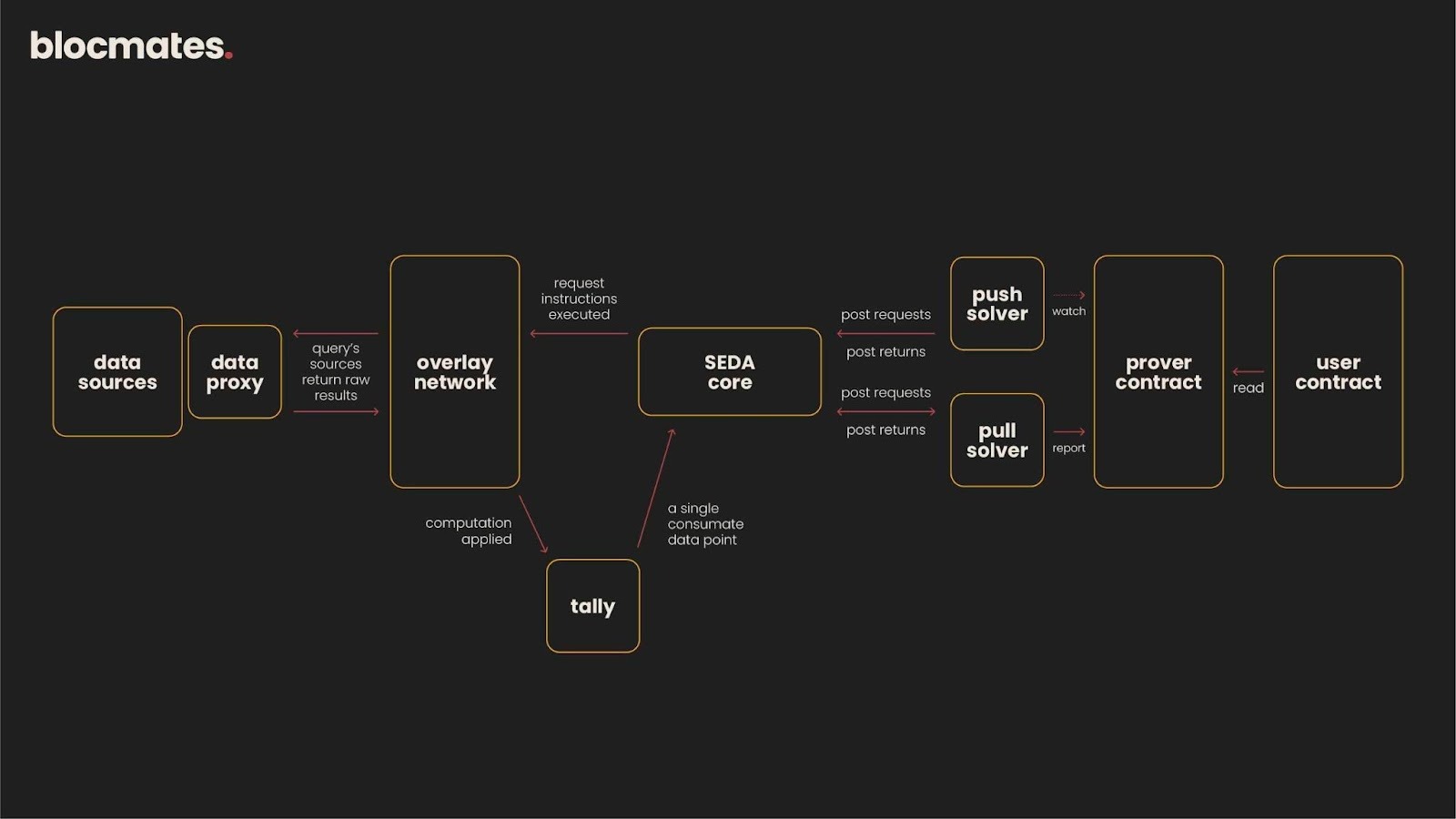
Under the hood, there are four key technical pieces that make it tick:
- Prover Contract - These are smart contracts on external chains (e.g., Ethereum, Solana, Hyperliquid, etc.) that act as entry/exit points for data requests via the SEDA network.
- SEDA Chain - The source network where the settlement of data requests occurs. All data requests are recorded, validated, and stored here.
- Overlay Network - An independent network of third-party nodes that fetch and process data according to the program's instructions and return raw results.
- Solver Network - A network of relayers (or solvers) that act as the bridge between SEDA and other blockchains. They relay the different requests and results back and forth between the networks in accordance with the Oracle Program to ensure applications run smoothly.
Now, of course, all data requirements aren’t the same.
Yes, a trustless and decentralized network for Oracle Programs is necessary and certainly has its place, but it’s unfortunately not best suited to satisfy the needs of all types of applications.
Some applications, like perps, which is the drug of choice for every basement-dwelling crypto degen, depend on ultra-low-latency data delivery to ensure a top-tier user experience.
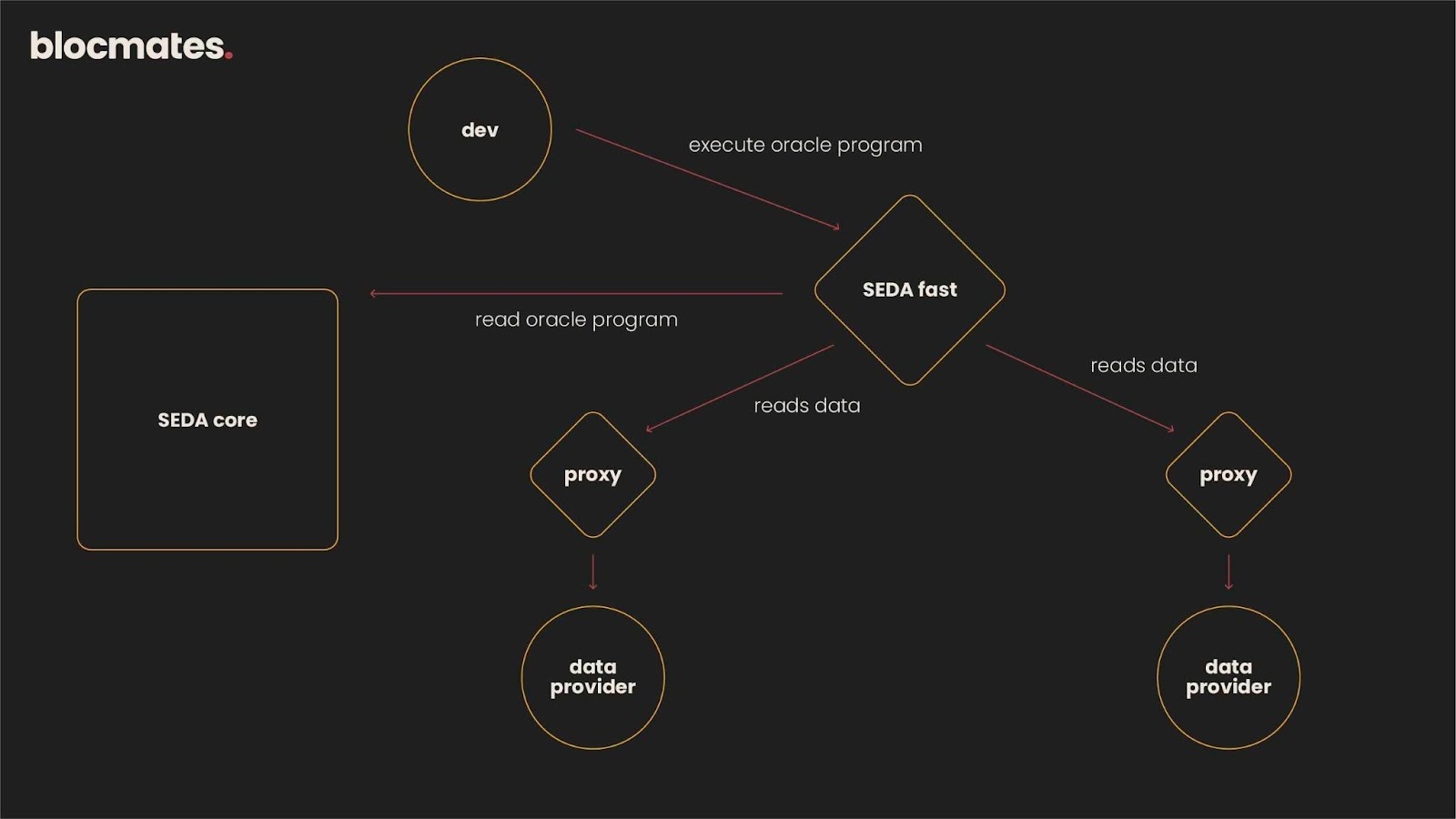
For such scenarios, developers can opt for SEDA Fast.
SEDA Fast is a high-speed version of SEDA’s regular onchain data delivery designed specifically for applications that may need real-time or near-instant data delivery.
Not much changes in terms of functionality. Developers still create Oracle Programs that will be on the SEDA chain, but in this case, rather than triggering the onchain data requests, developers call SEDA Fast’s API endpoint.
It basically uses an offchain execution engine to process the data request and then returns the result, which can be relayed to any chain and received by the SEDA Fast Prover contract that confirms data has come from the endpoint for verification purposes.
The core infrastructure and Oracle Program design process remain the same; only data processing and delivery are done offchain to enable faster transactions that aren’t limited by block times.
You will likely see perps protocols, prediction markets, FX trading protocols, commodity trading protocols, and so on utilize SEDA Fast.
How does SEDA work?
The SEDA network is made up of three components:
- Oracle Programs
- Data Proxies
- The SEDA Chain
At a high level, this is how all three of these components work together
- A developer looking to leverage SEDA’s programmable Oracle Infrastructure starts by building an Oracle Program (i.e., a smart contract)
- This Oracle Program is deployed to the SEDA Chain
- At the same time, there are data providers that deploy data proxies on the SEDA Chain
- Data Proxies are middleware between data providers and the SEDA network to ensure data is transmitted quickly and verifiably.
- Data Proxies are middleware between data providers and the SEDA network to ensure data is transmitted quickly and verifiably.
- The Oracle Programs interact with the data proxies to query for results.
- The developer's application then receives the programmable data based on the specifications in the Oracle Program.
- All of this is secured by the decentralized makeup of the SEDA Chain.
On top of this, you have two distinct delivery mechanisms.
1. SEDA Core
As mentioned earlier, SEDA Core is the permissionless data delivery mechanism that leverages the Solver Network and Prover Contracts to communicate data requests, trigger Oracle Programs, and return data results.
It works a little like this.
Once the Oracle Program is up and running, the application initiates a data request by calling the Prover Contract on the native chain. So an application on Solana will call the Solana Prover Contract.
As mentioned earlier, the prover is the smart contract that acts as the entry/exit point for data requests between the SEDA chain and any other blockchain. So this initiation triggers an event for relaying on SEDA.
Now, the Solver Network gets involved.
The solvers are constantly monitoring prover contracts for data requests, and once they see one, they submit a quote.
Once the quote is settled, the solver, which is essentially a bridge between SEDA and any other chain, relays the data request to the SEDA chain.
2. SEDA Fast
The other data delivery mechanism is SEDA Fast, an ultra-low-latency endpoint that uses offchain computing to trigger Oracle Programs and data requests in a hyper-performant way.
SEDA Fast is specifically designed for high-volume applications that need real-time dynamic data feeds. Think exchanges, perps trading, options trading, and so on.
In terms of how it works, it’s all very similar to SEDA Core.
The Oracle Programs remain the same, but the program will query the SEDA Fast endpoint, which will then communicate with the Fast Prover to communicate data requests and deliver data results.
Ultimately, all the offchain computation is published onchain with proofs, so you get the hyper-performant speed without sacrificing on transparency/verifiability.
That’s a high-level summary of how SEDA works. The future is here.
Why SEDA matters
Alright, I’m sure you’re tired of the technical nitty-gritties by now. So let’s get into the more juicy stuff. Let’s understand just how significant SEDA is for revolutionizing the onchain world.
1. New design space
With legacy oracles, the crypto world has been in the space of creating “use cases for feeds” rather than having “feeds for use cases.” We simply haven’t realized just how much legacy oracles have limited innovation.
With SEDA flipping the model on its head, the world has opened up to a whole host of different applications.
2. Perps for anything
Perpetuals are one of crypto's greatest inventions, and as more people begin to come onchain, the significance of perps will only grow.
But beyond trading crypto on leverage, perps can be applied to a wide range of assets, including collectibles, prediction markets, stocks, commodities, structured products, memes, and more.
Facilitating such applications thus far has been difficult because oracles have been static, which means building price architecture would be difficult and time-consuming.
SEDA’s flexibility not only makes this a possibility, but it can be done with ease.
- Equities, commodities, and pre-IPO - Although technically not novel per se, the existing versions of these products onchain face major drawbacks, especially during off-market hours, because they have to build their own pricing algorithms.
SEDA automates, simplifies, and improves the accuracy of this process.
Now, you will begin to see more mature TradFi assets onchain and tradable 24/7, without pricing issues, allowing them to support higher-volume activity.
- Ticketing - There are also a bunch of non-financial use cases possible with SEDA. One great example is ticketing.
Imagine a ticketing platform for flights and hotels. This platform can use SEDA to track weather data and dynamically adjust prices accordingly.
For example, if there’s a high chance of a blizzard as picked up by the SEDA oracle, it can trigger the platform to start a flash sale of tickets to Ski resorts.
- Financial engineering - SEDA unlocks a whole new level of onchain financial engineering.
Yes, many structured products already exist, but things can be taken to the next level with SEDA’s oracle feeds, as you can source data from other chains, other apps, and source things like rates or scores from the real world.
All of this can be combined into interesting automated strategies or structured products that are at the intersection of multiple verticals.
Like, just as a hypothetical, there could be a yield vehicle that has crypto assets, real estate, bonds, and some stocks all onchain.
- AI agents - AI agents will certainly play a huge role in crypto. They already do.
But SEDA can help them reach the next level.
Imagine being able to plug in real-time data on things like news, social signals, sentiment metrics, smart wallet analysis data, and TradFi market prices.
You plug all this data into an agent that automatically builds a trading strategy that keeps evolving with the data and trades for you.
This is just one hypothetical, but programmable oracles will be a game-changer for AI agents in crypto.
3. Backbone for institutional-grade onchain finance
The title is not clickbait; everything, sooner or later, is coming onchain.
When you have the CEOs of BlackRock, JP Morgan, Franklin Templeton, and so on harping on about tokenization being the future, it’s a matter of WHEN, not IF.
With this as the backdrop, the discourse then turns to ensuring we have the infrastructure to make this a reality.
So far, all the other pieces are in place. Blockchains are now scalable, onchain spot trading and perpetuals are flourishing, and the UX issues are more or less solved.
The only missing puzzle has been the oracle infrastructure.
SEDA will power institutional-grade finance onchain because it's the only technology available to take assets that mainly trade during market hours and allow them to be seamlessly converted into 24/7 global markets.
Whether it's RWAs, real estate, stocks, indices, commodities, lending, structured products, or any other major traditional asset, SEDA will be the go-to choice for powering the oracle feeds and price feeds for these products.
4. Reduce the DeFi repetition cycle
Just because we have TradFi coming onchain, it doesn't mean that DeFi is dead. Far from it. It, in fact, gives DeFi applications more of a chance to shine.
However, DeFi has been in a never-ending doom loop of repetition.
Every time a new chain launches, you have the same things over and over again. A DEX, a money market, an aggregator, a bridge, and some sort of yield product.
Eventually, when you have hundreds of the same products but on different chains, you reach a point of saturation.
SEDA enables the DeFi world to break this loop of repetition.
As mentioned earlier, it unlocks a completely new design space for onchain applications, and that means more innovation in the DeFi space, whether it be through new exchanges, different types of financial engineering, or new types of structured products. The possibilities are endless.
So once we have everything onchain, the next generation of DeFi applications have a chance to shine and benefit from the new users coming onchain, thereby giving the space a second wind of sorts.
5. Optionality without compromising decentralization
Beyond the optionality offered by Oracle Programs, SEDA also offers optionality in terms of product offering, as developers can choose between SEDA Onchain or SEDA Fast.
This way, everyone's needs are catered to, but it's done in a manner where decentralization isn’t compromised.
Everything is ultimately settled onchain, offering verifiability, permissionlessness, trustless data transfer, and transparency.
This is something that even a lot of legacy oracle providers cannot boast.
SEDA in action
I know what you’re thinking. “Yeah, all of this is well and good, but it's just words at the end of the day.” I agree, what good are words if the execution doesn’t match?
So here are a couple of examples of SEDA’s programmable oracle infrastructure in action.
1. Dreamcash
Dreamcash is a mobile app for the Hyperliquid trading interface that allows users to trade perps for a wide range of assets like crypto, indices, commodities, and so on.
Dreamcash leverages SEDA to have a continuous oracle feed stream for off-hours trading.
Having recently surpassed $3 billion in volume, it's safe to say things are going well for Dreamcash, partially thanks to SEDA’s technology.
Having recently secured a major investment from Tether, one can only imagine just how far this thing can go.
2. Perps.fun
Perps.fun is essentially a launchpad for perps on Hyperliquid. It leverages HIP-3 to create a perpetual market for literally anything.
SEDA will power the oracle feeds for all unlimited-perp markets on Perps.fun, including collectibles, prediction markets, volatility products, and whatever else people desire.
3. Helix App
Helix App is a lot of things, but one of the things they are bringing to market is a 24/7 perpetual market for pre-IPO stocks and indices.
They are leveraging SEDA’s oracle infrastructure as it's the only one capable of facilitating a use case so unique and dynamic.
4. Nunchi
Nunchi is an exchange for yield that is offering a new primitive that they call a perpetual yield swap or a yield perpetual.
They will be leveraging SEDA fast in combination with Pyth to get the prices and rates for their platform. It’s genuinely innovative stuff going on here.
5. HyperOdd and VDEX
HyperOdd and VDEX both offer perpetuals for a variety of asset classes, but one of the more interesting ones is perpetuals for prediction markets.
Fortunately for them, SEDA's technology is perfect to make it easy to create the pricing architecture for such a product and offer a smooth user experience.
6. Pyth
On a lot of products that leverage SEDA, they are doing so in a Pyth and SEDA combination.
In some cases, Pyth may provide the relaying infrastructure that works with SEDA fast, or in other cases, Pyth may be used for something like market hour prices, while SEDA is used for off-hours or continuous market pricing.
Tokenomics
Here’s the bit that most of y’all are here for.
Yes, this technology is revolutionary, and yes, as the title says, you can own it. We often talk about “pick and shovel” plays; now imagine owning the shovel that brings EVERYTHING onchain.
The SEDA token is the core economic driver of the SEDA network, so unlike most tokens, the success of the SEDA network = the success of the SEDA token.
Here are the key functions of the token:
1. SEDA burn
Data delivery on SEDA is done through two pathways, SEDA Onchain and SEDA Fast.
In both scenarios, network resources are used for purposes like storing, processing, querying, executing, and securing.
The value of each computation on the network is reflected through a deterministic burn model.
Essentially, as the usage rates and execution rates on SEDA increase, the burn of the SEDA token happens in proportion to that network usage.
So, the more the network is used, the more SEDA tokens are burned.
Therefore, the success of SEDA as a network will likely loop back into the success of the SEDA token.
2. The growth engine
The magic of SEDA is that the token mechanics activate in line with an increase in network usage.
Therefore, ecosystem expansion is of utmost importance.
SEDA not only improves on existing crypto infrastructure but also enables use cases that weren’t previously possible.
With more builder activity, there are more Oracle programs and increased network usage. With increased usage, the SEDA burn mechanics amplify.
As SEDA continues to expand its ecosystem through integrations and partnerships to eventually become the baseline Oracle infrastructure for onchain markets, its success will be accentuated by the SEDA token.
- Staking - To run an overlay node or solver, users must stake SEDA tokens. For participating in the network, these stakers receive staking rewards but may also have their stake slashed if found to be acting maliciously.
- Transaction fees and token burns- SEDA tokens are used to settle costs associated with network activity. Data requests, solver quotes, data provider fees, and gas fees are all handled using the SEDA token, making it the economic driver of SEDA.
- Governance - Pretty standard one. Token holders will be able to vote on proposals for upgrades and other activities on the SEDA network.
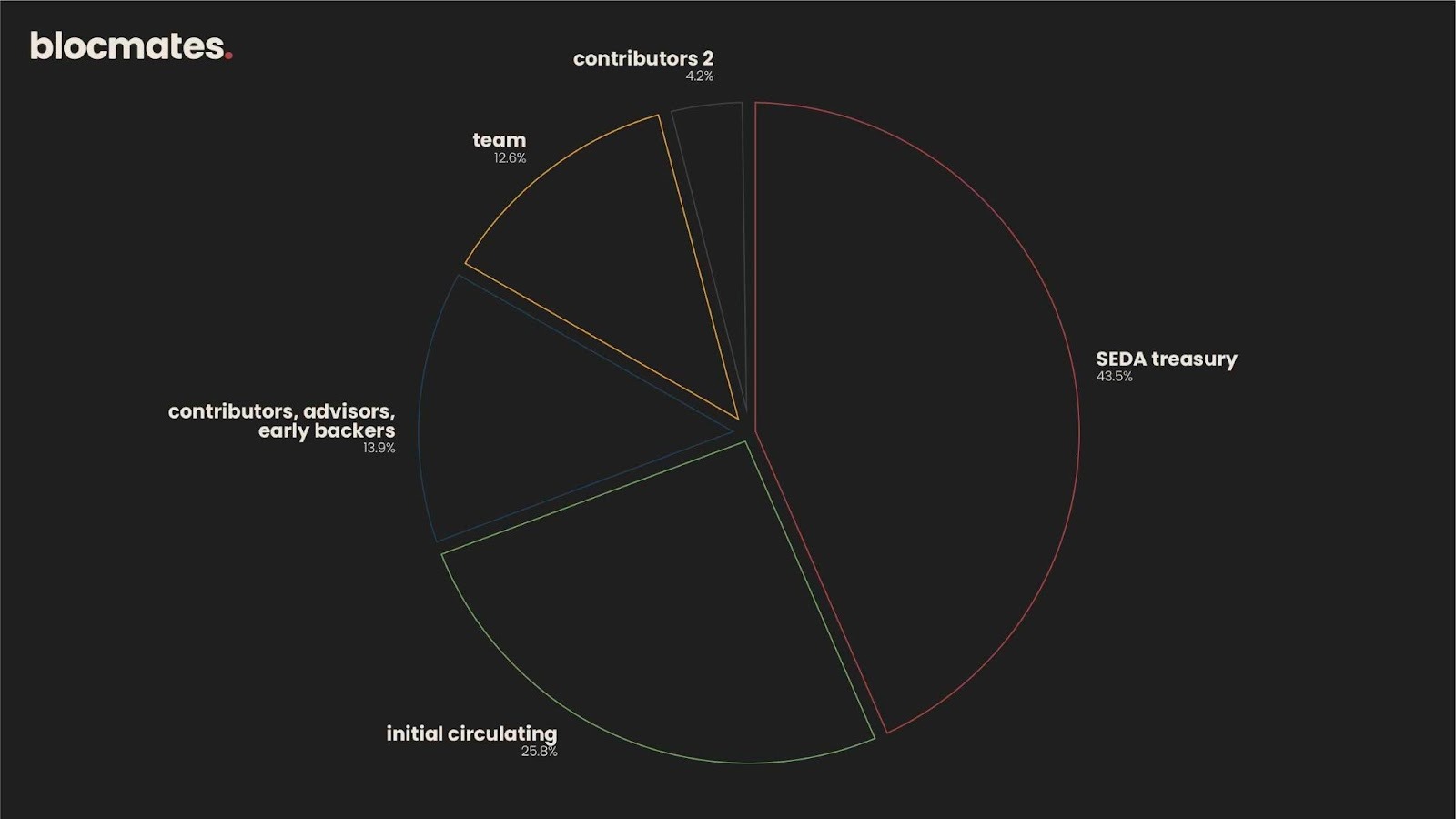
The current circulating supply is 1,000,000,000, and it’s distributed as follows:
- SEDA treasury - 43.5%
- Initial circulating supply - 25.8%
- Contributors/advisors/early backers - 13.9%
- Team - 12.6%
- Contributors two - 4.2%
SEDA has raised a total of $22 million thus far from backers such as Coinbase, Maven 11, Distributed Global, GI Ventures, and many other notable angels.
Concluding thoughts
In an industry that moves at the speed of light, it’s very easy to miss the forest for the trees.
In reality, there are only a handful of times when we encounter technology that is genuinely game-changing.
Oracles have always been the backbone of some of the most important products that have come out of the crypto world, but with things running fine so far, nobody really thought to look at the fact that there’s more to be done with them.
The gigabrain team at SEDA simply flipped the oracle model on its head and has, all of a sudden, unlocked a completely new design space for onchain applications.
The level of innovation, financial engineering, and application product quality enhancement will be taken to a whole new level. It’s just a matter of time.
The early strides are already visible with products on Hyperliquid. In a couple of years, when every asset is onchain, don’t be surprised when you see that SEDA is behind the pricing architecture.
The opportunity here is simply massive; I wouldn’t bat an eyelid away from SEDA if I were you.
Thanks to the SEDA team for unlocking this article. All of our research and references are based on public information available in documents, etc., and are presented by blocmates for constructive discussion and analysis. To read more about our editorial policy and disclosures at blocmates, head here.






.webp)
.webp)

.webp)
.png)
.webp)

.webp)
.webp)
.webp)
.webp)








.webp)

.webp)

.webp)
.webp)
.webp)
.webp)
.webp)






.webp)
.webp)
.webp)
.webp)
.webp)


.webp)
.webp)


.webp)


.webp)




.webp)


.webp)


.webp)












.webp)


.webp)




.webp)
.webp)
.webp)

.webp)








.webp)

.webp)

.webp)





.webp)