There it is. A platform that finally turns losses into tangible wins. It's paradoxical, and yet it works.

Some call it the next ponzi doomed to collapse. Others? Well, the others are us, and we’re here for the chaos.
Here’s all you need to know about PaperTrade.
What is PaperTrade?
PaperTrade is a novel perp venue where users can trade any asset on Hyperliquid with up to 1000x leverage, zero slippage, and no funding costs or trading fees, all without relying on its own order book or oracle.
On PaperTrade, when you open a trade, you’re not directly placing an order in the asset’s order book on Hyperliquid or trading against other users.
Instead, the counterparty is an LP, similar to GMX v1, with asset prices determined by a BBO mid price, which is the exact midpoint between the highest buy order (bid) and the lowest sell order (ask) for any given asset on Hyperliquid.
Where the LP replaces the order book, the BBO mid price obviates the need for a classical oracle, eliminating the choice between trusting a centralized operator or running a decentralized one that's slow and expensive.
On PaperTrade, asset prices are continuously streamed to a smart contract on the HyperEVM via L1 read precompiles.
If you’re wondering what precompiles are, it’s just a means of querying information such as perp positions, spot balances, vault equity, staking delegations, oracle prices, and the L1 block number directly from HyperCore (the consensus layer that runs Hyperliquid’s native spot and perp order books).
Herein also lies the reason why there are no funding costs, trading fees, or slippage.
When you open a position, the contract reads Hyperliquid's BBO mid and locks that price as your entry. When you close, the contract reads BBO mid again and settles PnL directly against the LP.
Because no actual perpetual contract changes hands on Hyperliquid, there are no funding costs. Ingenious, isn’t it?
But this isn’t even the fun part.
Martingaler LP
The most clever aspect of the platform is the LP design.
According to the whitepaper by Jez (@izebel eth), a martingaler LP is a bootstrapping mechanism for sustainable asynchronous speculation games of chance.
Sounds a bit like gambling, doesn’t it? Well, the paper describes this as a mechanism that can help betting games address common problems, such as the need for initial liquidity providers and their incentivization, constraints on bet sizing, and solvency concerns.
Regarding the topic at hand, however, the martingaler LP cleverly sidesteps the typical liquidity bootstrapping route, which involves venues entering into market-making agreements or posting their own liquidity, which is not cheap if you want to be competitive.
When PaperTrade eventually goes live, there will literally be no liquidity in the LP. And that’s by design. Instead, traders will simply begin trading, and depending on whether they win or lose, two things will start to happen.
The winner’s route
For the sake of argument, let’s say the first trade that ever happens on PaperTrade ends up being with a positive PnL. In this case, how would the platform ever dream of disbursing the funds if there is no money sitting in the LP?
Technically, this means the protocol is insolvent from day one. Not off to a great start, are we? But hold your horses, as we are yet again met with an Oppenheimer-worthy bombshell.

If a trader wins a trade and the protocol cannot pay out the full amount (margin + winnings), the margin is always returned to them, and the remainder of their position (winnings, minus an asymmetric impact haircut) is placed in a first-in-first-out (FIFO) queue.
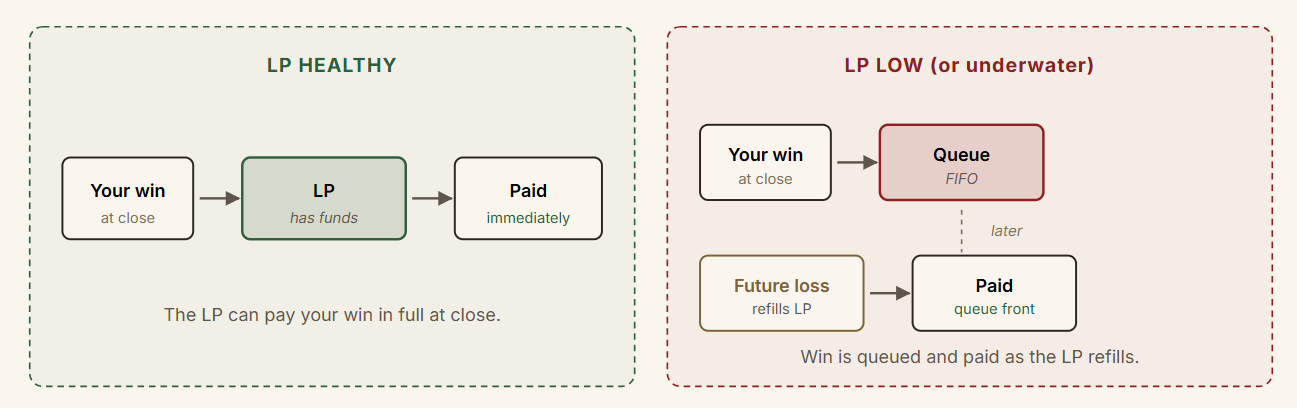
Thanks to this queuing mechanism, the platform can never become insolvent in the traditional sense, as long as traders keep coming back. We'll explain a tad later why someone would choose to trade under these conditions.
Going back to the trader, keep in mind they’re the first in line to earn profits from the LP. To understand what occurs next, let’s examine a trader who loses their trade right after.
The loser’s route
You saw the news about Michael Saylor bidding BTC, and after hearing it, you open a 1000x position on PaperTrade and go all in, hoping for a quick buck.
Unfortunately, the market moves against you, and within 15 seconds, your position is liquidated.
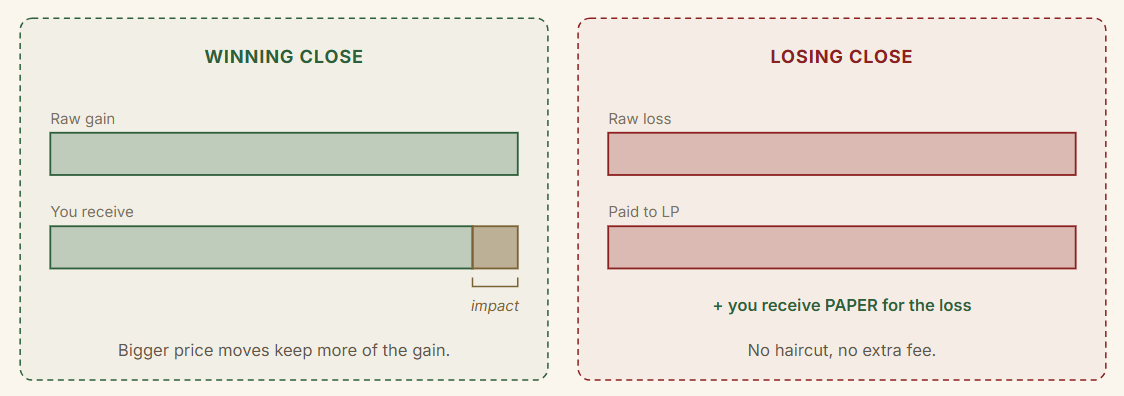
Since the LP is the counterparty, all losses from losing trades are added to it. Turns out, the chap in front of you was just waiting for this moment, as he was the first in line to collect his profits.
For him, the protocol disburses his raw gain with a small haircut, and the party continues.
But what about you? On any other platform, that’s the end. Day ruined.
Lucky for you, however, your losses are actually encouraged on PaperTrade, and you end up getting a nice little token of appreciation in the form of PAPER.
PAPER tokenomics
PAPER is the native token of the protocol, crafted with a distinctive fair-launch structure to encourage participation, while providing a genuine reason to hold it.
There will be no pre-mint, no team or VC allocation, no airdrop, and no vesting schedule.
Every token that will ever exist must be minted through an onchain emissions curve, and only traders who close at a loss or get liquidated can trigger a mint.
However, the number of tokens minted varies based on the LP's state. If the LP is below a $2 million USDC threshold, including when it's negative, the emission rate is fixed at 100 PAPER per $1 increase in LP.
Anything above $2 million, and the issuance slowly decays.
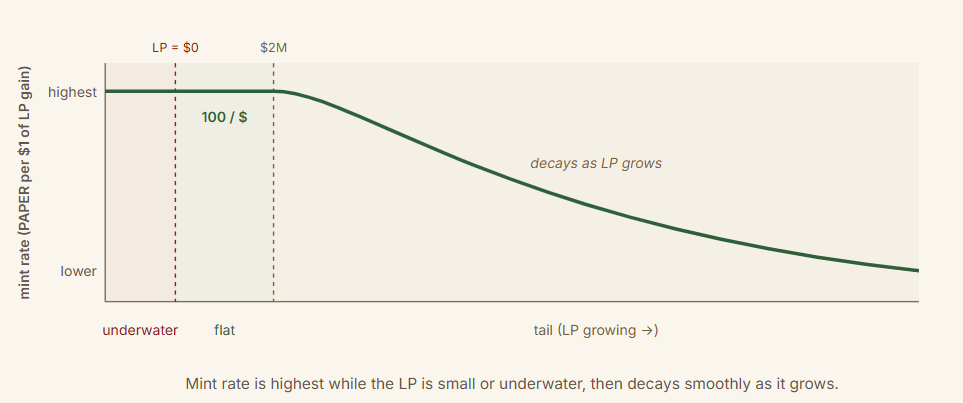
To explain why traders would be willing to trade even when the protocol is in a low-liquidity state or is outright in debt, PAPER is the LP's fee-claim token. By acquiring the token, you’re effectively claiming a stake in the protocol’s future revenue.
Staking PAPER grants a proportional share of the protocol's future revenue, strongly motivating users to trade when the LP is in a negative position or below the $2 million threshold, thanks to the increased PAPER emissions.
The revenue? That mainly comes from the asymmetric impact, which is a fee charged on winning trades. Secondly, once the LP exceeds $5 million, every dollar of additional LP gain thereafter is fully distributable to stakers.
Conclusion
It's been a while since something as unique as PaperTrade has come up, and the buzz it has created is well-deserved.
What I appreciate most is how PaperTrade blends the rather uninspiring act of trading perps with a sprinkle of gambling mechanics, turning it into a playground for game theorists (degenerate gamblers).
The trick lies in the perception that the game is +EV for the trader because it immediately remunerates them with a liquid token in case of a loss.
Clearly, early traders earn significantly more PAPER per dollar lost compared to late traders. As a result, we can anticipate a surge of activity right at the start, since the EV is at its peak (tokens are scarce and therefore highly valuable).
What is interesting, however, is how the martingaler LP addresses the conundrum the house typically faces regarding solvency later on in the lifecycle.
While traditional houses are "fragile" to variance (a long winning streak by players can bankrupt them), PaperTrade employs high token emissions that incentivize participation and a queue-based system that “guarantees” payout to winners, inevitably recapitalizing the LP when it needs it most.
Given that, on a long enough timeline, the “impossible” winning streak becomes a mathematical certainty, there will come a time when people see ultra-high emissions kick in again as the protocol edges toward insolvency.
And there is a fair share of skeptics out there who think the design is not sustainable due to other reasons as well.
Beyond the technicalities, my simpleton brain thinks the protocol's fate will ultimately hinge on whether the appeal of acquiring the $PAPER token is enough to motivate people to recapitalize the LP, or whether those waiting in line end up empty-handed.
Regardless of your stance, there’s no denying this is a cool experiment that clearly has had a lot of thought put into it and will surely bring a much-needed sense of fun to trading.







.webp)

.webp)
.webp)

.png)

.webp)

.webp)
.webp)
.webp)
.webp)








.webp)
.webp)

.webp)

.webp)
.webp)

.webp)
.webp)










.webp)
.webp)
.webp)
.webp)
.webp)
.webp)


.webp)
.webp)


.webp)


.webp)




.webp)


.webp)


.webp)













.webp)




.webp)









.webp)
.webp)
.webp)

.webp)










.webp)

.webp)


.webp)





.webp)