
Reading time: 7m 12s
Sometimes I get funny looks when introducing myself to fellow crypto researchers by telling them I started my career in the space industry. I’m still a moon-boy, now just in more ways than one.
But yeah, it probably seems odd that this moon-boy thinks the most exciting company in space right now is building, functionally, a tow truck.
The TL;DR is that getting to orbit is nearly a solved problem, and Starship is about to make it embarrassingly cheap. What’s up in the air (or… orbit) at this point is what happens after the rocket drops you off. Impulse Space is building out that logistical layer, and I think it could be one of the most durable bets in the 21st century space economy. The catch, and we’ll spend the back half of this piece on it, is that their highest-volume potential customers are often the ones best placed to build it themselves.
All dressed up with nowhere to go
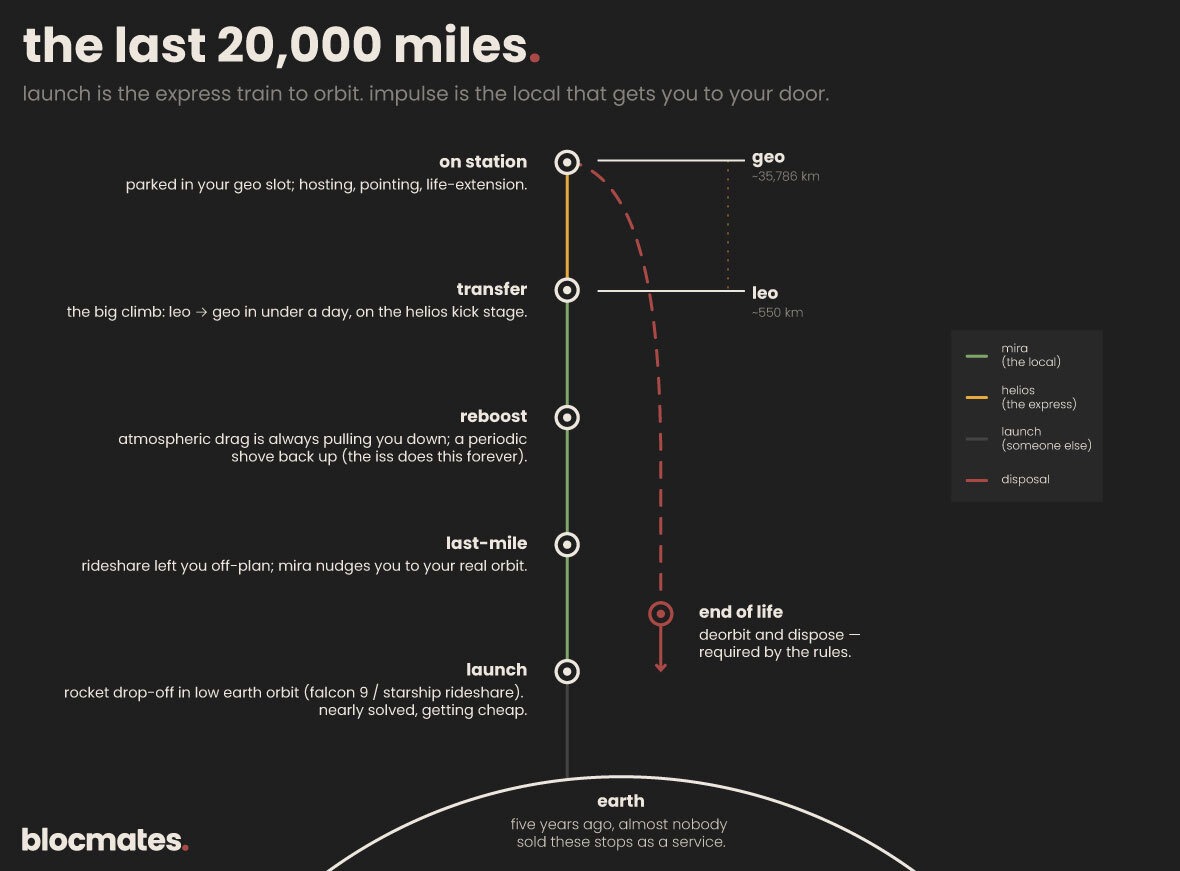
After you’ve hitched your ride aboard your rocket and dropped off, you’re basically on your own. You can’t refuel, so the day your tank runs dry, an otherwise healthy satellite becomes a very expensive projectile.
But what if your mission changes, or you need a boost due to atmospheric drag, or the rocket dropped you off at an orbit that’s slightly off-plan, or you spend all of your fuel avoiding space debris?
Right now, almost nobody is selling the service that supports on-orbit spacecraft life post-launch.
We’ve actually already run this experiment down here on solid ground. Cheap shipping didn’t kill the logistics industry, it supercharged the entire stack. Industry leaders and subindustry leaders carved niches into every nook and cranny, building a multi-trillion dollar empire on the back of reliable and inexpensive transportation.
Cheap bulk transport to space gets closer and closer after each successful Starship launch, but it has basically none of the logistics beyond that.
What Impulse actually is
Impulse was founded in 2021 by Tom Mueller (SpaceX employee number one), the guy who designed the Merlin and Draco engines that fly on Falcon 9 and Dragon. For making rocket engines, this is roughly like having Hendrix start a guitar company.
Right now, the company builds two products.
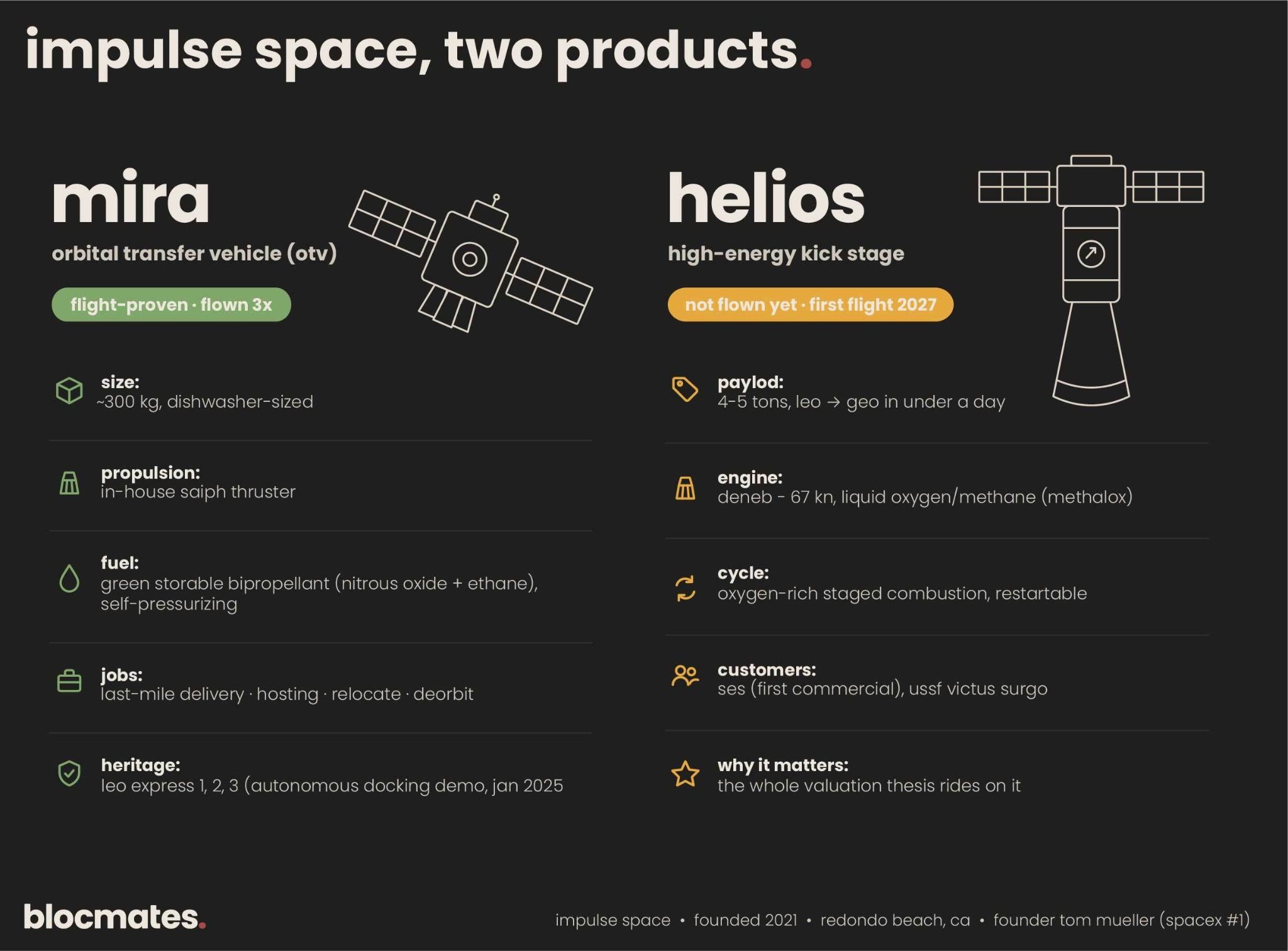
Mira is a small orbital transfer vehicle (OTV), a dishwasher-sized space tugboat that can grab your payload and maneuver it to a new orbit or bring it down through the atmosphere at the end of its life. It has actually flown three times, which in this field is shockingly rare (most competitors are still flying PowerPoints).
Helios is a strap-on kick stage that can bring 4-5 tons of satellites from Low Earth Orbit (LEO) to Geostationary Earth Orbit (GEO). Think of it like a taxi service. Sure, 200 people can load onto a jet flying from London to Paris, but your family still needs your ride to Versailles sorted once you land. Helios is the last mile (actually closer to last-20,000-miles) transfer service you sign up for so you don’t have to shell out for a dedicated rocket launch.
The only catch with Helios is that it hasn’t flown just yet (scheduled for ~2027).
The boring part that pays the rent
The best part of the model is that the problems Impulse solves, namely:
- Moving you to the orbit you actually wanted
- Giving you a boost if atmospheric drag is bringing you down (see: ISS)
- Latching on and providing temporary power, pointing, relaying, etc. (hosting)
- Deorbiting dead satellites at the end of their life (which is required, btw)
These can be offered as one-off or as a subscription service, especially if you’re going to be flying as many satellites as some of these entities want.
So let’s meet these potential customers, because while some will just build their own internal processes for handling these use cases, plenty would rather buy from a flight-tested provider.
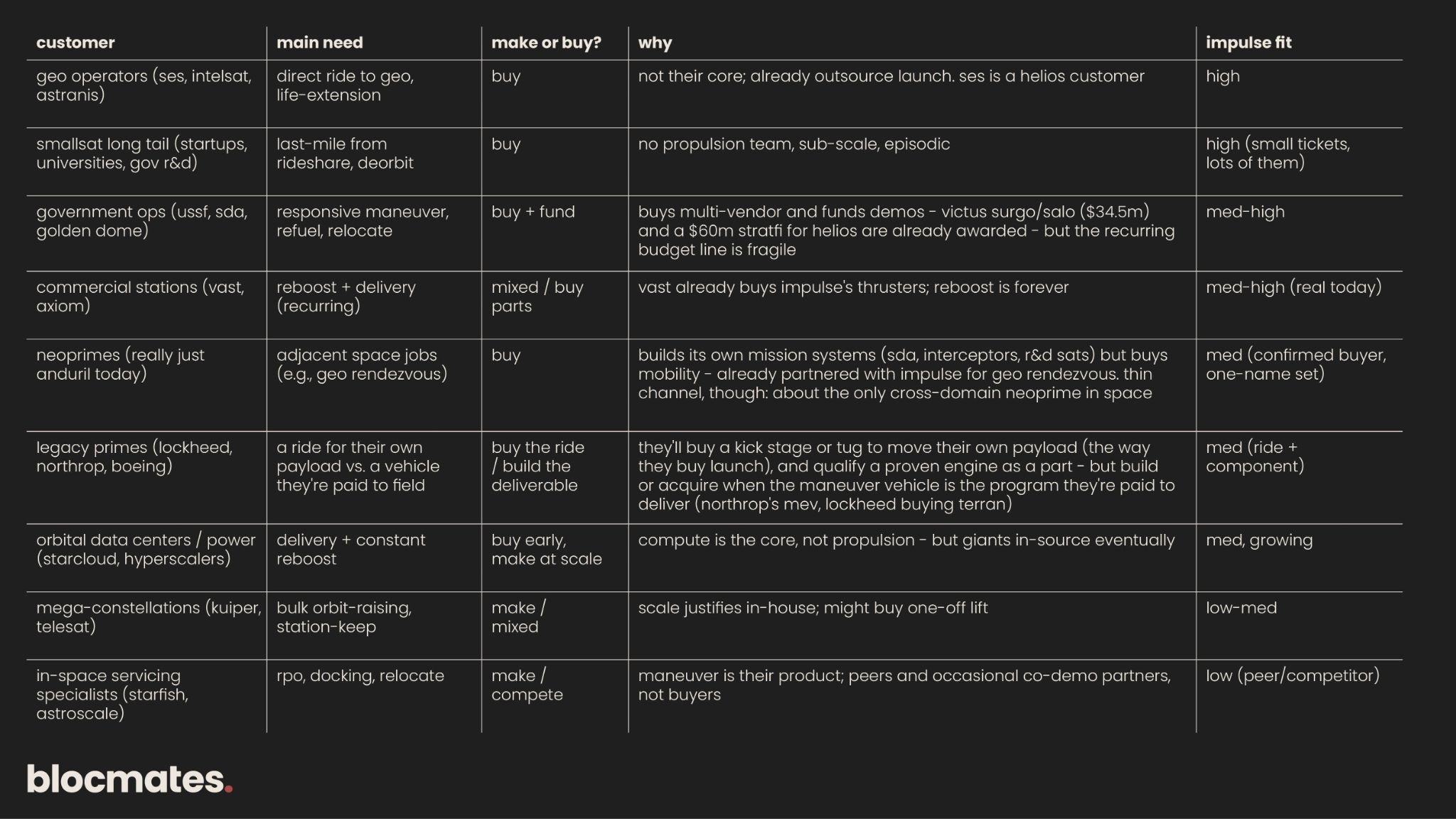
In the end, I see the main customers for Impulse being the fat long-tail of satellite operators (SES is already a customer), government/military (the $34.5 million VICTUS contracts and a $60 million STRATFI award already in place), and the upcoming swath of commercial space stations (Vast is already a customer).
On the other end of the spectrum is the vertical-integration king, SpaceX, who I’d bet is the scariest wildcard on the board - likely capable of capturing a large chunk of the “on-orbit logistics” segment if they set their minds to it.
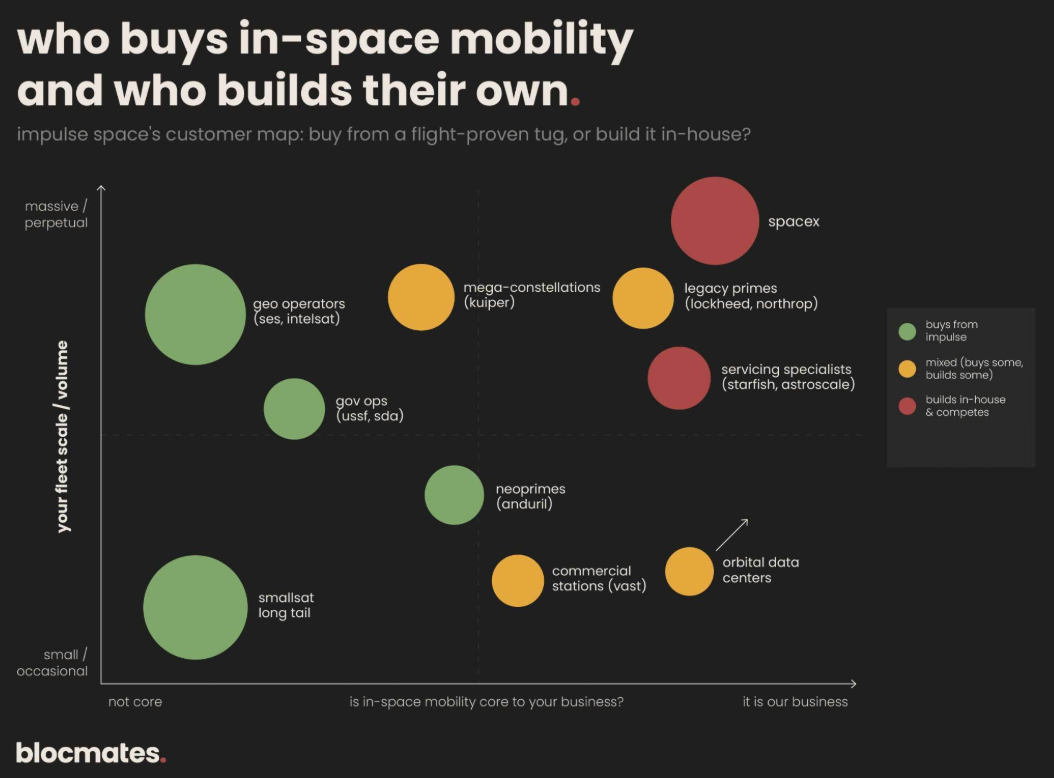
In the middle, where players like legacy defense prime contractors (Lockheed, Boeing, etc.), neoprimes (Anduril and whoever decides to join them in space), and the slew of hyped use cases like orbital data centers and mega-constellations live, my gut feeling is that we will see an inconsistent mix of folks preferring to build their own servicing/logistics in-house vs. buying a solution direct from Impulse.
It will probably look rosy in the beginning, with most opting for the simplicity of buying a flight-proven design (Anduril already partnered with them) before needing to consider vertical integration once their volumes justify the switch.
Our take: the road ahead is honest work
So I’m excited. But let me take off my perma-bull hat for a moment, because the trail ahead is not cleanly blazed.
Helios - the product the entire valuation leans on - hasn't flown, and its first flight already slipped from 2026 to 2027. Impulse is valued around $4.3 billion, sitting on top of a market that's still thin: industry estimates put today's orbital-transfer business somewhere around $1 to $3 billion, depending on whose report you trust, and most of that is demos and study contracts. Either way, the company is worth a healthy multiple of the slice it actually sells into today.
The government is the other tease. The Space Force will not stop talking about needing a "maneuver force," and it has actually backed that up with Impulse - the VICTUS SURGO and SALO awards and the STRATFI money for Helios are real dollars on the table.
And then it went and cut the dedicated budget line for space mobility and logistics to under $10 million for fiscal 2027. The demos are funded, but the recurring program of record is not (where the real money comes in). Talk is cheap, and I’m guessing investors are hesitant (for now) because of this disconnect.
And then there's the big one: SpaceX. Impulse has relied on Falcon 9 to reach orbit, while SpaceX is also the one company on Earth with the depth to build a competing tug the moment it decides on-orbit logistics is worth owning. This niche has its casualties, too - Momentus is on life support and Terran Orbital got sold to Lockheed for scraps. Nobody should pretend this is a sure bet.
To be fair to the bulls, here's what someone paying $4.3 billion is actually betting: 1) that Starship collapses the cost of reaching orbit, 2) that the collapse turns today's narrow transfer business into the whole in-orbit logistics layer - servicing, refueling, reboost, hosting, deorbit - a market many times larger, and 3) that Impulse, the only player with hardware already flying, becomes the default plumbing for all of it.
If you believe those three things, the $1-3 billion OTV market might look tiny in comparison to the entire on-orbit logistics business. Now it just comes down to execution.
Zooming out on the industry that doesn’t exist yet
Whether Impulse specifically ends up a winner is almost the less interesting question. There’s an entire industry forming a few hundred miles above your head, and I feel like not enough people are talking about it. You’ll see headlines about rockets or satellites (and data centers in space), but the mundane layer in between is being neglected by most pundits.
Let’s play this forward a couple decades. Starship (and competition) has made getting up there cheap and the amount of activity on-orbit has increased by an order of magnitude or two. Fuel depots are parked in orbit like rest stops on a highway. Tugs are running routes from LEO to GEO the way container ships criss-cross the Pacific.
Factories are manufacturing fiber and pharmaceuticals you can only make in zero-g, data centers are training models against the backdrop of the stars, and crews on commercial space stations get restocked like clockwork.
None of the sci-fi stuff happens without the boring layer holding it all together - the roads, the gas stations, and the tow trucks of space.
Boring is good. Boring means that the industry has matured to the point where you aren’t pulling off to the side of the road on the drive home from work to watch every Falcon 9 landing attempt (good times). It means the sector is growing up instead of just raising money - and Impulse is the furthest along. Real hardware, a uniquely-positioned founder, and an order book already filling up with commercial and government customers.
We’re calling it a credible early leader in an industry that feels close to inevitable in shape, but wide open on timing and on who wins - especially when the sector leader has the resources to one-shot you if they really want to.
So do me a favor. The next time you read “Company XYZ wants to launch a 10,000 satellite constellation” or “build a datacenter in space” or “start a zero-gravity drug factory,” consider the next logical question - what kind of logistics will be required to maintain all of this? Five years ago, that question was irrelevant. And the fact that we now have to consider it makes this moon-boy stoked about our space-faring future.
Disclosure: Impulse Space is private and I have no exposure to it or its competitors. This is independent research and opinion, not investment advice.










.webp)

.webp)

.webp)

.png)



.webp)



.webp)
.webp)

.webp)
.webp)
















.webp)

.webp)


.webp)





.webp)
.webp)




.webp)

.webp)




























.webp)
.webp)
.webp)

.webp)
.webp)
.webp)


.webp)
.webp)


.webp)


.webp)





.webp)


.webp)



.webp)






















.webp)







.webp)















.webp)

.webp)
.webp)

.webp)














.webp)

.webp)


.webp)







.webp)