Reading time: 9m 26s
If you’ve ever read any headlines about quantum computing or fusion reactors (not to be confused with contemporary nuclear reactors), they’re always presented as groundbreaking and suggest they’ve been solved.
As a result, there’s a common joke online that these technologies are always "just a decade away," which, funnily enough, has been the case for the last three decades or so.
Contrary to what the sensationalist news columnists tell you, unlocking what may be the final energy source humans will ever need or literally taming the building blocks of the universe is not something that’s just one key roadblock away, like finishing a crossword puzzle.
Whether these technologies materialize at scale is an open question, but dismissing something because it's taking longer than investors can bear would be foolish.
A more contemporary example of this is confidential stablecoins. The topic of private money has been around for eons, but the recent advent of digital money and the surge of stablecoin adoption have made money too transparent.
So, are confidential stablecoins going to be that new long-awaited solution?
In that same vein, there is another lesser-known technology that was first conceptualized in 1978, and for most of the time since, it was unclear whether a solution existed due to the enormous computational requirements.

With advancements in hardware, algorithms, parallelization, and memory bandwidth, it has moved from a mathematical pipe dream to the potential to become the ultimate tool for protecting our God-given right to privacy in a world so hell-bent on toppling it.
Often referred to as the holy grail of cryptography, Fully Homomorphic Encryption (FHE) is the next generation of public-key cryptography, where you can run programs directly on encrypted data without revealing its contents.
Though the benefits of FHE are far-reaching, today we’ll be unpacking it in the context of distributed systems, particularly blockchains, and how the industry stands to benefit from this tech.
FHE vs. other privacy solutions
Traditionally, all blockchain transactions happen in plaintext. Plaintext is essentially the raw transaction data, things like account balances, transfer amounts, and other transaction details.
The purpose of privacy tools is to encrypt the plaintext into ciphertext, which is just a bunch of numbers and letters mashed together that looks like gibberish without a decryption key.
Unfortunately, most crypto-specific privacy technology has an element of decryption at some point in the transaction data’s life cycle:
- Zero-knowledge proofs (ZKPs) - The “prover” or the entity generating the ZK proof must decrypt and access the plaintext to generate the proof. This is a vulnerability point for data privacy.
- Trusted execution environments (TEEs) - The data is encrypted throughout, but decrypted within the TEE's enclave. So, if the hardware is flawed or falls into the wrong hands, all that data is vulnerable to leaks.
- Multi-party computation (MPC) is often considered a secure privacy technology, but it assumes there will be no collusion among parties with split or shared data. In the event of collusion, the data is at risk.
With FHE, however, you can perform complex computations, such as additions, subtractions, or, in the case of crypto, smart contract logic, directly on encrypted data without decrypting it at any stage.
The transaction data is encrypted at the source and at every stage, from creation to execution to validation to finalization; all the computations take place on this encrypted data.
Unlike other privacy solutions, FHE seems to tick all the boxes. Data is never decrypted at any point, makes no trust assumptions, does not require third parties to handle the data, and does not rely on third-party hardware to secure the data.
But arguably the most important benefit of FHE, specifically in terms of future-proofing, is its quantum-resistant capabilities.
You see, leading FHE schemes are built on something called lattice problems. We don’t need to get bogged down with the technical jargon here, but lattice is the foundation of what makes the technology quantum-resistant.
But we wouldn’t be here if not for a catch. The primary limitations of FHE are its sluggishness and computational cost, which make it exceptionally hard to implement in distributed systems.
The topic of today is how a particular project, Fhenix, is solving this, and even doubling down with an acquisition of a pioneer in the FHE x blockchain arena.
What is Fhenix?
Founded in 2023, Fhenix is an R&D company specializing in bringing FHE privacy solutions to onchain finance.
At its core, Fhenix is trying to solve one of crypto’s biggest challenges: bringing confidentiality to finance without giving up the benefits of being onchain.
Both founders, Guy Zyskind and Guy Itzhaki share more than just their first names when it comes to their knowledge of cryptography and blockchains.
For those who remember the good old Cosmos days, Guy Zyskind, who holds a PhD in applied cryptography from MIT, was the brain behind Secret Network.
Based on TEEs, it was among the first privacy-focused blockchains to support actions beyond sending and receiving coins, enabling virtually any smart contract logic, such as private swaps or lending and borrowing.
Guy Itzhaki brings his own set of skills, particularly from years of experience as a director in Intel's Homomorphic Encryption and Blockchain Division.
On the research front, the team holds several accolades. The most notable is an award-winning paper released last year titled “High-Throughput Universally Composable Threshold FHE Decryption.”
It introduced a novel decryption method that doesn’t use "noise flooding," a status quo technique used for ensuring that the ciphertext cannot be decrypted by third parties, and uses a Multi-Party Computation (MPC) rounding technique instead.
If pushing the boundaries of decryption wasn’t challenging enough, these maniacs also released their own encryption method, DBVF, designed specifically for DeFi protocols, lending markets, and enterprise financial tasks.
Together, these solutions improve throughput by roughly 20,000× and reduce latency by up to 37× compared to other state-of-the-art methods and form the cryptographic foundation for CoFHE, Fhenix’s solution to bringing privacy to all of DeFi.
CoFHE: Enabling confidential smart contracts
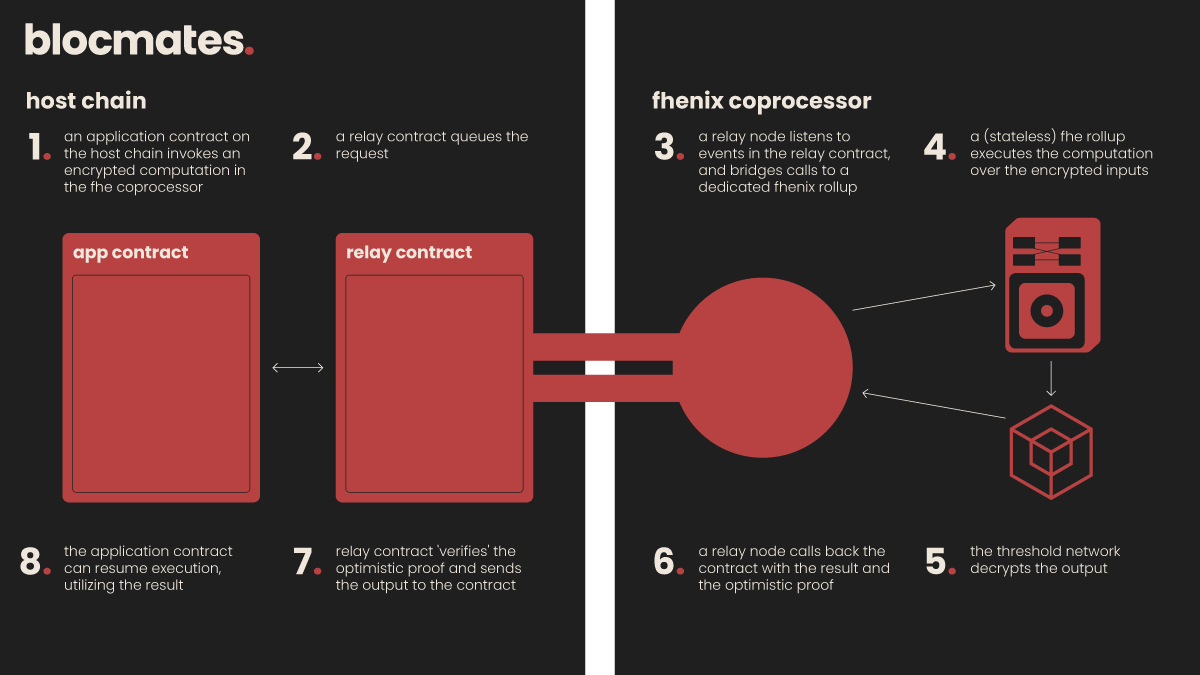
Instead of requiring developers to understand the intricacies of FHE or migrating to an FHE-enabled blockchain, Co-processor for Fully Homomorphic Encryption [CoFHE] brings privacy to an application’s doorstep with a single Solidity import.
The system combines onchain smart contracts with offchain processing to deliver secure, efficient, FHE operations.
The offchain coprocessor is what helps Fhenix avoid the long-standing performance issues associated with FHE.
It handles encrypted computations, and the results are subsequently committed back to the onchain ledger, which is verified via EigenLayer’s restaking network.
If we dig a little bit deeper, the data flows through four stages, ensuring privacy throughout its lifecycle:
- Encryption request: Manages the secure encryption of input data via ZK proofs before it enters the blockchain.
- FHE operation flow: Handles the process of requesting and executing computations on encrypted data.
- Decryption request: Processes requests to decrypt data using the Threshold Network.
- Decrypt/seal output: Enables users to access encrypted results while maintaining privacy.
So what does this unlock?
Crypto has always been in a state of 100% of transparency. Which, for those of us who’ve been around a while, is fine. We’re used to it. In fact, a lot of us enjoy it.
However, to go to the next step of institutional adoption or even general mainstream consumer adoption, 100% transparency is a no-go. A mix of transparency and privacy is the way forward.
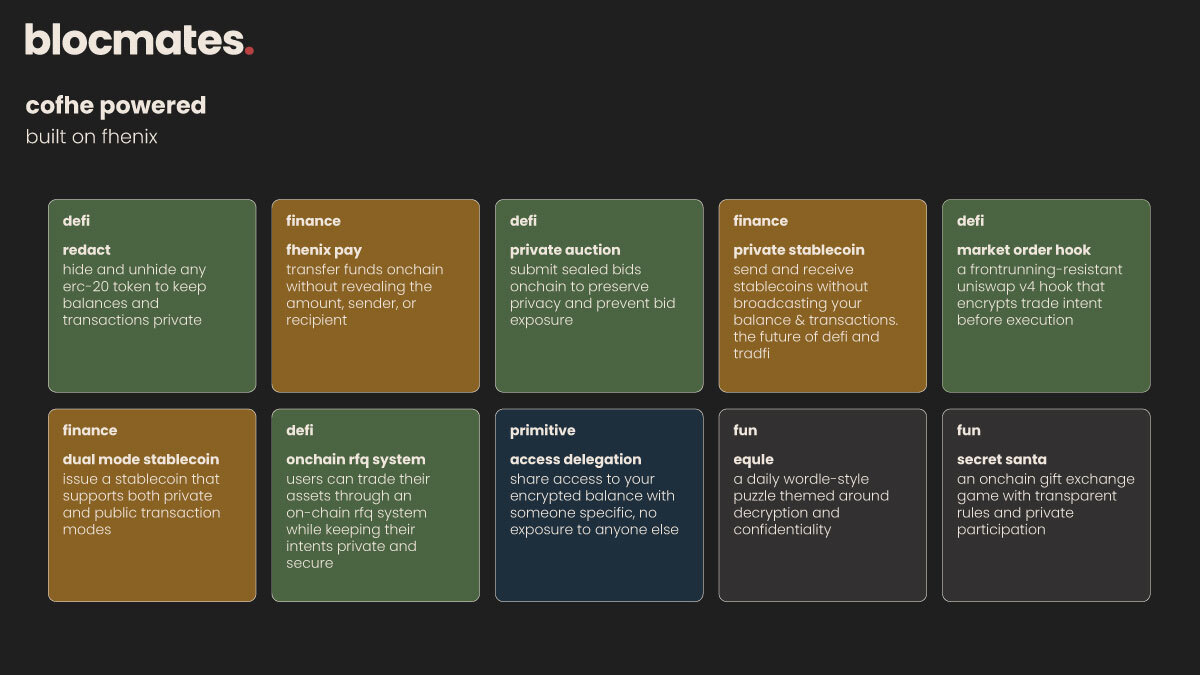
So, with a system like CoFHE, you unlock things like confidential stablecoins for payments.
Supply chain companies, employee salaries, payments networks, consumer transactions, and everything else can come onchain and still remain private.
But privacy is not antithetical to compliance. Because of the decryption key, this confidentiality can be compliant in situations where regulatory involvement is required.
So yes, Fhenix does create privacy technology, but it’s also financial infrastructure, ushering in a new age of confidential finance.
After numerous iterations that enhanced the mechanism's flexibility, composability, and other complex aspects beyond my understanding, it's important to note a caveat.
Similar to many Ethereum Layer-2 [L2] networks, CoFHE runs on 'training wheels,' meaning, for the time being, certain trust assumptions and centralization points are in place to let the team ship quickly and iterate on user feedback.
The other option is years of research and development with nothing to show for it, which, in the industry we’re in, means a project is dead in the water.
And truthfully, has the notion of temporary centralization stopped people from using L2s or Hyperliquid? Not one bit.
If the product is good, people will use it regardless, even if it's not in its final form.
As of today, testnet versions of CoFHE run on Ethereum, Arbitrum, and Base, so before you jump out of your seat in excitement, we’ll have to wait just a tad longer.
How long? Tough to tell, but considering Fhenix has just secured an immensely valuable asset that will undoubtedly propel their efforts, we might get it sooner than expected.
Here’s a little bonus for you voracious readers who made it this far.
We heard a little murmur through the grapevine that Fhenix is about to get even stronger than it already is.
Fhenix is on the verge of acquiring one of the earliest FHE-based companies out there. It’s a company that has been focused on making FHE practical for developers for years now, and soon, the two are likely to join forces to potentially make them the holy grail of privacy in crypto.
FHE in action
To bring home why everything we’ve discussed is relevant, it's best that we look at a few (out of many more) concrete examples of how FHE can improve the crypto space.
Everything ties back to confidential finance, laying the groundwork for a more private and secure onchain ecosystem.
Remember, instead of exposing raw data onchain, FHE enables computations to be performed directly on encrypted data. This enables several unique designs that are not viable with other privacy tech.
Private DeFi lending
According to Fhenix’s research, the most requested features from DeFi developers are encrypted collateral balances and private health factors.
With FHE, collateral balances, debt positions, and liquidation thresholds can remain encrypted throughout their lifecycle.
Liquidation logic executes directly on ciphertext, which means MEV bots cannot scrape a "liquidation hit list" because health factors are never exposed as plaintext.
MEV-resistant order books and AMMs
Trade amounts, prices, and order flow remain confidential. This prevents sandwich attacks and frontrunning, which cost traders about $1.2 billion each year across major DEXs.
By ensuring that order states are never revealed onchain, such attacks are structurally impossible.
With this in place, the door would finally be open for major funds to move onchain, as most won't today because doing so would mean giving away their strategies to whoever is observing the chain.
Confidential stablecoins
Traditionally, to make a token private, you have to "wrap" it by locking a normal USDC in a separate smart contract (a shielded pool) and receive a "Private-USDC" token in return.
This fractures liquidity and ruins compatibility with the rest of DeFi.
With FHE, a new kind of product is possible, where a stablecoin features a dual-mode system.
In a dual-mode system, the same token contract manages two states:
- Public mode: Standard ERC-20 behaviour, balances and transfers are visible onchain.
- Shielded mode: Public tokens can be rotated to encrypted tokens, which makes their balances private. Using these tokens also keeps the transaction amount private.
The key innovation is that both modes share the same underlying contract. There's no wrapped asset, liquidity split, or protocol fragmentation. Users simply toggle between shielded and public mode.
If you’re looking for a demo for a native shielded stablecoin using the ERC-20 shield extension, click here.
Sealed bid auctions
Sealed bid auctions are a common phenomenon in the TradFi world, particularly, this is standard for:
- Government bond sales
- IPO bookbuilding variations
- Some art and Telecom Frequency auctions
The core premise of sealed-bid auctions is that you can't see other bids during the auction, thereby preventing sniping and frontrunning.
Importantly, the final price reflects real market demand, not arbitrary guesses made by the team. More on this mechanism here.
But to make this work on the blockchain without programmable privacy, you need an entity to which you entrust all bids.
With FHE, you can compute clearing prices and allocations over encrypted bids without ever revealing individual order details.
And more interestingly, you can encode more complex preferences that go beyond "I want X tokens up to price Y," while still preserving privacy.
Conclusion
If you zoom out and look at the bigger picture across other industries, privacy has always been the natural next step.
Browsers added HTTPS, messaging added end-to-end encryption, and operating systems added full disk encryption well after platform maturity. See the pattern here? Ship for adoption first, but privacy will eventually have to be implemented.
Blockchains are simply next up.
As it becomes increasingly clear that blockchains will serve as the rails of modern digital money, it’s also becoming clear that FHE is the technology to turn this modern digital money infrastructure from 100% transparent to confidential.
Fhenix is the protocol that makes this confidential finance infrastructure efficient, intuitive, and scalable.
It could be the final building block for making blockchains viable at the grandest scale, alleviating two of the industry's biggest concerns: lack of privacy and the inevitable arrival of quantum computing, both of which FHE eats for breakfast.
Progress is being made, and confidential finance is moving closer to reality.
Thanks to the Fhenix team for unlocking this article. All of our research and references are based on public information available in documents, etc., and are presented by blocmates for constructive discussion and analysis. To read more about our editorial policy and disclosures at blocmates, head here.










.webp)

.webp)

.webp)

.png)



.webp)



.webp)
.webp)

.webp)
.webp)




















.webp)

.webp)


.webp)






.webp)
.webp)





.webp)

.webp)




























.webp)
.webp)
.webp)

.webp)
.webp)
.webp)


.webp)
.webp)


.webp)


.webp)




.webp)


.webp)



.webp)






















.webp)







.webp)















.webp)

.webp)
.webp)

.webp)














.webp)

.webp)


.webp)








.webp)