.webp)
Reading time: 13m 39s
Every millisecond counts.
Similar to how shaving off a couple milliseconds can take an F1 driver from good to great, improving block propagation time by just a few milliseconds can significantly boost validator returns.
Speed is money, and with faster block propagation technology, there’s an opportunity to improve a $100 billion market with increased efficiency, scalability, and monetary returns. Talk about good to great, am I right?
It all comes down to how data moves across blockchain networks.
Ethereum uses the Gossipsub protocol to propagate data across the network's nodes (more on it later). It works, but it also propagates a lot of unnecessary data.
Multiple nodes receive the same data from multiple peers, resulting in redundancy and inefficiency.
Validators are working with a 12-second slot clock that includes several hard deadlines. Missing one by milliseconds can be the difference between earning rewards or getting nothing at all.
Ultimately, Gossipsub is not only economically inefficient, but it also acts as a major bottleneck to scaling Ethereum.
This is not solely an Ethereum issue. Sure, blockchains are now processing transactions faster than before, but it's not TRUE decentralized scaling, and current propagation schemes will inevitably reach their limitations as more of the world comes onchain.
An easier way to think about it is to imagine a city full of roads with speed limits.
This place is filled with trucks and cars all sharing the same city roads. Everyone will eventually reach the destination, but some may take longer than others, and there can often be traffic chokepoints on high-volume days.
In this case, faster cars (transaction speed) won’t solve the problem; what you need is a more efficient road network so they can travel faster.
The Autobahn is a famous German highway system with no speed limit, designed to handle high-volume traffic at high speeds at any time of day.
The topic of today's conversation, Optimum, is like the Autobahn for block data.
So without further ado, allow us to introduce you to the blockchain world's very own Autobahn.
The team’s background
To truly understand the intricacy of the technology being built here, we believe it’s important to preface the technical explanation with a quick introduction to the core team members who built it.
- Prof. Muriel Médard - CEO and co-founder - Prof. Muriel has an exemplary track record in the world of information theory and data coding. On top of being the Optimum CEO, she is also the NEC Chair at MIT EECS and was actually the co-inventor of the RLNC technology that Optimum leverages. The perfect chief to spearhead an operation as complex as Optimum.
- Kent Lin - co-founder - Kent is focused on go-to-market and can be thought of as the more crypto-native person in the group, if you will. He’s been in the industry for a while, with feats such as serving as a partner at GSR Ventures and president of the Harvard Blockchain Club. He also founded the McKinsey Crypto DAO.
- Kishori Konwar - co-founder - Dr. Konwar was a former engineer and scientist at Meta, completed his postdoctoral fellowship in network coding at MIT, and was also a quant at Goldman Sachs. He brings a vast background and deep knowledge of distributed systems, coding theory, and AI to help take Optimum to the next level.
Beyond this, they’re also advised by some industry juggernauts such as Prof. Nancy Lynch, who published the first mathematical proof of Byzantine Fault Tolerance (a lot of you probably better know this as BFT) in 1985, and Prof. Sriram Viswanath, who has a wealth of experience from IIT Madras, Caltech, and a Stanford PhD.
So yeah, this team is probably not here to play games. They’re industry veterans who’ve identified an opportunity in a $100 billion market that needs addressing, and they’re more than capable of addressing it.
Okay, enough chit-chat, let’s jump in.
What is Optimum?
Optimum is a data acceleration network that revolutionizes how data moves across any blockchain, enabling higher throughput and lower latency.
As mentioned earlier, you can think of Optimum as a rebuilt road network. Rather than narrow speed-limited city roads, Optimum changes things to a highway with additional lanes designed for high-speed and high-volume traffic for all types of vehicles.
But beyond enhancing scalability through more efficient data movement, Optimum also enables greater decentralization.
By removing latency as a factor for more geographically remote and underrepresented regions, you are likely to see more validators from these areas rather than your usual strongholds (transatlantic corridor), further decentralizing and thereby strengthening the network.
The base upon which Optimum is built is something called Random Linear Network Coding (RLNC), the technology that the CEO Prof. Muriel Medard co-invented.
Understanding RLNC
The one-liner for RLNC is that it’s a technology for data movement that eliminates redundancy and inefficiencies, enabling data to travel faster across the network.
Unlike other similar technologies, RLNC can scale for free. As more nodes are added to the network, performance does not degrade due to bandwidth or economic constraints.
For the purpose of this article, we only need to understand RLNC in the context of crypto so as not to bog you down with too much of the technical nitty-gritty.
We’ll begin with Gossipsub, the peer-to-peer routing protocol used by Ethereum.
If you don’t know what that is, it's basically a communication method that allows nodes (validators) to share information like blocks and transactions with other nodes.
The way it works is that nodes on the network simply broadcast the same full data to all their node peers until every node in the network has the updated state of the blockchain. Everyone gets the same data.
Sure, it works fine, but it’s simply not efficient.
It’s not an optimized way to move data across a blockchain network since there’s a lot of redundancy. This causes congestion and bottlenecks, resulting in latency issues.
What RLNC does is break down the ‘full’ block data into smaller pieces called shards that are subsequently combined with each other to produce encoded shards (relax, we aren’t running back EIP-4844).
Each shard contains a mathematical blend of the original data. Therefore, all a node needs is a sufficient collection of these different shards to reconstruct the block data mathematically.
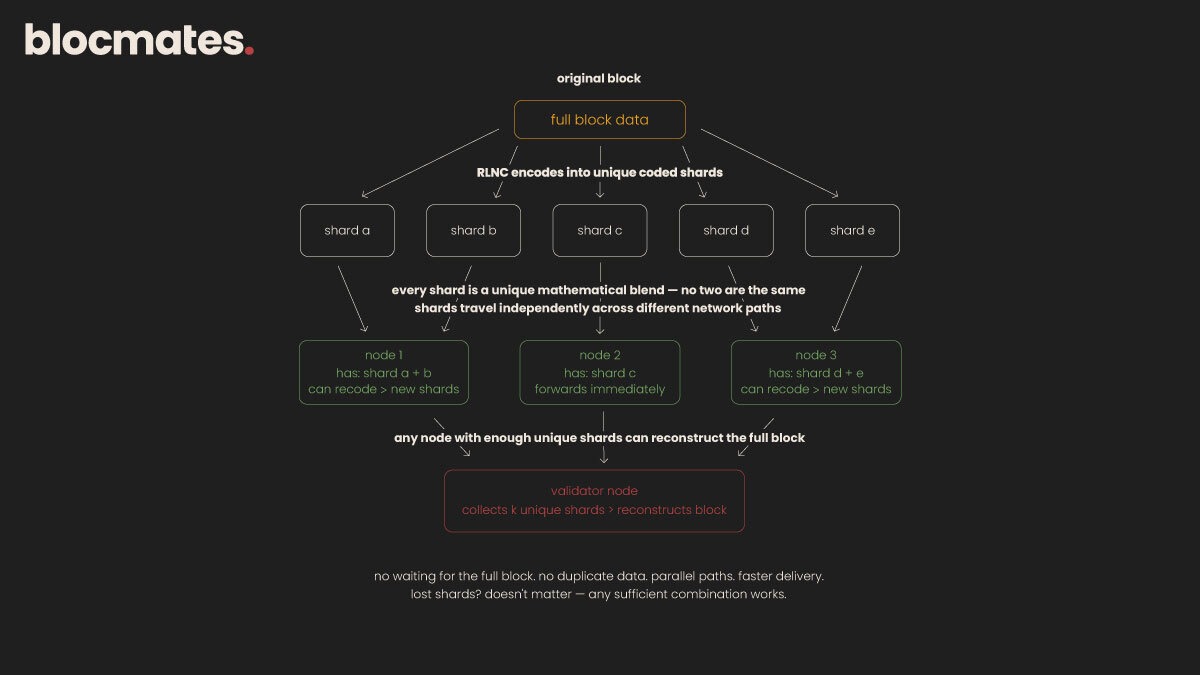
There are four steps to how RLNC works:
- Step 1 - Sharding: The original block data is split into fragments
- Step 2 - Encoding: RLNC takes this data and encodes each shard using random linear combinations. That’s complicated math speak to say that each shard is a unique mathematical blend of the original data.
- Step 3 - Recoding: This is what truly separates RLNC from any other technology.
Intermediate nodes in traditional systems (current blockchains) act as passive messengers. They simply forward the data they have received.
With RLNC, these intermediate nodes are much more active. They have the ability to receive the coded shards and create their own completely new coded shards that can be propagated to their peers.
The shards are mathematically valid, there are no duplicate transmissions, no waiting for full block data, and propagation occurs simultaneously.
- Step 4 - Decoding: A receiver only needs a sufficient amount of these shards to decode the data and reconstruct the block using math. No redundancies and perfectly reconstructed.
This technology is the foundation of Optimum and powers all of their products, the first of which is mump2p, a fast data propagation protocol for Ethereum.
mump2p
mump2p is the first product built by Optimum, focused solely on Ethereum data propagation.
mump2p breaks messages into coded shards that can be independently forwarded and recombined to reconstruct the original data. Each node manages encoding, recoding, and decoding of shards based on tunable parameters.
The architecture for mump2p nodes looks like this:
- Libp2p host: Responsible for peer discovery, network transport, and secure communication
- Mesh topology: Maintains a configurable gossip mesh similar to that of Gossipsub (Gossip protocol currently used by the likes of Ethereum)
- RLNC: Responsible for encoding, decoding, and recoding of shards based on tunable parameters
Look, things can get very technical with mump2p, so if that’s your thing, we recommend checking out their docs for the detailed technical explanation. However, if you’re an average pleb like me, here’s another analogy to simplify it.
Let’s go back to our Autobahn example from the start of this article.
A blockchain like Ethereum in its current state is a city with regular city roads, traffic lights, junctions, speed limits, and different vehicles.
The current Gossipsub protocol Ethereum uses can be thought of as the city’s strange courier system, where every time a new block (delivery) is created, it needs to be delivered to every building in the city.
With the traditional method, a courier delivers the package to one building, that building makes full copies of the package, calls their own couriers, and delivers it to the next few buildings, and the cycle continues.
These couriers need to go through traffic lights, junctions, roundabouts, and so on. That means there’s congestion. At the same time, these roads are often clogged with identical packages being driven all over.
It's redundant, wasteful, slow, and simply not optimized for an efficient city.
Optimum’s mump2p, on the other hand, is the Autobahn city. It’s the delivery system completely reinvented.
Imagine the same city, but instead of regular roads, junctions, roundabouts, speed limits, and traffic. It’s the Autobahn that connects every building.
Over here, the original package (the block) gets broken down like pieces of a grandiose puzzle. Now, rather than every courier carrying the same package all over, every courier is only carrying their unique puzzle piece.
No waiting, no congestion, no traffic, more lanes for bigger packages/vehicles, and every building (node) in the city is receiving all the different puzzle piece packages from multiple directions at once, ultimately getting all the pieces they need much faster than with the traditional method.
Now all of a sudden, with a reimagined logistics model, the city is operating at maximum efficiency.
All a building needs is to receive a sufficient number of puzzle pieces, and it can reconstruct the whole package from there and move on. No redundancy and less bandwidth used.
Remember, every millisecond saved is money earned.
Optimum in action
Okay, so you now understand how Optimum is improving blockchain efficiency in the background.
Let’s next get into the real on-the-ground impact of this technology. Let’s talk numbers.
1. Validators
One of the biggest beneficiaries of Optimum’s technology is validators.
As most of you may already know, validators get rewarded for participating in a network's consensus. These rewards are mainly shaped by these two factors:
- Consensus layer (validator performance)
- Execution layer (MEV capture)
Optimum offers validators significant improvements across these departments through enhanced speed. As we’ve said multiple times in this article, speed is money, and with Optimum’s mump2p, validators can increase their yield at scale.
Validator performance
One of the most important metrics to look at when it comes to validator performance is head vote accuracy.
Head vote accuracy refers to the accuracy of validator attestations.
Basically, when a block is proposed by a validator, there must be attestations made by thousands of other validators that essentially say, “Yes, I saw the block, it’s valid, and I think it should be added to the chain.”
For head votes to be accurate, the attestors need to receive the ‘head’ of the current block in time. If it’s not propagated within the window, they may lose out on rewards because the attestation was either wrong or late.
Optimum’s mump2p is specifically designed to enhance block propagation latency. A 50ms-250ms latency improvement means block attestors no longer need to worry about receiving block heads late. They will always comfortably meet the slot time.
Currently, the head vote accuracy on Ethereum is 98.6%, with the theoretical maximum being 99.4%. That’s a 0.8% gap between current performance and theoretical maximum.
Analysis suggests that Optimum can close that gap by more than 50% with its existing product.
Just to put it into perspective, closing that efficiency gap by that much would add an extra 1,000 ETH to 2,000 ETH in annual revenue as a byproduct for the network as a whole.
What’s even crazier is that validators can benefit from all these improvements by taking on no additional risk. They continue operating more or less the same as they always have, just with the implementation of mump2p, which is enhancing their performance.
It’s no surprise that the response thus far has been nothing short of extraordinary.
The mump2p testnet saw participation from 40+ of the largest Ethereum validators who collectively represent 29% of all ETH staked ($23.7 billion).
There were no message losses, even under high stress scenarios; the average propagation speed was 2.42x faster than libp2p, and the propagation variance (consistency of arrival times) was 7.88x lower.
Higher MEV capture
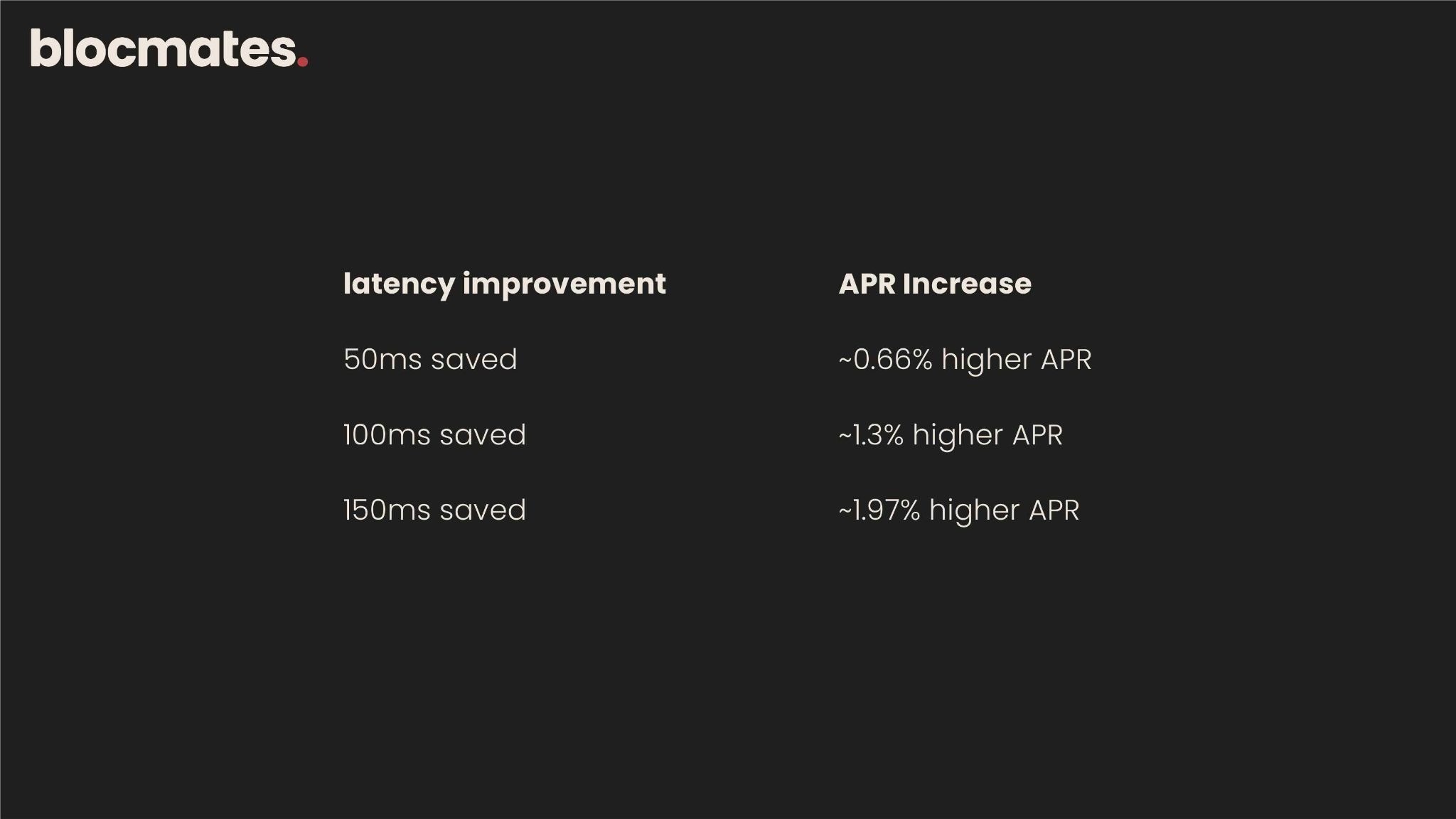
The direct impact of implementing Optimum is, of course, improved efficiency.
Lower data propagation latency = more usable slot time for proposers to choose the most profitable block = More MEV opportunities.
As per a study conducted by the Optimum team, every 50ms saved through latency improvement is equal to an approximate 0.6%-0.7% APR increase in average validator revenue.
(Note: these numbers are from a study where backtesting was done on previous Ethereum slots, so true mainnet economic effects may be slightly different)
For us degenerate yield farmers, 0.6%-0.7% looks like a number you wouldn’t even bat an eye at, but for validators, especially large validators operating at scale, that increase could mean an increased revenue of tens of millions of dollars annually.
But the potential benefits go even deeper than this.
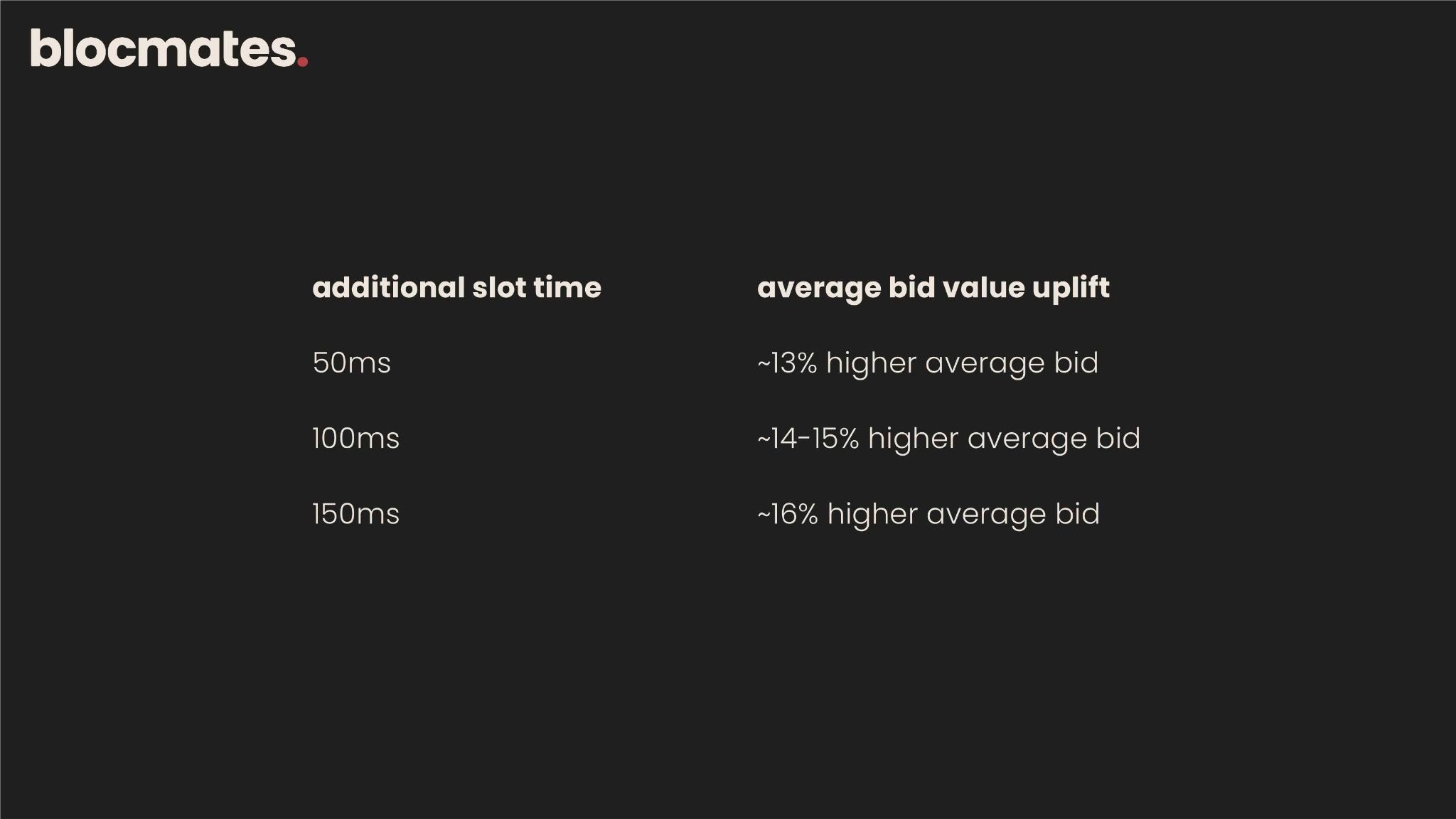
MEV is a major part of validator revenue. Roughly 90% of active validators rely on MEV capture to enhance execution layer rewards.
This is a simplified version of how it works.
A chain like Ethereum has a 12-second block time. Within this time, validators are expected to propose, attest, and aggregate the block to the network.
Therefore, within the first 4 seconds, the block proposal must be done, and in this short window, through transaction ordering, is where MEV is captured.
If you propose earlier in the 4 seconds, it is safer, but you get a lower bid. If you propose later, it is much more risky, but you get a higher bid. Pretty simple.
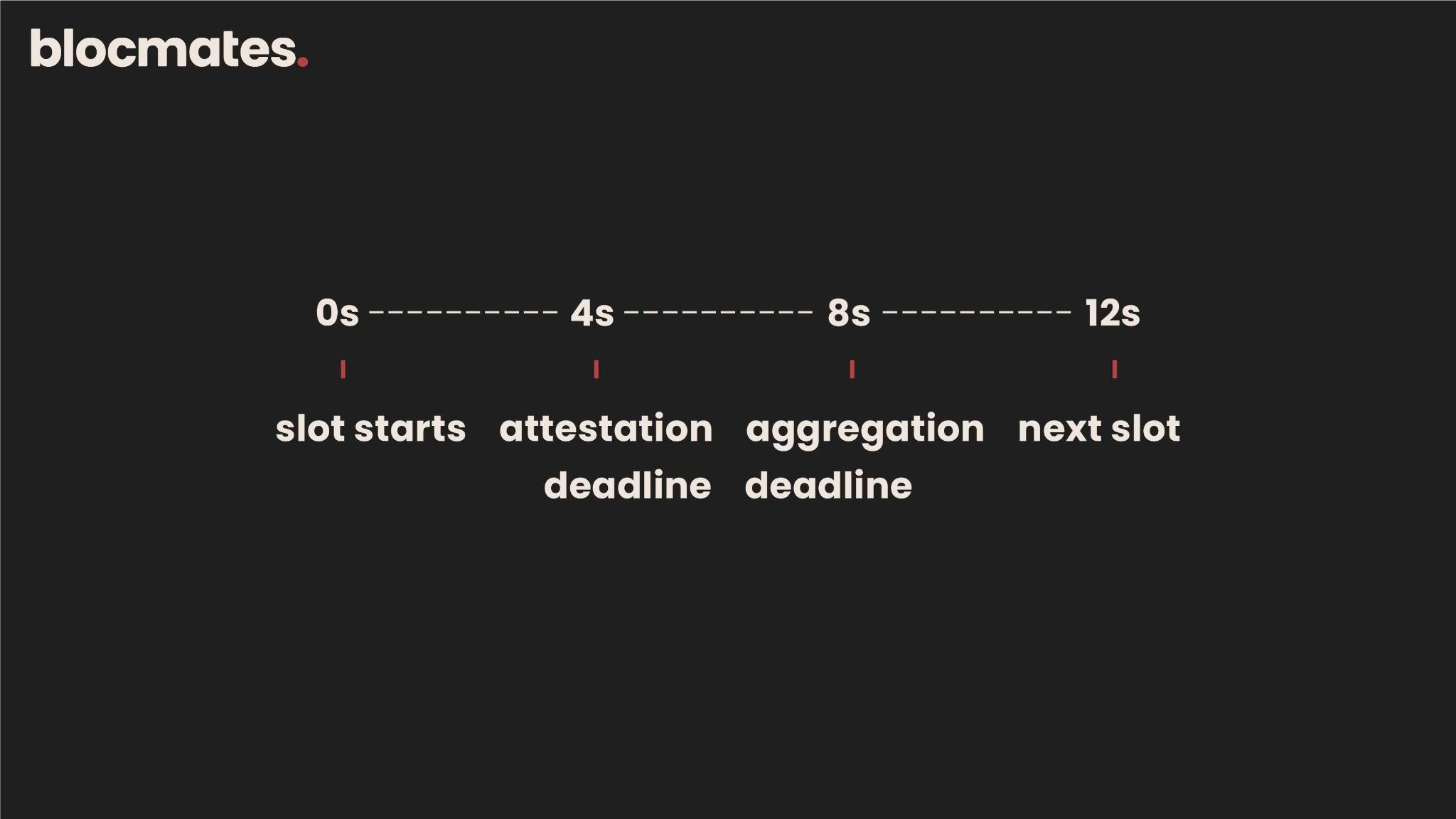
What Optimum does is offer enhanced propagation latency. So, with faster propagation, validators have the luxury of a couple of extra milliseconds to wait for higher bids before proposing the block, reducing their risk later into the 4-second slot.
But it's not just speed that matters here; it’s reliable speed.
There’s this thing called propagation variance. Basically, a message can arrive before the attestation deadline or after, but there’s no way to know which in advance. This creates uncertainty.
Naturally, to counteract this uncertainty, any rational participant will hedge. Proposers often do this by setting their cutoff earlier to avoid missing the deadline, but this also means missing out on higher bids, slower transaction processing for users, more expensive transactions for users, and lower headcount.
Optimum’s mump2p offers speed + reliability. If a proposer knows that they will always have 150ms saved (for example), it makes it much easier for them to optimize.

So let’s quickly pull everything together in the context of MEV capture with mump2p.
Every 50ms of improved latency contributed to an additional 1-2% in MEV capture.
The thing with MEV is that it can often be random. There can be a random spike where the capture can be 20x of what’s expected. Using Optimum, validators are better placed to capture more of these spikes than a validator not using Optimum.
A courier using city streets will reach the auction just as it ends, but the Autobahn courier will be there well in time to make the final bid.
2. Layer-1 blockchains
If it wasn’t obvious yet, another obvious benefactor of Optimum will be layer-1 blockchain networks themselves.
Optimum fundamentally changes the relationship between network size and propagation speed.
Typically, the more decentralized a network gets with more nodes, more validators, and more geographic spread, the harder it becomes to propagate blocks to everyone in the network on time, as there are more hops, redundant copies, and general congestion.
What Optimum’s mump2p does is eliminate these propagation delays.
This enables blockchain networks to become further decentralized without sacrificing the ability to scale.
More validators can participate, with shorter slots and larger blocks being more viable. It ultimately enhances the network's scalability by a huge margin, which trickles down to the application layer, where you’ll see true decentralized applications flourish at scale.
Ultimately, Optimum enhances decentralization to truly global levels without compromising, but rather enhancing scalability.
What’s coming up?
So, in terms of what’s next, there’s a lot to be excited about.
Firstly, mump2p is simply the first product to be released by Optimum. After mump2p is fully up and running with multiple validators, focus will shift to implementing the same data propagation technology across all chains.
For now, it’s only Ethereum, but eventually, it should be available to any high-activity chain where transaction throughput and scalability really matter. So decentralization at scale will be the new norm.
Then there’s the more immediate question. Wen mainnet?
As most of you know, this is an impossible question to answer in the world of crypto because there are so many moving parts that inevitably cause delays. For this, all we can say is that Optimum is expected to launch very soon.
The first product, mump2p, will be on Ethereum mainnet, designed specifically for Ethereum validators.
They have already signed 40+ top Ethereum validators to their testnet, including:
Ebunker - Ebunker is one of the largest node operators from Asia, with over $1.5 billion in ETH staked. The service has over 9.5k active validators and offers a 2.8% APR.
Meria - One of the more popular operators in Europe with over $400 million under management and delegation.
Blockdaemon - Blockdaemon is one of the biggest players in this field globally, working with over 400 institutions and managing/securing billions of dollars.
There are plenty more validators that Optimum will be working with at launch, so keep a close eye on their socials so you never miss a beat.
Concluding thoughts
At face value, a product like Optimum might seem like something that an average crypto participant like you and me shouldn’t even know about. Just one of those things that exists in the background.
While it does continue to operate in the background, if you really think about it, it could be the thing the industry has been searching for all these years.
Increasing network scalability while increasing decentralization, enhancing validator performance to boost validator revenue, increasing yield, and improving the quality of onchain applications for the end user.
We’re now reaching a point in this industry where we’re starting to see inklings of true mass-scale use cases coming onchain. Things like AI, compute, stablecoin payments, agentic economy, and tokenization all require massive scaling to pull off.
Optimum’s technology will only help enhance the industry from this perspective.
Everyone wins with no extra compromises.
Once Optimum really gets the ball rolling, I think this technology's growth will be rapid. Every validator will ultimately adopt it, every chain it's integrated with will reap major benefits, and the ripple effects will continue.
It’s incredibly refreshing to see such innovative technology that will undoubtedly propel the industry forward into better times.
Thanks to the Optimum team for unlocking this article. All of our research and references are based on public information available in documents, etc., and are presented by blocmates for constructive discussion and analysis. To read more about our editorial policy and disclosures at blocmates, head here.












.webp)

.webp)

.webp)

.png)


.webp)



.webp)

.webp)
.webp)

















.webp)

.webp)

.webp)





.webp)
.webp)




.webp)

.webp)

















.webp)
.webp)

.webp)
.webp)
.webp)


.webp)
.webp)


.webp)


.webp)




.webp)


.webp)


.webp)





















.webp)







.webp)














.webp)

.webp)
.webp)

.webp)














.webp)

.webp)


.webp)







.webp)