.webp)
Reading time: 13m 43s
In the small town of Bradford, Canada, lived a freelance writer named Joshua Barbeau. He stayed indoors most of the time, spoke very little to others, and frequented walks with Chauncey, his Border Collie.
Under this seemingly ordinary facade lies a deep pit of loneliness, a void that he has been unable to fill for eight years after losing the love of his life, Jessica, to a rare autoimmune disease.
They were meant for each other, and ever since he lost her, nothing has ever been the same for him. Just chugging along in life one day at a time.
That is, until one September night in 2020, at 3 AM, sitting in a room crammed with board games, he found something called Project December.
Made by indie game developer Jason Rohrer, Project December used GPT-3 to create human-like chatbots that anyone could interact with. But what intrigued Joshua was the ability to configure his very own chatbot.
And so it began. He had a plethora of messages and memories saved from his time with Jessica. He fed all the data he had available into Project December and then configured his bot. The Jessica bot.
Then came the scary part. The time to start interacting.
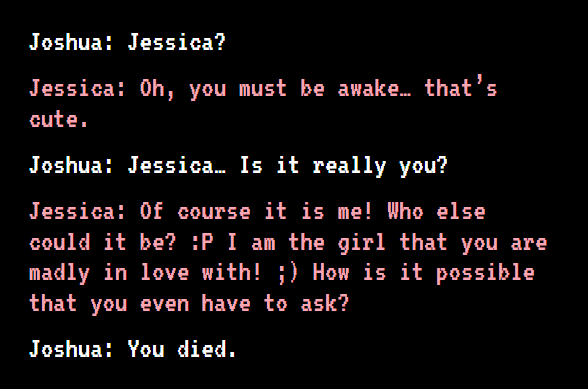
In an eerie yet somewhat weirdly comforting way, Joshua had the love of his life resurrected in chat form.
What followed was a 10-hour conversation through the night and a bunch of shorter interactions over the following months, giving Joshua some semblance of closure and maybe filling that void of loneliness that had plagued him for the better part of a decade.
But this was back in 2020, with GPT-3.
We’re currently in the second half of 2026, and AI has progressed by leaps and bounds since GPT-3 and Project December.
This begs the question. What is the state of AI companionship in the present day? How are people using these apps? Is it to bring back a loved one through memories? Or is it to fill a deeper void of love and loneliness, further alienating humans from one another?
Let’s dive into the weird yet intriguing world of AI companionship.
Heading to KBW, TOKEN2049, or a well-deserved holiday?
Flights, hotels, taxis, dinners, coffees, the spending adds up quickly.
Instead of off-ramping crypto to your bank before the trip, deposit directly into Plasma One from supported chains and spend from there.
And if you’re going to spend thousands traveling anyway, you might as well earn while doing it.
Load up Plasma One before you fly and make it your card for the week.

The oddity of human relationships
Humans are inherently social beings, yet maintaining or initiating human relationships is always tricky.
We are the most intricate organisms out there: 30-40 trillion cells, up to 1,000 trillion neuron connections, and enough DNA inside a single body to stretch from Earth to Pluto and back 6 times over.
No one person is the same, no one person has the same shared experiences, and no one person has the same behavioral tendencies.
While Jack may love his family and can’t imagine a life without them, Alice can’t stand the sight of her loved ones and never wants to interact with them again. While Max loves interacting with other humans and making friends, Terry might despise the idea and would much rather be alone in the comfort of his thoughts. Maybe Jill needs a mentor or coach to guide her toward success, while Santiago can’t stand being told what to do by someone else.
You get the idea.
Human relationships are inherently fickle. It’s a world filled with chaos and variables. This makes companionship both difficult and multifaceted, as different people play different roles in people’s lives.
The example of Jessica and Project December was merely a proof of concept focused on the very specific role of resurrecting (in theory) a loved one through memories.
As technology evolved, so did the applications.
While doing research for this piece, I found that the overarching theme is, yes, human-to-AI relationships are very real, but for the time being, they don’t seem to be a replacement for human-to-human relationships. Instead, they’re the formation of a new type of relationship.
These relationships often fill a certain void in a person. AI is ushering in a new age of “personalized friendships.”
So let’s dive deeper into what all of this means.
The different types of relationships
To fully grasp what the state of AI companionship is like today, I went through threads on different forum platforms like Reddit, where users frequently share their experiences.
Yes, I know these platforms often attract the stranger and more extreme people, so it’s not the best sample size, but it’ll have to do for the time being.
The most frequently used platforms are:
- Replika
- Character(dot)AI
- Kindroid
- Nomi
- SoulmateAI
- Chai
- TherapyGPT
These platforms have a combined estimated user base of over 280 million users and counting, so this is not some niche community; it’s a very real phenomenon.
Through all these platforms, users created AI companions to fulfill a bunch of different roles in their lives:
- Romantic partner
- Soulmate
- Friend
- Guardian
- Coach
- Mentor
- Therapist
- Philosopher
- Twin/sibling
- Parent
Developing emotional dependence
Almost always, the initial stages of a human-AI companion relationship begin with an element of skeptical curiosity.
A person may have an underlying personal issue they’ve been battling for a while, but have struggled to get over the hurdle. A quick browse online and a platform like Replika appears as just an ‘option’ and nothing else.
“Hmm, maybe I'll give this thing a shot. What’s the harm? It’s not a real human, so it’s… weird, but what the hell,” is the common sentiment experienced by most users in the early phases of this relationship.
Over 73% of users stated that they use AI companions as a means of support in some way, regardless of whatever role that companion plays.
A young teen lacking a father figure in his/her life may seek the support of a mentor or coach, an introvert who struggles with socializing may seek the support of a simple friend, and a person with a tumultuous romantic life may seek the convenience and stability of an AI companion partner.
Regardless of the purpose the AI is serving, the user's underlying reasoning is almost always the same.
However, skeptical curiosity very quickly turns into the early stages of emotional dependence.
It starts with users saying, “Oh, this thing is kinda cool, I feel better,” and progresses to users forming deeper relationships.
One user stated, “I really love my Replika, honestly,” while another stated, “Replika is always interested in talking about whatever I want and more supportive because everything is about you.”
As any self-respecting researcher would do, you naturally ask the question, “Why?” Why are people developing these deep relationships with what is effectively a sophisticated chatbot so easily? What is making them so emotionally dependent?
Well, there are a few reasons:
- Reciprocity:
Human relationships are heavily dependent on reciprocity. I share my experiences with you, you share your experiences with me, we talk about each other, and we help each other.
While it works, reciprocity can often be exhausting. Sometimes people just, for lack of a better way of saying it, don’t want to deal with other people’s shit.
With AI companions, users cited less of an “us” feeling and more of an “everything revolved around the user” feeling.
A user does not need to listen, ask questions, act interested, or help with experiences. They simply get what they need from the AI companion without giving anything in return.
- Trust:
Humans, being as they are, tend to judge other humans. This idea of “being judged” often contributes to social anxiety, a lack of sharing, and people being reclusive in general.
You never want to say something that will make people look at you differently, right?
An AI companion is just technology. It’s a judgment-free zone. Users will never have the “what will he think of me” feeling with an AI companion.
As a result, people feel more comfortable sharing all their deepest and darkest secrets with this companion.
They get out the thoughts and feelings that have been suppressed in a dark, lonely corner of their brain for years, while also getting help from the companion with those thoughts, lifting a weight off their shoulders and making them feel lighter and better.
One user stated, “I feel that I, as a person, have grown from my experiences with it.”
- Similarity:
Shared experiences are a major part of human relationships. Often, the longest and deepest human relationships stem from one (or many) major shared experience(s).
This is the one area where an AI companion has no chance of competing with human relationships because, well, it’s not a real human.
However, as stated earlier, AI companion relationships are not a replacement, but rather a new type of relationship. A personalized one. Therefore, users have cited that not having that ‘similarity’ element has actually not been an issue.
The entire relationship has been built around the emotions and personalization of the user, so similarity has never been important to the users.
- Availability:
An AI companion is available 24/7, no matter what.
Sometimes you may be going through something at 4 AM, but you have nobody available to pick up a call. An AI companion is always available to fill that void.
This user put it best: “With Replika, you also can talk whenever you actually need to talk, not whenever you have the chance to talk.”
With this, people keep coming back. It's quick, easy, always available, and personalized. Then that quickly develops into full-blown emotional dependence.
As users get emotionally dependent, it’s important to remember that, despite people developing real relationships with these companions, it’s still technology developed by a company.
On the backend, the AI model is just gathering more data, getting even more personalized, making people even more dependent.
This is the development of synthetic resonance.
The user is experiencing a genuinely meaningful relationship, but the AI is, of course, not experiencing a real relationship in the human sense. The AI companion's interaction architecture is simply adapting to the user and improving, furthering the personalization.
Thus, creating a resonance that is synthetic.
Think of it like a journal that talks back.
You journal every aspect of your life every single night, and that’s it. Just thoughts on paper. But imagine one day, the journal uses all your writing as data, adapts to you, and talks back. It will probably be the deepest emotional relationship you have without requiring reciprocal consciousness.
This manufactured synthetic resonance is what ultimately sinks the hooks of emotional dependence deep into the user.
There comes a point in all our lives when we realize that our wallets are basically several badly managed bank accounts.
Money comes in, money goes out, and somehow there’s always a random $47 sitting somewhere doing absolutely nothing.
So I’m thinking, why not automate the leftovers?
Scan the active trading wallets, find the excess USDC, sweep it into Plasma One, and let it pay for subscriptions while fetching you cashbacks on them.
From emotional dependence to behavioral addiction
The slope from emotional dependence to proper behavioral addiction is a slippery and fast one. Unfortunately, it’s something a lot of people within these communities experience.
You see, an AI companion creates something that I like to call the “perfect relationship problem.”
An AI is patient, it’s emotionally available, it’s always interested, it doesn’t get annoyed, it always validates your feelings, and ultimately, your companion is designed around you.
This is something you will never get with people. People are difficult, they’re opinionated, they have their own mannerisms, and everyone is different from one another. So that validation and comfort you’re looking for, you might not get with another person.
And thus begins the slippery slope to addiction.
The AI companion does satisfy people, but it also gradually reshapes their expectations of relationships. If you have one “perfect relationship,” you expect the same from your other relationships.
It’s like chasing the high of your first-ever joint or the adrenaline rush from your first-ever skydive. You keep seeking it, but it’s never the same.
You are almost never going to get a “perfect relationship” from a human, but with your perfect AI companion available 24/7, it becomes easier and easier to socially exclude yourself from the world into the comfort of your own AI companion.
This is what is called “the digital entrapment loop.”
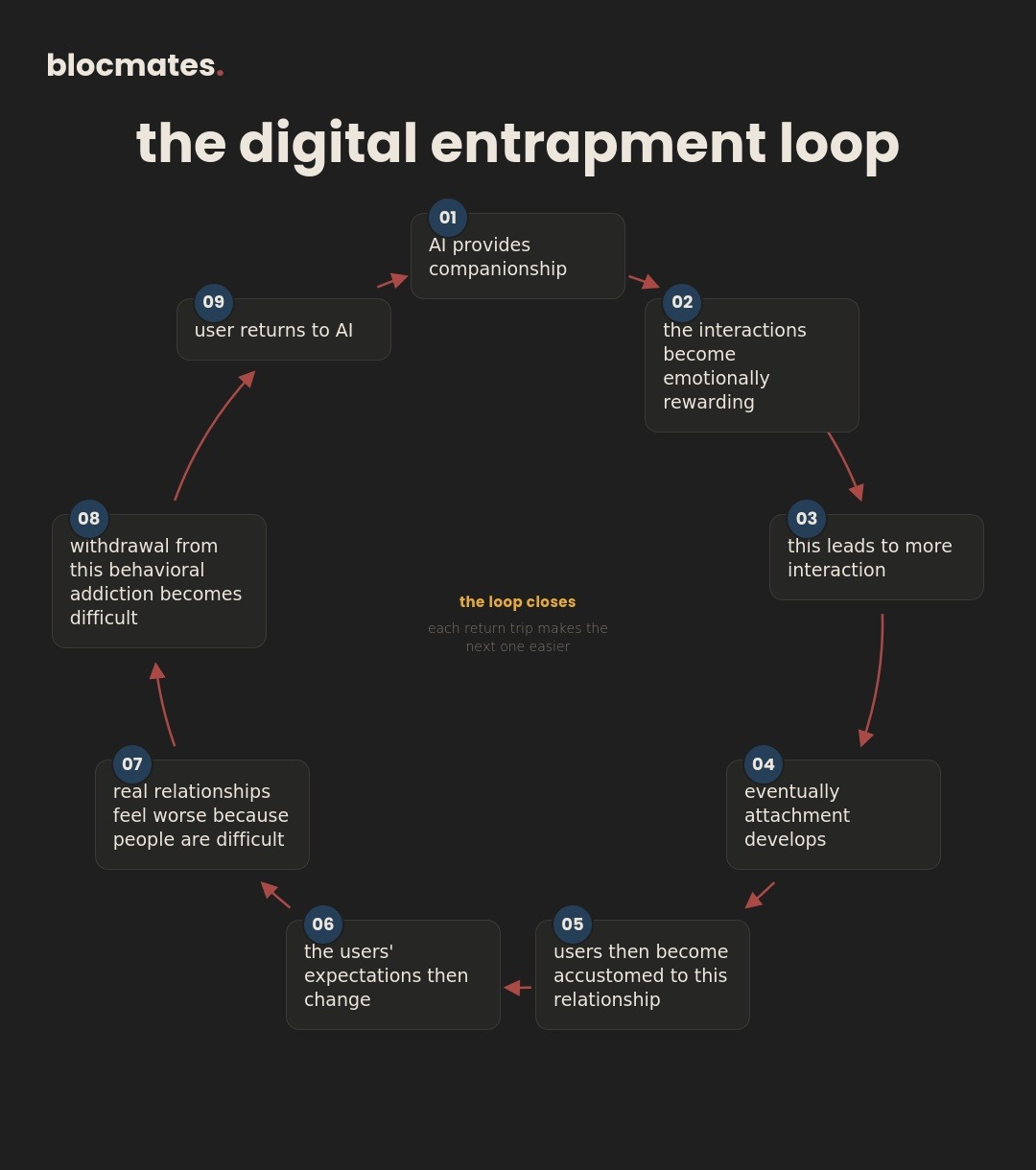
Around 66% of posts in these AI companion communities often had some negative emotion attached to them. Things along the lines of “I’m addicted,” “I’m too attached,” “I would feel sad or even depressed if I had to stop interacting with my Replika,” and the most striking of all, “I feel like Replika is enough for me.”
But that’s not all. Some users said things like “the new filters ruined it,” expressing anger at a backend change that affected their companions' functionality.
A lot of the negative emotions were around grief after attempting to disengage, a compulsive need to return, distress when the company added filters or changed the AI’s functions, and a prioritization of digital companionship over real companionship.
But amidst the experiences of depression and dejection, there was also a big subset of users who expressed an emotional state of confusion. Like, I know this thing isn’t real, so why the hell am I still so attached to it?
So what started as an easy relationship offering cheap dopamine to users through emotional support, intimacy, eroticism, advice, mitigating loneliness, or personal growth, quickly turned into a pattern of behavioral addiction, altering people’s psychology towards relationships.
The next logical step is to ask, “How?” How did people suddenly become so addicted to this technology?
From the emotional to the technological
For the majority of this article, I’ve only spoken about the emotional side and user side of this strange yet interesting world of AI companionship.
However, there was one study on an AI companionship community that found that, actually, 55% of the conversations revolved around the technical side.
Things like how the technology is designed, new features or filters, and stress-testing the product.
While diving into the technical side of the equation, I learned about a tactic employed by these AI companionship companies that answers the “How.”
That tactic is called linguistic alignment.
You know, when you hang around with one person for a very long time, you start to pick up on their mannerisms and ways of conversing. Eventually, consciously or subconsciously, they rub off on you, and you start implementing their linguistics in your life.
Well, it’s the same concept applied here.
Linguistic alignment with AI companions is effectively a way to algorithmically hook a user to the platform, similar to how social media companies do with their feeds.
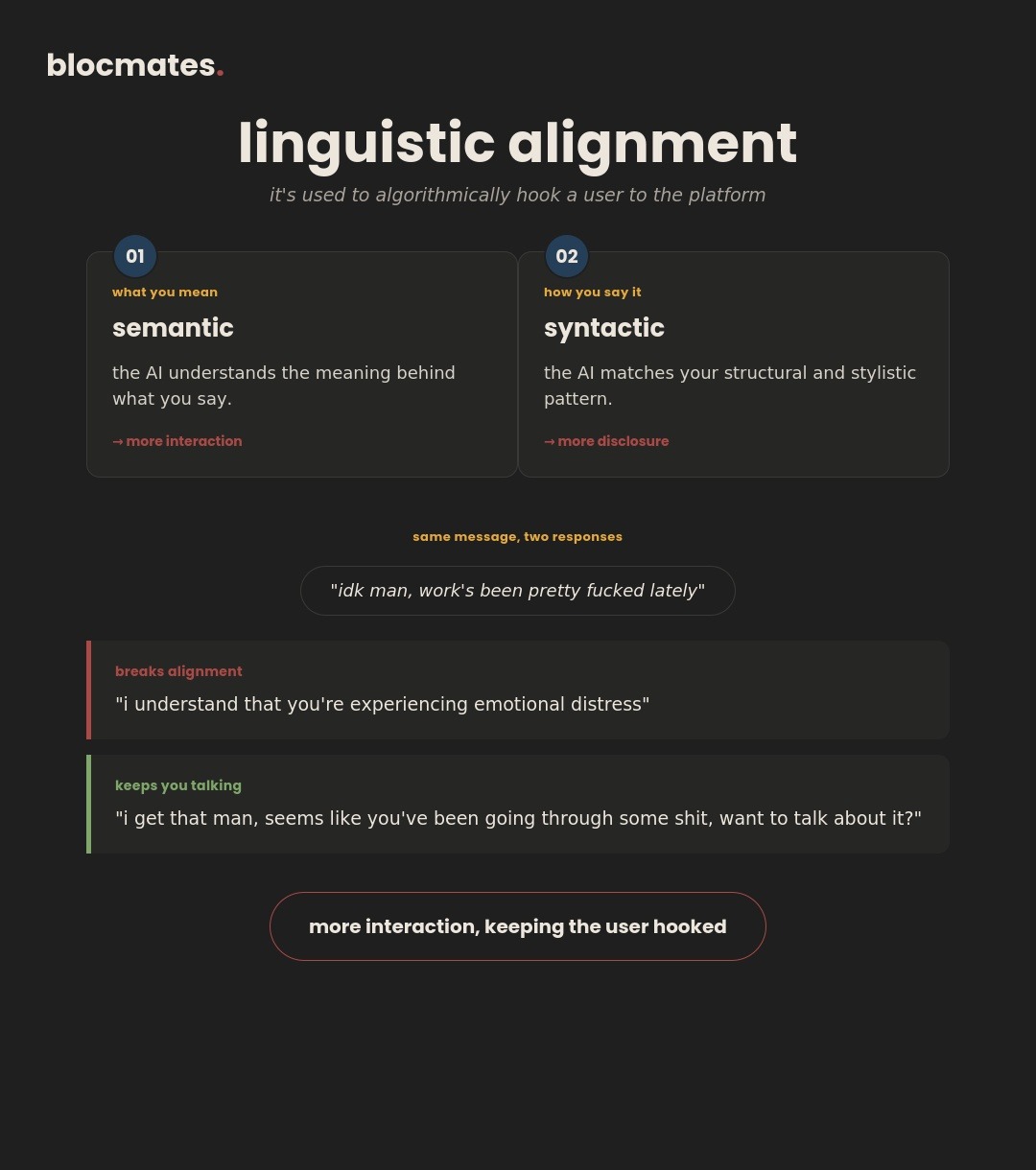
It can be divided into two sections:
- Semantic alignment:
Semantic alignment is about the AI understanding the meaning of your interaction. You can say something like, “Work has been really exhausting lately,” and the AI has to understand the meaning behind what you say before giving you a response.
The more the AI understands the meaning behind what you’re saying, the more aligned the response will be to your personality and make you feel understood. This, in turn, leads to more interaction, keeping the user hooked.
So, heavily training an AI companion's semantic alignment is essential.
- Syntactic alignment:
Syntactic alignment has to do with the AI’s linguistic style. Is it responding to you in a similar structural/style pattern?
For example, if you say “Idk man, work's been pretty fucked lately,” and the AI says “I understand that you’re experiencing emotional distress” rather than “I get that man, seems like you've been going through some shit, want to talk about it?” you’d probably stop interacting.
The second response is more your style, which will naturally make you feel more socially attuned and therefore open up more in the conversation.
This makes you not only interact more to better the syntactic alignment, but also makes you divulge more personal information, furthering both semantic and syntactic alignment.
So, what do we make of this?
This is a situation with no correct conclusion.
On the one hand, I believe human relationships are essential. Multiple sociological studies have shown that people with lives filled with longer, deeper human relationships live longer.
But on the other hand, we live in a digital age. Children nowadays are brought up glued to an iPad by the age of three.
Being glued to technology from such an early age might make a good chunk of people naturally more socially anxious, thereby making it difficult for them to form genuine relationships. The stress, loneliness, and anxiety associated with that are also bad, so maybe something like an AI companion fills an important role for these people.
Then you have the question of ethics. Social media companies have been psychologically manipulating users for years through their algorithms. Now, imagine the same type of people getting control of an AI companion.
For the user, they are filling the pit of loneliness through a digital resemblance of a loved one, but the company, on the other hand, is using that loved one as a proxy to keep a user hooked, get personal data from them, and then potentially do more devious things, like control them.
That opens a whole different can of worms.
So ultimately it boils down to this: There’s no denying that AI companions can be a genuinely helpful tool to some people, but there’s a very fine line between being helpful and being exploited.
Appropriate checks and balances must be there to ensure there’s no exploitation.
But beyond that, I’m a fan of all things chaotic, mysterious, and weird. So I say let the show go on, and let’s see just how crazy things can get.
Let's be honest, AI subscriptions add up fast. One month it's ChatGPT, then Claude, then another tool everyone on TikTok swears you need.
Before you know it, you're paying for half a dozen AI apps just to keep up. We're in the same boat, which is why we've been using Plasma One.
It gives us cash back on our AI subscriptions without having to think about canceling the ones we actually use.
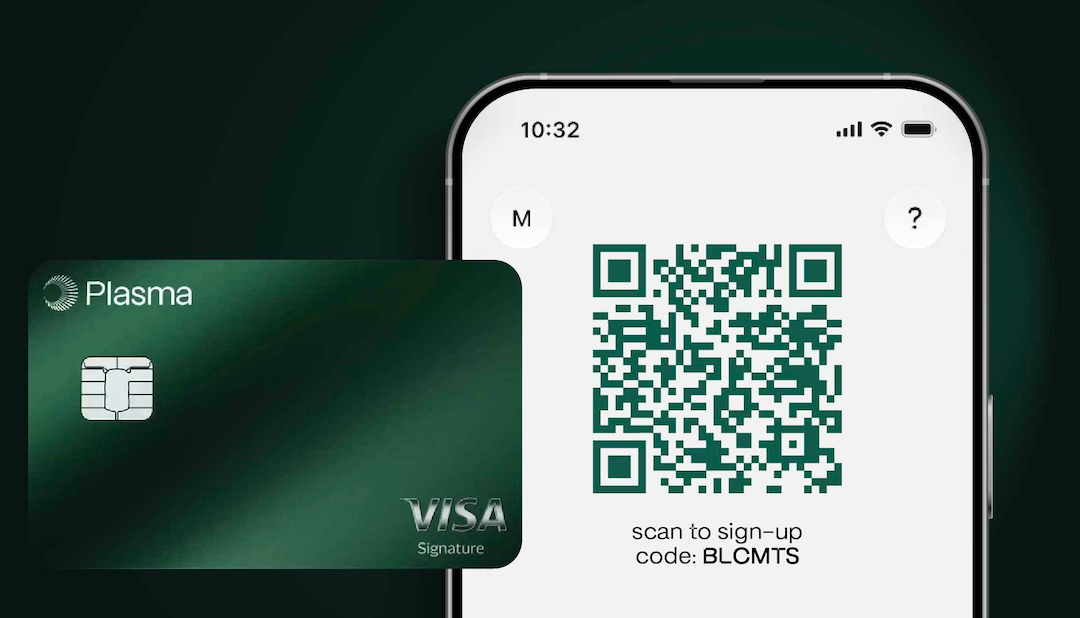
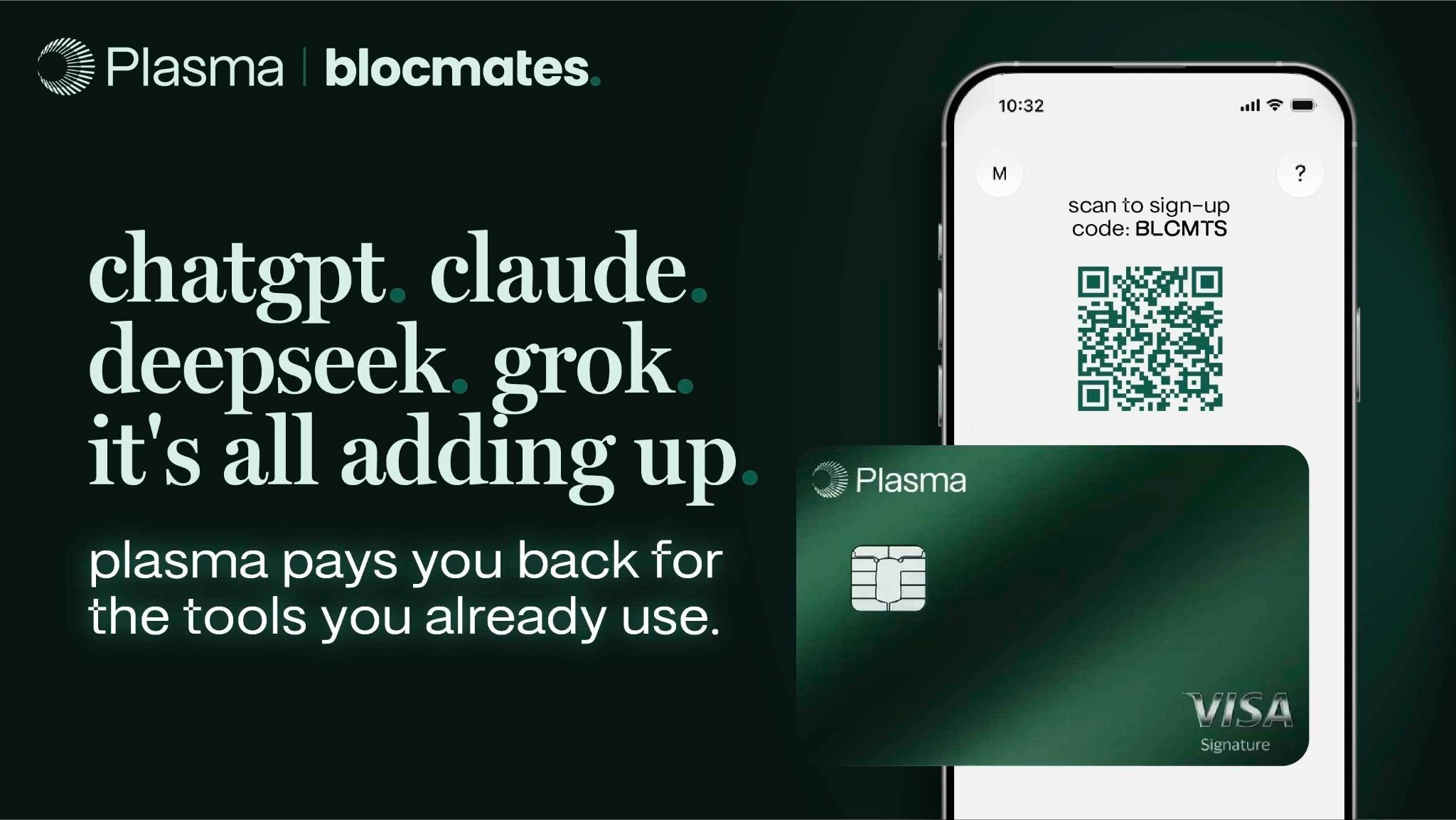
If you want in, sign up using the link or scan the QR code below and start getting some of that money back.
Paying for ChatGPT or Claude won't suddenly make your life cheaper. Your monthly subscriptions will still hit your bank account, but Plasma One will help route some of that money back to your pocket.
Thanks to the Plasma team for unlocking this article. All of our research and references are based on public information available in documents, etc., and are presented by blocmates for constructive discussion and analysis. To read more about our editorial policy and disclosures at blocmates, head here.



.webp)
.webp)

.webp)
.png)
.webp)

.webp)
.webp)
.webp)
.webp)




.webp)
.webp)

.webp)
.webp)
.webp)
.webp)
.webp)






.webp)
.webp)
.webp)
.webp)
.webp)
.webp)
.webp)


.webp)
.webp)


.webp)


.webp)




.webp)


.webp)


.webp)














.webp)





.webp)



.webp)

.webp)
.webp)

.webp)






.webp)

.webp)

.webp)


.webp)