Reading time: 8m 21s
It has been a little over two years since Andy Ayrey launched Truth Terminal, setting the wheels in motion for what the convergence of AI x crypto could look like.
The first wave of products came in the form of ChatGPT wrappers posting their ramblings on X. Did we think it was the future of France? Absolutely. The largest one, Aixbt, reached nearly $1 billion in market capitalization.
After 2 months of insane froth, most of it sold off, never to return. The dream of a crypto-AI symbiosis was dead.
Only it wasn’t, as the next wave came with the launch of the x402 protocol, an internet-native payment protocol, spawning countless runners on Base.
A bit later, the notion of agents making payments was further developed into full-blown standards for agentic commerce, most notably ERC-8183 and ERC-8004, which turned agents from mere code into economic actors capable of evaluating each other’s work and reputation.
Looking at the landscape today, the clanker economy continues churning, with 187.7 million cumulative x402 transactions, 579.3k agents registered with a reputation, and around 2.6 million total jobs facilitated via Virtuals ACP.
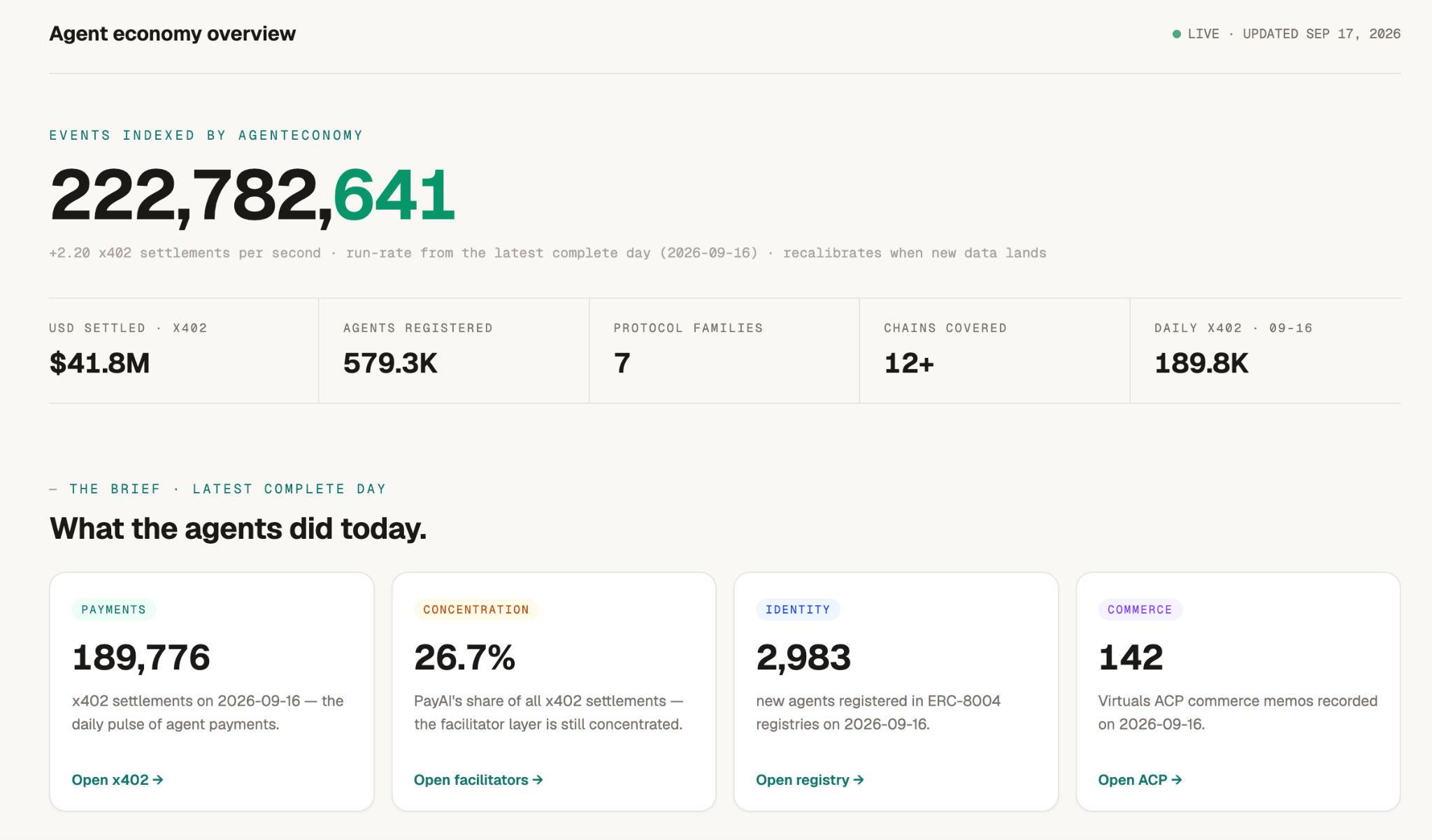
Commerce, micropayments, identity, that’s all great, but I don’t see a whiff of anything trading-related.
Come to think of it, that makes sense. Unlike lending protocols or DEXs, where there are commonly accepted measures of success (be it TVL, trading volume, holders' revenue, etc.), pinpointing success to assess how useful an AI project is varies significantly depending on the product.
For products that rely on deposits or transaction volume, that’s not a problem, as we can look it up onchain, but for others, where, for example, the primary product is intelligence, success can’t be pinpointed that easily.
Perhaps that’s exactly why this product category still eludes people. Or is the trust factor still the primary blocker?
Let’s find out.
The convergence
The trading landscape is experiencing a material transformation, with three catalysts shaping it.
First, onchain infrastructure has matured, most notably cross-chain and wallet infrastructure, giving agents the tools they need to participate in financial markets safely.
Secondly, models have gotten exponentially better, now featuring vast context windows, advanced reasoning, and multimodal capabilities compared to their first iterations.
Third, TradFi assets are slowly but surely migrating onchain. Today, nearly $40 billion in RWA tokens sit on blockchains, excluding stablecoins. That’s roughly an eightfold increase from two years ago.
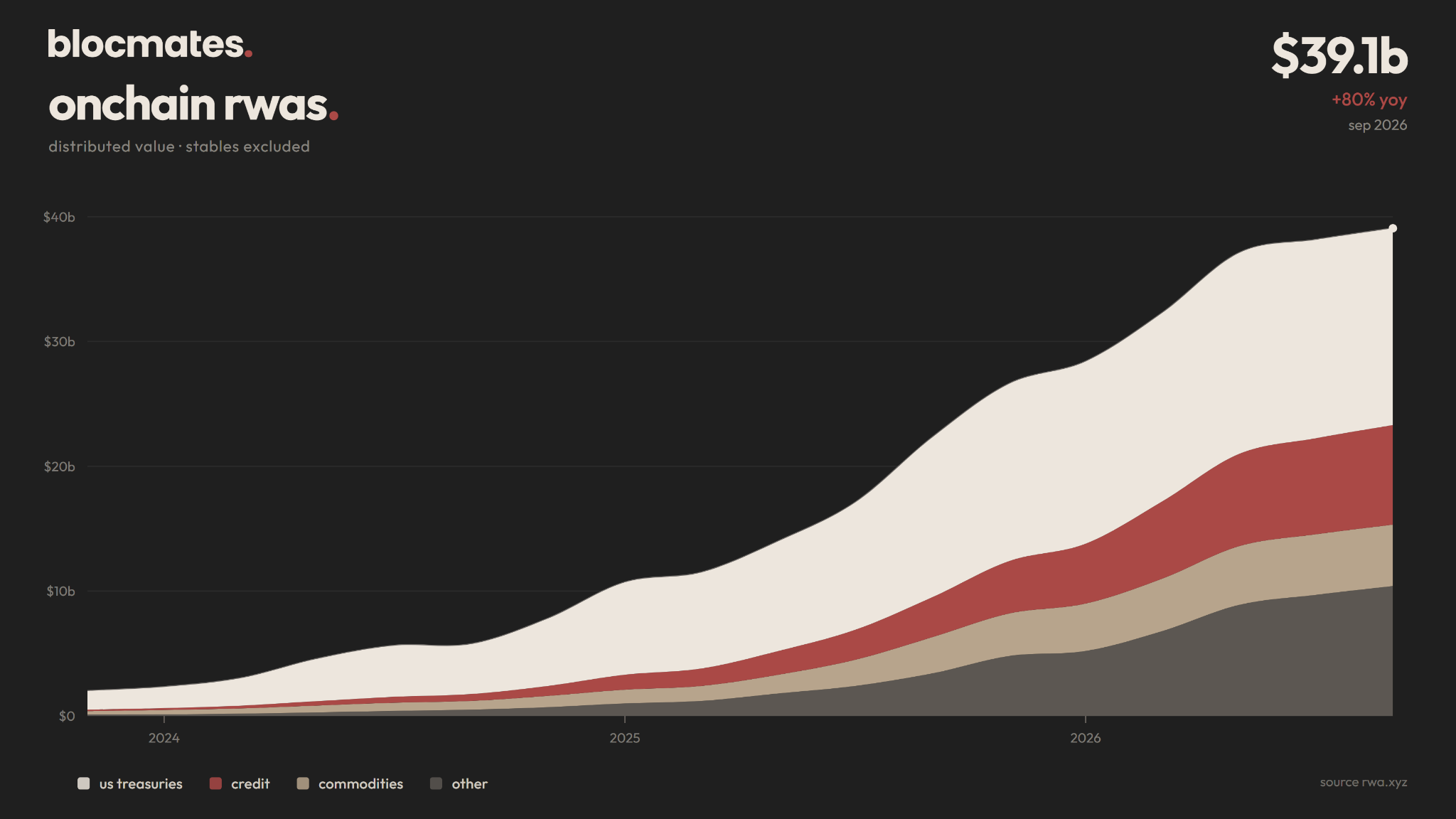
And that’s perfect for agents, as you cannot expect them to log in to countless legacy brokers to access a variety of instruments, because that would require creating an account in a human's name and passing KYC.
Conversely, a blockchain enables an agent to interact with markets programmatically across any venue at any time. Order books, funding rates, open interest, and liquidation levels are all machine-readable and just one API call away.
Given these three ongoing developments, there’s no doubt in my mind that a breakout financial trading companion will be born onchain.
But to understand where all of this is leading, we must first assess the current agentic trading landscape.
Agentic trading ecosystem
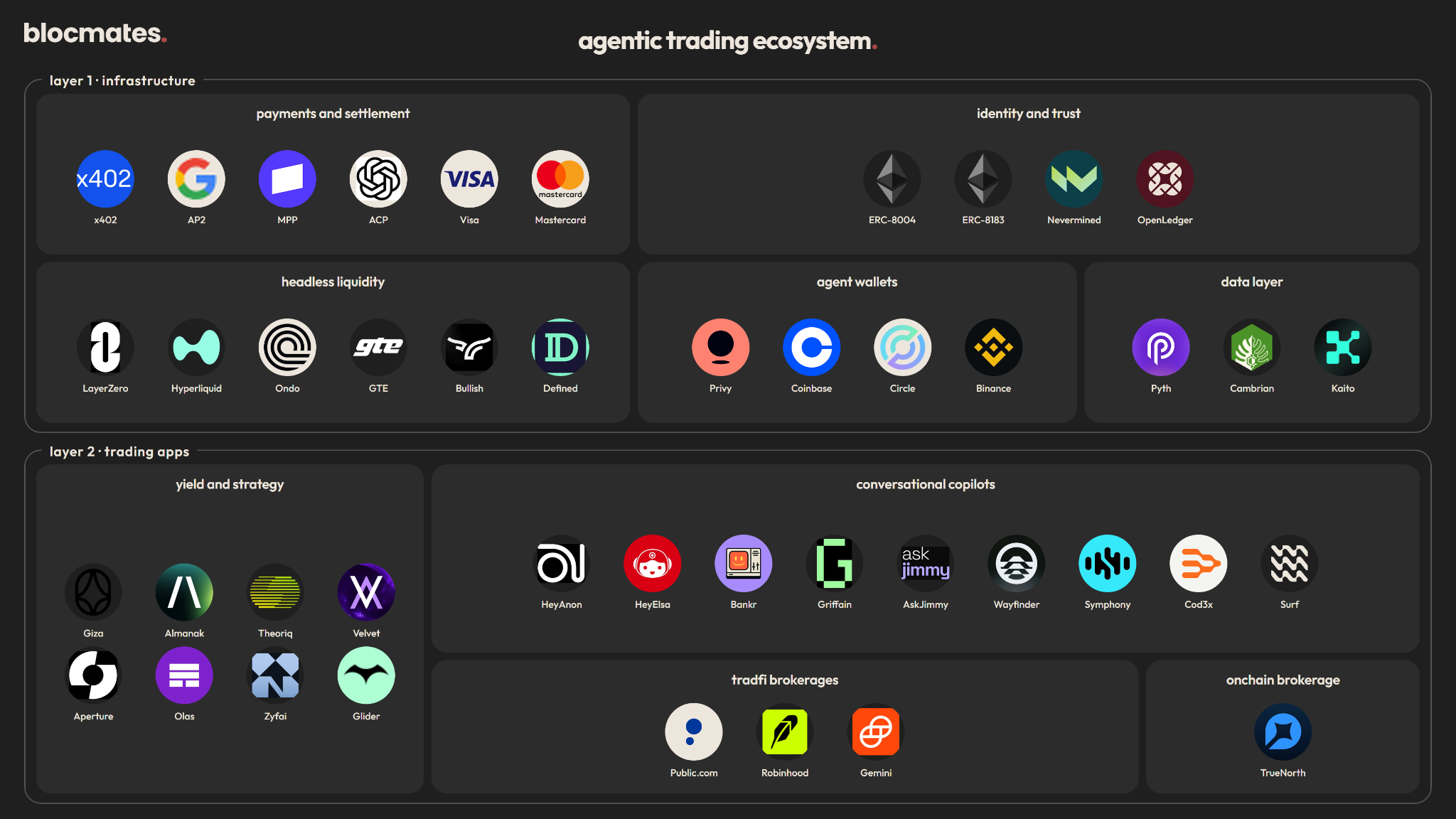
Infrastucture
Wallets literally hold the keys to your onchain kingdom. The same is true for agents.
Privy’s agentic wallets, Coinbase agentic wallets, and other options enable agents to execute onchain transactions while adhering to user-defined policy controls and security measures.
Protocols such as ERC-8183 and ERC-8004 provide agents with their own identity and verification mechanisms. Though more pertinent to commerce, one can imagine a wide variety of applications built with these in financial markets as well.
Without up-to-date market data, agents would lack awareness of their environment. Consider Pyth Pro AI, which provides agents with access to more than 3,000 institutional-grade price feeds spanning crypto, equities, FX, metals, and commodities.
Finally, we come to the fundamental element: the trading venues.
Here, well-established venues like Hyperliquid, Ondo Perps, and the recently announced ATLAS from LayerZero offer builder codes that enable developers to tap into their markets, regardless of whether the end user is a human or a clanker.
Apps
In the year 2026, manual labor is an apt term for how it feels to swap coins for gas, bridge, and then swap into wETH just to ape a coin.
Conversational execution copilots let you use natural language to effortlessly navigate the onchain expanse.
Take Bankr as an example. You get an agent you can talk to in plain English, with first-class crypto support that’s capable of bridging, swapping, performing scheduled automations, and more.
Then there are the yield specialists like Almanak that turn your DeFi strategy ideas and selected market signals into live, non-custodial onchain strategies.
For those looking to go straight to the source without the hassle of self-custodying assets, some centralized exchanges have launched support for agents to interact directly with their markets via MCP.
While visually impressive, a common rebuttal is to ask why create all this for agents when humans can already participate in markets on their own?
But that would be like asking why coding agents like Codex, Claude Code, and others exist when skilled coders are available to do the work.
Just examine the trading statistics, and you’ll see that participating in markets is one thing, but achieving success is exceedingly rare. For example, European regulators require brokers to disclose client performance, and 74% to 89% of retail accounts lose money.
The right question would be: what obstacles prevent traders from being successful in the markets, and how can AI help address those?
The missing link
In a recent Iced Coffee Hour Interview, Robinhood CEO Vlad Tenev noted an interesting observation.
After opening their platform to the agentic world by introducing a Robinhood MCP, a common response from the agent was that it didn't think it was a good idea and refused to cooperate.
The logical assumption is that guardrails are embedded within the models. However, Tenev points out that the training data primarily consists of coding traces and contains almost no trading data. As a result, the model lacks patterns to match and instead relies on hedging.
This observation reveals two things: the infrastructure clearly works, but there is a missing ingredient in the agentic trading puzzle, namely, the models lack the training data to function effectively in financial markets.
BUT.
Trading involves much more than just looking at charts and successfully guessing an asset’s movement based on horoscopes for men (technical analysis), so relying on a better model won’t save you.
It’s everything that surrounds the action of pressing the buy or sell button. The research, setups, position monitoring, and analysis. The painful truth is that without these ingredients, you’re better off going to the casino, my friend.
Now, imagine a virtual desk where, on top of a market-aware agent that surfaces setups, it also questions your thesis before you fire, monitors your positions around the clock, and reviews every trade to make the next one even better.
What are the ingredients to make this desk a reality? It’s two-fold.
The first half of this equation is exactly what Vlad noted. For the agent to perform well, it must possess an innate understanding of how markets work. If the models are not trained on it, the workaround is to give it the appropriate context and tools.
The second half is access to markets, without putting the user’s funds at any more risk than the markets already present.
TrueNorth: The world’s first agentic brokerage
The intelligence half
Financial markets live and breathe on data, and it would be logical to start with that. TrueNorth pulls from over 40 real-time sources, including CoinGecko, DeFiLlama, Hyperliquid, Polymarket, Deribit, and a spread of CEXs.
Everything then feeds into the TrueNorth CLI, which exposes every capability as a discoverable tool with a defined schema injected at runtime, plus a Named Entity Recognition method to extract the exact token, chain, or protocol from your prompt before the model starts reasoning.
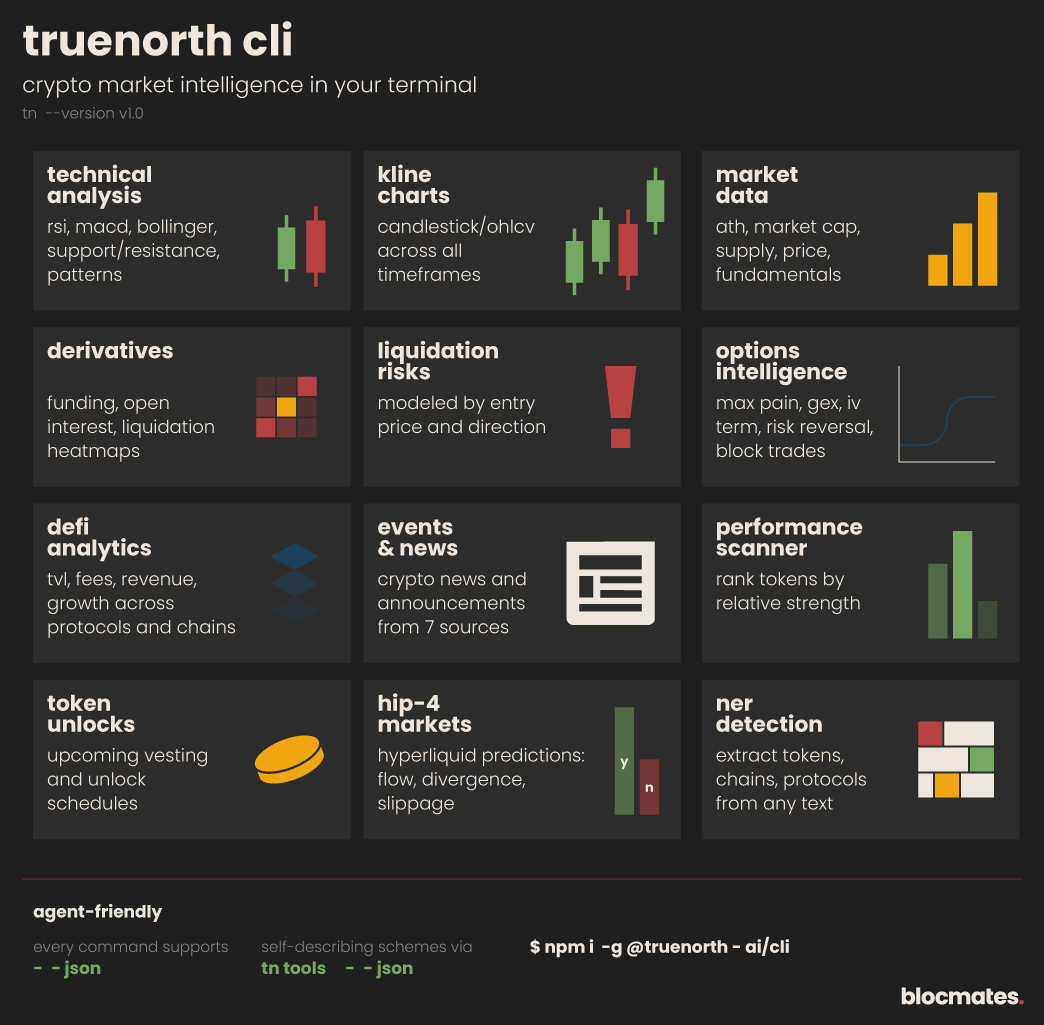
The cherry on top is a three-layer memory architecture, inspired by Hermes, that revises its own skills and logs its own mistakes as it goes. Crucially, it remembers learnings about you, the assets you trade, and preferred setups.
After all of that, the output isn't a wall of text either. You get S/R lines, entry, TP, and SL zones, and the indicators you asked for drawn onto a TradingView canvas.
A more in-depth look at how this works is available here.
The market access half
A brokerage wouldn’t be one without markets to trade in. Today, TrueNorth taps into Hyperliquid and Ondo Perps, covering crypto, US equities, commodities, macro indices, and prediction markets.
By connecting a wallet from either venue, users can move from thesis to action with a single click. Once a position is open, the user can set up an agent that monitors open positions and provides real-time Telegram notifications on whether to take profit, cut, or adjust.
Another pivotal feature is the ability to connect a wallet, allowing the agent to grade your performance and identify gaps.
Looking over the horizon, TrueNorth is set to plug into LayerZero’s ATLAS, with more trading venues to follow, both DEXs and CEXs.
For TrueNorth, this will consolidate everything from matching, clearing, settlement, and risk collapse into a single stack rather than four separate systems, managed by separate parties.
For users, this means lower fees, better execution, and a wider range of markets.
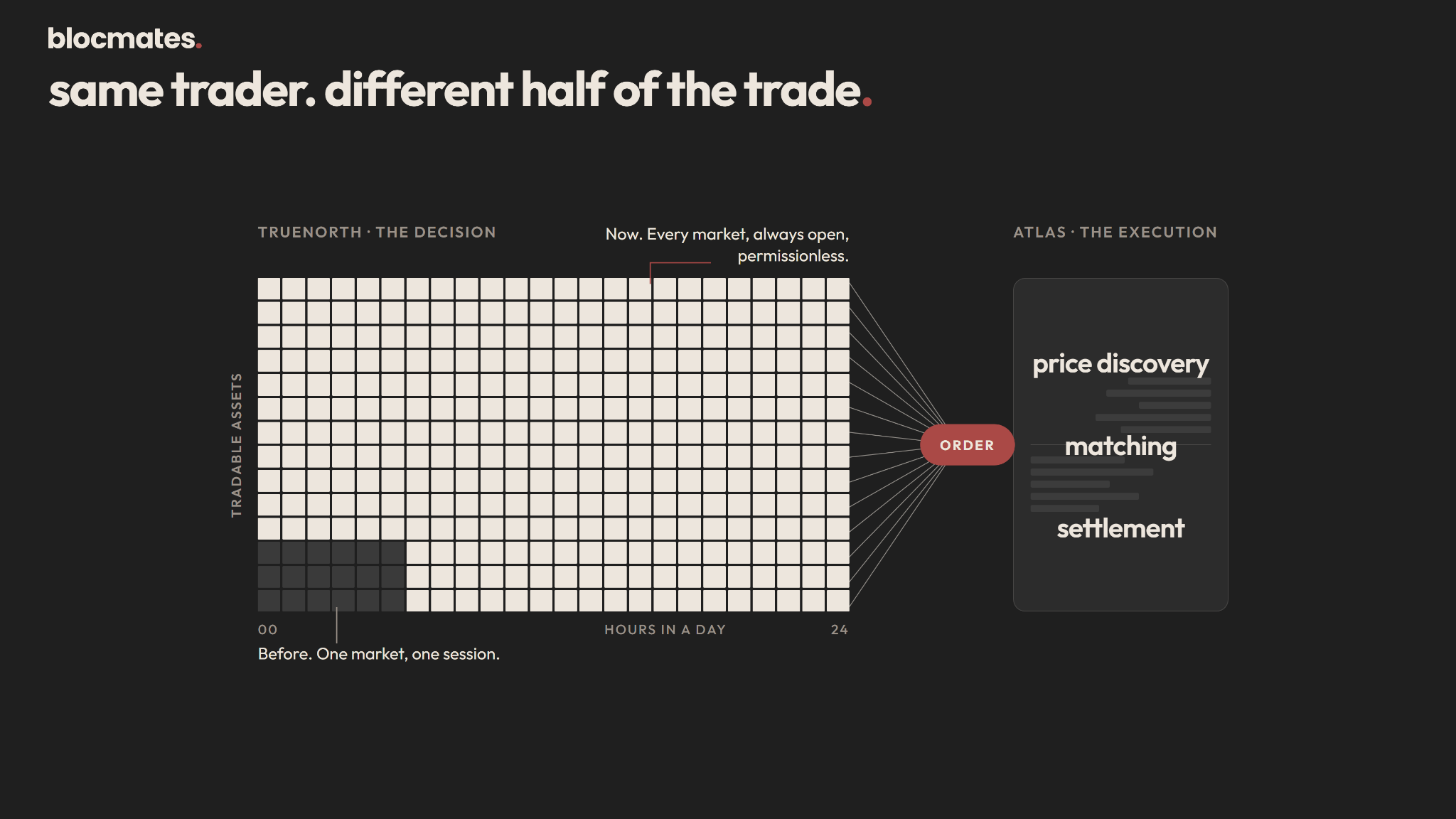
When the intelligence and market layers meet, it’ll mark a turning point in how we interact with markets. We’re stepping into a future where every individual will have personalized agents acting on their behalf.
This indicates that the value will flow down to either the intelligence layer or the liquidity layer, bypassing products that do not perform well in either area.
Conclusion
The co-founders of TrueNorth believe the shift to autonomous finance will be gradual, and I wholeheartedly agree, but with one caveat.
The first stage is the copilot phase, where agents are your trusty interns, helping you move faster by handling the boring stuff. Here, you remain in control at all times.
The second stage works such that you are the orchestrator, and the agent is your loyal servant. Here, you set the boundaries and parameters, and it executes your intended goal by following those guidelines.
In the third and final stage, agents are fully autonomous, operate 24/7, and optimize across market conditions, like setting a destination in Google Maps and letting an autonomous car take you there.
The specific roads to get there don’t really concern you as long as you reach the destination.
But to even reach the third stage, there are still very real blockers, the biggest being trust, which we discussed in more detail in our previous article.
Until we get there, our concern is answering the question I posed earlier. What obstacles prevent traders from succeeding in the markets, and how can AI help address them today?
It’s not necessarily the lack of information, although that certainly is a contributing factor.
Hands down, the biggest reason is that traders base position sizing on a gut-feeling, revenge-trade after a losing day, hold onto losers while selling winners, and, most crucially, never document their trades.
Frankly, this is the strongest case for TrueNorth, as it directly addresses this.
On TrueNorth, the agent constantly revises its skills and memory files based on user behavior and key "gotcha" moments, such as common user patterns or past errors, enabling the AI to avoid recurring issues and adapt to the specific user.
As more users find the insights useful and genuinely profitable, they’ll come to trust the agent more and more, progressing through the three stages at their own pace rather than everyone uniformly.
This means that creating the most intelligent financial analyst today increases your chances of retaining users, because each time the analyst proves useful, you’re warming them up to accept the inevitable, one thesis at a time.
Thanks to the TrueNorth team for unlocking this article. All of our research and references are based on public information available in documents, etc., and are presented by blocmates for constructive discussion and analysis. To read more about our editorial policy and disclosures at blocmates, head here.




.webp)
.webp)
.webp)
.png)

.webp)


.webp)
.webp)
.webp)
.webp)





.webp)
.webp)

.webp)
.webp)
.webp)

.webp)
.webp)










.webp)
.webp)
.webp)
.webp)
.webp)
.webp)
.webp)
.webp)


.webp)
.webp)


.webp)


.webp)




.webp)


.webp)


.webp)














.webp)







.webp)










.webp)

.webp)
.webp)

.webp)










.webp)

.webp)


.webp)





.webp)