Reading time: 8m 54s
Let’s be real with ourselves.
If we were to actually break down how much time we spend doing adjacent activities relating to AI, not actual work, I’d bet the house it’s half the time, probably more.
Most of that time is spent doing manual discovery. We think of an idea, and then we either engage in a long-winded chat with the clanker to figure out which tooling is the best fit for that use case, or we pull up our sleeves and do the digging ourselves on the trusty World Wide Web.
In either case, the problem is that nothing is free in this world. If you want to scrape a website, pull live data, or perform other actions over the internet, someone has already anticipated you wanting to do exactly that and created a service for it.
And I’m completely fine with that, since capitalism is what drives the world around.
The gripe we all have with these services is how time-consuming they are to use, with the default mode being a subscription that requires us to sign up for everything, even if we’ll use that service for a single API call.
I’d go so far as to say that I feel played by the big AI, as the future of automating our work hasn't materialized. Not to its full potential, at least.

The evolution of agent tooling
Because there are so many actions we can perform (i.e., fetch data, crawl a website, create photos, videos, music, etc.), in most cases, there is a vendor standing between us and the result we’re looking for.
Being the non-technical LARP I am, I thought Model Context Protocol (MCP) would solve this for a good while. Log in to a service you’re using, fetch a URL, paste it into your chatbox of choice, and the MCP is wired up.
Now, your agent can interact programmatically with that service, meaning it can both read and write data.
But to enjoy that luxury, I first have to be a paying customer of that service.
If I want my agent to scrape a website, I have to wire up a scraping MCP. If I want to enrich a lead, I have to wire up an Apollo MCP. The problem of tool discovery and payment friction remains.
Thankfully, there has been a shift to a hub-and-spoke model. Instead of forcing me to manually wire fifty individual tools to your agent, I simply connect my agent to a single central gateway that manages access to everything else, including payments.
In light of this shift, I think I might have found the one service that lets my agent discover and pay for more than 1,300+ services at runtime, reducing the hassle of manual discovery while saving precious dollars that would otherwise go to a subscription I forgot about the second I closed the tab.
What is Monid.ai?
Monid serves as a gateway to hundreds of data endpoints across the web.
Just as OpenRouter provides access to all models through a single account, removing the need to manage multiple keys and handle scattered payments, Monid offers similar convenience for agent tools.
.png)
The idea is simple, and yet it solves one of the biggest hurdles that users face when interacting with LLMs: fetching accurate data and using paid services.
How many people work at this company right now? What type of social media content is trending right now? Which competitor ranks the highest across SEO/GEO and why?
These are all questions that a better model simply cannot solve.
The missing link, or, better put, the opposite half of the same problem, is giving the model a set of practical hands so it can go out into the world and get what it desperately needs.
Without them, even a powerful model usually guesses or, at best, relies on historical data that does no one any good. It responds confidently, even as the request silently fails in the background, only for the agent to return and claim everything is sorted. Sounds too familiar, doesn’t it?
With Monid, that is no longer the case.
How to set up Monid.ai?
To access the vast library of more than 1,760 endpoints across 57 providers in Monid’s catalog, you have two options:
- Monid Skill
- Monid MCP
For most users, the difference between the two options is minimal as the number of available tools remains the same.
In my case, I went the skill route, but the MCP setup process is just as straightforward.
1. Install the Monid Skill
Copy the following and paste it to your agent: set up https://monid.ai/SKILL.md
2. Get an API Key
Head to the Monid Dashboard to create an account if you don’t have one. Then go to the API key management page to create an API key.
Copy the key. It is only shown once. Send the key to your agent so it can configure itself.
That’s it. It’s as simple as that.
First steps
Once you’ve done that, feel free to inspect this markdown file manually or ask the agent what the skill entails and how to use it.
What you’ll find is that the skill or MCP follows a strict path for every query, ensuring you don’t pay until you’re certain what a particular tool does and what results you can expect from it.
- Discover: Search endpoints in natural language (e.g., “twitter posts”, “amazon reviews”).
- Inspect: View the input schema, output shape, and price for any endpoint
- Run: Execute the endpoint with your inputs and receive the results.
At no point during the discovery or inspection phases will you be charged. Only when you command your agent to pull the trigger will you start depleting credits.
This gives you immense flexibility to research and compare specific tools, drastically shortening the discovery and brainstorming process without spending any money.
Another instruction buried in the skill file states that if the user has a dedicated MCP, API key, or workflow for a service, the agent should use it instead of Monid. How nice of them.
Heading to KBW, TOKEN2049, or a well-deserved holiday?
Flights, hotels, taxis, dinners, coffees, the spending adds up quickly.
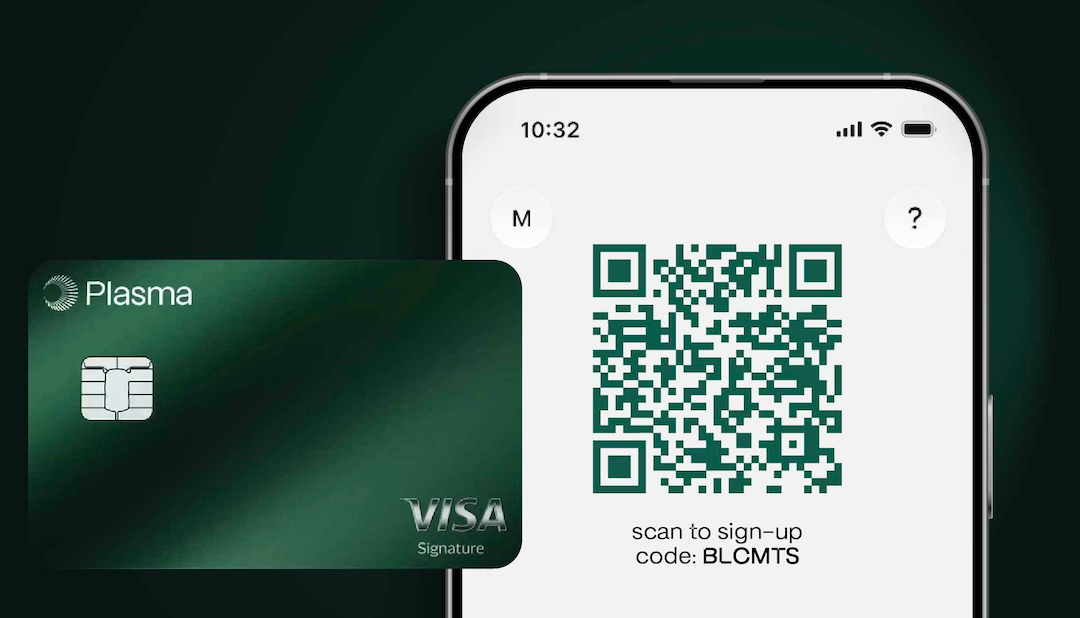
Instead of off-ramping crypto to your bank before the trip, deposit directly into Plasma One from supported chains and spend from there.
And if you’re going to spend thousands traveling anyway, you might as well earn while doing it.
Load up Plasma One before you fly and make it your card for the week.
Practical use cases
I like to think of Monid as the one ring that rules them all.
Unlike in the LOTR universe, where the ring renders a mortal wearer invisible by shifting them into the wraith-world, the wearer in question is an agent, and the power it grants is access to all the endpoints on the internet, from the comfort of one’s chatbox.
Creative
Fancy creating a nice demo for an ad you’re planning to launch? Without Monid, that’ll require signing up for a platform like Higgsfield to access top-of-the-line models such as ByteDance 2.0.
Want to generate an AI voice or music for that video? You’ll need an ElevenLabs subscription for that, please.
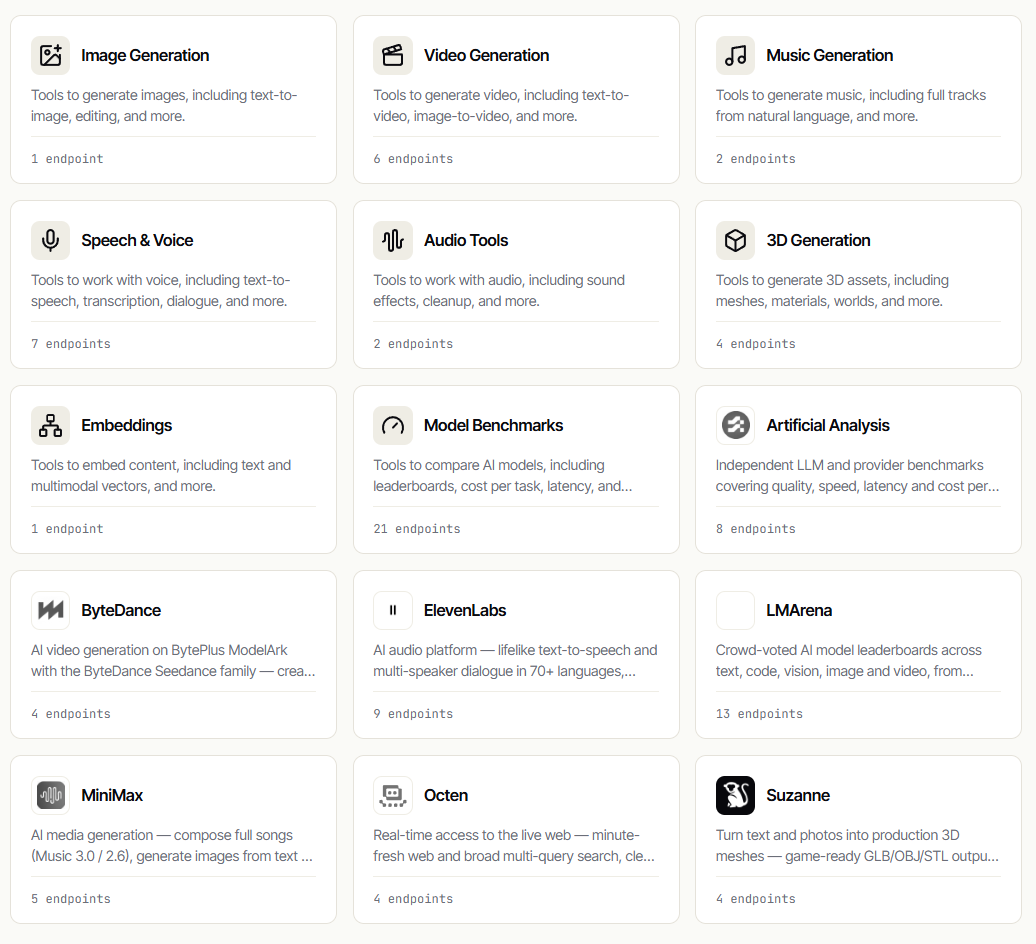
Oh, wait, you actually don’t, because with Monid, you can do all of that and more without having to sign up for anything. From image, video, and music generation to 3D assets and text-to-vector conversions.
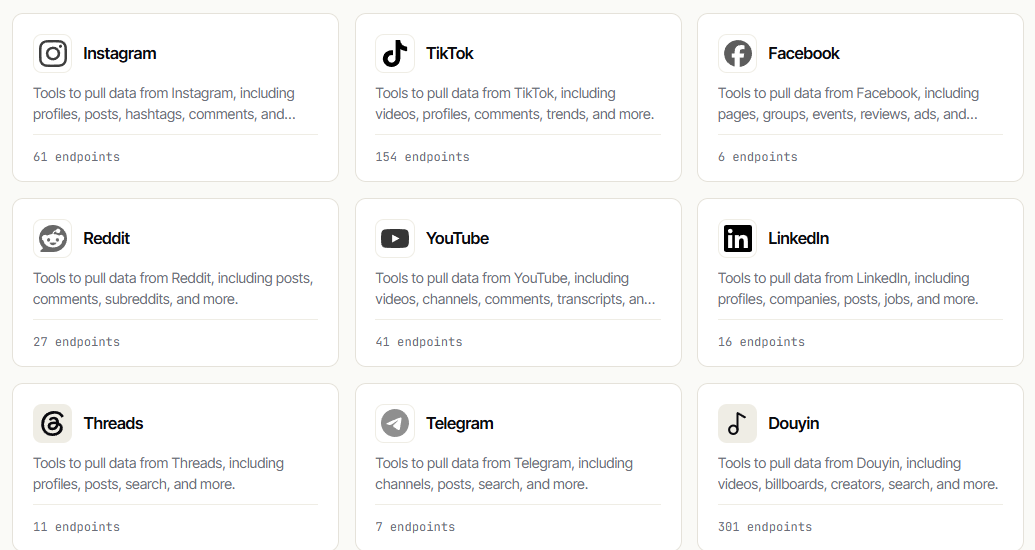
Content planning and strategy
Having a social media presence and strategy is paramount in this day and age.
It used to require a person to manually scan the feed to see what format/style is currently pulling numbers and try to cater their posts to that.
Now, all of that can be programmatically done with scrapers. Which one is the right tool for the job? That part doesn’t really concern us because Monid will tell the agent which query and tool are right for the job without you having to look it up.
SEO/GEO
If you think in the year 2026 that SEO is dead, you’d be wrong. There are multiple examples of companies using SEO/GEO to boost visibility.
To achieve that, you need to pinpoint inefficiencies and gaps in competitors' keywords and niches.
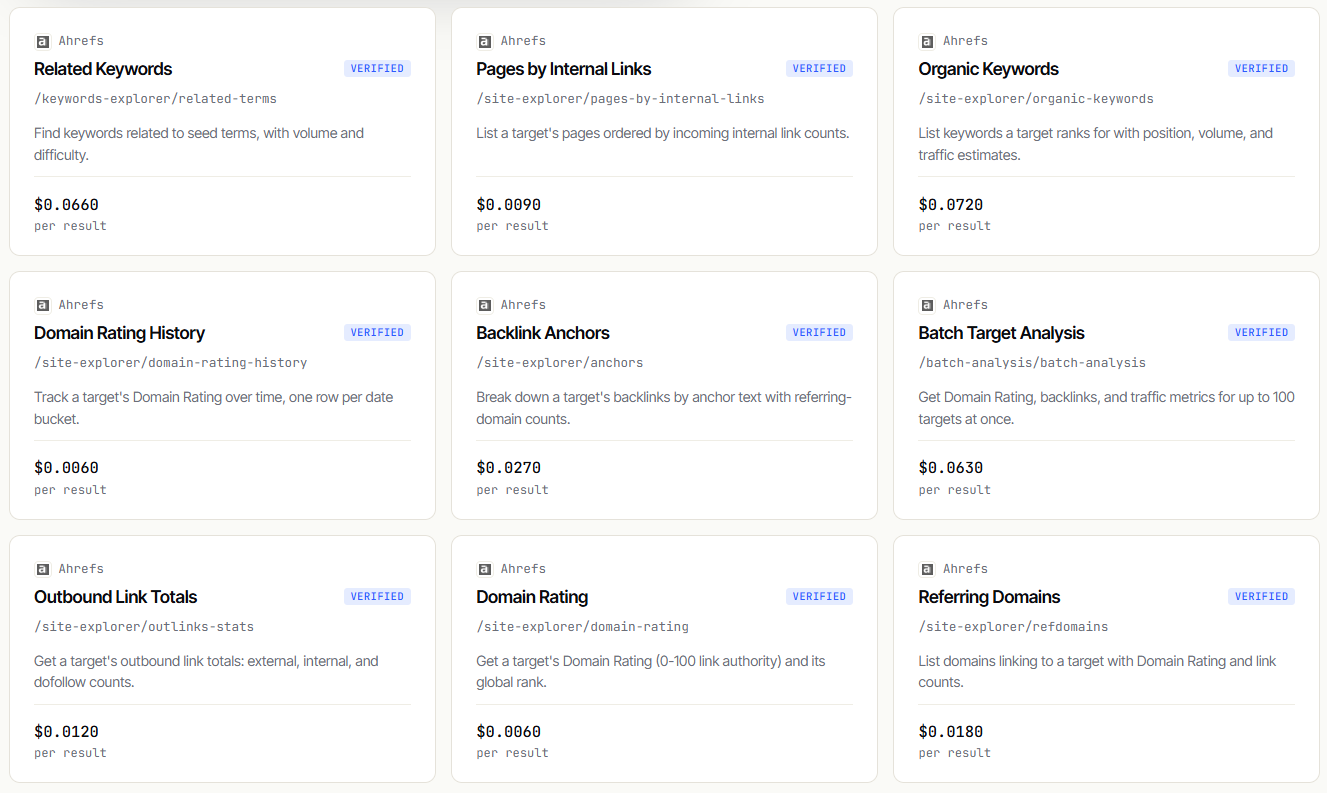
But have you ever looked up how much Ahrefs costs per month? Not cheap, I’ll tell you that.
The $130-per-month pricing for the entry-level tier probably makes sense for agencies/companies that rely heavily on SEO/GEO for their traffic, provided they use all the available features.
I’d say that’s a bit steep, especially when you can query ratings, organic and paid keyword reports, keyword metrics and ideas (volume, difficulty, traffic potential), and SERP overviews, perform bulk target analysis, and more via Monid without overpaying a cent.
Market intelligence
The financial markets are the most transparent yet most opaque thing in the world.
The transparency is based on the assumption that charts are the ultimate tool for truth. Every decision, factor, or foreseeable event, whether behind red tape or not, is visible on an instrument’s chart.
The paradox is that the opposite is also true because markets are masked by insider trading, OTC transactions, and obfuscated capital flows, making these movements invisible to the typical investor.
Unless you’re an institutional trader or investor, such data points only come from the news columns, long after they’ve occurred, rendering them useless.
Yes, many micro-SaaS companies have appeared promising to address that, but they are often subscription-based and costly. Plus, you might only need info on specific instruments, like stocks or crypto.
Luckily, Monid offers a range of vendors for both public and not-so-public market data, covering everything from quotes, fundamentals, earnings, and screeners to insider trades, institutional holdings, fund portfolios, and more.
The same applies to crypto, with over 284 endpoints available across DefiLlama, BlockRun, and Surf, enabling quick access to fresh onchain data with just a few keystrokes.
I could go on with examples, but the core premise is that the vast majority of people won’t use up their entire subscription allowance.
And even if your API bill exceeds the subscription threshold, go ahead and subscribe to that service directly. Until that point, it’s unnecessary to overpay for a service you probably won’t need to its full extent.
Conclusion
Convenience. It’s what we’re all aiming for when using AI.
Indeed, for the vast majority of folks, this tech has brought immense quantities of it, collapsing entire workflows into just a few words written in a box. But for those of us delving ever deeper down the rabbit hole, we’re often met with extreme inconvenience.
And that’s okay. It’s the price we pay for staying at the bleeding edge.
But what if this edge wasn’t so sharp and didn’t cut so deep, in terms of the time spent scouring API docs, copy-pasting keys left and right, and burning money on endless subscriptions?
What if we could access the internet, fetch any data, and perform any action without losing our minds in the process?
I believe we’re gradually moving toward that reality with services like Monid. By breaking the cycle of continuous optimization, custom configurations, and new tools, we ultimately free up mental space to work on ideas we’ve had in the back of our minds but struggled to piece together.
Maybe I’m overstating the convenience of this product, but personally, the first time I loaded it up on my Hermes instance, I felt like I had finally gotten my hands on the final infinity stone.
At what cost, you may ask? None. I pay as I go, squashing the subscription model, one API call at a time.
Oh, and by the way, they’re even giving you $1 in credits for signing up. That might not sound like a lot, but you’ll come to learn that the median cost for a single API call on Monid costs around $0.0015.
Let's be honest, AI subscriptions add up fast. One month it's ChatGPT, then Claude, then another tool everyone on TikTok swears you need.
Before you know it, you're paying for half a dozen AI apps just to keep up. We're in the same boat, which is why we've been using Plasma One.
It gives us cash back on our AI subscriptions without having to think about canceling the ones we actually use.
If you want in, sign up using the link or scan the QR code below and start getting some of that money back.
Paying for ChatGPT or Claude won't suddenly make your life cheaper. Your monthly subscriptions will still hit your bank account, but Plasma One will help route some of that money back to your pocket.









.webp)
.webp)

.webp)
.png)


.webp)



.webp)
.webp)
.webp)
.webp)










.webp)
.webp)

.webp)




.webp)
.webp)


.webp)

.webp)













.webp)
.webp)
.webp)
.webp)
.webp)
.webp)


.webp)
.webp)


.webp)


.webp)




.webp)


.webp)


.webp)



















.webp)





.webp)











.webp)

.webp)
.webp)

.webp)












.webp)

.webp)

.webp)





.webp)