Reading time: 7m 15s
Short the Golden Globe and the Oscars, there’s more drama in finance these days than you’ll find on Hulu, Netflix, and Amazon Prime combined.
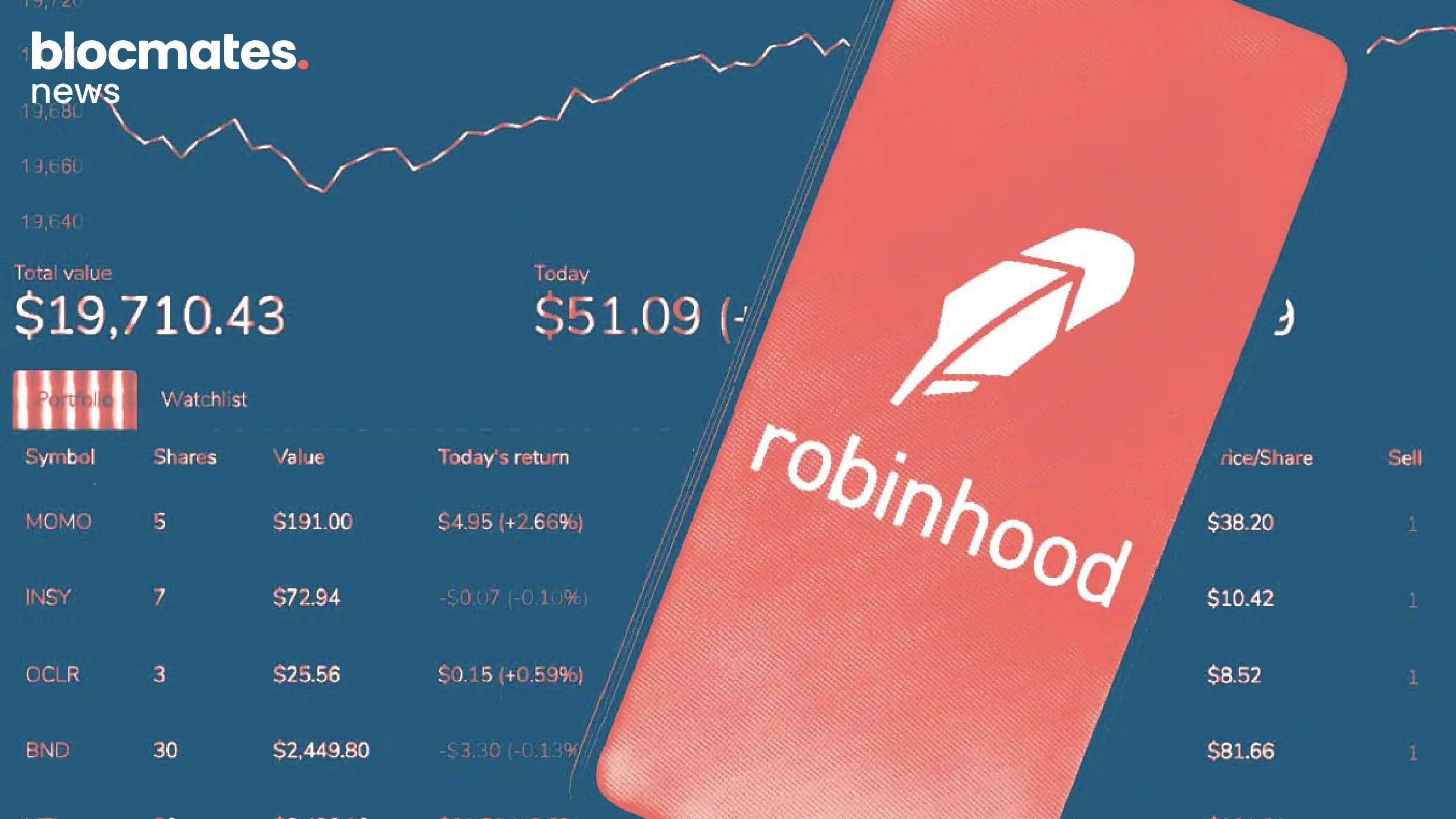
Memecoin traders, levered-suit-and-tie bros trading penny stocks, Robinhood, and issuers minting tokenized claims on real US shares - all part of a cast in what we think is a very familiar story happening in a totally new way.
Let’s refresh your memory a little bit.
If you remember the “memestock” saga, then you’re acquainted with the happenings of January 2021 - GME’s price shot through the roof thanks to retail investors piling into the stock in droves, triggering a short squeeze as hedge funds’ short positions came under pressure.
The next day, Robinhood controversially moved GME to “position closing only,” preventing users from opening new positions.
Fast forward to 2026, Robinhood is in the mix of a much funnier conspiracy where memecoin traders are attempting to launch a memecoin, pair it against a tokenized stock instead of ETH or a stablecoin, lock as much of that tokenized float as possible inside the meme’s liquidity pool, and hope the resulting volume and scarcity force new issuance.
New issuance, in theory, means someone has to go buy the actual shares. If the name is already crowded on the short side, the buying is supposed to hurt.
This is how it all works.
How the tokens get issued
A lot in crypto had been flat all year, and then Robinhood Chain went live on July 1, 2026, as an Arbitrum Orbit layer-2 built for tokenized real-world assets.
The core idea behind “a Robinhood Chain” is a flagship product called Stock Tokens - standard ERC-20 tokens issued by Robinhood Assets (Jersey) Limited.
These tokens track US stocks and ETFs, reinvest dividends via an onchain multiplier, and break the time zone trading threshold by being available 24/7.
It must be said that these tokens, of course, do not confer voting rights or legal ownership of the underlying shares. Rather, they are tokenized debt securities, fully backed 1:1 by real shares sitting with a US custodian.
A feature of these Stock Tokens is that primary-market minting and redemption are gated, meaning only authorized participants who have completed KYB can subscribe for new tokens or redeem existing ones.
Everyone else trades the existing float on major DEXs onchain or through the Robinhood Wallet.
When the onchain token trades at a premium to the real stock, the authorized participant can mint more. And of course, minting requires acquiring the corresponding real shares.
When markets are closed, that process slows or stops. The tokenized float becomes temporarily fixed, making the window a part of the trade.
For the first three weeks, the chain was a memecoin carnival, and it still is.
Thanks to Vlad’s famous “great for memes too” tweet.
Most of the volume was generated by regular memecoins with familiar pairings until things got a little bit freaky.
At first, stock-themed memecoin launchers creatively made their tokens interesting by using the fees from these coins to distribute real, tokenized stocks to holders.
Gradually, this meta evolved to a different, unfamiliar type of pairing, with special launchpads designed around them, triggering a wildfire effect.
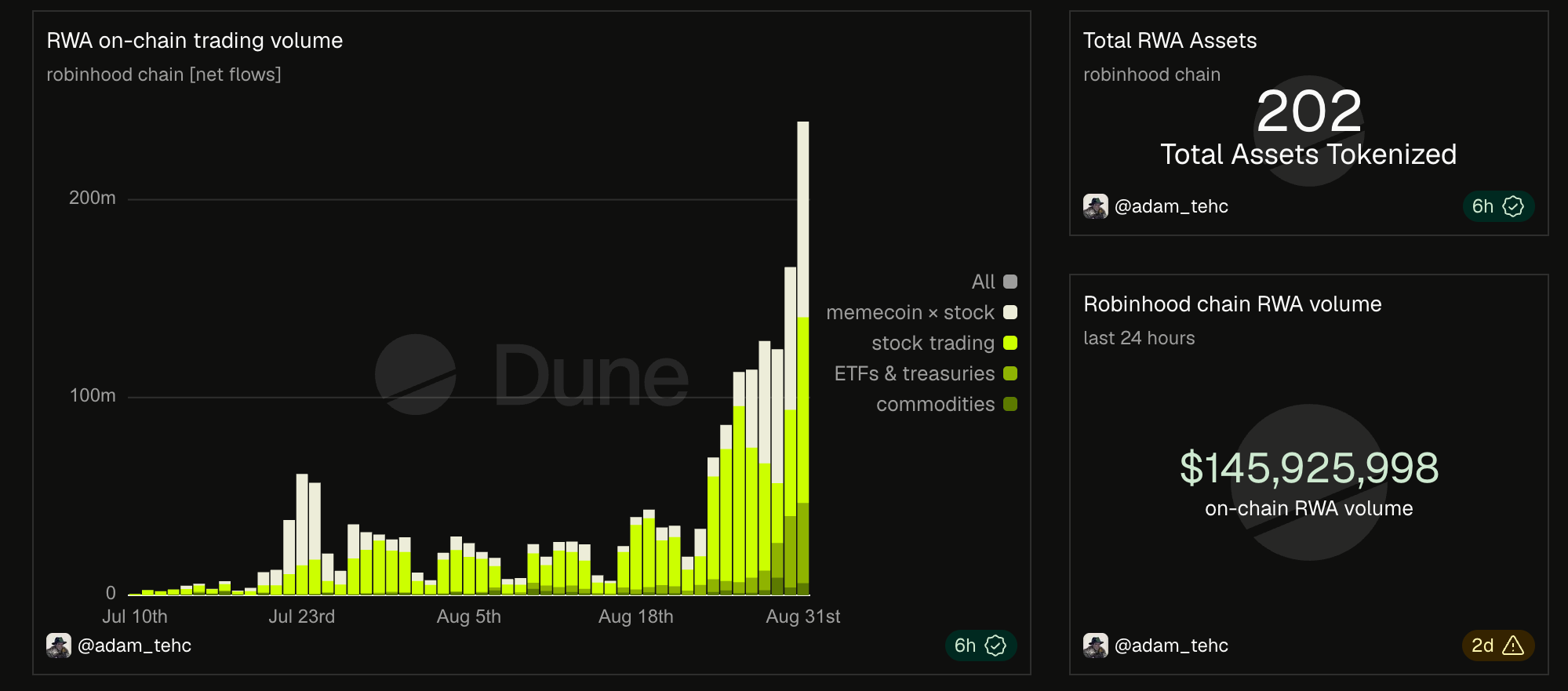
At the moment, memecoins and stock pairs are responsible for ~68% of the total onchain volume on Robinhood.
In fact, the trend has spilled over to other networks like Solana and is now comfortably a new trend worth our attention.
Let’s get into the mechanics, shall we?
Let's be honest, AI subscriptions add up fast. One month it's ChatGPT, then Claude, then another tool everyone on TikTok swears you need.
Before you know it, you're paying for half a dozen AI apps just to keep up. We're in the same boat, which is why we've been using Plasma One.
It gives us cash back on our AI subscriptions without having to think about canceling the ones we actually use.
If you want in, sign up using the link or scan the QR code below and start getting some of that money back.
Paying for ChatGPT or Claude won't suddenly make your life cheaper. Your monthly subscriptions will still hit your bank account, but Plasma One will help route some of that money back to your pocket.

The memecoin-stock pairing mechanics
Memecoins launched on Robinhood moved from being paired with ETH or stablecoins to being paired with Jersey-issued stock tokens such as NVDA, TSLA, SPCX, HIMS, and others.
The idea is to put the meme version beside the other pair - for example, “Artificial Inu” being paired with tokenized stock, NVDA, “Gently Used Tesla” paired with TSLA tokenized stock, “Stonks” paired with SPY, and “BONER” paired with HIMS tokenized stocks.
A variety of these pairings exist, launched on special launchpads such as - Long for levered pairs and Pons.
The way it works is pretty simple and similar to how ‘normal’ memes are traded, but with a caveat.
The token’s automated market making (AMM) pool holds both the meme and the tokenized stock.
Usually, when a token (x) is paired with, say, ETH (x/ETH pair), they buy x with ETH, triggering an exchange of ETH for x in the pool.
The same thing goes for stablecoins like USDC.
Thus, for stock-paired tokens like AI/NVDA, users buying the AI meme are selling NVDA into the pool.
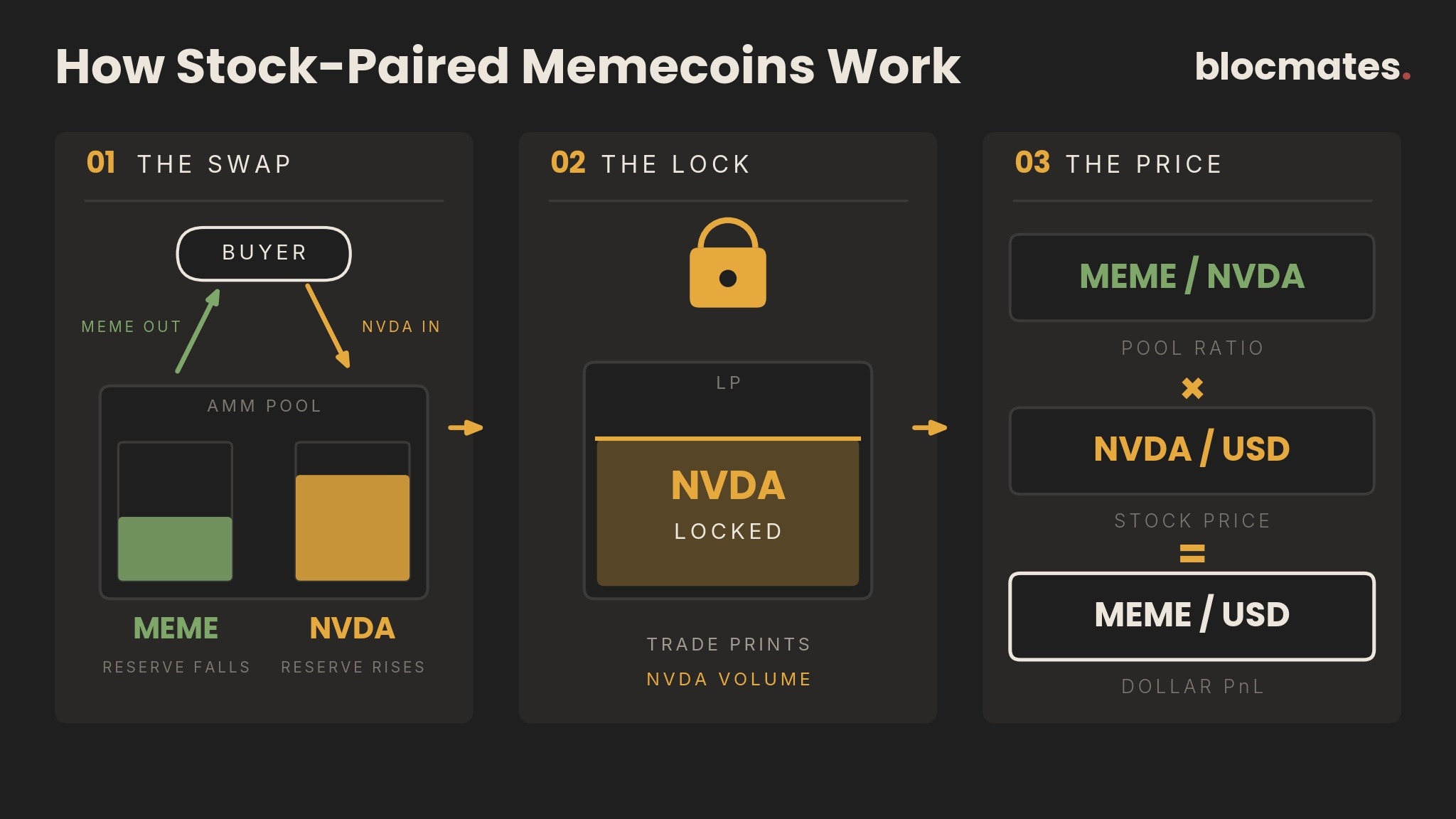
Therefore, trading the pair produces volume in the stock token (NVDA) as a byproduct and locks the deposited stock tokens inside the LP.
The meme’s price is, therefore, a ratio (how many stock tokens per meme token), and its stablecoin or dollar PnL is that ratio multiplied by whatever the underlying stock does in the market.
Targeting penny stocks
If you’re paying attention, you can probably already smell the play here.
You’re not exactly going to move the needle on the tokenized versions of the mega-cap names. There’s simply too much liquidity sitting around.
But the penny stocks? That is the real target. Thinly traded, heavily shorted underlying stocks - names where a burst of onchain demand can spill over into the offchain market and put some serious pressure on short sellers.
The idea is that a wave of meme-driven buying starts hammering the LP, buying up tokenized shares and draining a big chunk of the available onchain liquidity.
Suddenly, the amount of stock tokens actually floating around onchain gets pretty damn thin.
And when supply gets thin while everyone is punching the buy button on fomo, you can get some very funky price action.
The issuer can potentially mint more tokens to meet that demand, but something to consider here - TradFi still has a closing bell.
Crypto, on the other hand, doesn't care; trading continues even at 2 am on a Sunday.
So you can end up with a tokenized stock trading onchain while the underlying stock market is sitting there with the lights off.
During those periods, liquidity can get thinner, increasing spreads and making arbitrage difficult.
Which means a sudden wave of demand can push the onchain token above the underlying stock’s reference price creating a premium.
When the authorized participants can finally mint again, they have to buy real shares to back the new tokens - something that might be pretty significant for a small-float, heavily shorted asset.
A loop is then created: the stock’s rising price feeds the meme narrative, which in turn brings more volume.
We wish this were fiction.
It is indeed already happening, with a good example being the BONER/HIMS pair - a considerably low-hanging fruit target thanks to Hims & Hers carrying a sizable short interest.
Implications and predictions
From where we sit, we can identify three noteworthy implications of this trend.
Foremost, this feels like the on-ramp for tokenized stocks that we’ve been waiting for.
Cycle after cycle, memecoin activity has remained an industry staple - and as finance converges, is playing an important role in bringing more TradFi assets onchain. That’s one way to look at it.
Another way is to look at the indirect demand as an intentional design. It might not be direct, but it creates or brute-forces a liquid economy for more technically sophisticated teams to build concrete DeFi products around onchain stocks.
On another island of this, there is the closing bell dilemma.
For much of 2026, Wall Street has hinted at preparations for 24/7 markets, but in an ironic twist, memecoin stocks make market closings valuable for onchain activity - weekends and overnight sessions are when the float is most brittle.
Third, we are inclined to think that the longer this goes on, regulators might eventually have to ask whether pairing a memecoin with a tokenized debt security that requires real-share purchases is something closer to a coordinated bid.
When that time comes, I’m happy to point out to all of you who traded this and dropped a thesis but didn’t share any of those juicy gains (jkjk).
On a more serious note, it is hard not to see how this will eventually force authorized participants and market makers to optimize for rapid minting through the overnight session, which would shrink the exact window this trade needs, thereby reducing the ‘artificial’ premiums.
Make no mistake, none of this is large enough yet to “short-squeeze Wall Street” - at least, not yet, because memecoins, as we all know, remain volatile, and onchain hold time is still not where it used to be. The moment there’s a dump, all that locked asset flows back into the pool.
On this note, we will wrap up by saying it is indeed fun and exciting to watch, but also imperative to be cautious. Treat this as you would any other memecoin and don’t be caught in a cascade.
As always, none of this financial advice, and the author doesn’t hold any of the above-listed assets used as examples.
Heading to KBW, TOKEN2049, or a well-deserved holiday?
Flights, hotels, taxis, dinners, coffees, the spending adds up quickly.
Instead of off-ramping crypto to your bank before the trip, deposit directly into Plasma One from supported chains and spend from there.
And if you’re going to spend thousands traveling anyway, you might as well earn while doing it.
Load up Plasma One before you fly and make it your card for the week.








.webp)

.webp)
.webp)
.png)

.webp)

.webp)
.webp)
.webp)
.webp)









.webp)
.webp)

.webp)

.webp)
.webp)


.webp)
.webp)







.webp)
.webp)

.webp)
.webp)
.webp)


.webp)
.webp)


.webp)


.webp)




.webp)


.webp)


.webp)













.webp)






.webp)







.webp)
.webp)
.webp)

.webp)









.webp)

.webp)


.webp)





.webp)