.webp)
Reading time: 5m 52s
Crypto has demonstrated that viable businesses can be built onchain. However, the market still hasn't entered the exponential growth curve where it starts to eat the world.
And it certainly hasn't priced the businesses sitting at the point of real capital inflows, the ones best positioned to capture enormous value when that moment arrives.
For example, an exchange that owns its entire stack and earns trading fees whenever users trade, like Hyperliquid, or a transport network that earns revenue from facilitating the movement of onchain value, like…?
That second example comes with a question mark because it points to a fundamental question the market is yet to answer:
Who truly is best positioned to capture the premium for transporting onchain value?
Transportation is, at its core, the business of movement. It's one of humanity's oldest and most enduring industries.
Whether it's moving people to space, products across continents, or information across the internet, transportation has always created value by connecting demand with supply, capital with opportunities, and value with consumers.
Crypto moves different kinds of value, ranging from stablecoins to real-world assets, payments, DeFi positions, agents, and institutional flow.
A bet on crypto’s horizontal adoption is a bet on more of these assets coming onchain, which, inevitably, is a bet on the infrastructure that lets them move freely between chains, ecosystems, and applications.
Ultimately, it is a bet on whoever is best positioned to full-stack own that route and charge for passage.
We truly believe that our discourse for today, Squid, fits this bill - and over the next few paragraphs, we will go deeper into why we think so.
Current asset movement landscape in crypto
In our first deep dive on Squid, we introduced it as the full-stack infrastructure layer for moving value across 100+ chains. We covered what Squid is, what it isn’t, and how it works under the hood.
This time, we’re looking at a different question: What makes the product valuable?
To answer that, we need to start with the environment Squid operates in - it is an environment that misunderstands the main problem, fragmentation.
Crypto didn’t become fragmented by accident; rather, it was fragmented by design.
Fragmentation is the natural outcome of permissionless innovation, which makes the limitations of today’s interoperability stack the real challenge.
A bridge moves assets between chains. An aggregator picks the best bridge. But neither owns the route. Every layer depends on the one below it, from aggregators to bridges to messaging protocols to the underlying chains.
In other words, nobody truly owns the path. And if you don’t own the path, it’s difficult to build durable advantages or capture meaningful value from it.
This is where Squid fits: a full-stack layer for transporting value onchain, that extends all the way to consumer experience.
Comparative analysis: Squid vs. the industry standard
We’ve put up Squid against the industry standard on every dimension that matters to buttress our argument.
To effectively do this, the field breaks into three archetypes:
- Corridor bridges that own one excellent route
- Route-quote aggregators that rent everyone else's
- Messaging layers that everyone above them depends on
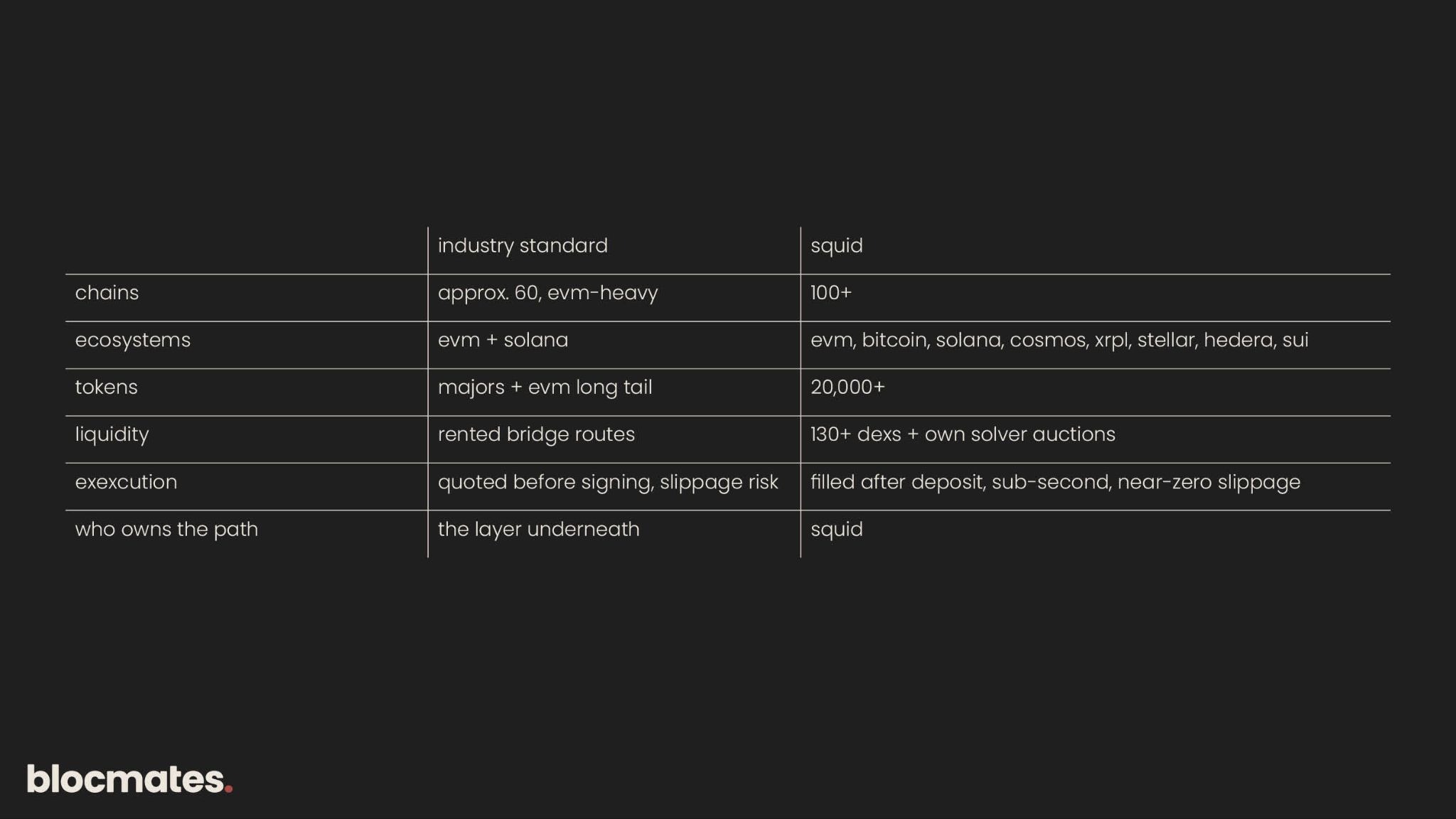
The bottom line is that Squid operates above industry standard. However, what is particularly interesting is the last row, which indicates an adequate split between tenants and owners.
This is because the typical aggregator does not move funds itself. It quotes across underlying bridges and skims an integrator fee, typically 5 to 15 basis points, off whichever bridge wins the route.
As a matter of fact, the corridor bridges actually own their execution, and their highways are genuinely fast, but a toll booth on one road is a different asset from the road network. This is where Squid is in a different league.
A few consumer aggregators already use Squid as an underlying path, with over 1,500 applications integrated with Squid's infrastructure, including major wallets, payment platforms, and ecosystem partners across XRPL, Stellar, and Hedera.
Squid has processed over $6.3 billion in volume for more than one million users since launching in January 2023.
But that’s not all, we’ll get into the technical advantages that make Squid THE full-stack transport product for the movement of onchain value.
Squid’s technical advantage
Importantly, it should be noted that Squid also had a tenant phase before systematically rebuilding its stack with Squid 2.0 and the CORAL and Intents evolutions.
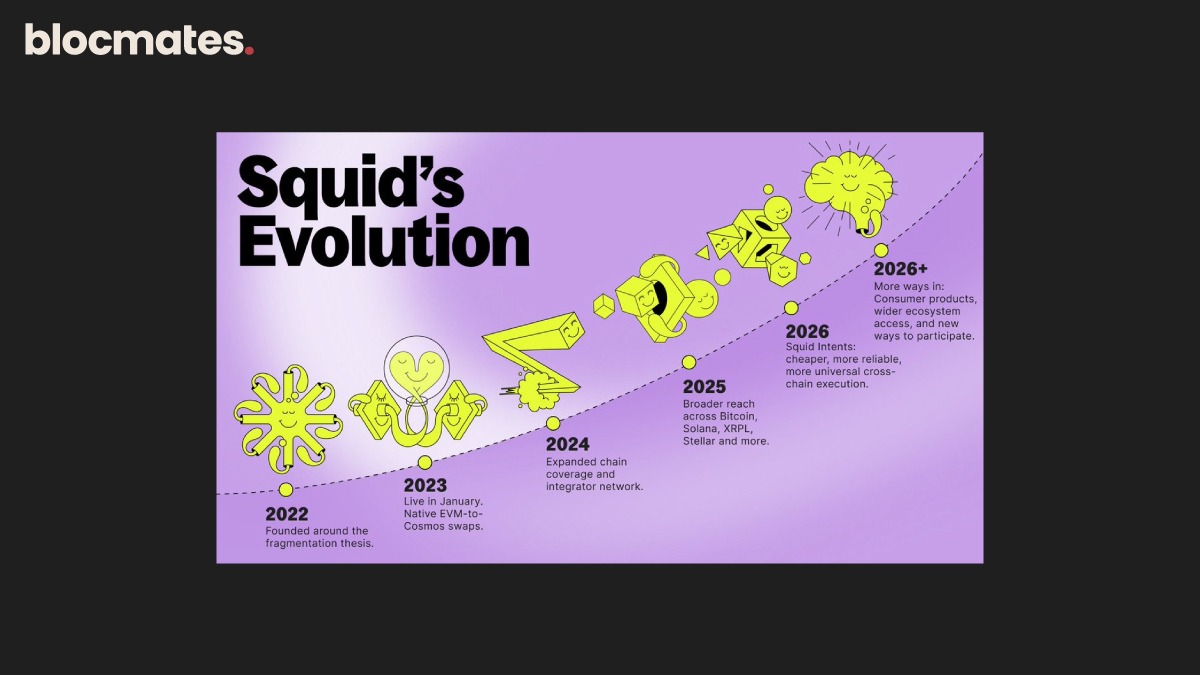
Each layer was added with the explicit goal of removing dependencies and expanding the reachable surface.
At the moment, this surface encompasses:
Full-stack ownership
Unlike most cross-chain protocols, Squid owns nearly the entire transaction path.
It controls the execution layer (Squid Intents), routing engine (Aggregator), developer SDK, and the consumer-facing products: the Bridge, widget, and APIs.
Instead of stitching together third-party bridges, messaging layers, and solvers, Squid operates an integrated stack.
That means improvements don’t depend on upstream vendors. When competitors want to optimize execution, they wait for another protocol. When Squid wants to optimize execution, it ships code.
Universal compatibility
Most cross-chain systems are constrained by their own architecture, optimized for EVM chains, specific messaging protocols, or predefined liquidity paths.
Squid is designed around a different assumption: route any token, across any chain, through any viable liquidity source or messaging layer.
It supports EVM and non-EVM ecosystems, native assets, DEX liquidity, market makers, IBC, CCTP, and Intents within a single routing graph.
Rather than forcing assets through wrappers or bespoke gateways, Squid searches for the best available path regardless of where liquidity lives.
Squid Intents (The execution engine)
Traditional bridges lock users into a quote before execution, forcing them to absorb market movement while the transaction propagates.
Squid Intents reverses that model. Users specify the desired outcome, while competing solvers generate an execution close to settlement using fresh market data.
Execution happens inside TEE-attested environments, with only final settlement occurring onchain. The result is:
- fewer failed transactions
- lower slippage
- reduced MEV exposure
- and fast refunds when execution cannot be completed.
This introduces a different trust model than multisigs or validator networks, but the assumption remains within Squid’s own infrastructure while settlement is still verified onchain.
Compounding position
Every new integrator strengthens the Squid routing network. More volume improves routing quality, attracts more integrations, and creates a classic network effect.
As network ecosystems become more fragmented, the value of owning the connective layer compounds.
Belief in the future of onchain is belief in Squid
Beyond the pristine architecture, Squid is a business.
As a business, Squid earns revenue from multiple sources:
- Protocol fees every time value moves across its network - so far, Squid’s moved over $6 billion in lifetime value
- Share of fees that integrators earn using Squid’s developer tools - 1,500+ integrations
- Fees for bespoke development of new crypto and interoperability technology
- Chain and asset integration fees
More importantly, Squid’s revenue is driven by usage, as opposed to the norm - incentives. Squid isn’t paying users to manufacture activity and hoping it sticks once the rewards disappear.
As more assets come onchain - stablecoins, RWAs, AI-driven capital - more value has to move between ecosystems. Every transfer is another trip across the network, and another opportunity for Squid to earn.
The pricing model reflects that reality. Simple transfers are cheap while complex, fragmented routes command higher fees because they’re harder to execute and far more valuable to users.
That’s the same principle we discussed at the beginning of this piece, that the greatest premium belongs to whoever can reliably solve the hardest transportation problem. As fragmentation increases, those difficult routes become more common.
Squid is uniquely positioned for an interoperability landscape that will only become more complex over time. As more chains and applications integrate Squid, and as it ships new features alongside consumer-facing products, its infrastructure reaches more users without sacrificing the reliability and simplicity that define the product.
Concluding thoughts
To capture any sort of premium onchain, the entity must own a chunk of the stack, if not the entire thing.
Hyperliquid understood this and went beyond building an exchange to rolling out the HyperEVM, builder codes, APIs, HIP-3 permissionless deployments, with a simple goal to house all of finance onchain.
Squid increasingly fits that pattern.
It owns its technology stack end-to-end, routes across ecosystems that many competitors still struggle to reach, and earns regardless of whether the next cycle is driven by memecoins, stablecoins, RWAs, or autonomous agents.
Moreso, three years of growing usage suggest that demand isn’t theoretical. If crypto continues to grow, more assets will come onchain.
Those assets won’t stay where they’re issued; they will move. And as long as that’s a possibility, Squid is well-positioned to capture that premium.
Thanks to the Squid team for unlocking this article. All of our research and references are based on public information available in documents, etc., and are presented by blocmates for constructive discussion and analysis. To read more about our editorial policy and disclosures at blocmates, head here.









.webp)
.webp)

.webp)

.png)


.webp)



.webp)
.webp)

.webp)













.webp)

.webp)

.webp)

.webp)
.webp)



.webp)

.webp)

















.webp)
.webp)
.webp)
.webp)
.webp)


.webp)
.webp)


.webp)


.webp)




.webp)


.webp)


.webp)



















.webp)






.webp)









.webp)

.webp)
.webp)

.webp)













.webp)

.webp)


.webp)





.webp)