.webp)
Reading time: 6m 4s
While everyone’s attention is being stolen by AI, something interesting is happening in stablecoins - we are witnessing The Great Decoupling of stablecoins from the rest of crypto.
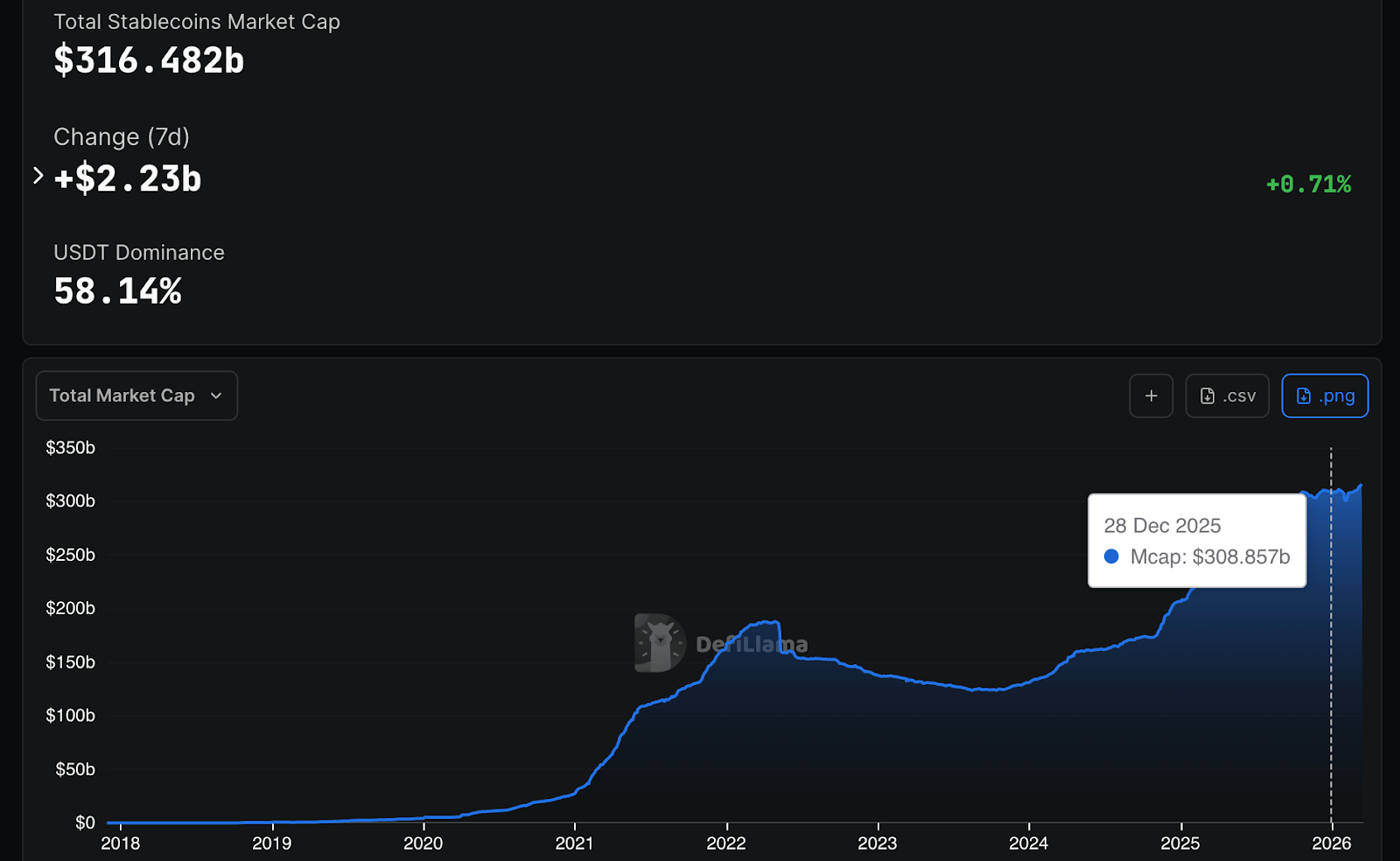
Stablecoin growth has been rapid through the windfall in token prices across the board. The total stablecoin market cap crossed $308 billion in 2025. Annual transaction volume hit an estimated $46 trillion, depending on who you ask. That’s more than 20x PayPal’s volume and closing in on Visa.
And yet, for all the progress stablecoins have made as a settlement layer, the market they’re most naturally suited to disrupt, foreign exchange, remains almost entirely untouched by them.
Surely, there is a problem.
Why is this happening?
The traditional foreign exchange market daily turnover hit approximately $9.5 trillion in 2025, according to the BIS Triennial Survey.
It dwarfs equities, commodities, and crypto combined. But beneath the surface, the infrastructure is remarkably dated. Let’s break down the key issues.
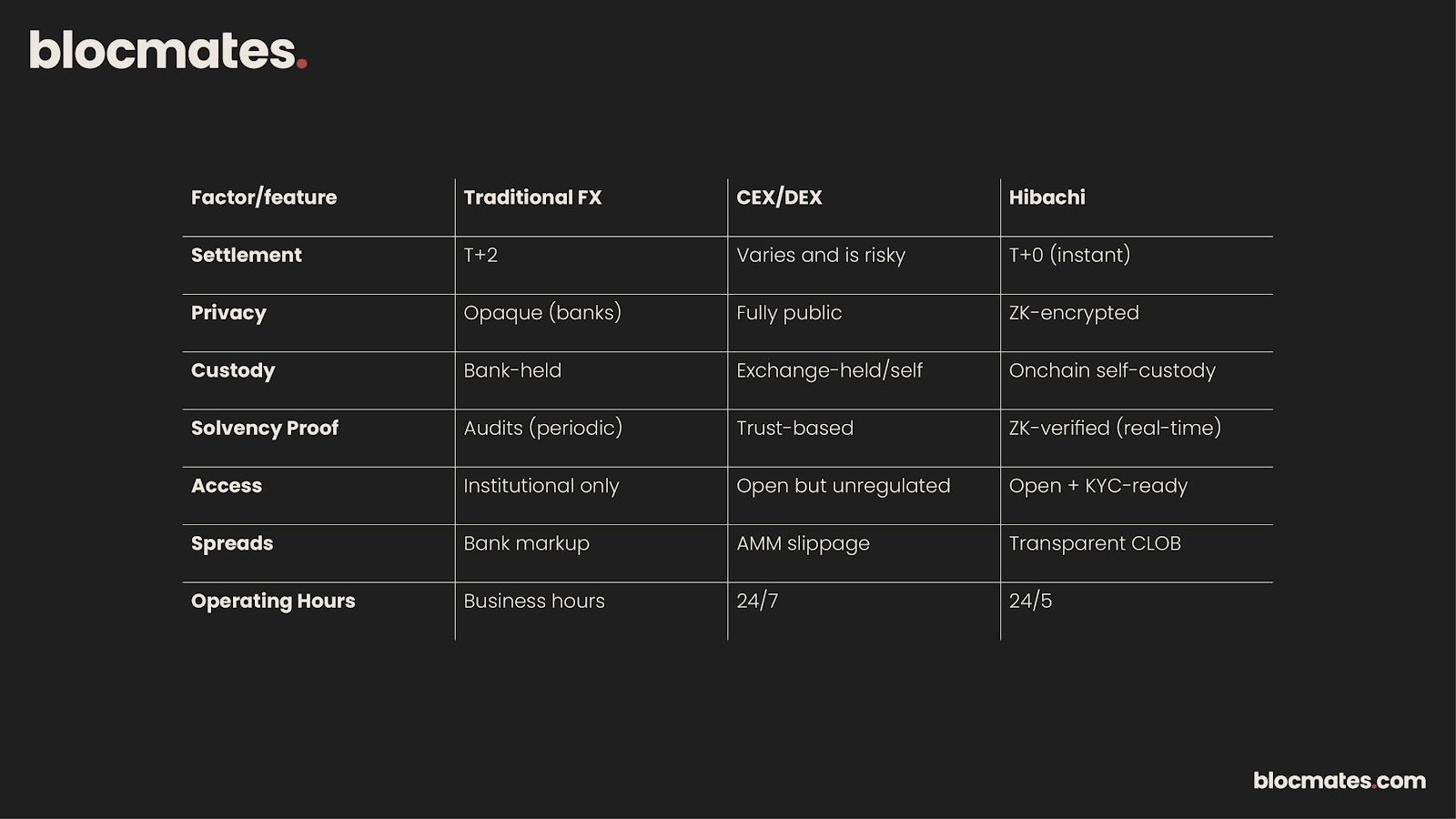
Most spot FX trades still settle on a T+2 basis, meaning your trade takes two full business days to finalize. Yeah. In 2026.
During those two days, you’re exposed to counterparty risk and market risk, and your capital is effectively trapped in limbo.
If a crisis breaks out over a weekend, tough luck. You’re waiting for Monday while the market moves against you.
Moreso, traditional FX requires bank intermediation, nostro accounts across multiple currencies, and relationships with prime brokers.
On the other hand, CEXs introduce counterparty risk through custody requirements. And onchain DEXs lack privacy protections, exposing trading strategies and order flow to competitors.
Neither offers the compliance infrastructure that regulated firms require, including proper KYC/AML screening, custodian integrations, and on and off-ramp support tailored for currency conversion at scale.
There is simply no venue purpose-built for stablecoin FX. No venue that combines stablecoin settlement with exchange-grade execution and transparent order books. This is the part where you click your fingers and say, “That’s the gap.”

But before we go into what’s filling this gap, here’s another angle that doesn’t get enough attention.
Stablecoin adoption to date has been overwhelmingly USD-denominated. Tether’s USDT and Circle’s USDC control over 94% of the market.
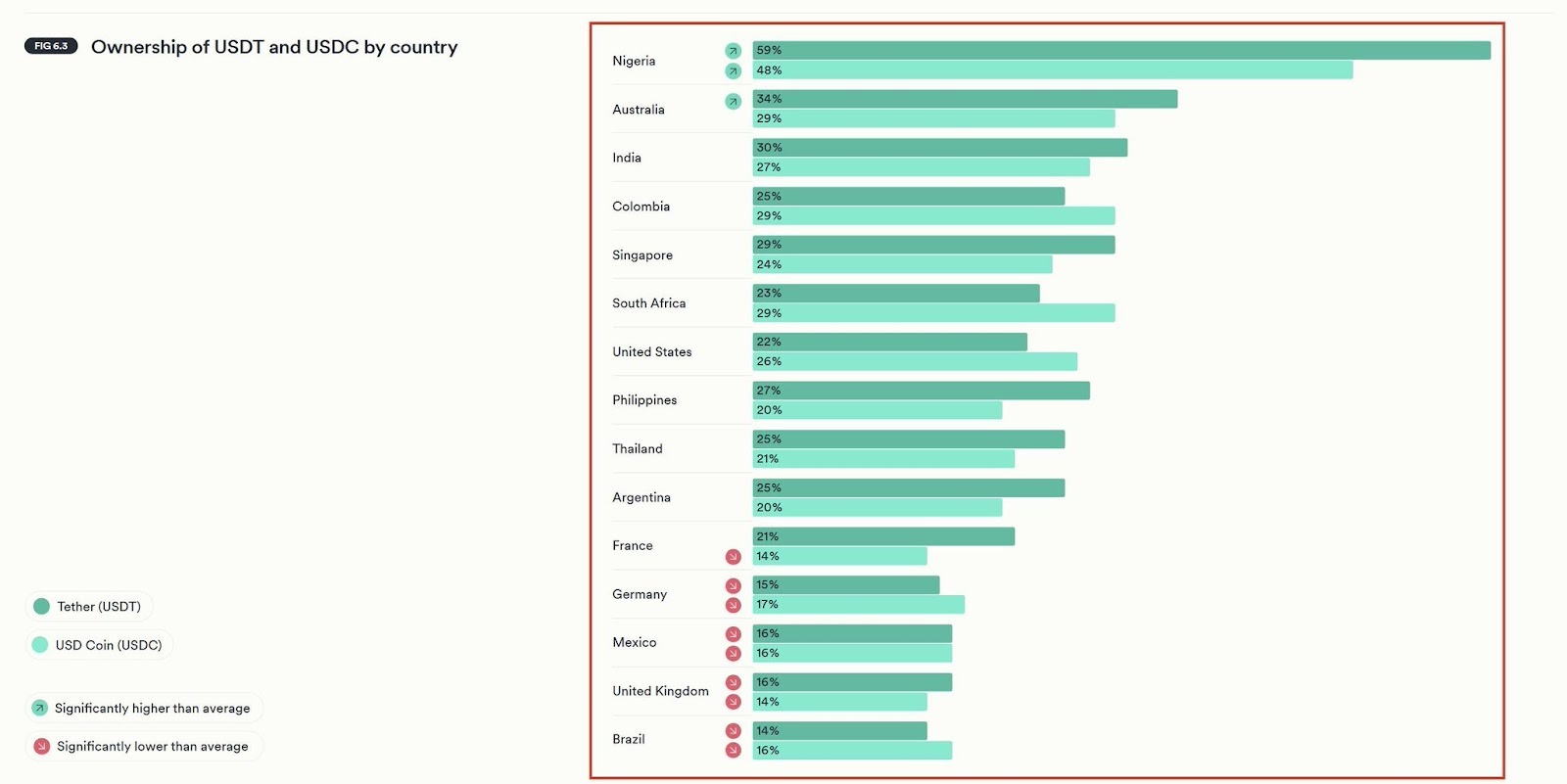
But the next wave of growth won’t be exclusively dollar-based. We are beginning to see euro stablecoins gaining traction under MiCA and the Japanese launching yen stablecoins. Most emerging markets, like Nigeria, are exploring the tokenization of their local currency, too.
To fully unlock the next phase of stablecoins, the market needs a dedicated stablecoin-native FX venue… and, ladies, gents, and agents, this is where Hibachi comes in.
What is Hibachi?
Hibachi is a modern central limit order book (CLOB) for global currencies. You can think of it as the venue that’s been missing from both the crypto and traditional FX worlds, now built from scratch for the stablecoin era.
At its core, Hibachi offers transparent pricing, direct access to liquidity, an architecture designed for continuous global markets, with no bank intermediary marking up the spread.
There is also no opaque pricing and no gated access that locks out everyone below a certain AUM threshold.
One of the most fundamental aspects of Hibachi is that it opens up currency trading beyond the traditional interbank system.
Its infrastructure is designed to encompass neobanks, payment processors, treasury desks, cross-border remittance companies, and professional traders who want to convert between stablecoin pairs with real execution quality.
Having begun as a perps exchange, Hibachi’s expansion into stablecoin FX is a natural extension of the technology they’ve already built. The zk-powered CLOB that made their perps exchange fast and verifiable is now the same engine powering its institutional-grade FX. Let’s get into the weeds of how it works.
How does Hibachi work?
One of the biggest pain points for institutional FX participants on existing onchain venues is the total lack of privacy.
Your order flow, your position sizes, and your strategies remain visible.
Hibachi solves this using zk-proofs. Every balance update, order fill, and system state transition is verified cryptographically without revealing the underlying data.
Users get full verifiability without sacrificing privacy. Proofs are posted as encrypted data blobs to a data availability layer, ensuring everything is auditable, but nothing is exposed to front-runners or competitors.
Moreso, Hibachi’s zk-proofs provide cryptographic proof of solvency. Users can independently verify that the system is solvent and that their trades were executed correctly.
Custody is handled entirely onchain via smart contracts, with every position collateralized.
This includes forced withdrawal guarantees; even if the exchange becomes unresponsive, you can recover your funds independently.
That’s a level of safety that no traditional FX venue and very few crypto exchanges can offer.
Hibachi matches orders offchain for ultra-low latency, achieving sub-millisecond execution. This is the kind of speed that professional market makers and HFT desks expect.
Settlement, however, happens onchain with cryptographic verification, giving you the best of both worlds - CEX speed with DEX transparency.
The CLOB architecture means visible order book depth, tight spreads, and order execution certainty. There’s no intermediary between you and the market.
Hibachi’s FX venue will be deployed on Arc, Circle’s open L1 when it goes live.
Arc is specifically designed for enterprise-grade stablecoin payments, FX, and capital markets transactions. It delivers sub-second finality and uses stablecoins for gas fees (no need to hold a separate native token just to transact).
Arc also offers privacy features that address institutional requirements out of the box.
Building on Arc makes strategic sense. Circle is the issuer of USDC, the second-largest stablecoin.
By building on Circle’s own chain, Hibachi gets native access to the most liquid stablecoin infrastructure in the market, plus the backing of Circle Ventures through the Arc Builders Fund.
Hibachi’s FX exchange will support KYC and AML screening as required by institutional trading firms as a core design decision.
The idea is that as stablecoins become standard for cross-border payments and treasury operations, regulated participants need a venue that speaks their language.
How to trade on Hibachi? (step-by-step guide)
Important to state that while the FX venue is currently in development, with liveness targeted for the second half of 2026, alongside Arc’s mainnet deployment, this walkthrough reflects the current platform experience on Hibachi’s perps exchange.
Step 1: Fund your wallet
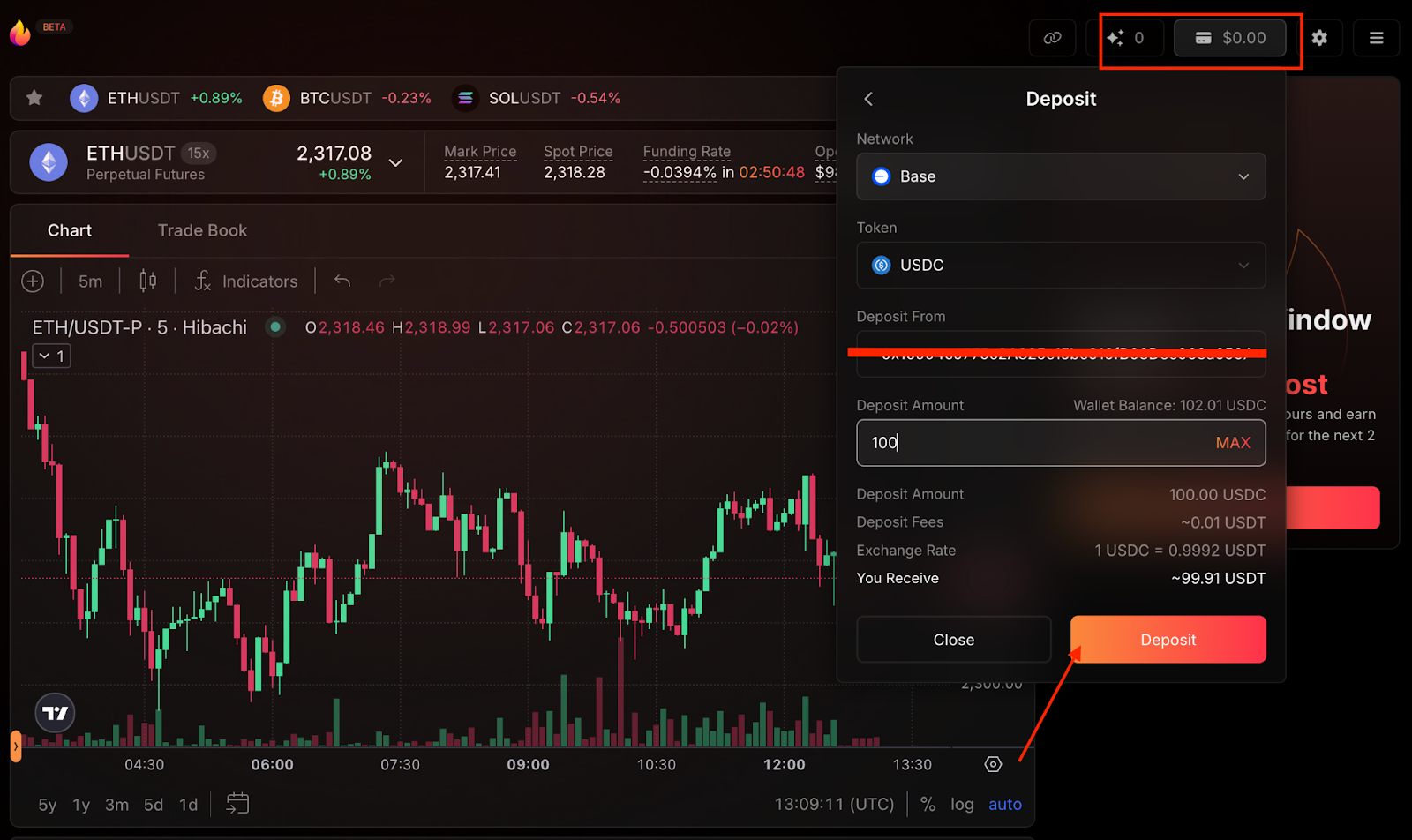
- Head over to https://hibachi.xyz/trade and connect your wallet.
- Proceed to deposit USDC to get started. Hibachi supports self-custody, so your funds remain in your control throughout the process.
Step 2: Find markets
- Navigate the markets tab to browse available trading pairs. The interface gives you visible order book depth, recent trades, and real-time price charts.
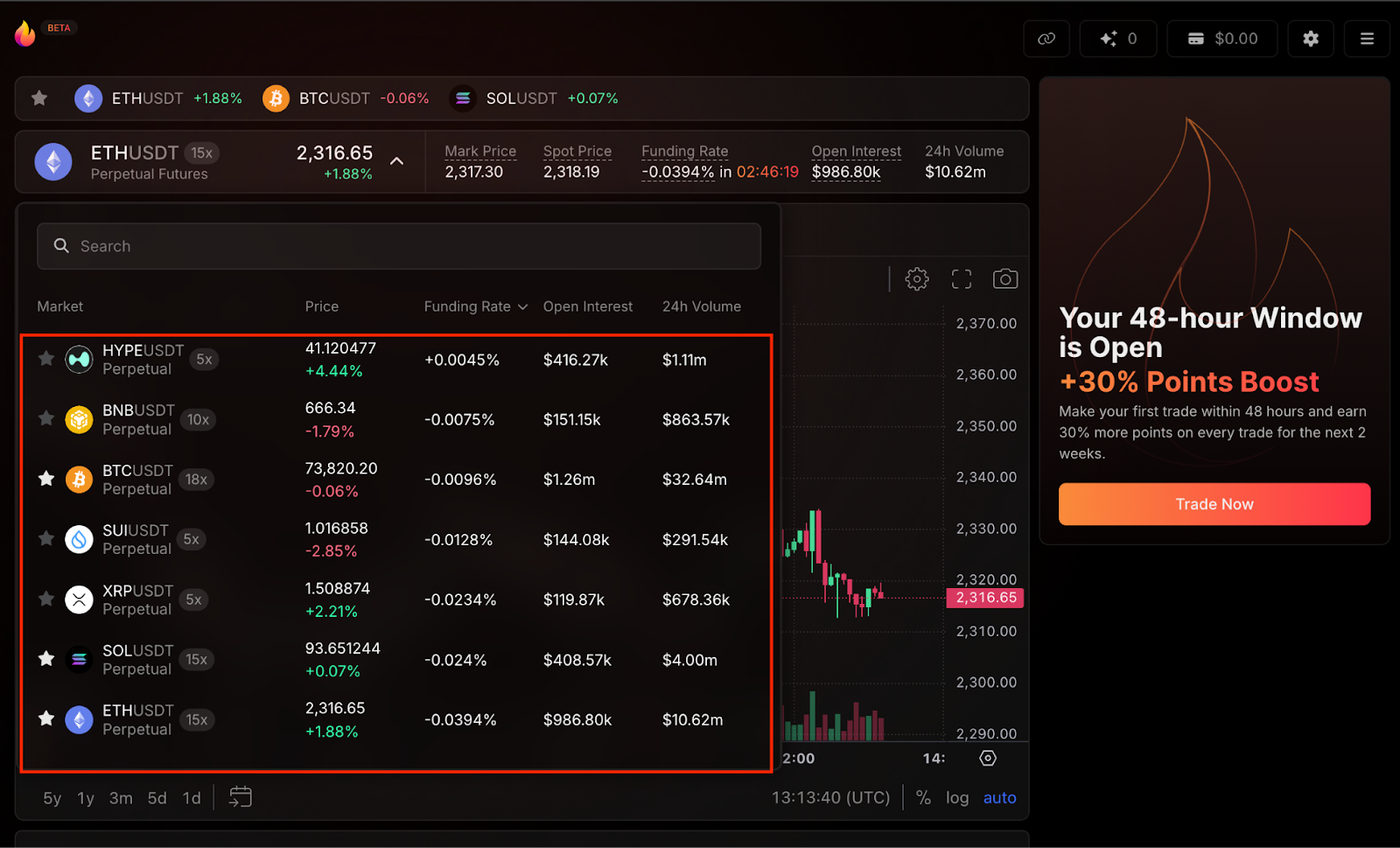
- For the current perps exchange, you’ll find major crypto pairs. When the FX venue launches, expect spot and derivatives trading across stablecoin FX pairs, such as GBP/USDC or JPY/USDC.
Step 3: Place orders and manage positions
- Place limit or market orders directly from the trading interface. The CLOB architecture means your orders enter a transparent order book.
- You can also manage open positions, set stop-losses, and monitor your portfolio from a single dashboard.
Hibachi vaults
Part of Hibachi’s products are vaults that will serve as a core liquidity layer designed to underpin Hibachi's markets. These vaults are called the Fire Liquidity Provider (FLP) vaults.
The FLP is available for live Hibachi markets today, but is designed to scale into Hibachi’s FX expansion. It serves as the primary source of deep, protocol-owned liquidity across all Hibachi markets, removing reliance on fragmented external market makers and ensuring consistent execution quality for participants.
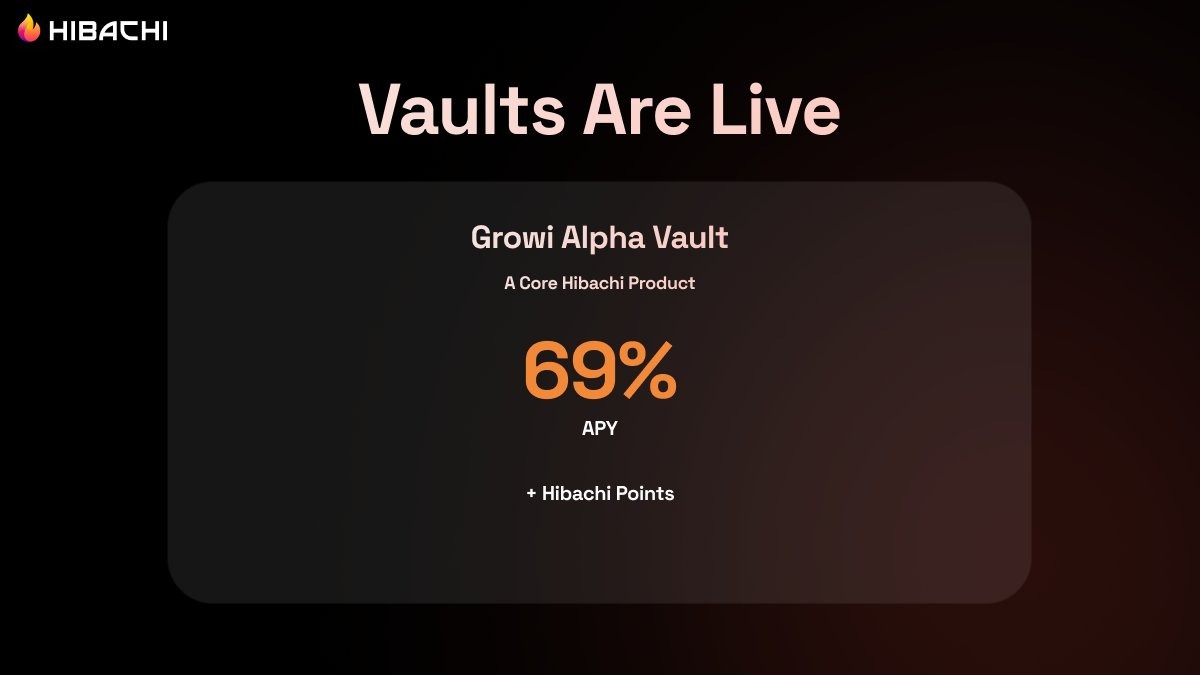
Users will be able to participate in FLP directly, providing liquidity to the venue and sharing in its growth.
Vault access and allocations will be determined by on-platform activity and points, rewarding the most engaged participants with priority access to the liquidity layer that powers Hibachi's CLOB.
The first vault, the Growi Alpha Vault (GAV), is now live, operated by Growi Finance. The vault currently delivers 69% APY in real yield and opens the door for more partnerships towards efficient vaults.
What Hibachi unlocks?
Closing thoughts
The stablecoin economy has reached a scale that demands proper infrastructure.
We believe that the demand side of this equation is already solved. However, what’s been missing is the appropriately designed venue.
A dedicated, institutional-grade exchange where stablecoin FX can be traded with the speed, privacy, compliance, and execution quality that professional participants require.
Hibachi’s architecture, including its deployment on Arc, makes it a strong contender to be that venue.
The traditional FX market moves $10 trillion a day on infrastructure from another era; meanwhile, stablecoins have already proven they can move trillions per year on better rails.
Hibachi is providing the missing infrastructure to make this happen.
Thanks to the Hibachi team for unlocking this article. All of our research and references are based on public information available in documents, etc., and are presented by blocmates for constructive discussion and analysis. To read more about our editorial policy and disclosures at blocmates, head here.







.webp)

.webp)

.webp)

.png)


.webp)



.webp)
.webp)

.webp)
.webp)














.webp)

.webp)

.webp)


.webp)




.webp)

.webp)





















.webp)
.webp)
.webp)

.webp)
.webp)
.webp)


.webp)
.webp)


.webp)


.webp)




.webp)


.webp)


.webp)





















.webp)






.webp)











.webp)

.webp)
.webp)

.webp)











.webp)

.webp)


.webp)





.webp)