$TAO is probably all over your timeline, so we’re giving you the complete rundown on everything that’s transpired so you don’t need to go anywhere else.
It’s been a crazy two weeks for $TAO and the Bittensor ecosystem as a whole.
$TAO started the month of March as the only beacon of hope in the otherwise dire crypto space, rallying 90% in a little over a week. Fast forward to yesterday, just as everything seemed all rosy and dandy, the token tanked by 20%.
So what the hell really happened?
The $TAO rally
In a crypto market where the only constant is doom and gloom, the $TAO rally naturally caught the attention of our pump-starved minds and finally got us believing that there is something genuinely worthy of investment in this space.
There were a lot of catalysts for this rally, like:
- The majority of the circulating supply is staked
- Emissions are getting cut by 50%
- Doubling of subnet capacity
- Sharp spike in social interest volumes
But by far the biggest catalyst came from Covenant AI.
Subnet 3 of the Bittensor ecosystem produced Covenant 72-B. The reason this was such a big moment is that Covenant 72-B is the largest language model to be permissionlessly trained, featuring 72 billion parameters all trained from scratch using exclusively decentralized infrastructure.
It was a HUGE breakthrough moment for the decentralized AI movement. It proved that this thing is no longer a concept but a reality.
This even led to the token of Subnet 3, TEMPLAR, pumping over 400%.
What further sparked hope among investors is that Covenant 72-B received recognition and plaudits from the likes of Jensen Huang (CEO of NVIDIA), the co-founder of Anthropic, and investor Chamath Palihapitiya.
Even Chamath’s podcast co-host Jason Calacanis tweeted “TAO > BTC.”
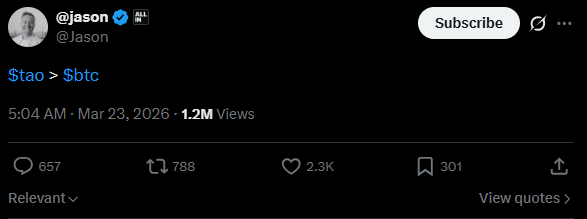
In hindsight, Jason is the only top signal you need, and unfortunately, a top signal he was (yet again).
The Covenant AI fallout
On April 10, 2026, the founder of Covenant AI, Samuel Dare, put out a statement saying that they will be withdrawing from the Bittensor network.

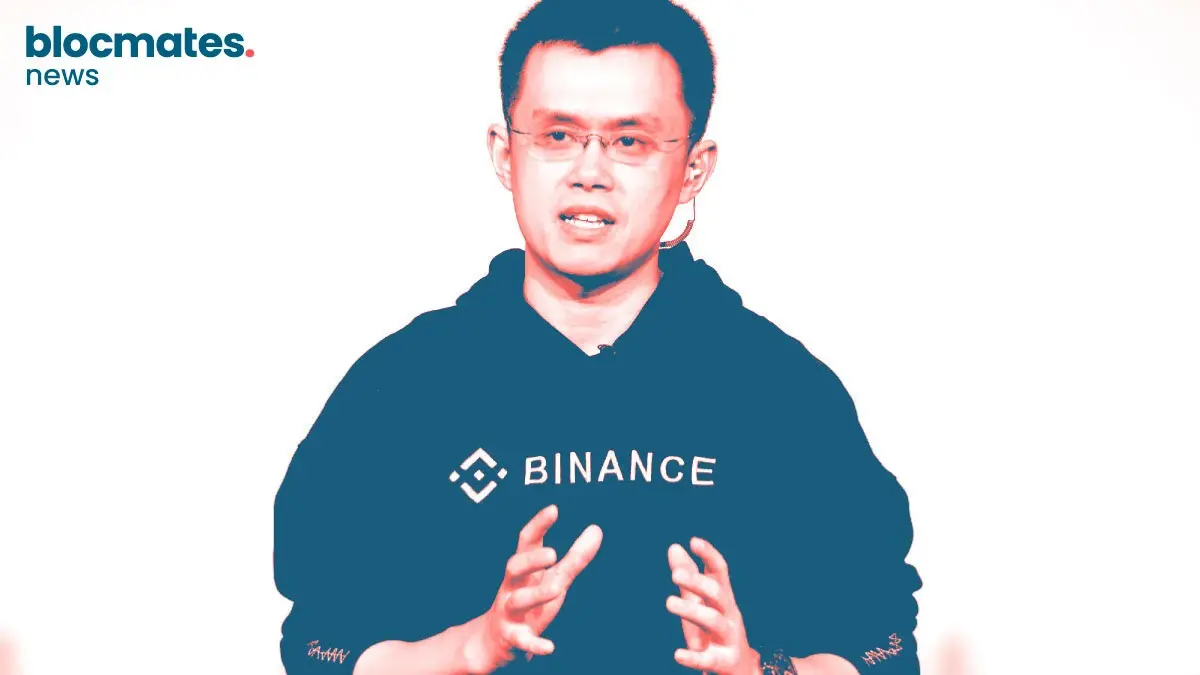
Covenant reportedly sold all its tokens (apparently over 37,000 $TAO, roughly $10 million worth was transferred to Binance), causing a sharp drop in the price of $TAO.
The reasons for this sudden withdrawal after being somewhat of the golden child from the ecosystem are to do with the Bittensor ecosystem being more of a decentralization theatre than true decentralization. Ahem ahem DeFi governance ahem ahem.
In the statement, Sam said that the founder of Bittensor (Jacob Steeves, AKA const) essentially exerts control over the ecosystem at will.
- Suspend subnet emissions
- Override the owner's authority on their own community spaces
- Publicly deprecate projects without due process
- Use token sales as a blackmail tool to compel compliance
He further states that three individuals manage the multisig for Bittensor network upgrades, but Jacob Steeves has ultimate control over them. If we’re being frank, even three is pretty poor for “decentralized governance.”
It’s due to this that Sam Dare believed it’s better to part ways.
The flipside
Now, of course, every story has two sides.
On the other side, you have people saying that Covenant AI finally got the breakout they were waiting for, leveraging Bittensor, and saw it as a perfect time to “exit scam” and “rugpull.”
Jacob Steeves mentioned in the TAO discord that Sam acted out of “greed and malice” and made an “ugly decision” as they managed to become almost bigger than the rest in the ecosystem.
Many other Bittensor proponents have also stated that they’ve had multiple verbal face-offs with Sam, with many people falling out with him over similar things in the past.
The history
To give slightly more color to the story’s background, Sam and Jacob worked together at the Opentensor Foundation (OTF) prior to all of this drama.
As part of the OTF’s plan of progressive decentralization, team members were encouraged to transition from working on the core functionality of the network to building on top of it (generally through starting their own subnets). Hell, even Const stepped down from his OTF role in February to focus on subnet contributions.
The concept of decentralized pretraining had always been a top priority of Bittensor since the start, and as such, Sam was able to leverage a lot of groundwork Jacob had initialized prior to the subnet getting off the ground.
Sam grew this initial idea, overcoming countless bottlenecks that centralized labs don’t have to worry about (which is out of the scope of this report, but you can learn more here).
The verdict
As always, there is merit to both arguments.
Yes, Bittensor is nowhere near as decentralized as it needs to be in its end state. But at the same time, all decentralized governance is theatre to an extent because we have yet to perfect the system.
If Bittensor intends to take on hyperscalers, it can’t be self-handicapping itself with unnecessary decentralization at every turn.
It comes back to the age-old adage of “Democracy is for the people, by the people, and of the people. But the people are retarded.”
News flash - Bittensor is a cult of personality. It works in the project’s favor more often than not, needing a strong direction to keep their disparate eyes on the proverbial prize.
But in moments like this, key-man risk can force investors to question if there are sufficient checks and balances in place.
What seems like the most likely scenario is that Sam and Jacob had a falling out, and we might never have the full details, and the public had to bear the brunt of the force.
Couple of takeaways.
First and foremost, subnet owners should be allowed to sell their tokens to pay for expenses (and most do). That said, abandoning a project is never okay, and this exit should have been handled differently. And, of course, Bittensor needs to allow more than a couple of voices to dictate the project's direction.
So, what now? Is it all doom and gloom for Bittensor?
I don’t think so. They’ve been around for a long time, have proved the product is great and works, they’ve “lost” Nous Research in the past, but still come out fine. This is all just part and parcel of the chaotic world of crypto.
Things do well, things break, the break ultimately makes systems stronger in the long run, and the cycle repeats. These systems should be designed to be anti-fragile.
If you would like to know more about Bittensor, check out the video we recently released with Raleigh, but after this summary, you should be up to speed with all the TAO drama.






.webp)
.webp)
.webp)
.png)

.webp)

.webp)
.webp)
.webp)
.webp)









.webp)

.webp)


.webp)
.webp)
.webp)


.webp)
.webp)











.webp)
.webp)
.webp)

.webp)
.webp)
.webp)


.webp)
.webp)


.webp)


.webp)




.webp)


.webp)


.webp)

















.webp)






.webp)








.webp)

.webp)
.webp)

.webp)








.webp)

.webp)


.webp)




.webp)