Reading time: 9m 15s
Contrary to the viral prediction that sometime in the future humans will consummate their matrimonial beds with robots as the other mating party, we are far more likely to need them for home care assistance instead, when decades of sedentary life - sitting 24/7 with blinding screens - finally catches up to us.
You don’t have to believe me, multiple posts like the one below exist on Quora and Reddit, and are a very honest way to know what people really think about ze robots.
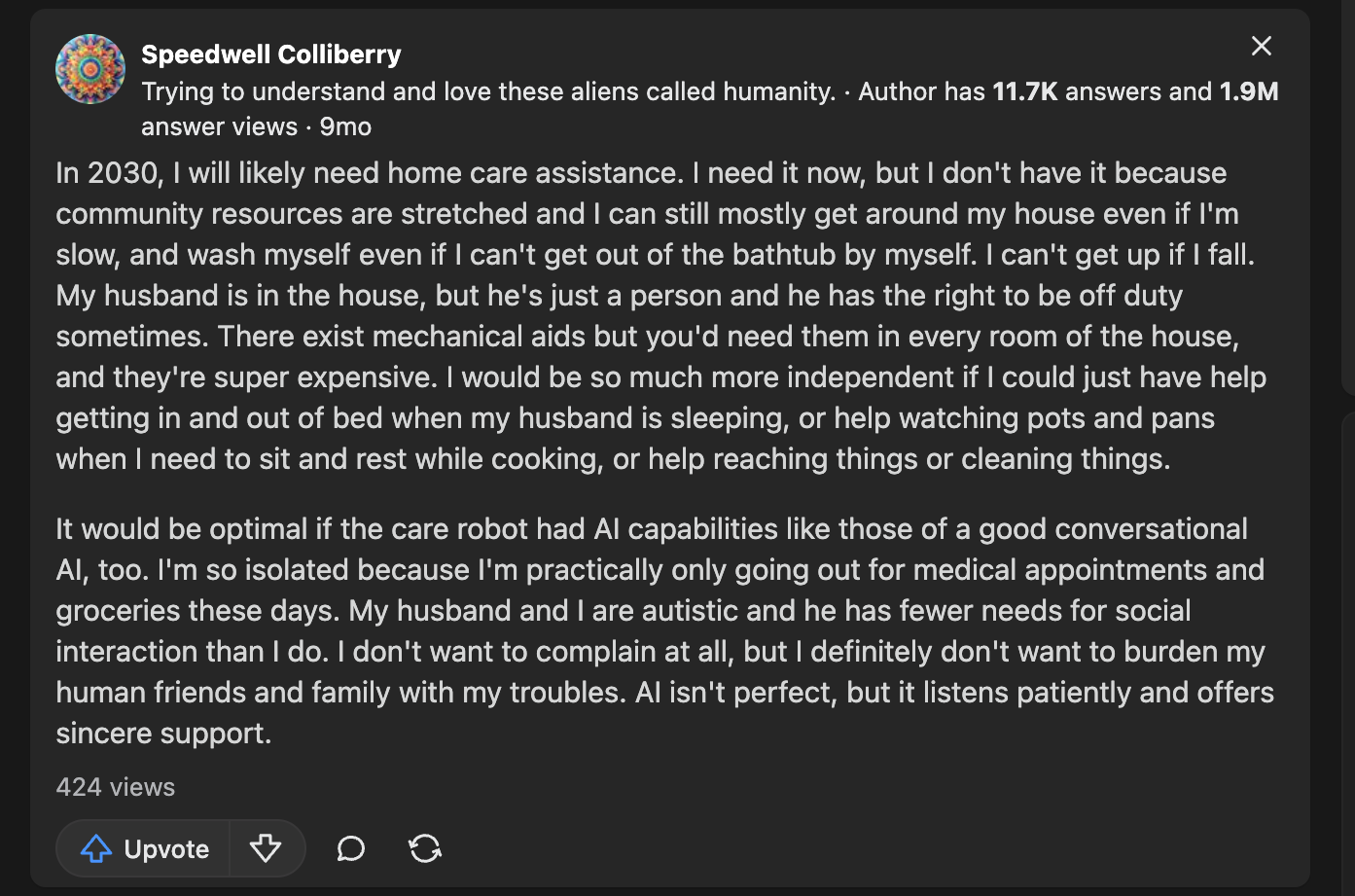
The point is, robots are only going to become an increasingly huge part of our future. Some people see this now, some don’t, while some see a trade.
For those who see a trade, you’re not wrong. The Robotics category on CoinGecko has grown 3x since our last article on the Crypto and Robotics nexus, moving from a $250 million market cap to ~$765 million.
These are early signs of an industry waking up. So, before retail does what retail always does (show up six months late and buy the top of whatever the other media mouthpieces call a “supercycle”), let’s actually break down the trade: Where is the money rotating? What are the real verticals? And which of these tokens are infra plays vs. which ones are pure narrative beta?
From AI to agents to robots
Remember Venice AI (VVV)? Yeah, loads of tantrums about the distribution process; however, recent price action has the timeline acting all brand new.
Happens that the tech, a privacy-focused, uncensored generative AI alternative to ChatGPT, is exactly the kind of thing crypto has a meaningful role to play in. Who would’ve thought?
Moreso, as an offshoot of the AI industry, agents exploded after the debut of OpenClaw. So far, we have been greeted by standout products like Hermes, reinforcing the idea that there is a real crossover between crypto and AI.
Calling robots x crypto “just AI agents with bodies” is lazy framing. It completely misses the point, especially from a market and infrastructure perspective.
Robotics introduces an entirely different set of coordination and verification problems that simply don’t exist in adjacent sectors.
The second you have machines operating in the real world, you need:
- a way for those machines to verify and identify each other, so rogue robots can’t spoof an entire fleet.
- a way to prove work actually happened, some form of Proof-of-Physical-Work.
- a way to settle payments instantly, globally, and in tiny amounts, without a human manually approving transactions.
Krix, in our last piece, broke it down into orchestration, financial layer, decentralized ownership and leasing models, data security and verifiability, and funding and community alignment.
Months later, we are consolidating this into four categories that color the robotics sector and, by extension, the trade.
The four verticals of the robotic trade
If you zoom out, the robotics trade is really four sub-narratives stacked under one banner. They have different risk profiles, different catalysts, and different timelines. It is important to know which one a token belongs to.
The machine economy infra layer
This is the foundational stuff that encompasses identities, wallets, payments, and task marketplaces.
This layer is built on a decentralized technology stack, enabling an emerging economic system where AI agents, robots, IoT devices, sensors, drones, and other machines act as autonomous economic actors.
peaq
peaq is an L1 explicitly built around the Machine Economy. Its peaqOS product gives robots verifiable identities, onchain wallets, and stablecoin payment rails out of the box - the full stack to operate autonomously in the real world.
The team has done live demos of robots performing tasks autonomously, which is the unit economics of the entire thesis.
peaqOS Turns LG Robots Into Autonomous Economic Actors
peaq is one of the more dominant names in the category right now, with serious adoption traction in Dubai.
Fabric Protocol
Fabric turns robots and physical AI agents into real economic actors that can own identities, earn revenue, pay for their own electricity, data, upgrades, and operate autonomously without humans in the loop for every decision.
You can think of Fabric as the ‘bank + legal + coordination system’ purpose-built for machines.
Despite being similar to peaq, it is just a fraction of peaq’s market cap.
OpenMind
We covered OpenMind in our previous article, but we believe it’s still worth a mention here, even though it’s not really a tradable runner yet.
OpenMind is building superintelligence for robots - the AI “brain” layer that turns physical robots into truly autonomous, intelligent agents.
OpenMind’s OM1 is an open, hardware-agnostic AI operating system and platform that equips robots with advanced perception, navigation, planning, and real-world decision-making using the latest vision-language-action (VLA) models, world models, and multimodal intelligence.
OpenMind supplies the actual smarts so robots can operate safely and usefully in cluttered homes, workplaces, or factories without constant human babysitting.
So, the next robot you order might just be using OpenMind’s tech to do whatever it does.
No token yet as far as our research goes, but one to keep an eye on.
Task marketplaces
Products built along the path of machine-economy infrastructure provide the rails, while the task marketplaces are the actual economic engine that powers the machine economy.
You can think of it as a smart contract built on a decentralized P2P infrastructure. The question this vertical answers is: How does a robot find work, do it, and prove it did?
Konnex
Konnex is a permissionless robot labor marketplace on Solana where robots and AI agents can discover tasks, sign contracts, execute them, and have sensor data verify execution onchain.
Having raised around $15 million earlier this year, these lads have been running a fairly aggressive points campaign, with NFT-based “Autonomous Units” acting as multipliers.
Full disclosure, we really do not like point campaigns, so we will leave that and focus on something more important, the Proof-of-Physical-Work (PoPW) primitive.
The PoPW is Konnex’s verification primitive for physical-world jobs.
In other words, it is a combination of elements that cryptographically prove that a robot actually performed a physical task in the real world, rather than merely claiming to have done so.
Yeah, you are thinking about it, aren’t you? SCAMBOTS might be a thing, haha.
The truth is, we are desperate to see how their thesis works. We believe it is early days, but fingers crossed.
Happy to delve into this a little bit more if the team comes around.
Modulr Robotics
Modulr is building the open, decentralized physical network (DePIN) for the Robot Economy.
Modulr’s ‘hardware + deployment layer’ enables users to host real-world robots, humanoids, drones, rovers, and productive machines such as 3D printers on a shared global infrastructure.
If you are thinking in our direction, then you’re probably whispering “Airbnb for robots” under your breath. It does resemble what is being replicated here.
Regardless, we think that the risk in this whole vertical is execution.
Marketplaces only work if both sides show up, and right now, the “robots looking for tasks” side is mostly hypothetical. That being said, we are looking forward to actual deployments, probably before the year runs out.
The data layer
Right now, robots don’t train themselves. Maybe they will sometime in the future.
Every humanoid demo you see on X is sitting on top of thousands of hours of teleoperation footage, sensor logs, and labeled environments.
That data is the moat for Figure, Apptronik, Tesla, etc. The crypto-native counterargument is: Why should a handful of centralized Big Robo (calling dibs on this - we coined it) companies get to own all of it?
So, of course, the proposal is to decentralize all of that stuff. Same playbook with the AI-decentralized data stuff (shoutout to ionet).
The data layer is the most DePIN-shaped piece of the puzzle. People with phones, cameras, microphones, and sensors contribute data, get tokens, and the network ends up with a dataset that no single company could build alone.
BitRobot Network
Okay, let’s just get straight to the point with this one. BitRobot is building the decentralized R&D and data layer for embodied AI in the robot economy.
The protocol is being developed on Solana with a subnet architecture. It crowdsources massive real-world robotics data by letting anyone own, operate, or teleoperate robots, run missions, contribute compute or models, and earn rewards through a crypto-powered, measurement-evaluation-rewards system.
You can see proof of the tech working here:
Every frame and action feeds into the largest open-source datasets on Hugging Face, creating a self-reinforcing data flywheel that trains better robot intelligence.
Strike Robot
Strike Robot built two unique products. The SR Agentic, a modular “cognitive awareness” system that gives robots real-time environmental understanding across any hardware, and the SR Platform, a natural-language-powered simulation factory that instantly generates massive, physics-validated training environments.
Both products combine to solve a major data pain point - the simulation-to-reality gap, allowing robots to train safely and scalably in hyper-diverse virtual worlds before they ever touch the physical one.
Krix covered Silencio (audio data) and OVR (visual/spatial data) in our previous piece, so we won’t go over those again. Both still apply here. If you believe robots need data the same way LLMs need data, this is the vertical that quietly underpins everything else.
Tokenized exposure to private robotics companies
RWAs are eating the onchain world faster than fatdog mendoza, and robots are not left out. Thankfully, there is a way to get exposure to the centralized robot trade through an SPV tokenizing these stocks. Let’s get into it.
XMAQUINA
XMAQUINA is a DAO that holds equity stakes in private humanoid robotics companies like Apptronik, Figure, 1X, Agility, and more.
The XMAQUINA token ($DEUS) is the wrapper that gives onchain users exposure to a basket of names that, in the trad world, you’d need to be a Founders Fund LP to touch.
This is essentially the Grayscale model, but pointed at exactly the names retail is most thirsty to get a piece of.
It’s the same idea that made $MSTR work for Bitcoin exposure during the ETF gap years, except the underlying isn’t a public stock, it’s a basket of pre-IPO humanoid plays. Please, buy my bags, bro.
Without further ado, we think this is worth keeping an eye on because, if it actually works mechanically (a big if - you see what one Anthropic announcement did to the pre-IPO market charts on Solana, right? right?), it’s the cleanest way for crypto-native capital to get directional bets on the names everybody actually wants.
If it doesn’t work, you end up holding a governance token for a portfolio you can’t verify.
The narrative beta
Where is Virtuals Protocol in all of this, bro? Relax! We just got here.
We believe there are existing protocols and networks that will do well simply because they are aligned narratively and technically to the ‘robot’ meta.
Virtuals Protocol
We believe that Virtuals sit in this category. It is, of course, the largest by market cap in the Robotics category on CoinGecko at around $450+ million.
That said, Virtuals’ robotics push should be viewed as part of its quite large (AI, AI agents, robots) ecosystem.
Virtuals’ core philosophy is that true agentic GDP (economic output from autonomous AI) scales massively only when agents enter the physical world.
Robots provide locomotion, manipulation, and real-world interaction that purely onchain agents can’t.
The bull case is that Virtuals, in collaboration with Eastworld Labs, will become the rails on which AI agents become robots, and as the agent-to-physical narrative kicks off, $VIRTUAL is the safer, more liquid expression of it.
The bear case is you’re paying agent-protocol valuations and hoping the robotics meta carries it. Either way, when the narrative trades, this is the one with the deepest order book.
What would the catalysts for the robot trade look like?
We’ve been in this long enough to know that narratives move on a specific sequence of events that retail learns to recognize.
For robotics, there are a few sequences we find watch-worthy, such as a continued growth of the category by marketcap, real deployments begin to happen at scale, positive performance in price trajectory for the XMAQUINA token, signaling retail appetite for robot-adjacent synthetics, and institutional interest like a16z funding a humanoid round in a way that gestures positively at the infra being built here.
These are the things that get allocators to allow “robotics” as a portfolio bucket. We believe that if two or three of these land in the same quarter, the category could see a real bid.
Concluding thoughts
Lots of things don’t work quite right in the robotics sector, and we still see videos of humanoids glitching, despite real progress.
In addition to robots still being a work in progress, there’s a gap in demand, meaning that, unlike AI, people are yet to warm up to the idea of having a robot in their homes for many reasons, one of which is surveillance risks.
We believe that these inefficiencies create the perfect buffer for retail to position across verticals for probable exponential returns.
And not to sound like 47-year-old Larry that works in sales in Manhattan, but the best time to be exposed was yesterday, and the next best time is probably when you’ve finished reading all this we’ve put down.
Whatever you decide to do is largely up to your conviction. We recommend that you go a bit further and do your own research before taking a stab at this category.







.webp)
.webp)

.webp)

.png)

.webp)


.webp)
.webp)
.webp)
.webp)









.webp)
.webp)

.webp)


.webp)
.webp)


.webp)
.webp)
















.webp)
.webp)
.webp)

.webp)
.webp)
.webp)


.webp)
.webp)


.webp)


.webp)




.webp)


.webp)


.webp)




















.webp)






.webp)













.webp)

.webp)
.webp)

.webp)














.webp)

.webp)


.webp)






.webp)