Reading time: 4m 52s
Take your eyes off Iran, the Strait of Hormuz, and those outrageous oil prices for a minute. Something else is happening that you should be aware of, and we bring you a part of it today.
It’s been a few months since Stepiete’s OpenClaw became the talk of the internet’s townsquare, and since then, almost every frontier model has launched some form of agentic infrastructure.
It is clear as day that AI is moving from static, elementary agents that just eat up software to the software version of a robot with eight hands.
As more users set up agents to run their lives, allowing them to book flights, text their wives, and run a new business from scratch, they are often greeted with a flaccid point - payments.
We gotta pay stuff, and so far, the financial system as we have come to know and use it was built for humans who click buttons; you know, the ability to enter card numbers, choose between subscription tiers, set up billing accounts, all of that stuff.
And agents… well, agents can't do any of these without someone babysitting every step.
The attempt to solve this problem further worsens the situation. Every service inventing its own billing flow for agent interactions ends up contributing to fragmentation.
Thus, it is clear that the solution is to unify the process via a protocol. And so far, four major protocols have shown up with solutions.
Coinbase with x402, Virtuals with the ACP, Google with the Agent Payments Protocol (AP2).
And now, Stripe and Paradigm have launched the Machine Payments Protocol (MPP) alongside Tempo's mainnet - an L1 blockchain purpose-built for payments.
While they all want to set the standard for how AI agents spend money, they're approaching the problem from very different angles, and the design choices they've made will matter far more than anyone's partner list.
However, we do think that MPP might have a wee bit of a structural edge, but before we lay out our thoughts, here’s a brief overview of what these protocols are:
The agentic payment landscape
x402 by Base
Coinbase revived the HTTP 402 status code - "Payment Required" - that was baked into the original internet spec but never actually used.
It works as follows: when an agent requests a resource, it receives a 402 response with a price and wallet address, sends payment onchain, and then retries the request. One transaction per payment.
x402 is already live and processing around 700k weekly transactions across Base, Solana, and Binance Chain. It's also been integrated into Google's AP2 framework, and Cloudflare's Agents SDK supports it natively.
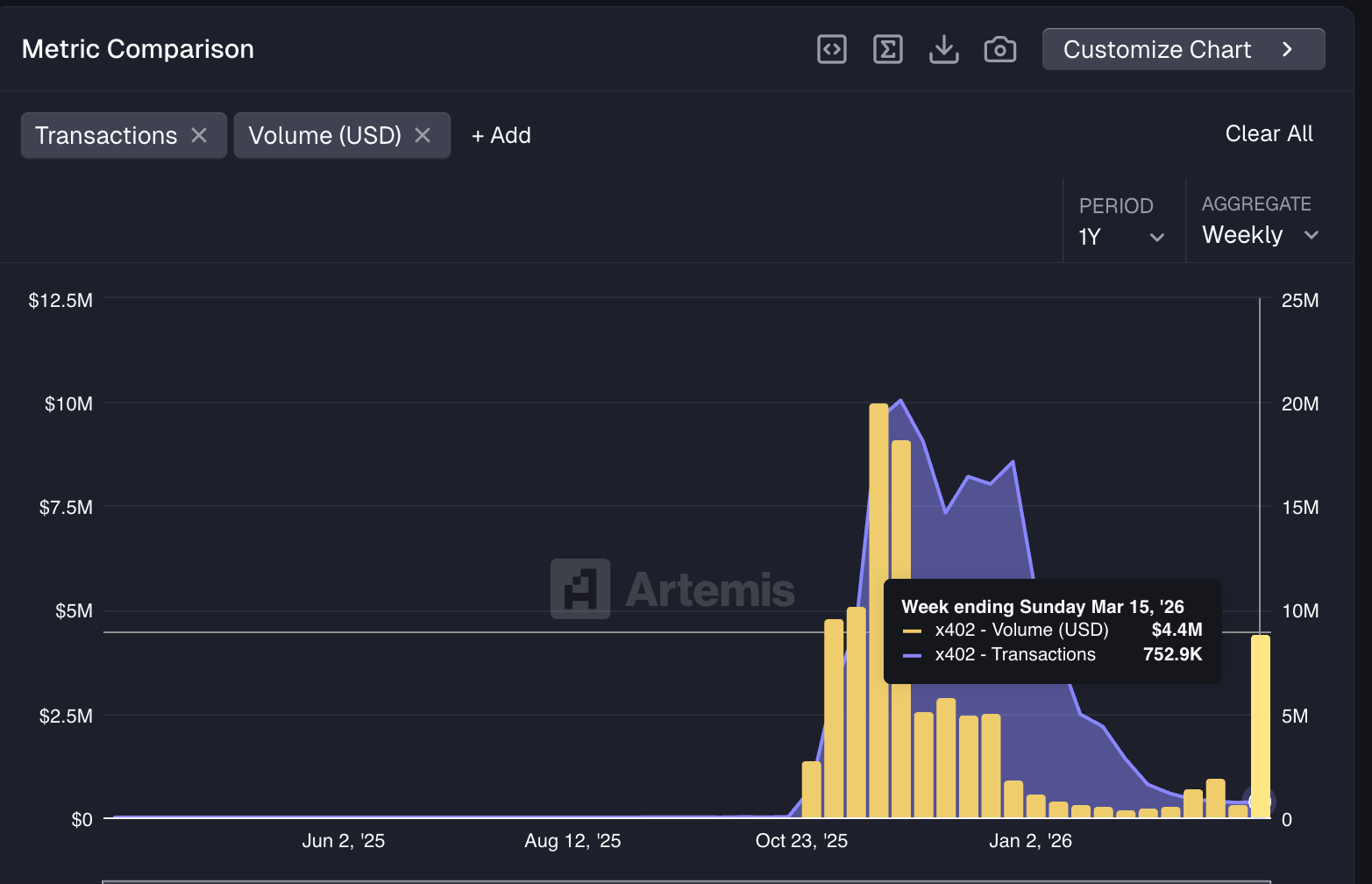
While x402 looks great, each payment requires a discrete onchain transaction, which, frankly, works fine for one-off purchases but tends to creak when an agent needs to make hundreds of micropayments per session.
This is the party where we could easily run into latency issues, and fees might begin to add up.
Agent Payments Protocol (AP2) by Google
If you’ve been keeping up with the AI scene, then you know that Google is playing Thanos.
Google's Agent Payments Protocol serves as a trust and compliance layer and is built on W3C Verifiable Credentials (VCs), decentralized identifiers (DIDs), to create tamper-proof audit trails for every transaction.
Here’s a great demo of how it works:
Beyond support for card payments through its PayPal integration, AP2 and x402 are actually designed to be complementary. AP2 handles the mandate and authorization layer, while x402 handles the actual settlement for stablecoin transactions.
Considering this structure, the existing shortfall for x402 payments mentioned above persists.
Agent Commerce Protocol (ACP) by Virtuals
The Agent commerce protocol by Virtuals is another contender, a pretty serious one.
ACP is an open onchain standard for fully autonomous agent-to-agent commerce. The ACP enables AI agents to trade and pay each other.
It functions through a request, negotiation, transaction, and settlement flow while using x402 as its primary micropayment settlement layer.
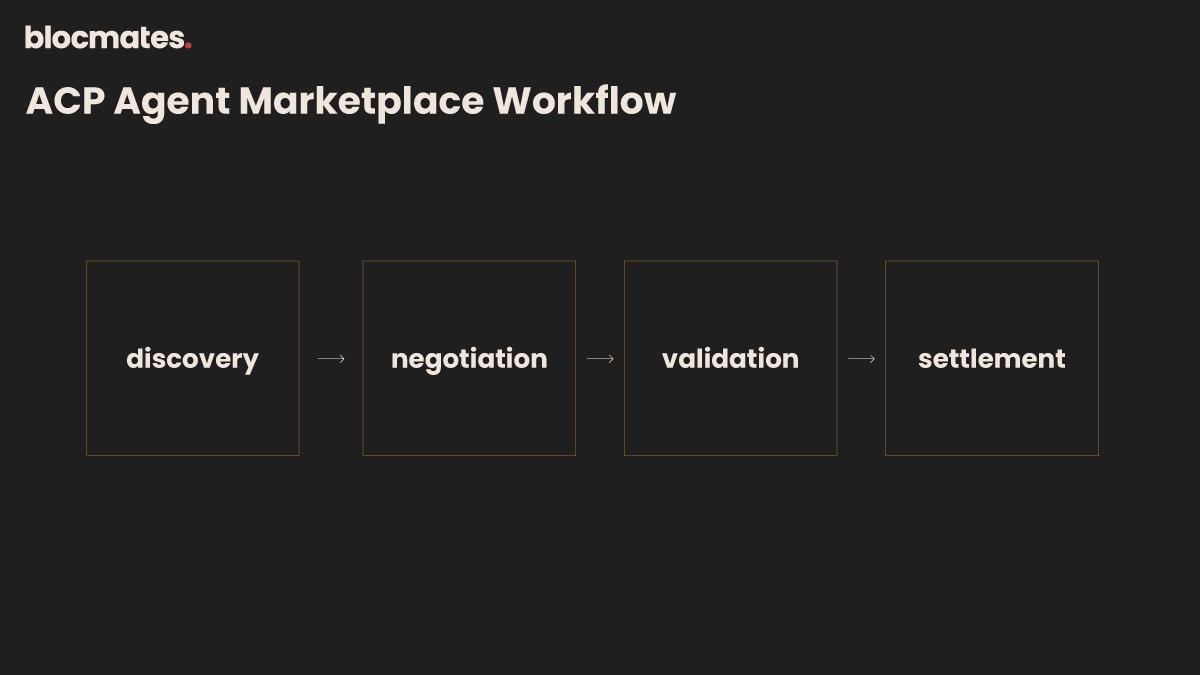
Again, while the economy built around Virtual’s ACP is thriving with an aGDP of ~$480 million, it still inherits the bottlenecks associated with the x402 structure.
Machine Payments Protocol (MPP) by Stripe & Tempo
Machine Payments Protocol MPP takes a different approach to micropayments entirely. Instead of one transaction per payment, it introduces "sessions" - a primitive that works like OAuth for money.
An agent authorizes once, pre-funds a wallet, sets spending limits, and then streams micropayments continuously as it consumes resources.
API calls, model inference, data queries - they all settle in real-time without a separate onchain transaction for each interaction.
Thousands of micro-transactions get aggregated into a single settlement batch.
MPP is open-source, rail-agnostic, and already extended by Visa for card payments, Stripe for cards, wallets, buy now pay later, and Lightspark supporting the Bitcoin Lightning Network.
The payments directory at launch includes over 100 compatible services.
Why MPP has an edge
In all honesty, sessions solve the throughput problem.
If your agent is making 500 API calls in a session, you don't want 500 onchain transactions when it all could be one transaction within a session.
MPP's session model aggregates thousands of micropayments into single settlement transactions, which makes true pay-per-use pricing viable at internet scale.
x402 can't match this for high-frequency workflows without layering additional infrastructure on top.
Moreso, as a shared advantage with Google’s AP2, MPP is rail-agnostic. Visa has already extended it to support card-based payments globally. Lightspark extended it for Bitcoin Lightning. Stripe extended it for cards, wallets, and buy now pay later methods.
An agent using MPP can pay with whatever the merchant accepts - crypto or fiat. That flexibility is a meaningful advantage over x402, which is currently stablecoin-native.
MPP also has the Stripe distribution advantage. Stripe has millions of merchants already integrated.
When a Stripe user can add MPP support in a few lines of code and start accepting payments from agents in both stablecoins and fiat, the adoption curve starts from $1.9 trillion in existing volume.
Lastly, Tempo’s ISO 20022 compliance makes MPP enterprise-ready.
That means financial institutions can plug into Tempo without rebuilding their reconciliation systems.
Partners like Standard Chartered, Nubank, Mastercard, and Revolut are already in the ecosystem. Klarna also announced plans to launch a stablecoin on Tempo.
Closing thoughts
While all of these advantages line up perfectly for Tempo and Stripe’s MPP, it is important to bear in mind that agentic payments are still very early, with lots of the current activity being experimental.
x402 covers the long tail of simple, one-off payments, AP2 is more about trust and compliance.
MPP, on the other hand, is built for high-frequency, enterprise-grade agent workflows. A world where all three coexist, and even interoperate, is the most likely outcome.
But if you're asking which one has the strongest structural position right now, I’d say MPP's combination of session-based architecture, multi-rail flexibility, Stripe's distribution network, and enterprise-grade infrastructure gives it an edge.







.webp)
.webp)

.webp)

.png)



.webp)



.webp)
.webp)
.webp)
.webp)













.webp)

.webp)

.webp)


.webp)
.webp)

.webp)

.webp)



















.webp)

.webp)
.webp)
.webp)
.webp)
.webp)


.webp)
.webp)


.webp)


.webp)




.webp)


.webp)


.webp)


















.webp)






.webp)










.webp)

.webp)
.webp)

.webp)












.webp)

.webp)


.webp)





.webp)