You’ve spent the last year or so supercharging your life with ChatGPT and your Claude Max subscription.
It feels pretty good, right?
Research is faster; you no longer need to draft those tedious emails for work. Need to make a low-effort graphic? Done, hell, some of you have even had a great time vibecoding applications.
It’s true, everything with AI so far has been great. It’s made you faster and your life easier.
But can you really supercharge your life with AI as it stands, or are you just sending prompts to a really good search engine?
You put in some words and files into a textbox, it’s processed, and you get an answer. You close the tab, and all the context is gone.
It’s really good tech, don’t get me wrong, but AI as the genuine force multiplier that most of us thought it would be isn’t what it is right now.
What if the issue isn’t AI itself but the architecture? What if I tell you that an AI agent exists that can completely reshape your productivity stack?
Let’s have a chat about Hermes Agent fellas.
What is Hermes Agent?
Most of you are probably already familiar with what Hermes is, so if you’re aware, feel free to skip this section.
For the uninitiated, here’s a quick primer on Hermes Agent.
Hermes Agent is an agent harness built by Nous Research, the team behind YaRN, Nomos and Psyche.
AI in its current state is static and stateless; the Hermes Agent has been built to change this status quo. You have a conversation, get your results, close the tab, and that's the end of that. Everything is forgotten.
Hermes is designed to be a persistent, self-hosted AI agent that lives on your machine or server, remembers everything across sessions, gets smarter the more you use it, and can be reached from your phone via Telegram or Discord, even when you're not at your computer.
It offers a closed learning loop that turns every completed task into a reusable skill, and every past conversation into searchable long-term memory.
It runs on any model you choose, executes code and terminal commands across six different backends, and ships with a growing library of skills covering everything from animated video production to autonomous novel writing.
Think of it like this.
When most people say AI, your brain synonymizes it with a chatbot-type product like ChatGPT.
Hermes is more like hiring a member of staff who never sleeps, remembers everything, gets better with more work, and is always available at a moment's notice through any device.
The Nous Research team has been consistently shipping to improve Hermes. Now, with the most recent updates, we may finally have a single agent interface that has completely fixed the productivity stack using AI.
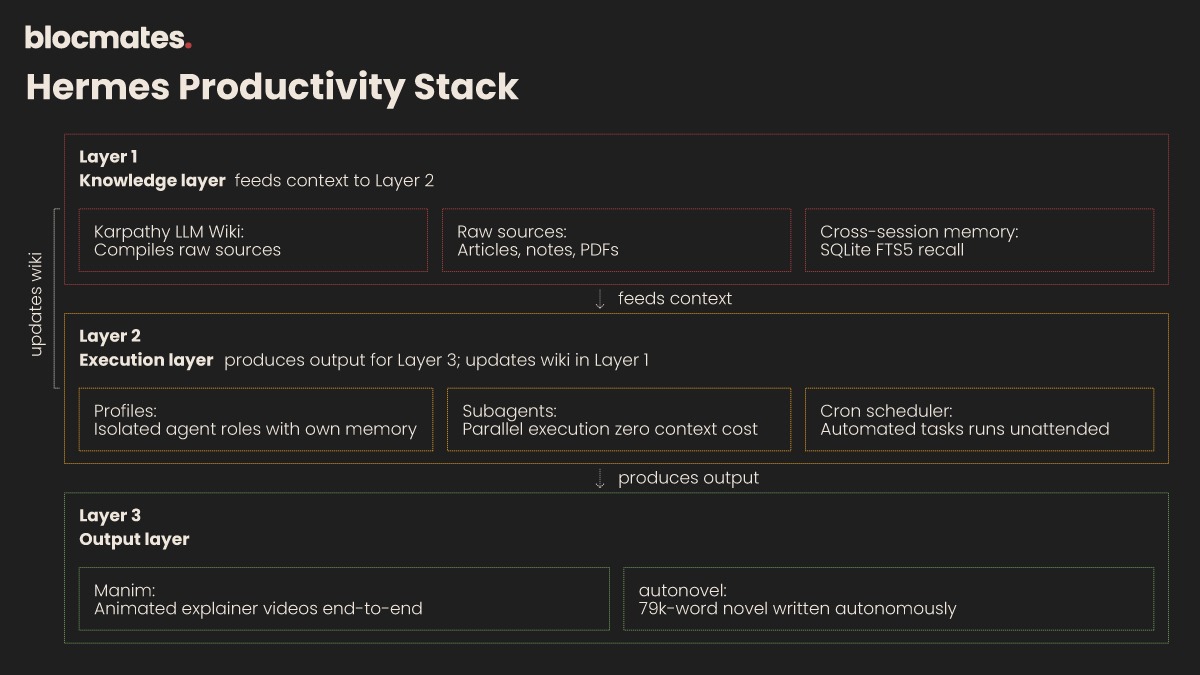
Layer 1: The Knowledge Layer
The first layer of this new productivity stack, powered by Hermes, doesn’t actually begin with the Nous Research team; it begins with Andrej Karpathy.
Being a renowned voice in the AI space, Andrej Karpathy put forth the idea of an “LLM-Wiki.”

To shorten it, the idea stems from the pain point that most LLMs today operate like RAGs. That’s fancy-speak for a system that’s not efficient enough in searching, structuring, navigating, and cross-referencing a vast knowledge base.
For example, you drop some files into ChatGPT and follow it up with a prompt, it retrieves the relevant chunk when querying, and gives you the answer. But you ask it a question that requires it to synthesize multiple documents, and it has to rediscover the relevant fragments.
There’s no accumulation of knowledge, just rediscovery.
Hence, an LLM-Wiki was proposed. A system that operates more like a dynamic encyclopedia where all the knowledge is structured, interlinked, persistent, and constantly accumulating with every new interaction, piece of data, or file added.
This makes the LLM more sophisticated with better memory, easier navigation, and cross-referencing of all the available data.
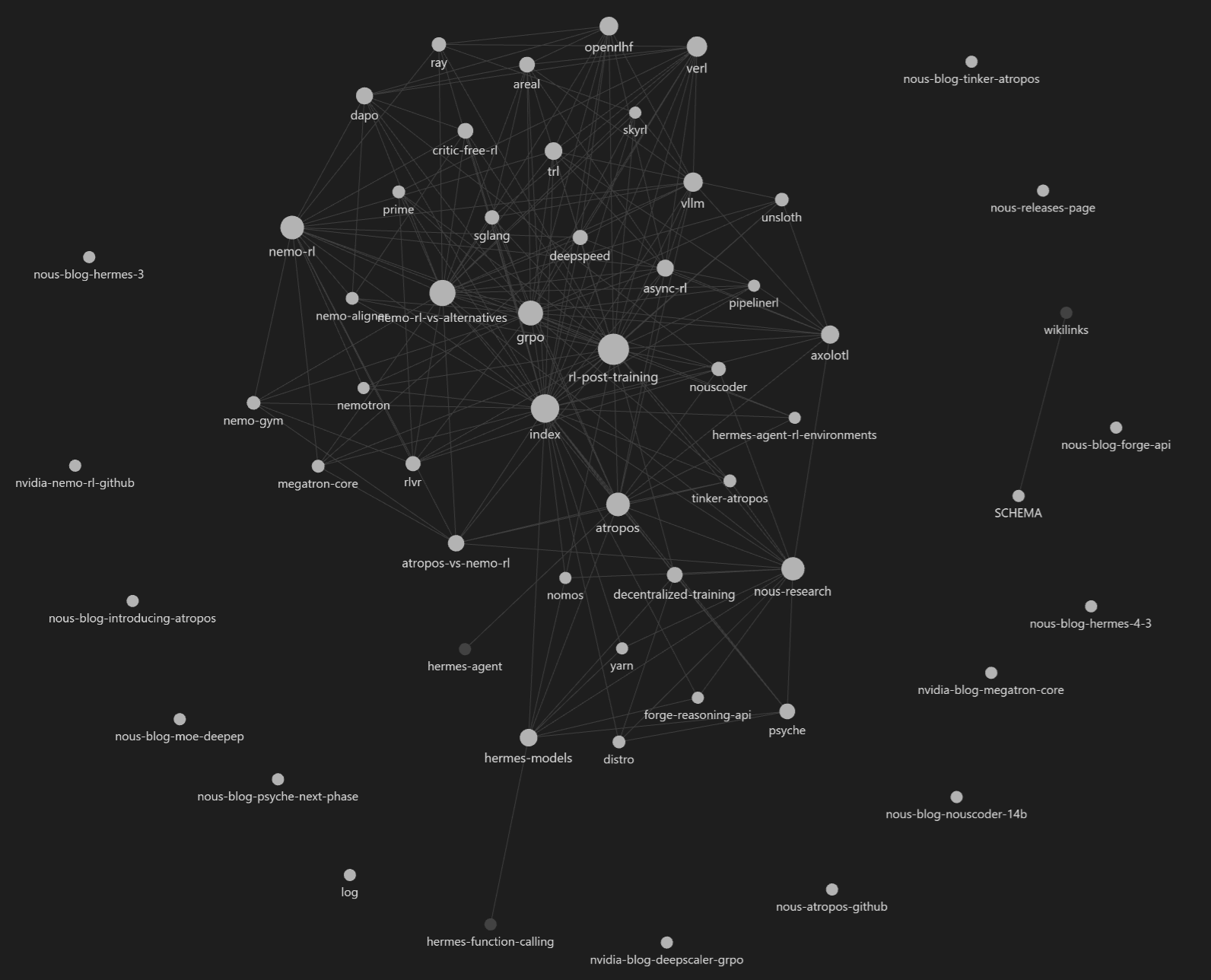
Think of it like this.
Imagine your brain as a library.
Every time you learn something new - an article you read, a conversation you had, a rabbit hole you went down at 2 am - a librarian walks in and files it somewhere.
Over the years, that librarian gets very good at knowing where everything is, how different ideas connect, and what's relevant when you need it. Your knowledge compounds.
The LLM-Wiki is like that librarian on steroids for LLMs.
Nous Research has recognized the power of the LLM-Wiki concept and recently implemented it as a “skill” in the Hermes Agent terminal.

This skill ultimately forms the base layer of your productivity stack.
All raw notes, interactions, files, and other information will always be available, with no need to renew context at any time.
The agent will permanently know your domain, and depending on what tasks you’ve designed it for, it will only get more powerful with the LLM-Wiki as the base Knowledge Layer.
Layer 2: The Execution Layer
Now we get to another recent upgrade made by the Nous Research team. Upgrade v0.6.0.
This is the introduction of a multi-agent profile.

The crux of the update is that with one installation, you can have multiple agents. These subagents are isolated workers that can be spun up by the main agent, and each subagent can be assigned to a specific task.
Paired with this is the introduction of profiles. Profiles make it so that each subagent can have its own separate configurations, memory, sessions, skills, and gateway services. So whatever task a subagent is designed for, it will do only that, persistently.
So let’s expand upon this productivity stack by adding the multi-agent into the framework.
Imagine a hypothetical scenario where you’re running a marketing agency (most of y'all are destined to remain in the trenches, but alas, one can dream).
A marketing agency has a lot of moving parts. Client relations, content writing, editing, organization/planning, research, and so on.
With this new multi-agent update, your main Hermes agent is able to spin up a research agent that focuses solely on research, a writing agent that knows your publishing conventions, an organizing agent that knows how to schedule things, and an email assistant that can keep on top of all the pesky client emails.
One installation, multiple agents.
At the same time, these agents have the ability to leverage the underlying LLM-Wiki (Knowledge Layer).
So, say a new research agent has been spun up to do a deep dive into clients in a new sector.
It will already have the ability to reference the relevant Wiki pages instead of starting blind.
This means from the get-go, all agents have context; they know your preferences, domain, structures, and anything else that is relevant.
Et voila, just like that, you have boosted your productivity stack.
But what does the actual output through Hermes look like?
Layer 3: The Output Layer
Well, unlike most products that just talk the talk, Hermes already has tons of live examples of walking the walk.
Let’s begin with the first, and honestly, what I deem to be the more impressive element of this Output Layer.
Hermes recently pushed out the ‘Manim’ skill.

The Manim skill is an engine for creating clean, aesthetic, and frankly top-drawer animations/visuals for mathematical and technical explainers.
The animations of this skill are inspired by the 3Blue1Brown channel, which I’m sure most of you are familiar with.
So let’s go back to our marketing agency example.
You’re running the agency through Hermes, and you’re working with one client who has an extremely complicated DeFi product. Nobody really understands, and absolutely NOBODY is reading the docs.
Something that will resonate with our brain-rotted, zero-attention-span brains is good, clean visuals.
Well, the content creation subagent can quickly spin one up by leveraging Manim, and just like that, you have a happy client with a bunch of new users.
Another example of Hermes in action can be seen in the fact that it literally managed to write an entire novel. A 19-chapter and 79,456-word novel. Completely written by Hermes and peer-reviewed by Claude.
So yeah, the Output Layer with Hermes doesn’t leave room for doubt. It's operational and working pretty dang well. Now, all it comes down to is how you choose to leverage it in your new productivity stack.
Hermes is quickly emerging as one of the best AI agents out there, offering you the ability to genuinely supercharge your life beyond some basic prompts that give answers aggregated through the internet.
If you haven’t already got your self familiar with the platform, there is no time better than the present to start acting and build your productivity stack to supercharge your life and separate yourself from the pack.





.webp)
.webp)

.webp)
.png)


.webp)


.webp)
.webp)
.webp)
.webp)







.webp)
.webp)

.webp)

.webp)
.webp)
.webp)

.webp)







.webp)
.webp)
.webp)
.webp)
.webp)
.webp)


.webp)
.webp)


.webp)


.webp)




.webp)


.webp)


.webp)
















.webp)






.webp)









.webp)

.webp)
.webp)

.webp)








.webp)

.webp)

.webp)






.webp)