Reading time: 7m 9s
There are not many things as massive as the World Cup.
Basketball fans might disagree, lots of folks in the US might scream the Super Bowl (even though that’s more about the half-time show than anything else), but the reality is that the FIFA World Cup is the most-watched sporting event in the world.
This lines up with the fact that this might also be one of the most significant World Cups in recent times, simply because there’s been a huge culture shift since the last one held in 2022.
While some fans will watch live, and others at home, we will most likely see the rise of streaming parties, watch-alongs, viral clips, TikTok edits, fantasy games, and podcasts, all new and growing forms of engagement native to the internet.
The thing all of these share is that they don't happen in one place. The modern fan rarely sits still in front of a single screen for 90 minutes anymore.
Rather, they're watching the match on one tab, bantering in a group chat on another, half-checking a fantasy lineup, and scrolling their timeline to catch up on the goal they just missed. Attention isn't focused; it's scattered across a dozen windows at once.
Weirdly, that fragmentation might be the entire point.
We believe that platforms that break out of this World Cup probably won't be the ones demanding your undivided attention; there isn't much of that left to give.
They'll more likely be the ones that slot into the chaos and connect the way people already behave, rather than fighting against it.
Crypto has built three of the most important lanes for exactly this kind of moment in memes, prediction markets, and fantasy sports.
Each captures a different slice of how the internet actually watches and prices the beautiful game. And one of them, we'll argue, might be walking into a breakout, with the World Cup as the catalyst.
The three lanes of internet football
Memecoin lane
If you’re plugged into Football Twitter enough, then you know it’s an entire memetic world, quite similar to CT.

There are inside jokes, moments, caricatures, and a lot more that ensure there is an endless horde of memes.
At the moment, we’ve begun to see a crossover, with memecoins like the $WORLDCUP coin by World Cup Coins, sitting at $8.86 million market cap, with an all-time high of $~12 million.
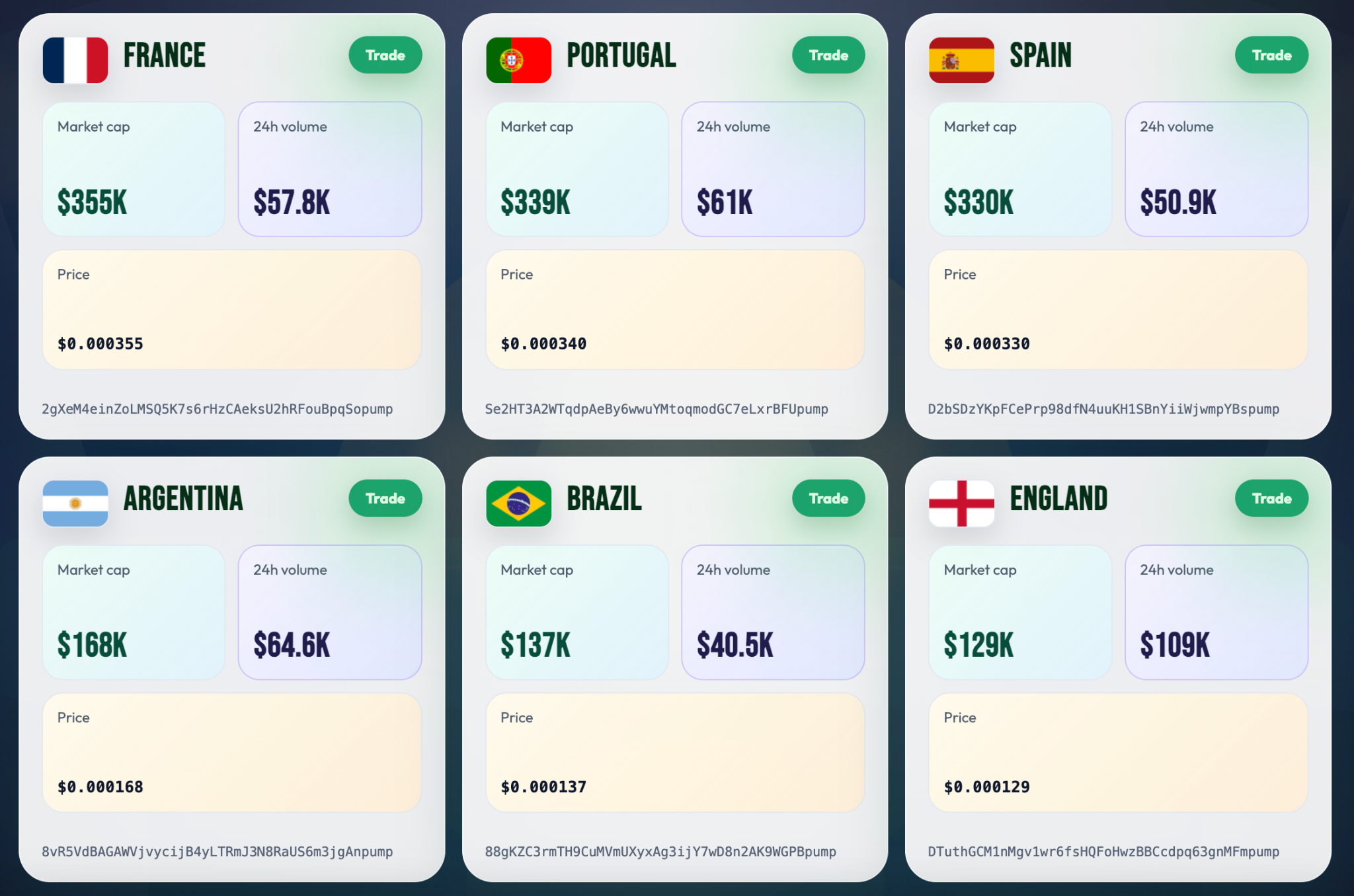
Teams or countries like France, England, Spain, and Portugal, perceived as likely to bring back glory to their respective countries, are also tokenized and speculated on, with fees being driven back to buying back the main World Cup coin.
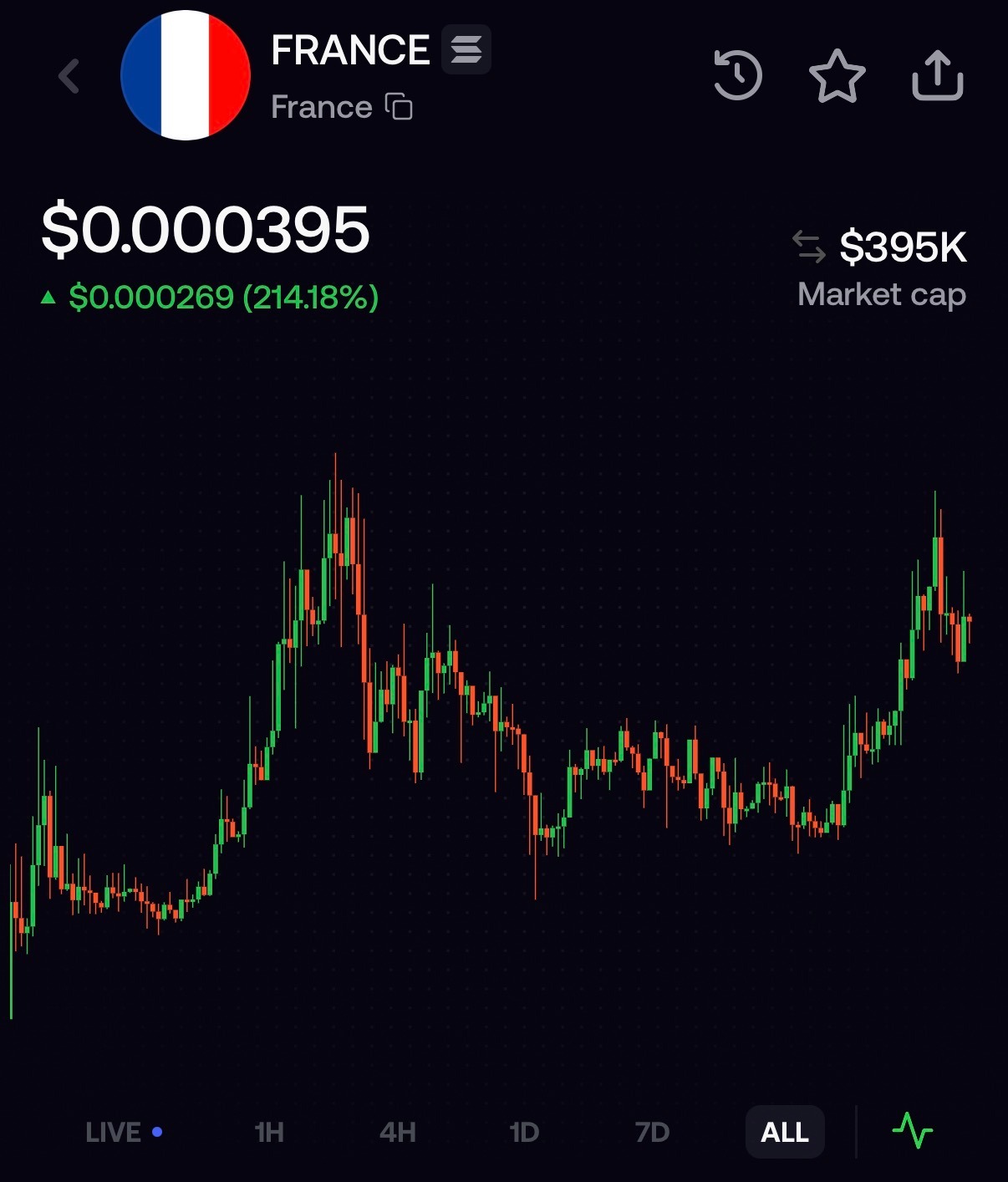
This creates a feedback loop tied directly to how much attention the tournament is pulling at any given moment. When Football Twitter is loud, the whole ecosystem pumps.
Wallet ownership is, however, heavily concentrated, and the entire thing runs on momentum, social noise, and match results, which means the second a fancied team crashes out, the coin riding on it can crater just as fast.
France's token sits at the top of the national-team pile right now precisely because the market is pricing in a deep run. That bet curdles if, for example, Mbappe’s dictatorial tendencies affect the team synergy and they crash out.
And once they do, the token becomes useless, and top buyers might begin to hurl insults at Dembele or Bradley Barcola.
The point is, memes are one of the ways the internet is watching and playing the game. The attention span in the trenches might be cooked, and so it might be riskier playing in such a minefield, but if the memes aren’t for you, then chances are you might be the prediction market type of guy.
Prediction market lane
Considering that football is a question machine, prediction markets are arguably the most natural crypto-sports product there is.
Who wins the group, who reaches the quarter finals, who lifts the trophy? All adjacent questions allow users to take a stab by putting their money on the table.
This will also be the first World Cup with prediction markets as an established category.
The World Cup is already showing up in the numbers. Cumulative trading volume across the winning markets on Polymarket sits at ~$1.4 billion in volume even before a ball has been kicked in the tournament.
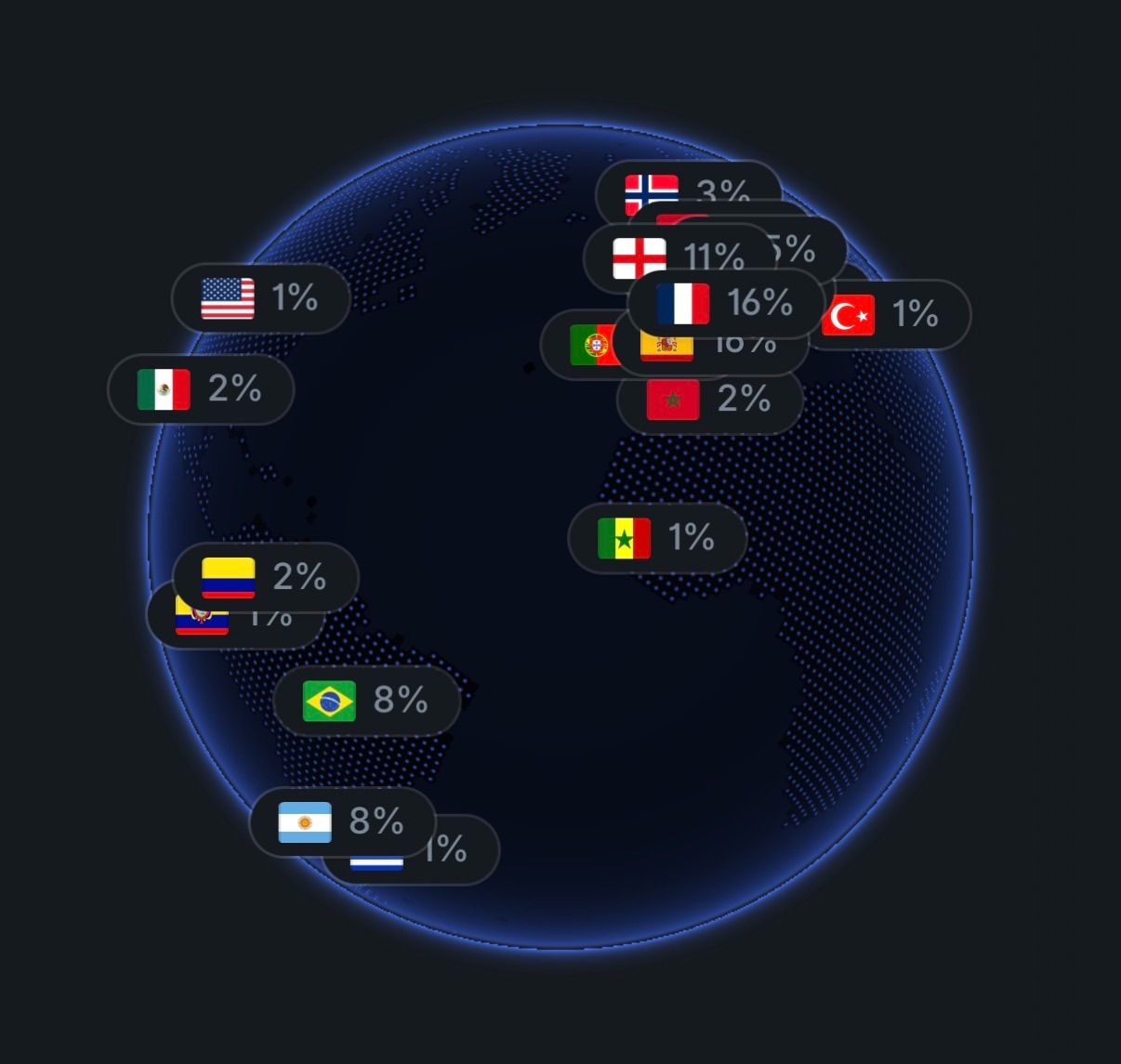
While prediction markets are an incredible way for people to interact with the World Cup, they don’t nearly give the full immersive experience that combines culture with the thrill of simulated participation.
This gap inevitably leads us to the final lane through which crypto users can interact with the World Cup: fantasy sports.
Fantasy lane
Fantasy sports is a $31 billion market with more than 245 million players worldwide, and it's the way an enormous chunk of the planet already engages with football.
Fantasy sports involves building squads, agonizing over transfers, talking trash in a league chat that runs all season, pricing in an injury, or looking at the more intricate performance data.
Fantasy sports is mainstream in a way memes and prediction markets simply aren't.
Sport.fun has successfully built a name for itself in this category - on crypto rails, utilizing league football to create the perfect culture experience for players, with rewards included, making it more incentivizing than the popular Fantasy Premier League (FPL).
With millions of dollars won across games through the league season, crowned with $168,000 worth of tournament points distributed at the UCL final (Ici c’est Paris), attention has now shifted to the World Cup, and Sport.fun is guaranteeing the same level of fun.
To do this, players don’t ditch their existing league squad, but get to pick who comes with them into the World Cup, while whatever’s left goes straight into the coming European season.
Users can build their squad, trade through the tournament stages, and earn TPs as they go through the entire tournament.
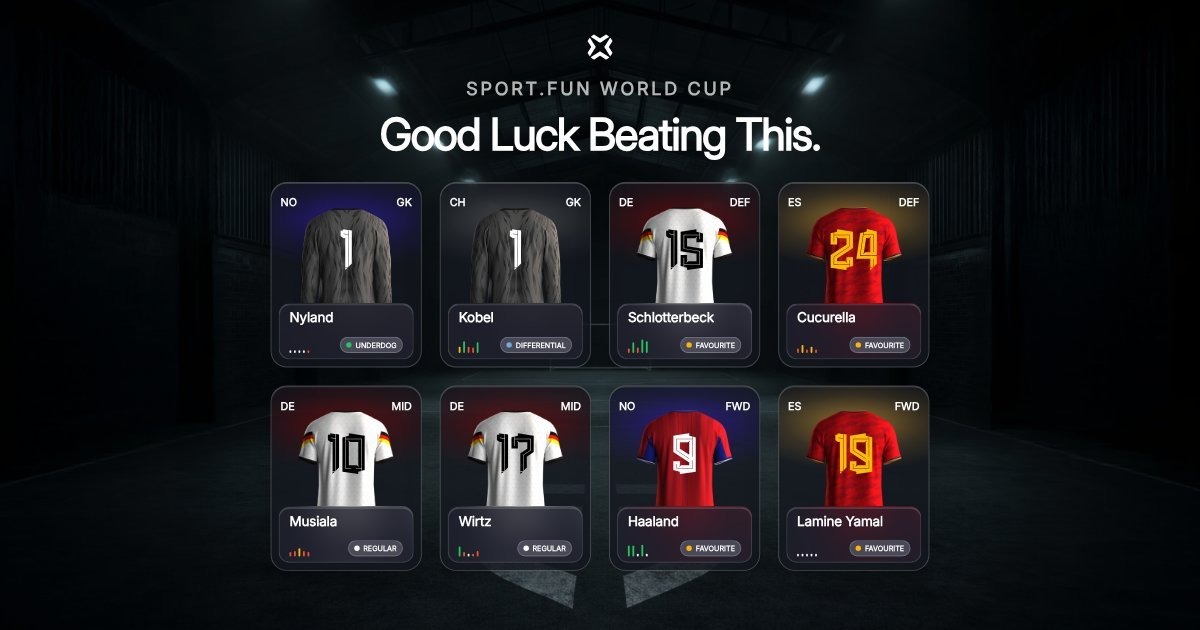
The cool part is that both the Pro version and Free-to-play (F2P) are both rewarding.
You can take a starter squad of eight players handed to you instantly, two from each position, re-rollable up to three times until you're happy, or spend your Gold and build from scratch, hunting undervalued players and shaping a squad around your own read of the tournament.
Player prices are fixed for the opening week, so everyone starts on level footing, then the transfer market comes alive as the tournament does.
Progression is built on sustained performance. This means every manager starts in the Challenger division on a 3,000 skill rating, and only after the Round of 16 does the field sort into divisions: Elite at the top, Bronze for late arrivals, based on how you've actually played.
It is set up such that the group stage feels different from the knockouts because the product narrows alongside the tournament itself.
F2P players will be competing for a $30k prize pool, paid out in matchday and travel experiences, VIP football packages, signed memorabilia, tech bundles, and hospitality.
It’s important to note that Sport.fun is built to be a live market layer, meaning gameplay is associated with real performance. This allows for a PRO version of the game where the stakes matter, as there’s a pool with every player having a price, and that price is backed by real-time performances.
The blocmates League
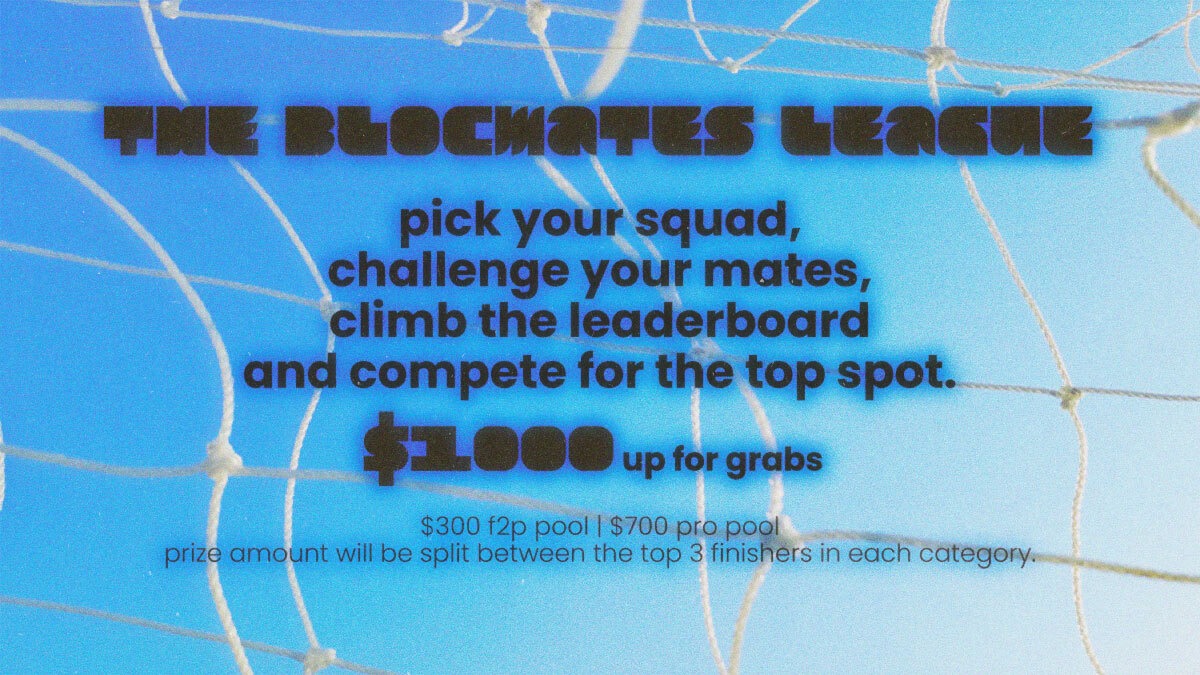
The blocmates League is up and running, with $1,000 up for grabs. You can pick your squad, ask your pals to join, and compete for the top spot.
The prize amount will be split between the top 3 finishers in each category (Pro and F2P).
Dropping the league invite link below.
Pro users - click here
F2P users - click here
Why WC ‘26 could be Sport.Fun’s breakout moment
Every keen eye knows that the 2024 US election was the breakout moment for prediction markets, specifically Polymarket.
The right combination of culture, uncertainty, and predictions made Polymarket the source-of-truth layer for those willing to put their money on the outcome of who becomes the 47th president of the United States.
Beyond the similarities in the four-year cycle between the US elections and the World Cup, we believe that this could be a breakout moment for fantasy sports like Sport.fun.
This is because the product has been designed to be fluid with the culture of the game.
It is the first crypto sports product built with football’s rhythm woven into the product rather than slapped like a sticker.
Constituting the tournaments, the transfer windows, and the division reshuffle after the Round of 16, it’ll all move in lockstep with the real thing.
Moreso, Sport.fun has been designed to combat the friction that makes it difficult for crypto products to go mainstream.
Its free-to-play product invites players at zero cost, stripping out jargon like gas, wallets, and multiple transaction signing, all while still rewarding players.
It is the perfect lead magnet to attract enthusiastic fantasy sports players, thereby capturing a slice of a $31 billion market.
Additionally, the team’s marketing efforts tie into how the internet keeps up with football today - covering watch-alongs, streams, and football leagues created by partners with audiences that are tuned into the game.
We believe that all of these set the scene for the World Cup to act as a significant catalyst for the next phase of growth of crypto’s most popular fantasy sports platform: Sport.fun.
Concluding thoughts
The truth is that for all the noise about crypto and sport, this is the first World Cup where the stack is actually complete.
In 2022, the onchain version of football fandom barely existed. In 2026, it has arrived fully formed in three lanes: memes to capture the moments, prediction markets to settle the arguments, and fantasy to hold the whole tournament together.
In reality, none of these replaces the way football is already watched. The argument is not that these lanes are swapping the match itself, the bants, or the pub culture in England for a chart.
Rather, what they do is layer on top of it, making the 2026 World Cup feel different from every World Cup before it.
While all three appeal to different user types, fantasy is the only one designed for the tournament’s arc, and it's the lane sitting in the biggest mainstream market, with the deepest social moat.
Thanks to the Sport.fun team for unlocking this article. As always, nothing in this piece should be considered as financial, investment, or wagering advice.
All of our research and references are based on public information available and are presented for constructive discussion and analysis. To read more about the editorial policy and disclosures at blocmates, head here.






.webp)
.webp)

.webp)

.png)

.webp)


.webp)
.webp)
.webp)
.webp)











.webp)
.webp)

.webp)
.webp)
.webp)

.webp)

.webp)









.webp)
.webp)

.webp)
.webp)
.webp)


.webp)
.webp)


.webp)


.webp)




.webp)


.webp)


.webp)


















.webp)






.webp)














.webp)

.webp)
.webp)

.webp)











.webp)

.webp)


.webp)





.webp)