Reading time: 12m 12s
Crypto’s (mainly stablecoins) value transfer reportedly grew by 105% in 2025, reaching ~$33 trillion, and is likely to blow past that figure this year as TradFi settles in.
TradFi’s incursion into the onchain world is introducing new asset classes, markets, and billions in tokenized assets, all of which are being brought to market through different venues.
As these assets move onchain, new infrastructure rails are emerging to meet demand and rising user activity. But with this growth comes new complexities and, even worse, fragmentation.
For users, this means juggling wallets, gas tokens, bridges, and wrapped assets to move value, while for builders, it means a compounding maintenance burden of supporting multiple ecosystems.
Fundamentally, this challenge is not new; it is persistent, and the solutions, though great in their own way, have not ideally solved the issue holistically. Assets and users remain siloed in their preferred chain’s economy.
This is because siloed solutions can't fix a problem their own design keeps reproducing. Therefore, crypto needs an operational layer that absorbs fragmentation instead of adding to it - and it has to deliver three things at once.
Depth: Full-stack infrastructure built to handle value transfer across the entire industry.
Breadth: The ability to connect anything, any liquidity source, any chain, any messaging protocol, any entry point.
Experience: Tailored surfaces for every user - traders, developers, institutions, and chains, each meeting their audience where they are, all powered by the same unified foundation.
That layer already exists. You've probably used it. You've just misprofiled what it is, and clearing that up is our job for the rest of this article.
It's called Squid, and we're about to cover what it truly is, how it works, who it's for, and why its position only strengthens as crypto fragments further.
What is Squid?
Squid is a secure, non-custodial, full-stack infrastructure layer that facilitates the movement of value of digital assets across multiple networks (100+).
While many people first encounter Squid as “a bridge app,” labeling it a bridge undersells what it actually is.
Squid isn’t a single product or narrow tool. It is a vertically integrated platform that owns the full stack: from its own intent-based settlement protocol to a sophisticated routing engine, and all the way to developer tooling and consumer interfaces.
Under the hood, Squid combines multiple layers: bridge, aggregator, and intents.
Squid leverages multiple intersecting messaging layers and DEXs (Axelar, LayerZero, CCTP, Chainflip, IBC, plus its own intent-based settlement protocol) and stitches in over 130 DEXs and offchain liquidity sources alongside them.
The output of all that machinery is a single routing engine that finds the optimal path between any two points, whether the user knows or cares what's happening beneath the surface.
Since its inception, Squid has moved over $6 billion in volume across networks, processed over 4 million transactions, and had over 1 million unique users. Not a small boy in the yard!

Squid is built to orchestrate cross-ecosystem value transfer and not just cross-chain transactions. Users can move money between EVM networks and Cosmos, Solana, Bitcoin, Hedera, XRPL, and other networks yet to be invented.
Of course, the big question for such engineering would be: what is the trade-off? And usually, this translates to how decentralized Squid is or where the custodial shortcut is located in the design.
However, Squid is strictly non-custodial, has completed multiple audits, and prioritizes decentralization. Every transaction on Squid executes on its own execution layer, with final attestation settling onchain.
This design choice did not come easily. Squid, as a product, traded hype for fundamentals - building a product that takes design (UX), decentralization, and security into account. Ultimately, Squid is made up of a lot of features that give it a competitive edge.
Products, key features, competitive edge
Squid is designed for a broad range of user types, and all its features come together to serve a single purpose: connecting the whole of crypto.
Full-stack ownership
Squid builds every layer in-house: Squid Intents power the protocol layer, the Squid Aggregator handles routing, the Squid SDK equips developers, and Squid Bridge serves as the consumer-facing layer.
This architecture minimizes third-party dependence. The advantage can be felt with upgrades, where Squid can easily push new upgrades across the entire stack at once. Also, it allows the team to iterate at a pace that stitched-together architecture pieces can't match.
Intents
Intent protocols are a relatively new design pattern in crypto that flips the traditional transaction model on its head. Instead of you specifying how to execute something, you specify what outcome you want, and a network of solvers compete to deliver it.
Most intent protocols lock users into quotes that expire before execution finishes. Squid takes a different approach towards its intent infrastructure. For Squid, solver auctions run after the user's deposit is semi-finalized, so quotes are priced closer to execution.
The result of this choice is tighter pricing, fewer failed transactions, and no race against an expiry window.
Execution occurs offchain within Trusted Execution Environments (TEEs) with cryptographic attestation, and final settlement occurs onchain, making the entire process non-custodial throughout. If a transaction fails, funds are automatically refunded on the source chain within ~15 minutes.
Aggregator
Users locked into different ecosystems should be able to move value seamlessly. As crypto becomes saturated with fewer native users, infrastructure needs to be designed to support interoperability between consumer layers across networks.
What we mean is that users should be able to move anything onchain from a single point. Any liquidity source, any token type, any chain, any messaging protocol, any entry point, any route.
Squid solves this by integrating multiple DEXs, offchain market makers, and bridges like Axelar, LayerZero, CCTP, Chainflip, and IBC into a single graph database that maps every token, DEX, bridge, and chain in real time.
A swap from an EVM token to a Solana token to an XRPL asset is handled with the same speed and reliability as a same-chain trade.
Cross-ecosystem coverage as a moat
As a serial aggregator user, I can attest that most of the products out there are EVM-only or cover only one or two ecosystems at most. Fair enough, value is dense across EVM networks (and Solana), but there’s a ton of consumer apps, RWAs, assets being launched, built, and deployed across other networks.
Squid supports Bitcoin, Solana, XRPL, Cosmos, and the L2 tail in one routing engine.
To do this, the team has spent significant time on ecosystem-specific engineering, covering various transaction models, account structures, and execution environments.
In so doing, Squid’s cross-ecosystem coverage creates a seamless, unique experience for users, enabling them to use one-click swaps to transfer assets across ecosystems.
Users also enjoy improved access and liquidity, tapping into the full breadth of DeFi across ecosystems with minimized failures and MEV risks thanks to Squid’s intent-based execution.
Developers, on the other hand, get to take advantage of a wide range of ecosystems with a single integration.
It is as simple as defining the destination contract, while Squid handles the rest (routing, bridging, gas abstraction, contract calls, or multihooks for more complex flows).
Squid’s reach obscures liquidity challenges for developers, unlocking cross-ecosystem liquidity for their users.
Squid SDK and bridge
As we mentioned, Squid services multiple user groups. As such, the SDK, API, MCP, and widgets are designed for developers and programmatic onchain actors (AI agents), allowing any dev to embed cross-chain capability inside their own product, which is how 1,000+ teams have already integrated Squid.
On the consumer end, it features a bridge app that lets users swap, bridge, and route value across 100+ chains directly, and it will include a Squid app that consolidates multiple product lines.
Both the SDK and the bridge app share the same infrastructure, albeit built for two very different user groups. Squid is built to handle a variety of products for a variety of user groups - and word out there is that a new product is on the way.
Performance optimization
To compete in the fast-paced world of onchain finance, infrastructure must be non-negotiable in terms of speed.

In this regard, Squid is built for sub-second transactions, featuring trial sub-second quotes of ~0.2s, ~5-second execution, and extremely cheap fees.
These numbers compete on an industry-wide scale, holding up against centralized alternatives, impressive for an infrastructure that never surrendered custody to get there.
Squid product guide: How to use it?
Squid is built for 5 distinct user groups: users, builders, chains and ecosystems, agents, and institutions. Here’s a guide to using Squid products for each group, starting with the end user.
For users
The primary consumer product available for users to directly interact with at the moment is the Squid Bridge.
While the Squid app is still in development, we will briefly go through the bridge.
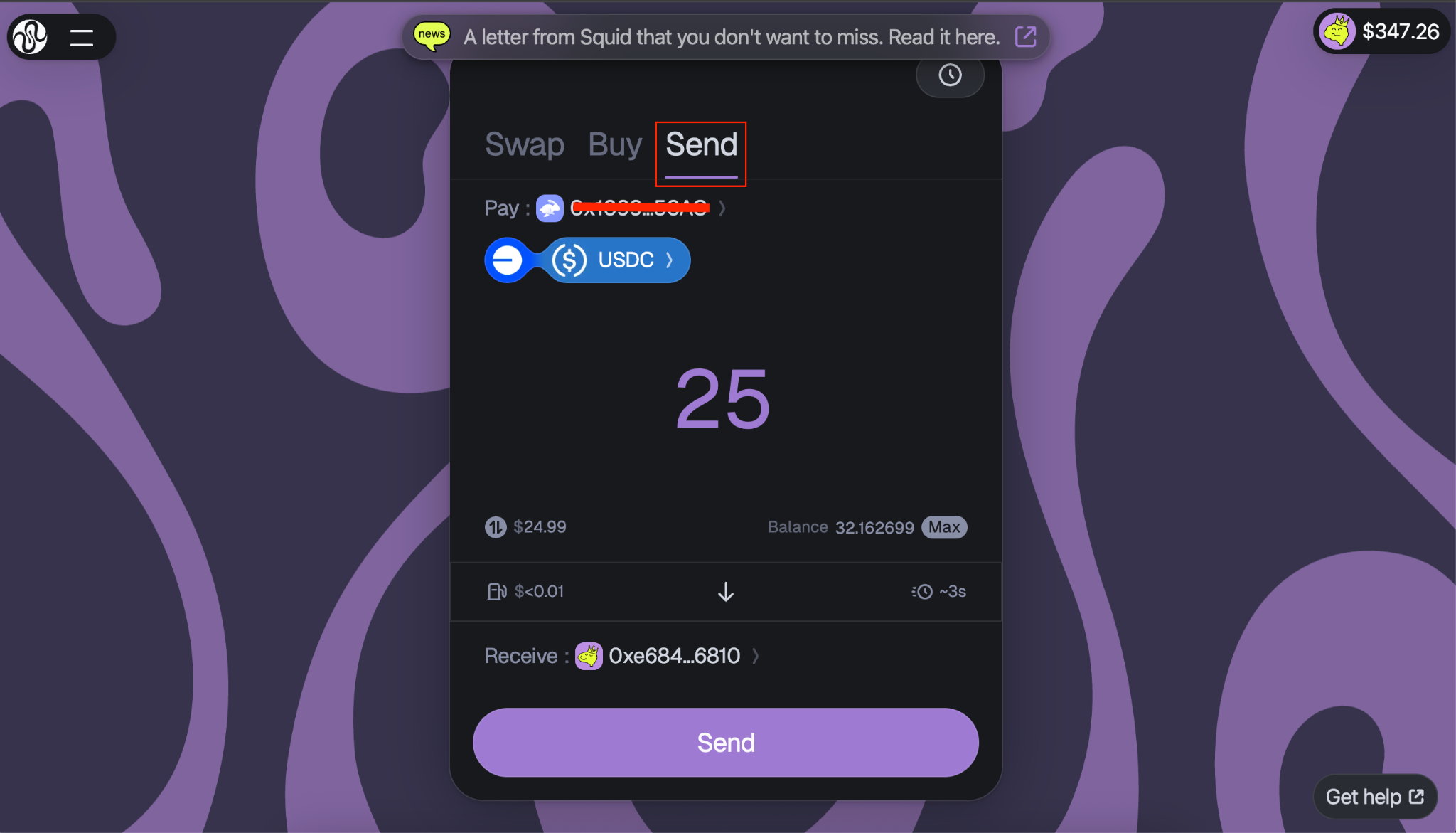
Users can bridge 20,000+ tokens across 100+ networks. The bridge also allows users to onramp directly from their bank and through P2P. Users can also send tokens directly to other addresses.
All of these are built into what is arguably crypto’s most aesthetic UI, with an incredibly smooth user experience.
- Begin by visiting https://app.squidrouter.com/
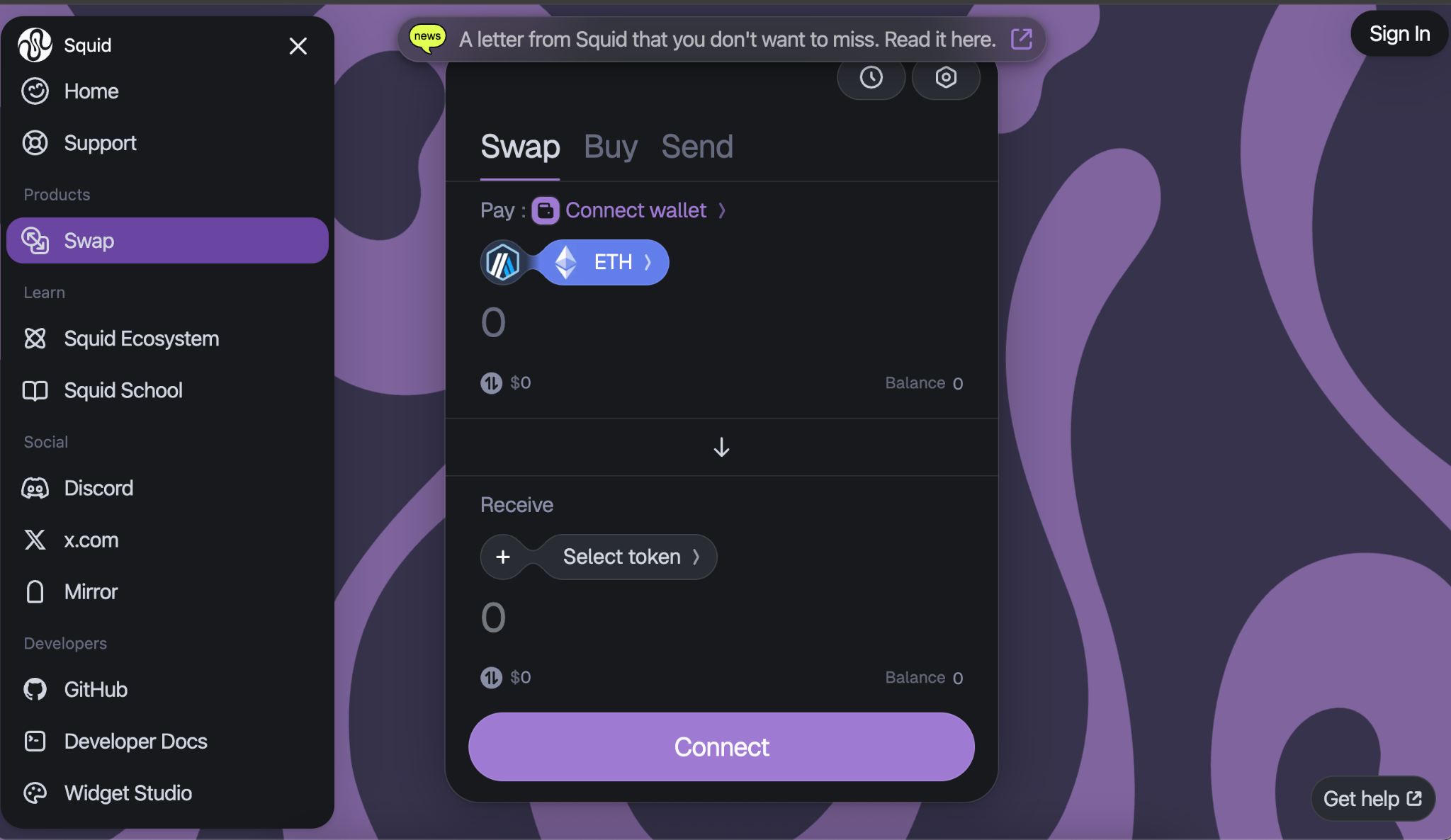
- Connect your wallet. Squid supports multiple wallet types, spanning general wallets and ecosystem-specific wallets.
- Squid also aggregates account balances across chains, so that you can see all of the USDC you own on every chain.

- Choose the source network chain and asset you intend to bridge, then select the destination network and token.
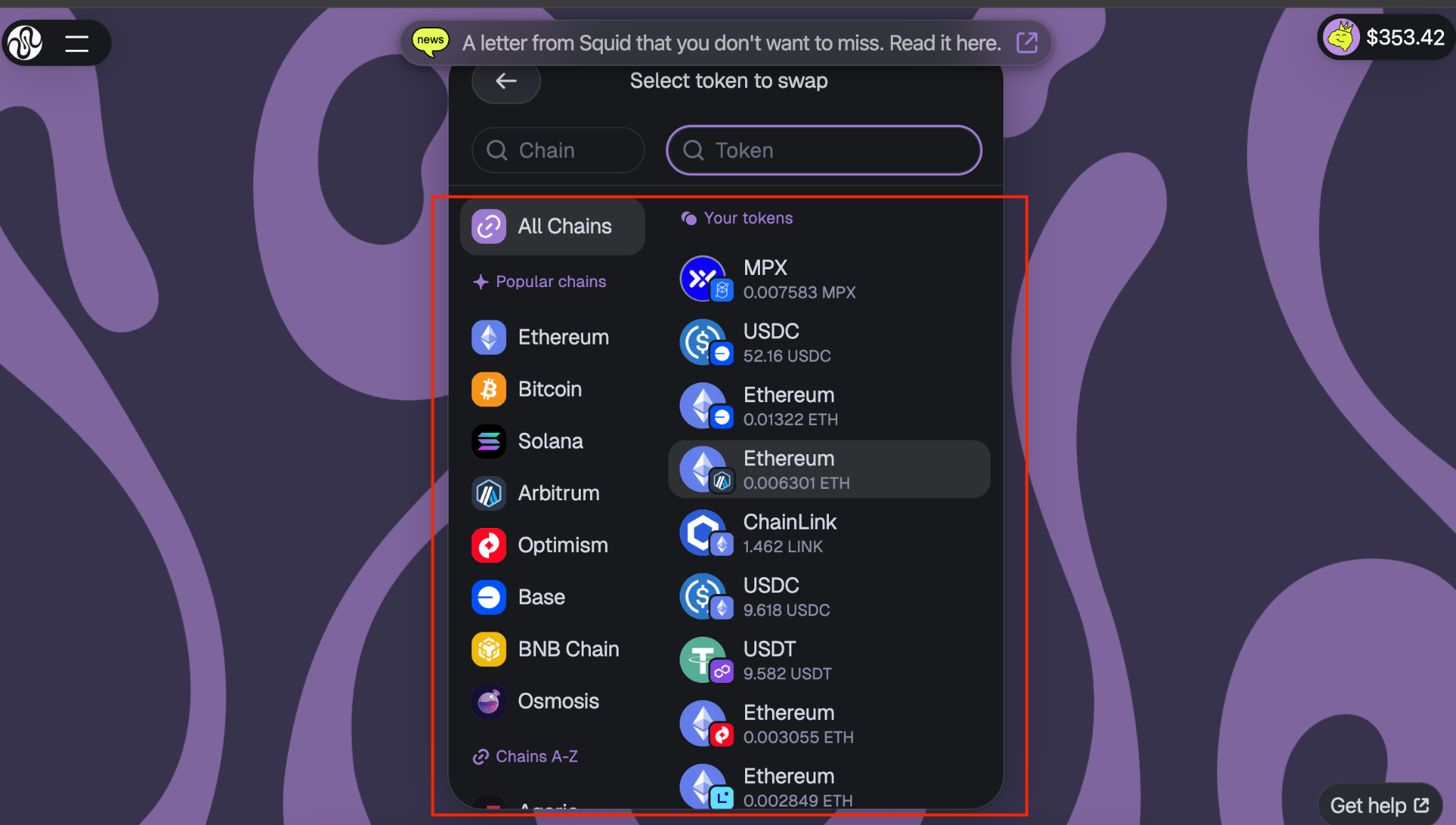
- Enter the amount and click swap. Your asset will be routed to the destination in record time.
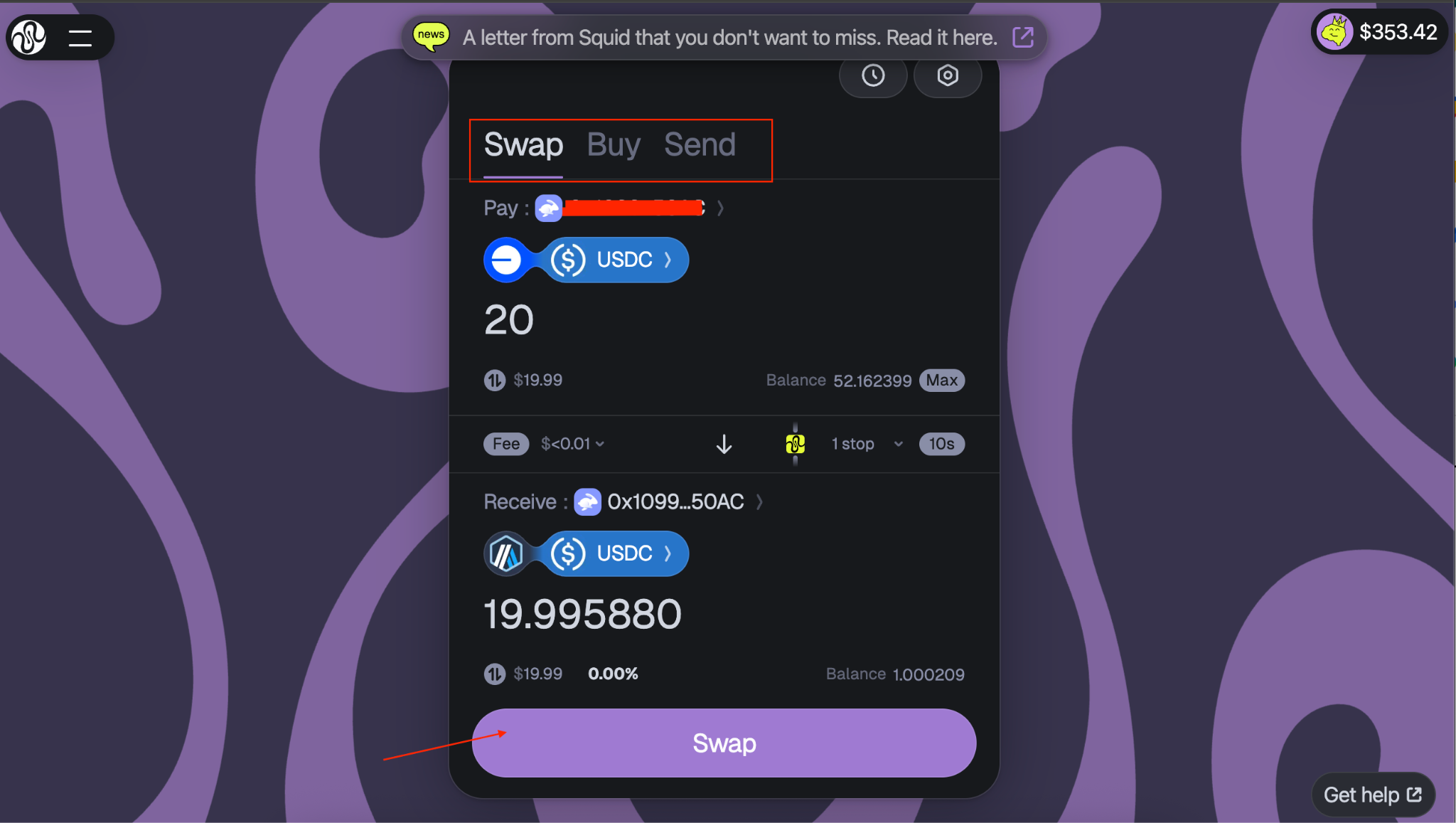

- To buy crypto with your bank account or through P2P, simply click on the ‘Buy’ button as seen below and proceed to purchase.

- Users can also send any token through the send tab, as seen below.
For builders
Squid Build is the product line designed for teams that want to embed cross-chain power directly inside their own product.
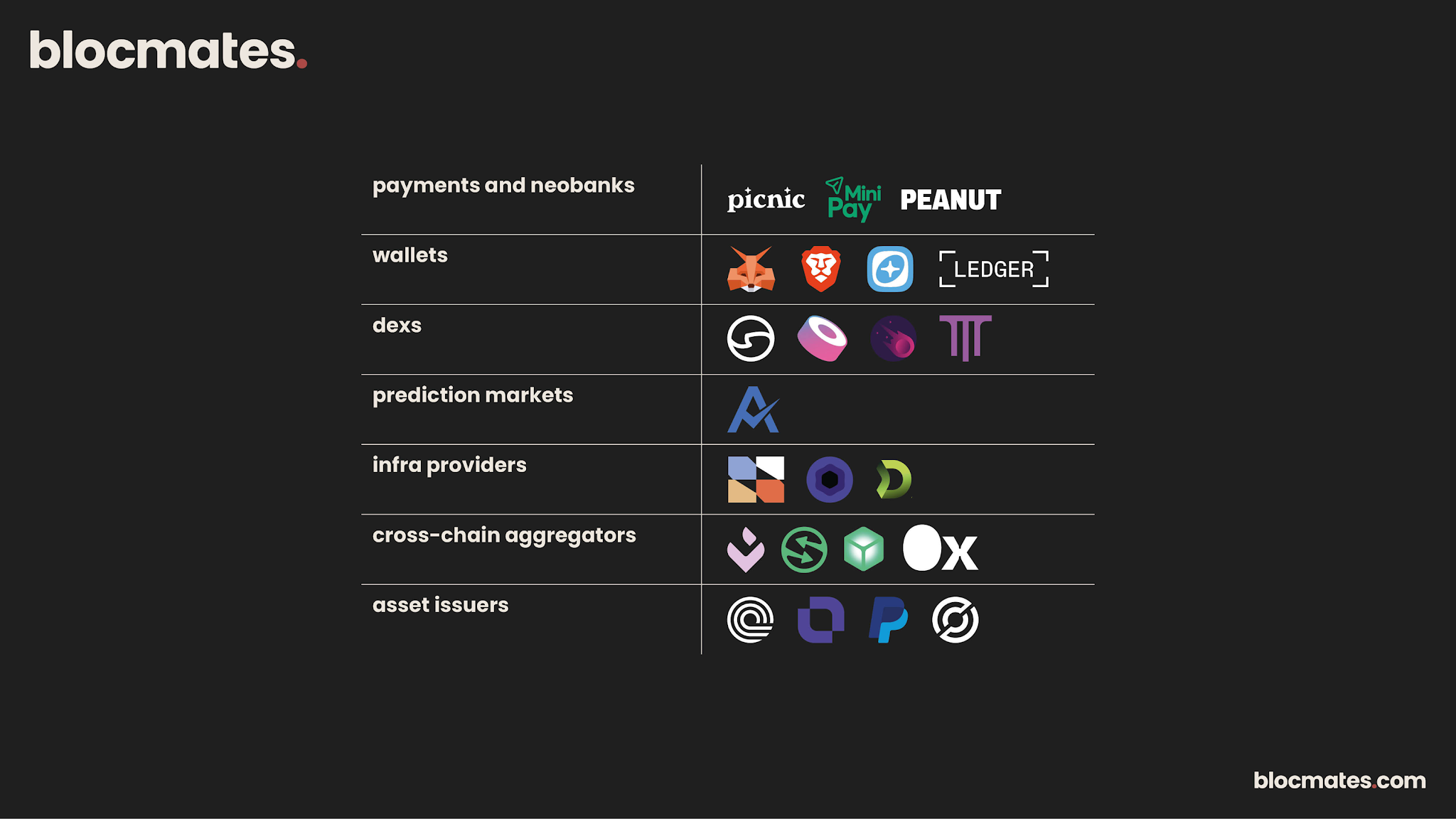
APIs, SDKs, hooks, and widgets, pick the surface that matches what you're shipping. Over 1,000 teams are already integrated, including MetaMask, Brave, Ledger, and LI.FI.
Pick your integration path
- Widget: Drop-in UI for swaps and bridging. Configure it visually in Squid Studio, copy the snippet, and ship. Best for teams that want cross-chain functionality to be live in an afternoon.
- SDK: TypeScript library for full programmatic control over routing, quoting, and execution. Best for custom UIs and apps that need their own flow.
- API: Direct REST access for backend services, bots, and agents. Language-agnostic, no SDK required.
- Hooks: Pre and post-execution logic that runs alongside a swap. Useful for staking after bridging, auto-depositing into a vault, and triggering onchain actions in a single transaction.
The integration loop (same for all four)
- Get an iIntegrator ID: Request one here. This is how Squid attributes volume to your product and how you earn referral fees.
- Choose your surface: Widget for speed, SDK for control, API for backend, hooks for composability.
- Install and configure: The SDK is 👇
The widget is configured in the Studio. All three need your Integrator ID in the request headers.
- Get a route: Pass source chain, destination chain, token in, token out, and amount. Squid returns the optimal path across 130+ liquidity sources.
- Execute: Sign the transaction and broadcast; Squid handles the rest: routing, gas normalization, cross-chain settlement, and status tracking.
- Ship: Test on mainnet with small amounts, then turn it loose.
For chains and ecosystems
For a chain or ecosystem, the cold start problem is brutal. You can launch with the best tech in the industry and still spend 18 months stuck in a chicken-and-egg loop: no liquidity means no users, no users means no apps, no apps means no liquidity. Most chains die here.
Squid collapses that timeline. Plugging into Squid means a new chain inherits the routing graph immediately (100+ chains, 20,000+ tokens, $1 billion+ in aggregated liquidity, and direct exposure to 1 million+ users and 1,000+ integrated apps from day one).
Squid’s onboarding runs through Squid-as-a-Service, a bespoke integration pathway. The idea is that every ecosystem brings its own assumptions about transaction models, account structures, and finality.
A lot of projects already utilize Squid’s infrastructure. They can be categorized as:
For agents
Agents are one of the fastest-growing user categories in crypto, and they don't behave like humans. Agents only care whether the route exists, the costs, and whether it settles. Cross-chain infrastructure built for human clicks falls apart under programmatic load.
Squid was built with this in mind. The same routing engine that powers the bridge app is exposed to agents through three surfaces, depending on how the agent is built:
- MCP: For AI assistants like Claude. Natural-language swap execution with wallet management, route quoting, and status tracking handled through conversation.
- API: For autonomous agents, solvers, and bots running their own infrastructure. Direct REST access, language-agnostic, with no SDK required.
- SDK: For agent frameworks that need tighter integration, custom logic, or programmatic control over the full lifecycle.
The execution loop
- Discovery: Agent queries available chains, tokens, and balances through get_chains, get_tokens, and get_balances.
- Quote: get_route returns the optimal path with amounts, fees, slippage, and ETA. The agent can compare routes, factor in costs, or pass the quote to a human for approval.
- Execution: execute_swap submits the route. Squid handles routing, gas normalization, and cross-chain settlement in the background.
- Verification: get_status polls until the swap lands or fails. If it fails, funds are automatically refunded to the source chain within roughly 15 minutes.
For institutions
Earlier, we established that institutions are coming onchain. They are not early, but they are here. However, to meet the demands of institutional activity, the nuances that retail tolerates, such as certain risks, are pretty much non-negotiable.
Institutional requirements sit higher than retail's by an order of magnitude, encompassing compliance, reliability, custody, audit trails, and execution that fits into approval workflows that take days, not seconds.
Squid is optimized with this in mind. The same non-custodial architecture that protects retail users is what makes it palatable to enterprises: assets never leave the user's control, settlement is verifiable onchain, and the system has held a 99.99% uptime track record across nine audits and every major market cycle since 2023.
A few things matter specifically for institutional use:
- Execution that fits real approval workflows: Squid Intents runs solver auctions after deposit semi-finalization, so quotes aren't expiring while a multi-sig collects signatures. If a transaction fails, funds are automatically refunded on the source chain with minimal wait time.
- Compliance-aware infrastructure: Squid-as-a-Service includes bespoke smart contracts and routing logic designed for regulated environments, such as KYC-gated chains, permissioned asset flows, and jurisdictional carveouts.
- Tokenized asset support: As RWAs, treasuries, equities, and FX move onchain, they won't live on one chain. Squid routes between issuers, networks, and compliance environments, and curates which versions of an asset are canonical so institutions aren't routing through wrapped junk.
- Direct partnerships: Squid is the cross-chain infrastructure for Ripple/XRPL, Stellar, and Mento's institutional FX product. PYUSD's first cross-chain route between Ethereum and Stellar was built on the Squid protocol.
What puts Squid ahead?
The most obvious answer is longevity. Connecting anything and everything in crypto is a tall task with a lot of wiring underneath, and only sustained commitment to first principles gets you there.
Squid started in 2022, shipped in January 2023, and has been compounding ever since.
That headstart matters because cross-chain isn't a problem you can sprint through. Each new ecosystem (Bitcoin, Solana, Cosmos, XRPL) is years of specialized engineering. Teams entering the category now are starting from where Squid was three years ago, and the gap widens every quarter.
The other compounding force is the network itself. Every new chain plugged in makes every existing chain more useful. Each new integrator brings volume and distribution to the others.
With 1,000+ teams already using Squid to go cross-chain, the platform is moving from being ‘just a product’ to becoming core infrastructure that is indispensable to the onchain world.
Add real revenue from real fees, a non-custodial track record through every major exploit cycle, and impeccable branding, and the moat stops being one thing.
We believe the differentiator for Squid is a combination of depth, breadth, and time, and that no one else has ideally put it together.
Concluding thoughts
If we are gonna sum it up, all we’re trying to say is that Squid sits in a category of its own - one that cuts across multiple solutions at the same time.
An important aspect of all this is the ethos of the team. The Squid team stayed focused on a much bigger vision of what the movement of value onchain should actually become.
They took the longer path and ended up building something truly powerful: a complete infrastructure stack that’s evolved into a foundational layer for crypto.
The other thing that must not be left out is how all of this attention to detail at the backend is also replicated at the frontend. From design to user experience, Squid delivers an interface that’s well above the industry standard.
Now, our job isn’t just to inform you about all of this stuff. We want you to actually use this thing.
- If you're a user, swap something on app.squidrouter.com.
- If you're a developer, the SDK is docs.squidrouter.com.
- If you're a protocol looking to build infrastructure on first principles, or an institution looking to partner, you know what to do.
Thanks to the Squid team for unlocking this article. All of our research and references are based on public information available in documents, etc., and are presented by blocmates for constructive discussion and analysis. To read more about our editorial policy and disclosures at blocmates, head here.





.webp)
.webp)

.webp)

.png)

.webp)



.webp)
.webp)
.webp)
.webp)











.webp)

.webp)

.webp)
.webp)
.webp)


.webp)
.webp)









.webp)
.webp)
.webp)
.webp)
.webp)
.webp)


.webp)
.webp)


.webp)


.webp)




.webp)


.webp)


.webp)


















.webp)





.webp)






.webp)

.webp)
.webp)

.webp)










.webp)

.webp)


.webp)





.webp)