Read time: 7m 51s
Ape-tizers:
- From the team behind Kraken, Nado offers spot and margin trading with leverage up to 40x, self-custody, and speeds comparable to those of centralized exchanges
- With Season 1 in full swing, 950,000 points are up for grabs every week
- Nado originates from a talent acquisition deal between the Ink Foundation and Vertex Protocol
The question I keep coming back to is, why are we still, in the year 2026, obsessing over perp DEX diversity when Hyperliquid is completely dominating the sector and reeling in on its CEX counterparts?
Believe it or not, there are reasons for choosing a venue that don't involve airdrop farming. If that were the case, Hyperliquid wouldn't have remained the top choice. The real difference between platforms depends on what they list and how they operate.
While I know most of you aren't losing sleep over this, there are very real trade-offs between security and execution. Some users want onchain settlement. Others are comfortable with SBF filling their orders from his jail cell, as long as the performance and fee structure hold up.
It's the same reason there are 78 kebab shops, 36 barber shops, and god only knows how many coffee shops scattered around any given city.
Some coffee shops offer ecologically sourced beans, which attracts a certain type of crowd. The one I visit doesn't play loud or obnoxious music. The fact that there is a particularly hot barista does not factor into my decision (it does).
The point is, if given a choice, people will exercise it. But unlike overpriced coffee shops or unsanitary kebab places, the venue you choose for trading actually matters as it directly impacts the safety of your assets, order execution, and fees.
The platform we'll be discussing today excels in all of the aforementioned aspects, will soon launch a plethora of RWAs, and yes, despite what I said about airdrops, might reward you for trading there.
What is Nado?
Nado is a central-limit order book DEX developed by Kraken and deployed on the exchanges' own layer-2 [L2] INK, offering spot and margin trading for crypto assets like BTC, ETH, SOL, BNB, and XRP with up to 40x leverage, and other asset classes coming soon.
Nado features industry-leading capital efficiency for traders, such as unified margin, automatic yield on deposits, and borrowing against margin, while offering passive earning opportunities for yield farmers through the NLP vault, which serves as the counterparty to the former.
At a technical level, Nado’s risk engine, which monitors account health, collateral ratios, and liquidation thresholds, resides directly onchain, with the sequencer (trade matching engine) being the only offchain part of Nado’s equation; a necessary component to ensure CEX-like speeds.
Even so, self-custody remains, as the assets stay locked in onchain smart contracts. The benefits of this setup are that the trades are executed between 5–15 ms, and periodic batching renders MEV attacks unfeasible.
Looking beyond the impressive stats on paper, Nado has an interesting lore that I suspect many of you are not familiar with.
A stroll down memory lane
In our article on INK, we covered how Kraken is entering the onchain arena with its own L2 and why you absolutely should be paying attention to it.
And what better way to attract traffic than by launching a perpetual DEX with a points season, am I right?
Interestingly, though, Nado was born from a talent acquisition deal between the Ink Foundation and Vertex Protocol, which, according to a press release, prompted Vertex to cease operations on its EVM deployments, including Arbitrum, Blast, Avalanche, and Sonic, and launch a new version of the protocol purpose-built for Ink.
While the exact terms of the deal were not disclosed, all you need to know is that Nado inherits Vertex's proven technology and talent, which recorded the highest notional trading volume among Arbitrum perp DEXs from November ‘23 until September ‘24.
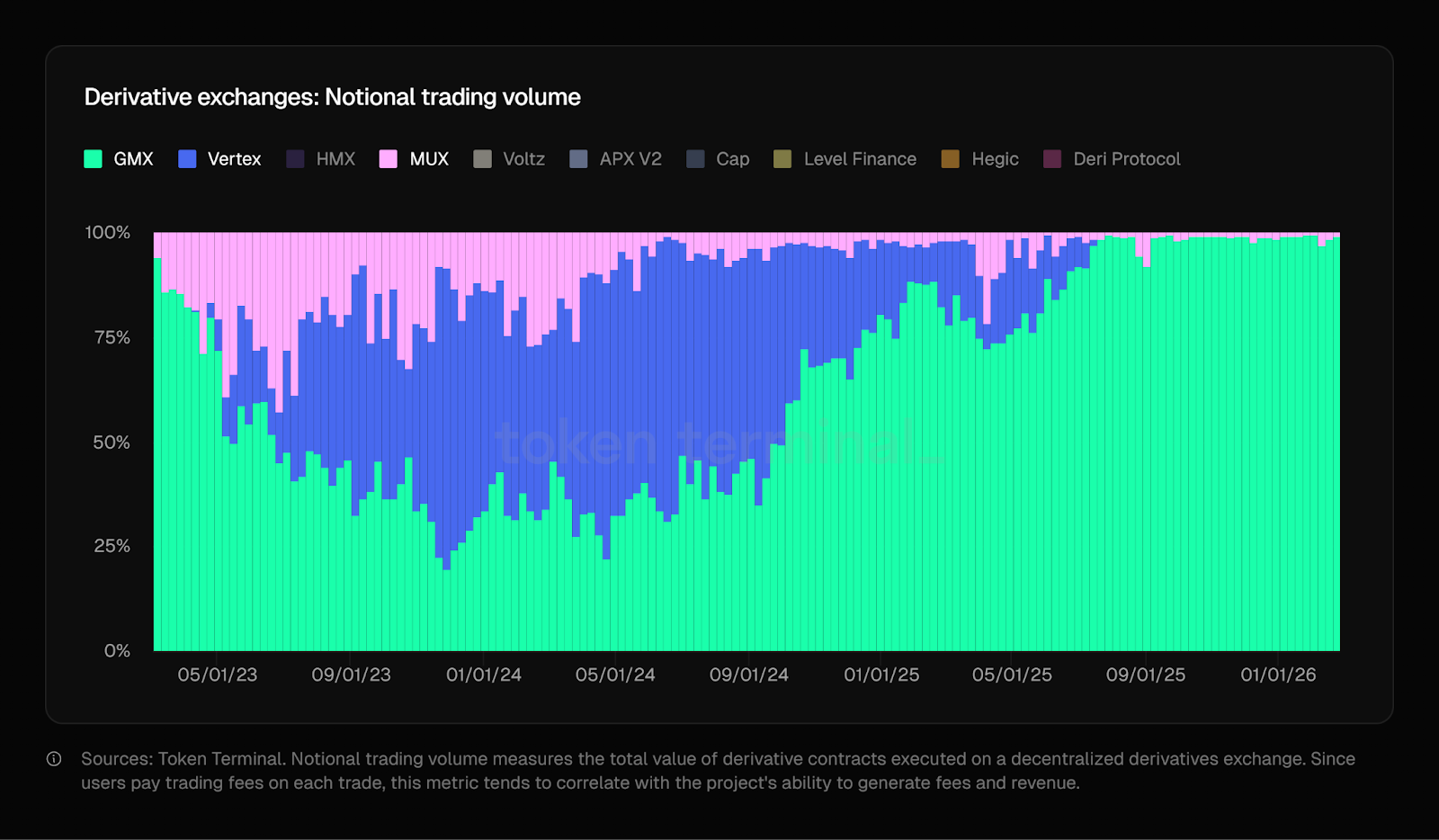
During Vertex’s Arbitrum run, the exchange handled a cumulative volume of $135+ billion without any documented hacks or exploits, more than proving the technology's viability.
Today, the same technology and talent have been translated into Nado, which has established itself as the leading app on INK in terms of usage, volume, and revenue, averaging roughly 3,000–4,000 daily active users, over $48 billion in cumulative volume, and more than $11 million in cumulative fees.
Fairly impressive for a perp DEX that’s been live for just under 4 months.
However, once you learn that Nado is one of only two confirmed protocols contributing to the INK airdrop (the other being Tydro), the reason for the flurry of activity becomes clear.
The elephant in the room
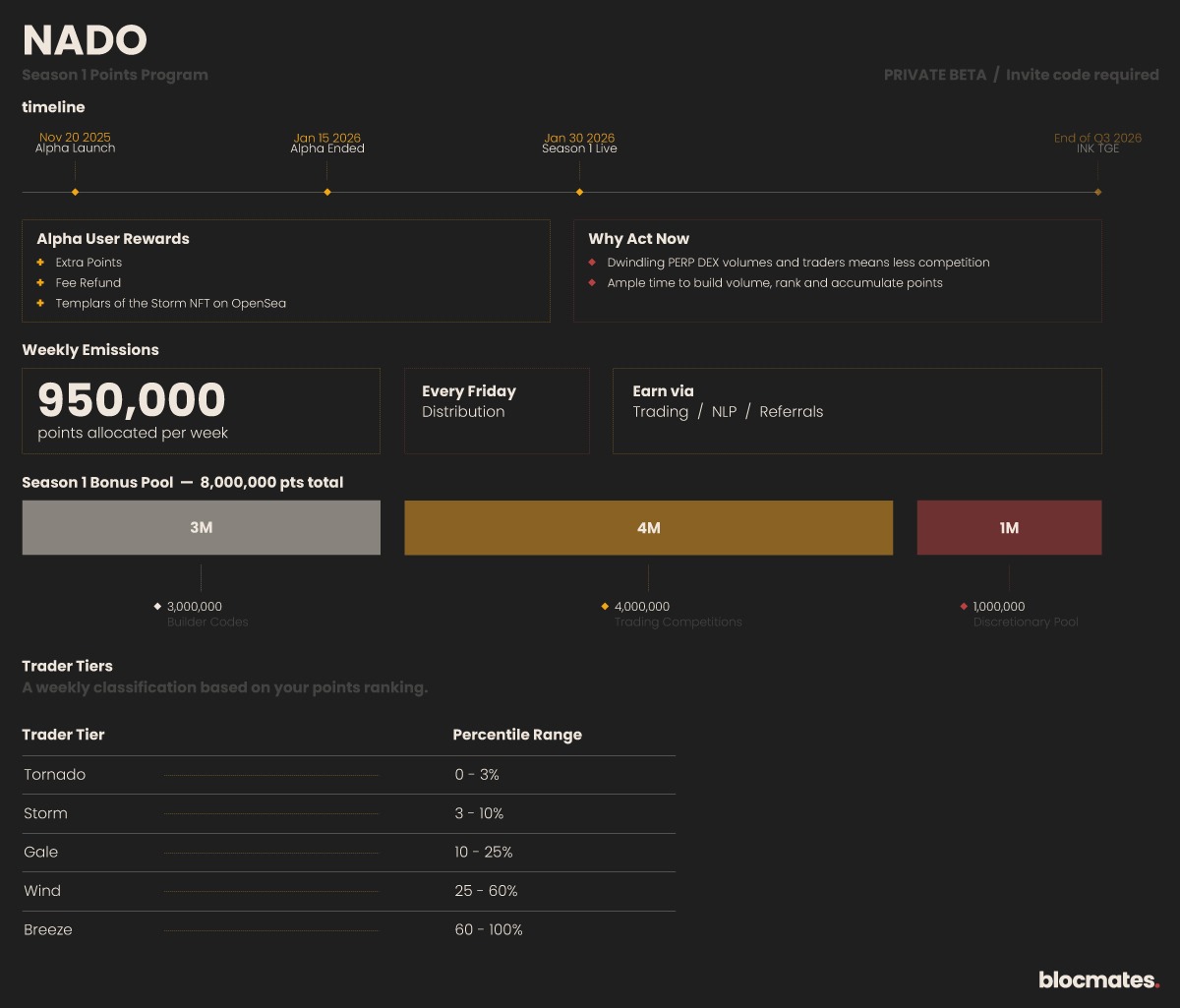
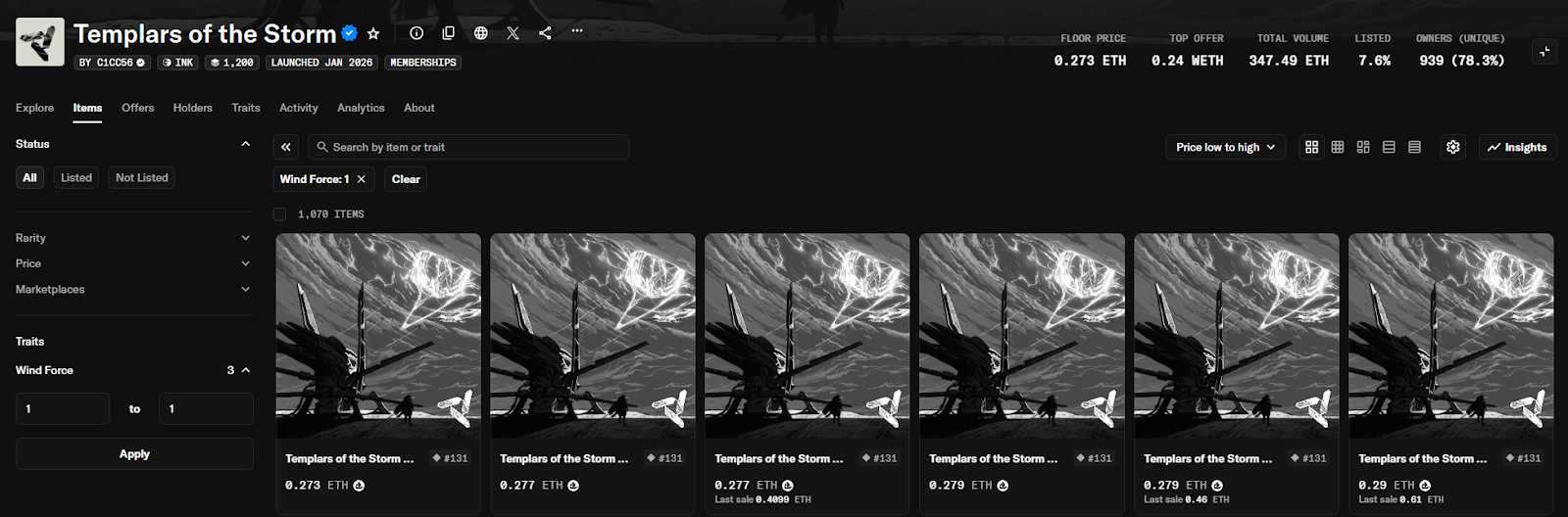
Nado kicked things off with a private alpha, which launched on November 20, 2025, and ended on January 15, 2026. After the private alpha concluded, users were given "the choice," where they could choose between extra points, a fee refund, or a “Templars of the Storm” NFT, now available on OpenSea.
Shortly thereafter, Season 1 began on January 30. Important to note that this is a private beta build, so you’ll need a code to access the app.
First things first: unless you’re a KOL or have a huge stack of stables lying around, relying on referrals or depositing in the NLP isn't an option.
The opportunity cost of depositing in the NLP for smaller fish is simply too high, and I’d say you’re probably better off buying the Templar NFT that not only grants you a points multiplier (the exact multiplier depends on its Wind Force trait) but also a fee rebate, lowering your cost per point basis.
Furthermore, with only 1200 examples, the scarcity of the collection combined with upcoming lore, utility, and PFP reveals makes the $640 current floor price of Tier 1 Templar a more attractive investment than depositing that money in the NLP.
From a first-principles perspective, Season 1 focuses on two paradigms: value-add (what you’re giving to Nado) and consistency (how often you're giving it to them). Just realized the way I described it sounds a lot like marriage, but that’s a topic for another day.
Firstly, Nado's incentive structure aligns points with value-add behaviors that strengthen the platform, specifically highlighting two types of activities: market making and liquidations.
While most of your points still come from accumulating volume through taker trades, think of market making and liquidations as extracurricular activities that impress your parents and increase your chances of being allowed to go to that one house party.
In addition to regular trading, it's recommended to place limit orders, and if you’re technically savvy, call the liquidate-subaccount API endpoint or the onchain contract to liquidate underwater positions (just not mine, pls for ma familia).
Secondly, at the end of each week, a tier is assigned based on how you performed relative to all other users.
Crucially, this tier does not carry over into the next week and is simply stored in your profile to show how consistent you’ve been throughout the entire campaign.
This means you can’t just log in one day, rack up millions of dollars in volume, and bugger off.
Showing up every week is key.
Now that we have established the ground rules, it’s time to speculate.
Napkin math
Note: the calculations below are what Benjamin Cowen would call dubious speculation, but it’s a fun exercise anyway. Since this is my article, we’ll indulge.
The core approach multiplies the expected $INK fully diluted valuation (FDV) by Nado's allocation percentage, then divides by the estimated total points issued.
Based on common sentiment, people estimate the FDV of $INK could reach $1 billion, with an allocation to Nado users around 8%. Considering that S1 is expected to run until the end of Q3, that gives us roughly 34 weeks for point distribution.
34 (weeks) × 950,000 (points per week) = 32.3 million points
On top of that, we need to include Alpha Bonus points (582,000), retroactive points (80,000), off-season points (2,000,000), and S1 bonus points (8,000,000), totaling 10,662,000 points.
This gives us the grand total of: 32,300,00 + 10,662,000 = 42,962,000 points distributed throughout the whole campaign.
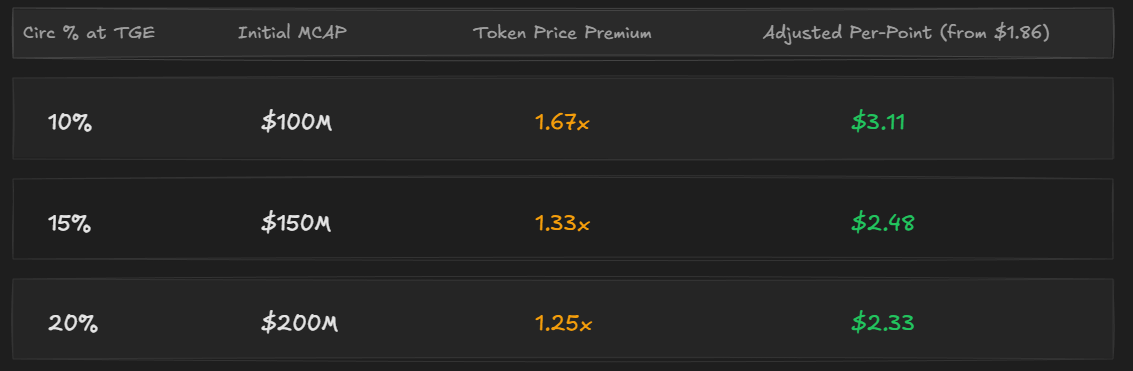
Now that we have all the variables, we simply plug them into the formula ($1 billion x 0.08 / 42,962,000), and voilà, we get a value of $1.86 per point.
Of course, this estimate ultimately relies on pure speculation in several areas and doesn’t account for the launch mechanics involving the initial circulating supply, which historically creates an initial price premium.
Future outlook and catalysts
We all recognize that perp DEXs are among the clearest PMF products in crypto, and with Nado being the primary venue on Ink, it serves as a proxy for Kraken’s onchain expansion success.
And so, once the demand and technology are validated, it’s safe to say the protocol will eventually be accessible to Kraken’s 10+ million user base.
And this isn't just a fantasy I made up. We have a whole article exploring Kraken’s L2 and explaining why that’s the case, so I recommend you read that next.
The main point is that once that happens, Nado will gain access to a vast distribution channel through the exchange, including direct on-and off-ramps and integration within Kraken’s UI.
On the product side, a recent X Space revealed a lot of alpha and behind-the-scenes insight into what’s happening over at Nado.
Most notably, the integration of different RWA instruments, including equities, FX, commodities, exotic equity perps, and more.
The first of these assets to become available was Silver, with trading open from Sunday 10:00 PM UTC to Friday 9:00 PM UTC, in accordance with the CME Globex precious metals calendar.
Additionally, QQQX (tracking the Nasdaq-100 ETF), SPYX (mirroring the S&P 500), and xStocks are operational on Kraken and Ink, with a full Nado rollout targeted for Q2.
Building on the previous two segments, you’ll be happy to hear that xStocks also announced a points campaign, resulting in a double farming opportunity.
Nado also plans to soon include alternative tokens as collateral (with risk-adjusted haircuts), building on the current BTC/ETH-only model to improve capital efficiency across spot, perpetuals, and money markets.
Along with introducing new asset classes and collateral types, a trading competition was also hinted at. It is planned as a four-week contest, with each week featuring a different track and a total prize pool of 4 million points.
And to top it all off, a native mobile app was described as "a few months out," addressing the current clunky QR-code browser workaround.
Concluding thoughts
To sum up, when choosing which platform to dedicate your money and time to, one should consider it from multiple angles, paying particular attention to the protocol's future.
In Nado’s case, I think the following points make a strong case for this being a protocol you should definitely interact with:
- Direct affiliation with Kraken amid the exchange’s expansion efforts to attract users to its L2
- One of just two protocols confirmed to count toward the $INK airdrop
- Proven track record of the underlying technology and team
- Self-custody and security with CEX-like speeds
And finally, with declining volumes across the board, there is an opportunity to fish in an undercrowded environment.
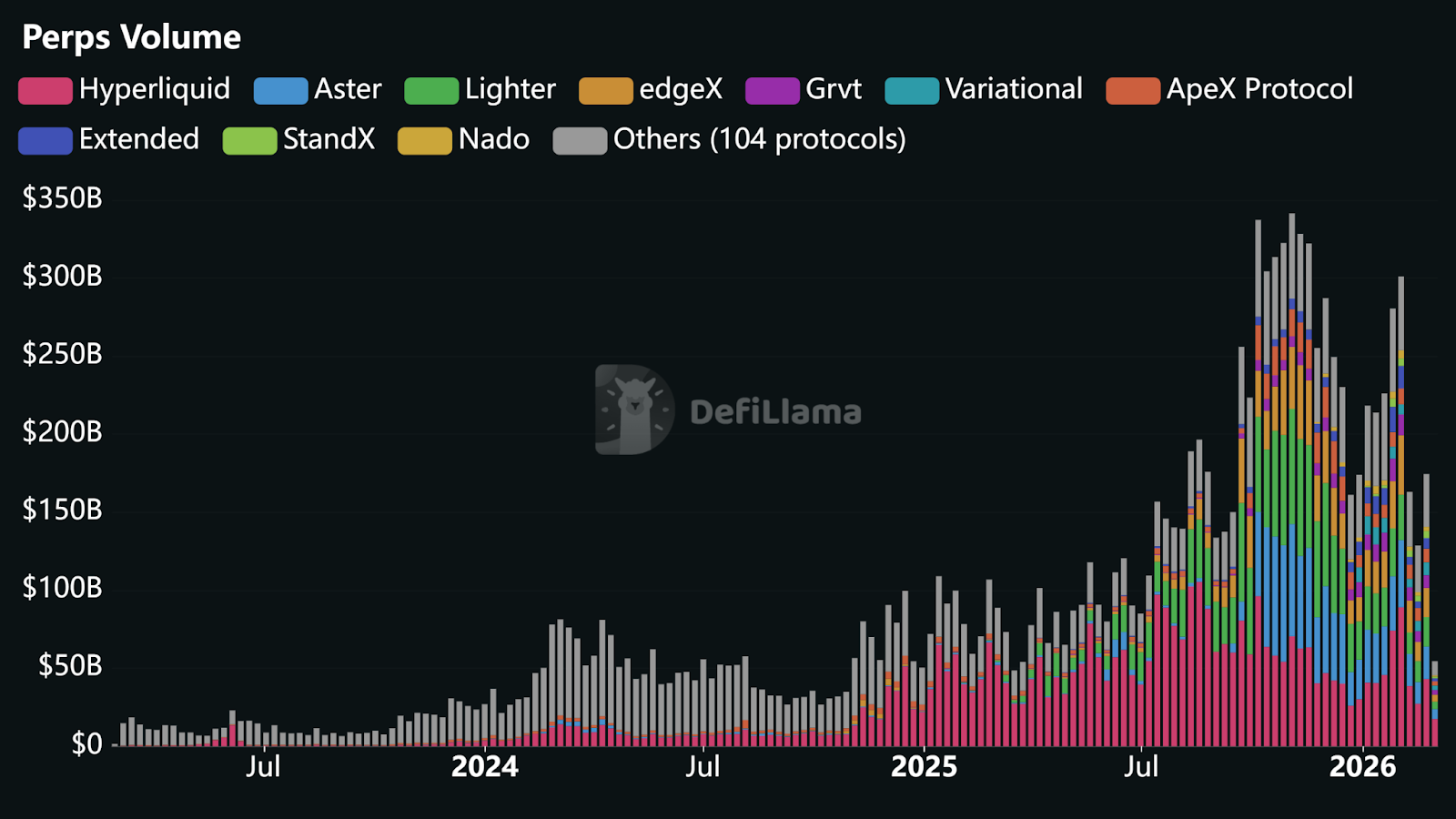
Before you continue doom-scrolling, I’ll leave you with this: only 9,100 people claimed points in week 6 of the program.
If that doesn’t qualify as the most undercrowded points season in crypto, I don’t know what does. Trade accordingly.
Thanks to the Nado team for unlocking this article. All of our research and references are based on public information available in documents, etc., and are presented by blocmates for constructive discussion and analysis. To read more about our editorial policy and disclosures at blocmates, head here.





.webp)
.webp)

.webp)
.png)

.webp)



.webp)
.webp)
.webp)
.webp)











.webp)
.webp)


.webp)


.webp)
.webp)


.webp)
.webp)















.webp)
.webp)
.webp)
.webp)
.webp)

.webp)
.webp)
.webp)


.webp)
.webp)


.webp)


.webp)




.webp)


.webp)


.webp)

















.webp)





.webp)









.webp)

.webp)
.webp)

.webp)












.webp)

.webp)

.webp)





.webp)