Reading time: 12m 37s
You’re seeing everyone and their uncle talk about AI on Base, and you've decided it is now your turn to FOMO buy the local top. Don’t worry, we’re here to help.
In this article, we’ll simplify the Base AI landscape just so you have a clearer idea of what's exactly going on.
What you do after that is completely on you; we take no responsibility for your financial stupidity.
So let’s go through the most prominent projects
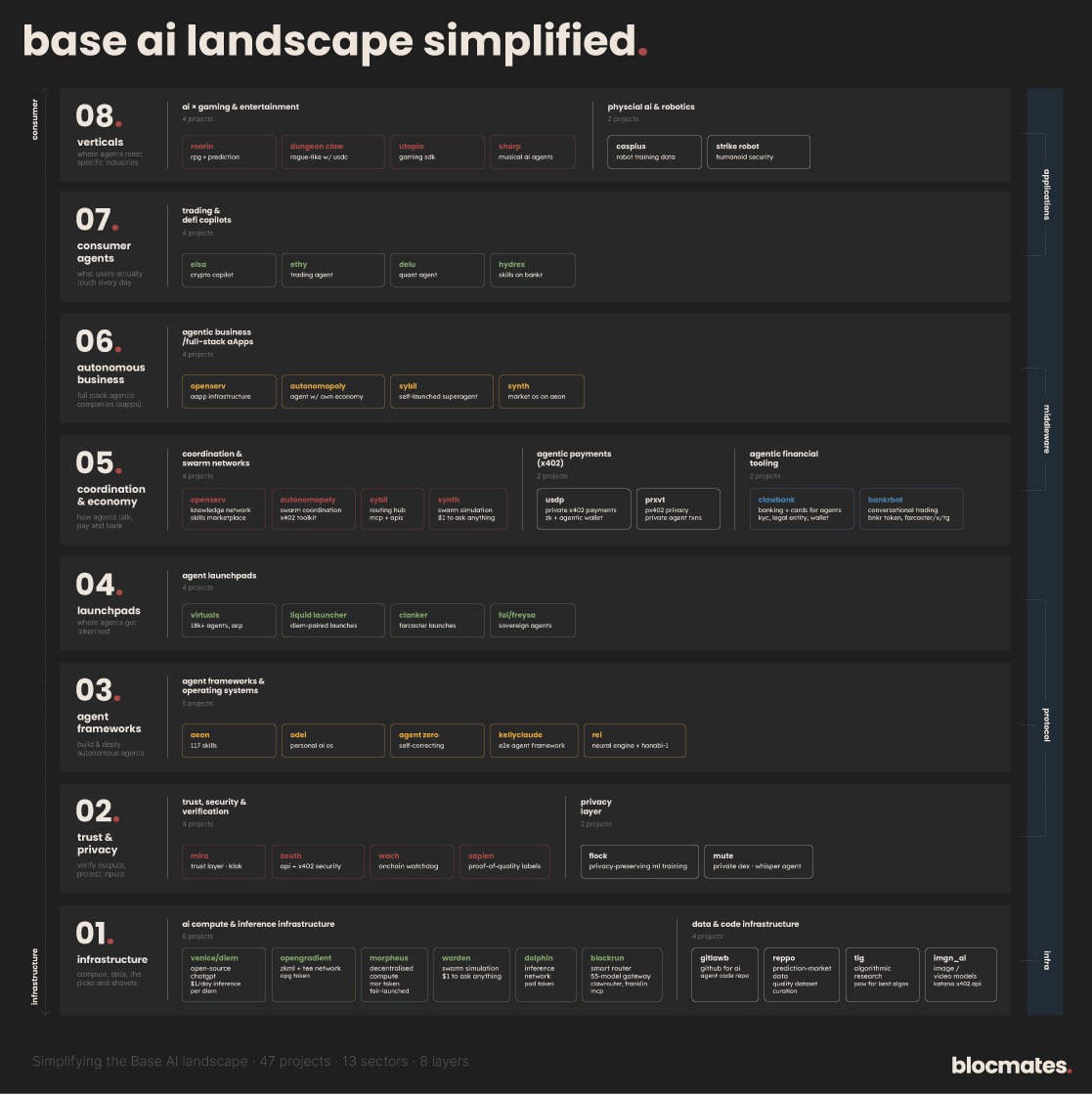
Agent frameworks and operating systems
@aeonframework - The Aeon framework is essentially a real-life implementation of what people expect AI agents to be.
It’s classified as ‘the most autonomous AI agent’ for good reason. As a user, all you have to do is configure the agent once, and that’s it, no babysitting or infinite approval loops.
The framework leverages over 117 different skills and now seems to be getting integrated everywhere.
@odei_ai - ODEI allows you to create your own personal AI operating system.
The idea stems from creating an AI model that’s more than just a glorified search engine.
It executes tasks, constantly observes, logs results, maintains consistent memory, and updates policy to ensure users get an autonomous AI model that’s actually trustworthy enough to operate on behalf of the user.
Their native token, ODAI, was recently launched.
@Agent0ai - Agent Zero is a pretty standard agentic framework.
It runs on its own computer, uses and creates tools, learns, self-corrects, and executes workflows.
@KellyClaudeAI - Kelly Claude is a fascinating experiment.
It started as the AI agent Kelly Claude, and through social growth/interactions, grew to open businesses, operate a company, and achieve economic autonomy through crypto while leveraging social activity.
It has now developed into offering a fully autonomous AI agent framework capable of end-to-end creation and operation. It’s gone from agent to infrastructure in a really short time, and it's fascinating to watch.
@rei_labs - REI is a bit of a complex behemoth, but here’s my best attempt to condense it.
Its AI model architecture is based on a neural network.
It’s a four-layer cognitive engine with evolving memory, a parallel reasoning cluster that routes subtasks to specialist models, and an open-source 16-million-parameter financial transformer (Hanabi-1) that knows when it doesn't know.
Wrap that in an OpenAI-compatible SDK and a factory that lets anyone deploy their own agent on top, and you've got the infrastructure layer underneath the AI agent narrative.
That’s $REI.
AI compute and inference infrastructure
@AskVenice - Venice can be thought of as an open-source, unbiased, uncensored, and private version of ChatGPT, with a bunch of AI models attached.
It has the $VVV token, which has been on a tear recently, and the $DIEM token, which is an AI compute credit token.
Each $DIEM is minted by locking staked $VVV and entitles the holder to $1/day of perpetual AI API access, turning AI inference into an onchain yield-bearing primitive.
@OpenGradient - OpenGradient is an open network to power decentralized AI.
Its technical architecture uses a hybrid of zkML+TEE to create a network upon which AI models can be hosted, inferences can be run securely, and agents can be launched onchain.
The native token $OPG just launched a month ago.
@MorpheusAIs - Most of you are probably already familiar with this.
Morpheus is another infrastructure solution. It's a decentralized network that makes it easy to build, deploy, and scale AI models without any gatekeepers. It already has a distributed set of nodes and a network of peer-to-peer superagents performing financial tasks.
The MOR token was fair-launched and is heavily entrenched in the network's yield economics and compute payments.
@wardenprotocol - It’s a full-stack AI-agent infrastructure spanning multiple chains, including Base. It uses SPEx (Statistical Proof of Execution) to verify AI inference.
On top of the protocol is an agentic wallet that anyone can use with a simple prompt; the agent then performs the requested action.
@dphnAI - Dolphin is a project centered around sophisticated AI models and better inference networks.
It offers a range of features, including a chat feature for interacting with the model, a Telegram bot, a decentralized inference network, a collection of unique AI models, and synthetic data generation.
Its native token, $POD, has recently been on the rise and is worth paying attention to.
@BlockRunAI - BlockRun offers a vast product suite. The best way to describe it would be a sort of economic layer for AI agents.
It has a smart router called Clawrouter that routes your prompts through the cheapest LLM module.
There’s the Franklin agent that pays for its own AI.
There’s an MCP server wherein one installation gives access to 10 different tools.
There’s an AI model gateway that provides access to over 55 models via a single endpoint.
Lastly, there’s also a marketplace where AI buys data and runtime.
There’s a lot more to this and a lot more coming, but I think you get the idea.
Agent launchpads
@virtuals_io - Most of you are already probably familiar with this.
It’s an AI agent launchpad on Base where anyone can tokenize an autonomous agent with a fixed 1 billion token supply paired against $VIRTUAL in a 10-year-locked liquidity pool; agents earn inference fees that fund buyback-and-burn of their own tokens.
The protocol now spans 18,000+ deployed agents across Base, Ethereum, Solana, and Arbitrum with the Agent Commerce Protocol (ACP) for agent-to-agent transactions.
@_proxystudio (Liquid Launcher) - Liquid Launcher is a launchpad for agents built on Base.
Here’s the kicker, and why it's picking up momentum: All tokens launched through the platform have a 100 billion supply, a Uniswap V4 pool, permanently locked liquidity with configurable rewards, but most importantly, the option to pair the token with $DIEM.
What this means is that swap fees for the token directly get converted into AI inference credits.
@clanker_world - Clanker World is a launchpad, which means it's not directly tied to AI, but a bunch of AI agents have launched popular coins through it, almost giving it a de facto affiliation to the AI sector on Base.
A simple mention of @clanker on Farcaster would allow anyone to launch a coin.
It was ultimately acquired by Farcaster, and then Farcaster got acquired by Neynar. Interestingly enough, Banker was launched through Clanker, and the co-founder of Clanker actually went on to launch the Liquid Launcher launchpad.
So to some extent, it’s heavily tied to the Base AI ecosystem.
@freysa_ai - Freysa, with the native token FAI, is a sovereign AI agent stack on Base built around TEEs and zkTLS that lets agents hold their own cryptographic keys, manage treasuries, and execute autonomously without human intermediaries.
Originally a viral "persuade the AI to release the treasury" game, Freysa is now an open framework that allows developers to deploy their own self-owned agents.
Agentic business/apps
@openservai - OpenServ is a full-stack infrastructure project that helps build agentic AI businesses called aApps.
With just a few clicks, you can launch your own autonomous startup run by agents directly on the platform.
The $SERV token is heavily tied to the network as it's used for payments, staking, governance, and buyback/burn schemes.
@AUTONOMOPOLY ($AUTONO) - As the name suggests, the project is autonomy + monopoly.
It's an agent that has a monopoly over its own economy. It has its own wallet through which it conducts operations without human intervention.
Autonomopoly also has a token $AUTONO that is paired with $DIEM.
Fees from this pool go to the agent's wallet, and it decides what to do with the funds by itself.
Eventually, new features like Twitter posting, email sending, hiring freelancers for help, art generation, and so on can be expected to roll out.
@sibylcap - Sybil is the so-called superagent created by the research arm Sybil Labs LLC.
It is an agent that supposedly self-launched through Virtuals and claims to be a superagent capable of creating products, generating revenue, performing financial actions, reinvesting in infrastructure, acquiring projects, and so on.
How true any of this is, I don’t know, but it did come on my radar during research, so I thought I’d mention it.
@bankrsynth - BankrSynth is one of the first agents to launch on the Aeon framework.
It’s proclaimed to be a market operating system on Base that allows you to deploy, synthesize, and execute.
Agent coordination and swarm networks
@nookplot - Nook is a coordination network for AI agents.
The idea is to create this interconnected web of agents that all leverage the same network.
Agents can publish skills, learning, and tools to the network. These can be used by other agents, allowing them to gain a reputation based on the usefulness of the knowledge.
This then creates an agent economy of sorts where agents collaborate and grow the underlying knowledge base for a whole suite of potential tasks or applications.
@awenetwork_ai - $AWE enables multi-agent coordination at scale.
You can have vast worlds with thousands of agents coordinating with one another for a variety of purposes. It also includes a suite of supporting technologies, including an x402 agent, an agent-building toolkit, an x402 facilitator, and an x402 market.
Within this, you can run your own large-scale agent simulations.
@AgentlyHQ - This is a routing layer for AI agents.
It’s sort of a central hub into which thousands of agents, MCP tools, data sources, and APIs are connected. This creates a central routing layer through which AI agents can coordinate and transact.
@miroshark_ - Miroshark is classified as the universal swarm intelligence engine.
Basically, you can drop in anything like a political statement, a video, a question you can’t answer, a hypothetical $500k or dinner with Jay-Z type question, literally anything.
The platform then spawns hundreds of agents that react to it hour by hour, whether that be arguing, debating, trading, creating, or whatever else is required in the situation. For $1, you can simulate anything.
Agent financial tooling
@ClawBankHQ - The idea behind Clawbank is to give your agent a whole suite of financial tools.
Basically, you first upload KYC details and get verified; from there, you get API keys that can be plugged into any agentic framework. With this, your agent can have a bank account, a debit card, a legal entity, a crypto wallet, a company, and literally anything else of that nature.
@BankrBot - BankrBot is a conversational trading agent that lives on Farcaster, X, and Telegram, letting you execute swaps, send tokens, deploy new tokens via Clanker, and manage your wallet by just typing what you want in plain English.
The $BNKR token captures protocol fees from agent activity and was fair-launched on Base.
Agentic payments
@UsdpBase - USDP is a payments layer built for the agent economy.
It leverages zk technology with x402 to create a privacy-preserving payments network for AI agents on Base. It's one of the first privacy-focused agentic wallets.
@PRXVTai - This is privacy x AI.
Provides a variety of privacy infrastructure rails for agents, with the most popular one being px402, which is privacy for agentic x402 payment transactions. This will eventually be expanded into any type of agentic action onchain.
Trust, security, and verification layers
@miranetwork - Mira is a trust layer for AI operations.
Using collective intelligence, it verifies outputs and actions at every step of an AI agent/LLMs lifecycle. It further adds to resilience by leveraging the MIRA token within the system.
Mira has been around for a long time, and its flagship app, Klok, is already pretty popular.
@zauthinc - Zauth is focused on providing security for the upcoming world of an agentic internet.
It finds vulnerabilities before exploits, scores code to ensure it can be trusted, but most importantly, verifies API endpoints before agents make payments, a major pain point for agents currently.
It’s primarily on Solana but now secures agentic payments through the x402 payment system.
@Wach_AI - Wach is the onchain watchdog in the world of AI agents.
They keep on changing, make mistakes, and are often misaligned to act maliciously.
Wach uses mandates to bring trust and verifiability to agents while also standardizing the process of task verification.
@BuildOnSapien - Sapien is a decentralized data-foundry on Base for labeling quality signal at any point in the AI lifecycle.
The idea is that with AI models moving so fast and agents performing so many actions autonomously, it is hard to know what can be trusted. Sapien provides these “quality” labels through a Proof of Quality (PoQ) staking mechanism.
Privacy layers for agents
@Mute_swap - Mute is a privacy-focused cross-chain DEX that ensures all your onchain swaps are private.
They are now bringing their services to the Base ecosystem by becoming the privacy layer for the Virtuals ecosystem, where everything will be powered by the Whisper AI agent.
@flock_io - Flock is a player that has recently moved cross-chain to Base.
Flock is focused on privacy and ownership.
It’s a privacy-preserving AI platform that lets anyone train their AI models and then fully own every element of it. They currently have active products that are doing well, such as the AI Arena, the FL Alliance, and the Flock API Platform.
Data and code infrastructure
@gitlawb - As you can probably deduce from the name, Gitlawb is basically GitHub for AI agents.
As coding by agents and AI models reaches an unimaginable scale, there needs to be a collaborative code-sharing base where all the code can be stored and used to further build apps.
Gitlawb is that.
@reppo - Reppo combines elements of prediction markets with AI to offer a self-improving AI model trained on the highest-quality data.
Publishers submit raw data into different domains → domain experts stake capital in 48-hour prediction markets to judge quality → curated datasets flow directly to AI teams, models, agents, or robots.
@tigfoundation - TIG is a network for algorithmic breakthroughs.
Basically, it coordinates decentralized algorithmic research. Innovators submit algorithms that solve computational problems across fields such as cryptography, AI, and biotech research.
These algorithms are run through proof-of-work systems to see which one works best. The best algos get commercial licenses.
Within this system, the $TIG token is intricately woven for rewards, fees, and other such functionalities.
@imgn_ai - Imgn allows you to leverage the latest AI models for photo and video creation and gives you $IMGN rewards for platform activity.
Most recently, they introduced KATANA, a one-stop AI API with x402 support and privacy models priced below Venice.
Consumer agents
@HeyElsaAI - Elsa is basically your crypto co-pilot.
It’s an agent that does everything you need from discovering opportunities, onchain research, executing trades, farming yield, managing portfolios, and basically anything else you’d need in your crypto journey.
It also has an x402 API for payments.
@ethy_agent - Ethy is your personal autonomous trading assistant.
You explain what you want in plain English, and the agent executes the trade for you in the most efficient manner possible.
It operates 24/7 and leverages the best onchain trading/DeFi agents available to create the most profitable trades for you.
@deluquant - Delu is an agent who won the Bankr hackathon.
It’s a self-evolving agent that thinks in quant terms and posts its findings through its Twitter account constantly.
@HydrexFI - Hydrex is a liquidity hub purpose-built for the Base ecosystem. So it’s technically not AI.
However, there’s an interesting new feature called Hydrex Skills, which is now live on BankrBot.
Through a simple chat command, you can tap into Staking, voting, LPing, and more on Hydrex directly through the Bankr terminal.
Robotics/physical AI
@caspius_ai - This is more to do with robotics than AI, but nonetheless, it counts under physical AI, so let’s give it a mention.
What Caspius does is pay people to take first-person videos of their daily tasks: Walking, doing laundry, working, washing the dishes, and so on.
This data is then fed into robot teleoperations, which can train robots on real human movements.
It's basically building a data center for physical AI.
@StrikRobot_ai - This is another player in the robotics/physical AI space.
It’s an intelligence platform for humanoid robots that are focused on security.
Specifically targeting facilities like nuclear, electricity, or active radiation zones.
Their first product, Safeguard ASF, is an agentic humanoid robot focused on monitoring, surveilling, patrolling, and intervening in high-risk situations in industrial areas.
The SR token acts as a bootstrapping and revenue-sharing primitive for this product.
AI x gaming/entertainment
@roarin_ai - An interesting crossover between AI, gaming, and prediction markets.
This is an RPG game where AI agent monsters can be trained, evolved, and ultimately battle each other on the Polymarket books for who is the better trad…. or should I say gambler.
@dungeonclaw - Another fun AI x gaming mashup.
This is a skill-based rogue-like game where both agents and humans can compete for daily rewards in USDC in either free-to-play or pay-to-play tournaments.
Typically, people make agents play on their behalf for rewards, but it’s a pretty fun concept nonetheless.
@Uptopia_xyz - Uptopia is another project that falls at the intersection of gaming x AI.
It’s a central interconnected network where agents, gamers, builders, and creators can all converge onchain.
It offers an SDK to make it easy for anyone to build applications onchain while also offering their own suite of games/applications. They also support x402 for seamless payment systems.
@sharpagentic - This is more of a fun and interesting experiment.
Sharp is the self-proclaimed “label for musical AI agents”.
AI agents have the ability to create, compose, react, and curate music, which can be traded amongst other musical agents on the platform to create unique tunes purely by the machines.
Concluding thoughts
This brings our Base AI guide to an end. If we missed anything, let us know in the comments.
Before signing off, want to quickly reassert that we have presented all the information above based on our research. None of this is an endorsement to buy any token. A lot of these are early-stage projects, so you never know what can happen. That said, make sure you always DYOR.





.webp)
.webp)

.webp)
.png)
.webp)


.webp)
.webp)
.webp)
.webp)






.webp)
.webp)

.webp)
.webp)
.webp)

.webp)
.webp)








.webp)
.webp)
.webp)
.webp)
.webp)
.webp)


.webp)
.webp)


.webp)


.webp)




.webp)


.webp)


.webp)
















.webp)





.webp)








.webp)

.webp)
.webp)

.webp)









.webp)

.webp)


.webp)





.webp)