Reading time: 8m 29s
An emerging trend in recent months is the use of blockchains and crypto primitives for “non-crypto native” purposes.
What I mean is that the industry is seeing success by moving beyond classic gambling games and ponzinomics, to actually implementing the underlying technology to enhance existing non-crypto-native industries.
Whether it be collectibles, real estate, fantasy sports, or the topic of today’s article, AI/compute, it’s clear that blockchain infrastructure in the background as a tool to enhance other industries is the best way forward for true adoption.

The AI industry is in a strange spot. Just as valuations begin to reach trillion-dollar marks, we’re beginning to see watered-down versions of models where hallucinations and incorrect outputs are common occurrences.
The bottleneck is, and was always going to be, compute supply.
Running these complex AI models is compute-intensive and expensive; there are natural limitations to the available hardware capable of processing the required data, and we are at the point where ceilings are being hit.
Despite the trillion-dollar valuations, there’s only so much investor money AI research labs can burn through before new solutions are required to address compute supply and cost issues.
Technically, blockchains do have the capability to solve this issue; however, we have yet to see any implementation achieve mainstream success.
Recent murmurs in the industry have led most to believe that there are two up-and-comers who can successfully wield blockchains to address compute supply issues.
These two are Nockchain and Pearl Network.
So today, we’re going to do an objective comparative analysis between the two and see where each of their strengths (and weaknesses) lie.
What are they?
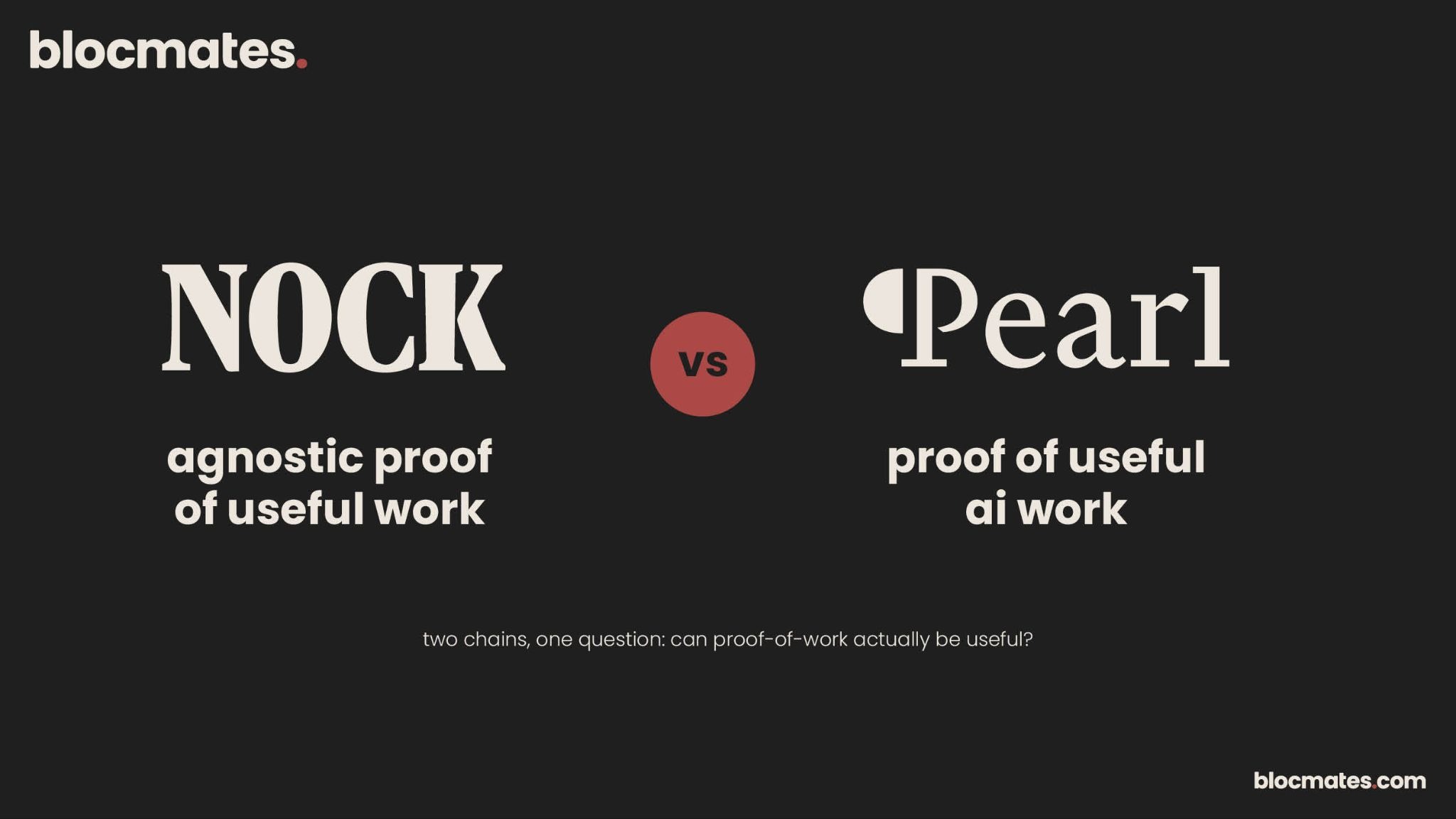
Both Pearl and Nockchain fall under the category of what is called “Proof of Useful Work” (PoUW) networks. They take the tried-and-tested Proof of Work (PoW) mining used by Bitcoin and eliminate the wastefulness in favor of something “useful.”
The general idea is that PoW showed that energy can be turned into a decentralized, trustless, monetary asset. However, the way Bitcoin uses it is wasteful.
Bitcoin uses hashing, which essentially involves using energy to solve complex mathematical puzzles to win the right to mine a block and make cheating expensive. But the resulting hashes are essentially discarded; they’re not actually used by network participants.
PoUW takes the same mining power and instead uses it for something useful, which in this case is complex computations.
Pearl
Pearl is a layer-1 blockchain that’s a fork of Bitcoin. The primary difference is that it replaces the mining puzzles with matrix multiplication, or matmul for short (more on this later).
Miners utilize their hardware to run real AI workloads, things like training a model, generating images, inference on LLMs, and so on.
This ‘useful work’ is then added to the network via a cryptographic proof by the miner (hence PoUW), showing that they actually solved the problem and performed the computation.
This earns the miner a crypto reward in PRL tokens for performing the computation.
It’s worth noting that the Pearl team actually wrote the original paper on the tech of bolting tiny PoUW tensors onto matmul workloads. This tech is now used by them as well as other teams.
Nockchain
Nockchain is a layer-1 where the computations are done offchain by the miners who then generate a zero-knowledge proof (ZKPs) which is attached onchain for verifiability.
It’s designed to be very lightweight and versatile in terms of the types and complexity of compute the network can handle.
ZKPs are simply the original version of Nockchain, which has now been proven to work. Now, the network supports different workloads, including matmul.
Nockchain also has its own virtual machine, the NockVM, and allows developers to build any sort of permissionless applications on the network called NockApps.
Core thesis
Although very similar at a high level, the differences become clear at a more granular level.
Pearl
Pearl Network has taken a very pure AI approach to building the network. The entire premise is to leverage crypto mining and merge it with AI computations to create this 2-for-1 scenario, where mining activity gets actual AI computational work done while also generating crypto rewards (in $PRL) for the miners, thereby creating a sort of market around AI compute.
This is why they go by the slogan “Bitcoin of the AI compute era.”
Nockchain
Nockchain has a slightly broader approach of turning verifiable computations as a whole, regardless of what sector they’re used in, into an economic asset.
The entire idea behind Nockchain is basically using ZK proofs (verifiability) to support offchain computation (lightweight, efficient, scalable settlement) and tackle complex workloads (AI training, agents, data availability, intents, etc.).
The bet is very much on verifiable computation becoming the commodity of the future and creating a tradeable asset around it.
Recently, however, the team has been leaning increasingly towards the AI computation narrative, seeing that it is one of the biggest use cases for the network, and they’re also soon introducing matmul at the network level.
But overall, the approach and target markets are still a little broader than Pearl.
Technical implementations
Of course, the biggest point of difference between the two is the fine print. The technical details that none of y'all bother reading, so we do it for you. Things like how PoUW is implemented or just the general design of the technical architecture.
Pearl
The core innovation of Pearl, as stated multiple times in this article, is the introduction of matrix multiplication (matmul) at the mining level.
For those unfamiliar, matmul is basically at the heart of all your beloved AI products. All of your inputs into AI models, whether it be words, images, or audio, are converted into rows and columns of numbers (called vectors and matrices).
Then there are weights added to these numbers during the AI training process, which is a value indicating importance.
These inputs and weights are multiplied by each other in a table to get all the possible combinations and produce an output. This is how AI is able to process thousands of inputs simultaneously.
This system is ingrained in the Pearl Network, as the hardware requirements for miners (at the time of writing) are mainly Nvidia GPUs. So miners perform these matmul operations for AI inference/training on their GPUs while simultaneously earning crypto rewards for their work.
The second-order effect of Pearl’s technical design is that it offers better unit economics for AI by intertwining energy, AI compute, and money.
By turning every GPU cycle into a 2-for-1 deal (AI computation + $PRL rewards), compute costs get subsidized, and over time (dependent on adoption), the network becomes a meter for the energy demand of AI.
The only caveat at the moment is that Pearl handles only integer matrix math, while most of AI runs on something called low-precision floating point. The team has said that a floating-point version is coming soon, so this shouldn’t be an issue for too long.
Nockchain
ZKP, NockVM, NockApps, how NOCK intertwines
Nockchain can be broadly described as ‘the verifiable compute engine.’ At a high-level, it follows a three-pillar design.
- Programmable sound money - The native token NOCK, which was fair launched (albeit with some controversy at launch) and hard-capped at 232 with diminishing emissions over time. It’s exclusively minted through the PoUW mining and is deeply entrenched in the network's ecosystem and functionality.
- Proof of Useful Work - Unlike Pearl, which is very similar to Bitcoin, the PoUW in this case is complex offchain computations being verified onchain via ZK proofs (plus the additional supported workloads). So the 2-for-1 in this scenario is verifiable computation, which is subsidized by mining rewards.
- Sovereignty at the edge - There’s a framework called NockApps, which brings programmability to Nockchain. Developers state their desired outcomes using ZK-intents, execute logic offchain, and settle onchain.
If we dive a little deeper beyond the three pillars, there’s a little more to Nockchain that’s worth noting.
The consensus level is miners generating ZK proofs for off-chain computations, which means the hardware requirements are broader. Basically, whatever is effective for general ZK proving, CPUs, GPUs, accelerators, and so on.
At the state level is something called notes. The details are not that important, but you can think of it as an enhanced version of Bitcoin’s UTXO model.
The execution layer is the NockApps. Logic and computation are handled offchain with proof for verifiability attached onchain. This means no gas limits and verification costs remain constant regardless of compute size.
Then there’s the virtual machine, the NockVM.
By design, the NockVM is a minimal engine designed to run Nock, the native programming language that contains only 12 opcodes to make the lives of developers easy.
While the NockVM runs the actual codes and the apps, the Nock ZKVM records the full execution trace of what happens on the NockVM and generates STARK proofs, which are attached onchain.
Within this complex system is the $NOCK token, which is used for gas payments and acts as the de facto tradable instrument for verifiable compute as a commodity.
The main caveat with Nockchain is that it currently (at the time of writing) does not have the matmul implementation like Pearl has, which is important for AI compute. However, the team has mentioned that this is coming soon.
The tokens
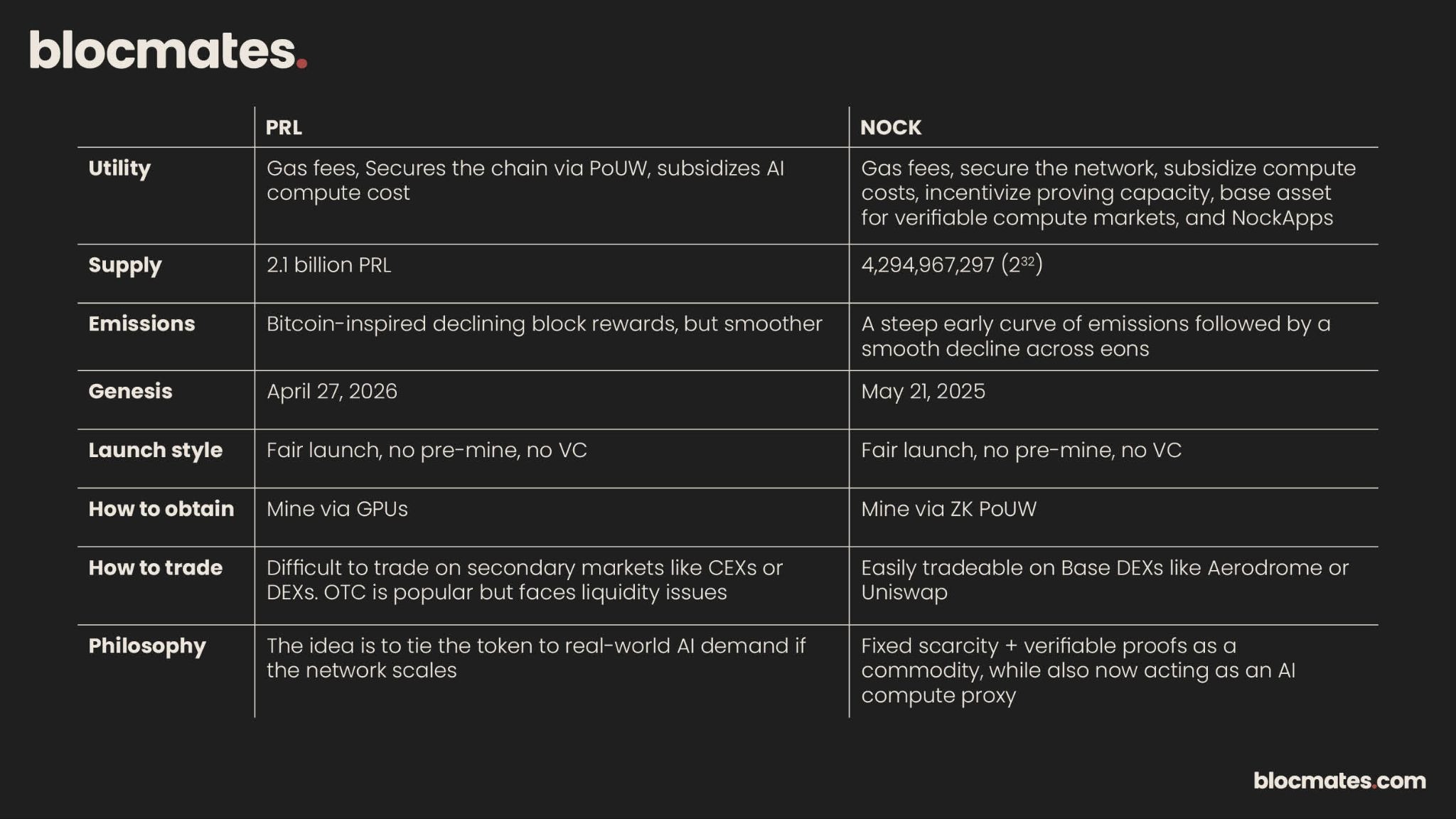
Speaking of tokens, let’s get into the bit that most of you are most excited for. The difference between PRL and NOCK.
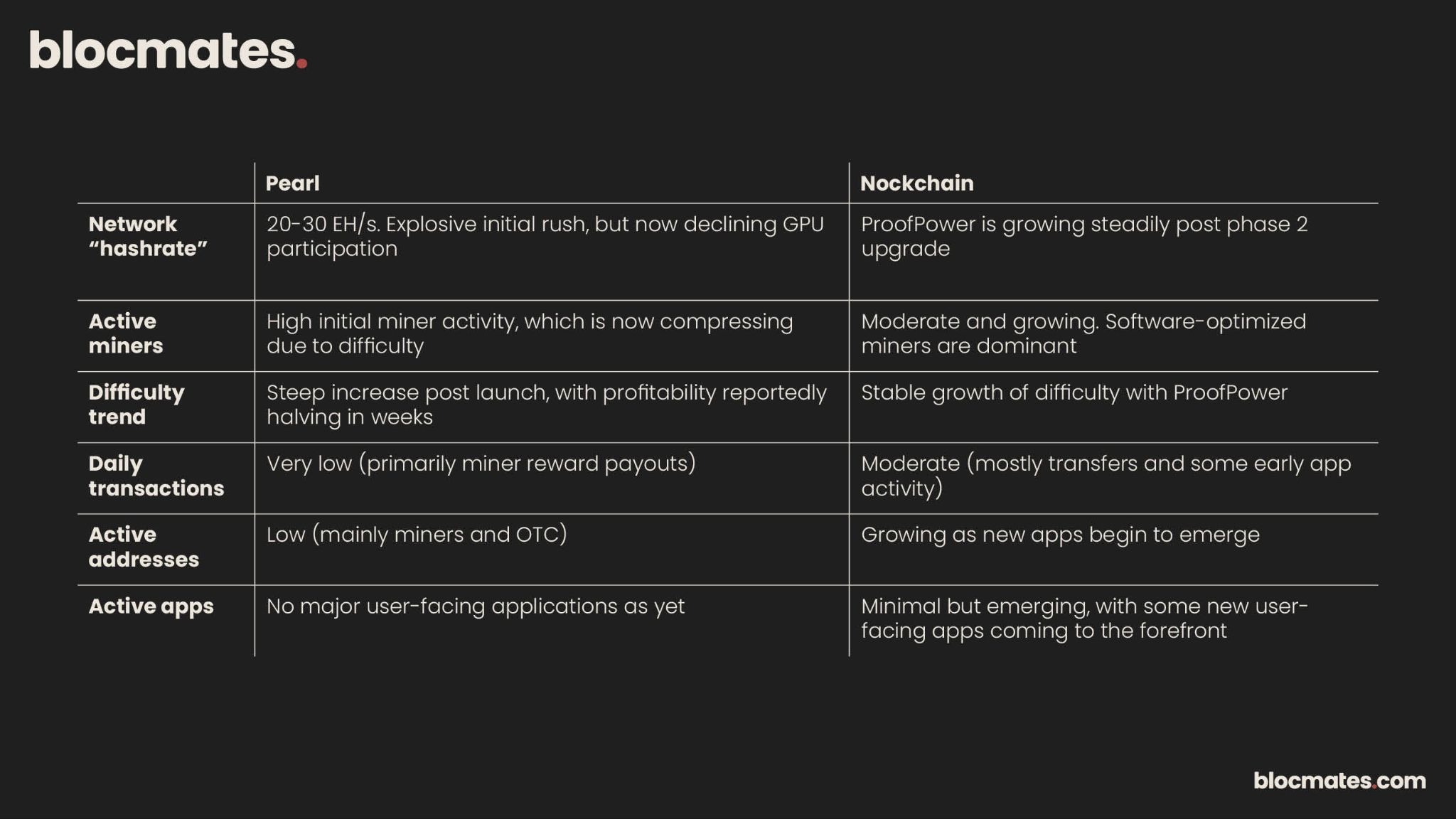
Adoption metrics
Now let’s get into who’s winning in the adoption race.
Admittedly, this is not the most fruitful topic of comparison, given that both projects are very early stage, with Nockchain launching about a year ago and Pearl being live for less than 2 months.
However, let’s look at what the early data says.
Partnerships and roadmaps
In terms of partnerships, things are fairly limited because again, they are both very early-stage.
With Nockchain, there’s no real notable partnerships beyond some key mining pools. However, one of the key factors for the growth of the NOCK token is the two-way bridge with Base that makes it easily tradable.
Pearl, on the other hand, came to market with a partnership with Together AI.
Together AI is a cloud platform built for developers and researchers to train, customize, and run generative AI models. Pearl has partnered with them by providing a discounted inference endpoint, enabling them to push Pearl-powered products and allowing customers to earn emissions.
In terms of the roadmap, the future looks exciting for both.
With Nockchain, the most immediate thing to note is the introduction of matmul to create an AI compute market.
Beyond this, there is the grander vision of data availability, privacy pool apps, native token standards, ZK compute markets, private DeFi foundations, and much more.
With Pearl, the near-term focus is clear. Expand Pearl-powered inference products with Together AI and introduce low-precision floating point to be able to work with all AI products.
Then the broader vision is to introduce an onchain compute marketplace and foster native settlement of compute contracts.
The differing value propositions
If we now zoom out and look at the two networks holistically, it boils down to this.
The primary value proposition of Nockchain is commoditizing computational proofs. It builds infrastructure for trustless compute markets. The product is verifiability with composability.
Pearl, on the other hand, commoditizes raw AI computation. Miners perform AI computations for rewards. Simple.
It’s effectively attempting to build a monetary network that benefits from an increased demand for AI computation and the energy for AI computation.
Although we in crypto love to be tribalistic and pit one group against the other, the two networks here have a good amount of broader similarities with certain technical differences.
It is not necessary that one must fail and the other must succeed.
However, this brings in the age-old adage of “ball don’t lie.”
The world of blockchains is brutal and ruthless. It’s sink or swim. So ultimately, only time can tell us whether we see both succeed in tandem or if it’s a king-of-the-hill situation where there’s only one man at the top.
Regardless, I’m glad to see continuous innovation in this industry.






.webp)
.webp)

.webp)
.png)
.webp)

.webp)
.webp)
.webp)
.webp)








.webp)
.webp)

.webp)
.webp)
.webp)

.webp)

.webp)




.webp)
.webp)
.webp)
.webp)
.webp)


.webp)
.webp)


.webp)


.webp)




.webp)


.webp)


.webp)













.webp)



.webp)






.webp)

.webp)
.webp)

.webp)








.webp)

.webp)


.webp)





.webp)