Reading time: 8m 10s
Launched in early August 2026, the Solana ecosystem finally got a competitor to Pump.fun.
Hitting an ATH of just over $290 million market cap (at the time of writing), facilitating a cumulative volume of over $1.2 billion, and burning over $22 million of the native token through buyback/burn, it’s not “just another” launchpad; it’s taken the basic concept and innovated a lot on top.
So without further ado, allow us to give you a complete breakdown and simplification of StonkFun (@LaunchOnSF) so you understand exactly how it works.
Heading to KBW, TOKEN2049, or a well-deserved holiday?
Flights, hotels, taxis, dinners, coffees, the spending adds up quickly.
Instead of off-ramping crypto to your bank before the trip, deposit directly into Plasma One from supported chains and spend from there.
And if you’re going to spend thousands traveling anyway, you might as well earn while doing it.
Load up Plasma One before you fly and make it your card for the week.

What is StonkFun?
StonkFun is a launchpad on Solana that allows you to launch tokens paired with any other token.
Rather than having the classic ‘create a memecoin that’s paired with SOL,’ you can create a coin that’s paired with any other coin, be it a tokenized stock, another crypto asset, or even another memecoin.
The product is built on Raydium liquidity pools, the leading DEX on Solana, which allows it to have a unique system for routing fees/revenue in multiple different ways.
So let’s get into the details.
How does StonkFun work?
StonkFun is the user-facing launchpad with all the cool features, but it’s really Raydium's liquidity infrastructure underneath that makes things work.
Initially, StonkFun used Raydium’s CLMM (concentrated liquidity market maker pools) for tokens launched through the platform, allowing users to provide liquidity for tokens within specific tick boundaries.
However, StonkFun did encounter minor issues with this architecture, with things like sniping, operator wallet centralization, one-sided pools, poor routing, and so on.
Recently, they completed a full migration to LaunchLab, Raydium’s very own token launch program. LaunchLab operates like your classic bonding curve launchpad mechanism.
Create a token → traders buy token with SOL (or other asset) → price of token goes up → SOL accumulates with buys → once the token reaches a certain threshold, it graduates out of the bonding curve.
Once it graduates, the tokens go back to operating in your classic CLMM or CPMM (constant product market maker) pools.
That’s the underlying infrastructure; now let’s get back to the StonkFun platform itself.
As stated before, the primary differentiator with StonkFun is that you can create any asset paired with any asset.
For example, let’s say you’re making CATDOG coin. Typically, it would be CATDOG/SOL, competing with CATDOG2/SOL, ILOVEINU/SOL, and DONKEYKONG/SOL.
With StonkFun, you have variety. You can have CATDOG/SOL, MEME/NVDA, ILOVEINU/ZEC, DONKEYKONG/BTC, and so on.
With this, coins launched through StonkFun can be divided into two categories: Standard and Reward.
Standard tokens are the ones you’re already familiar with. A pair is created, the pair graduates, it collects trading fees from volume, and depending on the configuration, a portion goes to the creator and the other portion goes to StonkFun as revenue.
Reward tokens are the game-changer. A pair is created, something like CATDOG/ZEC. If configured to be a reward token, CATDOG holders receive the quote token, ZEC, as rewards.
The pair is traded, the pair generates fees and taxes. This is used to collect ZEC, and the ZEC is then distributed to CATDOG holders.
Attached to this is another interesting feature: the airdrop mechanism
Let’s stick with the same example of CATDOG/ZEC. Suppose the creator of the coin believes the ZEC community is really strong and are good holders or should be rewarded for some reason, they can configure the pair to airdrop up to 50% of the supply to ZEC holders based on the snapshot criteria.
On the same idea of trust, you also have the dev-buy mechanism. This is fairly straightforward; it allows the developer to buy up to 50% of the supply in a single atomic transaction if they don’t want to lose a big chunk of supply to snipers or other predatory actors.
But this is not nearly degen enough for the crypto world. StonkFun also offers leveraged assets. At the moment, it’s xSOL and xBTC. So theoretically, you could launch MEME/3x BTC if you really want to get crazy.
Then, to tie it all together, you have the STONK token.
STONK is the native token for StonkFun. Its value is derived directly from protocol activity. 60% of revenue generated by the protocol is used to buyback and burn the token. The flywheel is simple:
More launches → more trading → more fees → more revenue → more money buying STONK → more STONK burn → lesser supply, higher price, more attention → cycle repeats.
There comes a point in all our lives when we realize that our wallets are basically several badly managed bank accounts.
Money comes in, money goes out, and somehow there’s always a random $47 sitting somewhere doing absolutely nothing.
So I’m thinking, why not automate the leftovers?
Scan the active trading wallets, find the excess USDC, sweep it into Plasma One, and let it pay for subscriptions while fetching you cashbacks on them.
How is StonkFun different?
Now that you understand how the protocol works and its underlying infrastructure, let's actually read between the lines with regard to what exactly StonkFun unlocks and what sets it apart from the competition.
- Any asset/Any asset pair
With typical launchpads, you have every coin paired with SOL. The result is that all the attention and liquidity are attached to one quote asset. If SOL suffers, so does your profit, but worse than that, your competition is millions of other identical coins with the same quote asset.
By allowing the pairing of any asset with any asset, you are effectively creating new markets around existing assets. There’s a new and unique economic relation between assets, and there’s less loss correlation with varying quote tokens.
But most of all, there’s less SOL dependency; every new quote asset becomes another potential liquidity/attention anchor.
- Reward tokens
The ability to pay holders of a certain token in a quote token is incredibly unique and unlocks completely new avenues.
First off, it creates a better reason to hold. Staying with our CATDOG/ZEC example. You have exposure to the upside of CATDOG while at the same time earning a passive ZEC income. Pretty sweet deal.
Secondly, it turns a memecoin into a distribution mechanism of sorts. The meme’s virality and attention can be leveraged to better distribute the quote asset in question for whatever purpose.
However, if you extrapolate this idea, there are great potential utility-based ideas out there, like pairing a yield-based DeFi coin with a tokenized stock so users earn stock income plus DeFi yield and token upside.
Lastly, if you combine the airdrop mechanism into this, it’s a very effective way to borrow communities.
Say you think the community of XYZ coin is strong are good holders, and is good for your coin. You can configure your coin to airdrop your supply to them, hoping they support you and therefore form a strong foundation for your coin to potentially be successful.
What StonkFun is ultimately creating is a permissionless market for arbitrary relationship assets.
- Relative performance market
Another benefit of pairing any asset with any asset and creating a completely new, uncorrelated market is that you build a whole ecosystem of relative-performance markets.
It’s easier to gauge overperformance and underperformance with assets other than SOL. This is particularly interesting with the RWA stuff. When a tokenized stock or a tokenized commodity is the quote asset, you are operating in a different market and gauging performance against it.
For example, you can have DEGEN/NVDA and DEGEN/MU and see how a token compares to the chip sector. The meme can go up +50% while the one stock is up +10% and the other is -10%, which creates interesting choice dynamics.
The StonkFun ecosystem then effectively becomes a market for all sorts of relative performance pairings.
- Ecosystem flywheel
Lastly, but most importantly, there’s the broader ecosystem flywheel.
Every V3 pool and every launch through LaunchLab contributes a share of trading fees that goes towards this ecosystem flywheel.
It’s basically a mechanism where revenue is used to buyback and burn the top 15 tokens in the ecosystem by market cap. Let me put it in simpler terms.
Creator launches CAT → CAT gets attention → CAT gets more volume and the token pumps → CAT eventually climbs into the top 15 → fees from the flywheel flow into CAT → CAT buybacks and burns activate → better price → more attention → and the cycle continues.
Successful tokens get additional demand and continue to grow, making the StonkFun ecosystem a memecoin index of sorts, with STONK as the representative token.
How to use StonkFun?
Creating guide
The process is pretty straightforward.
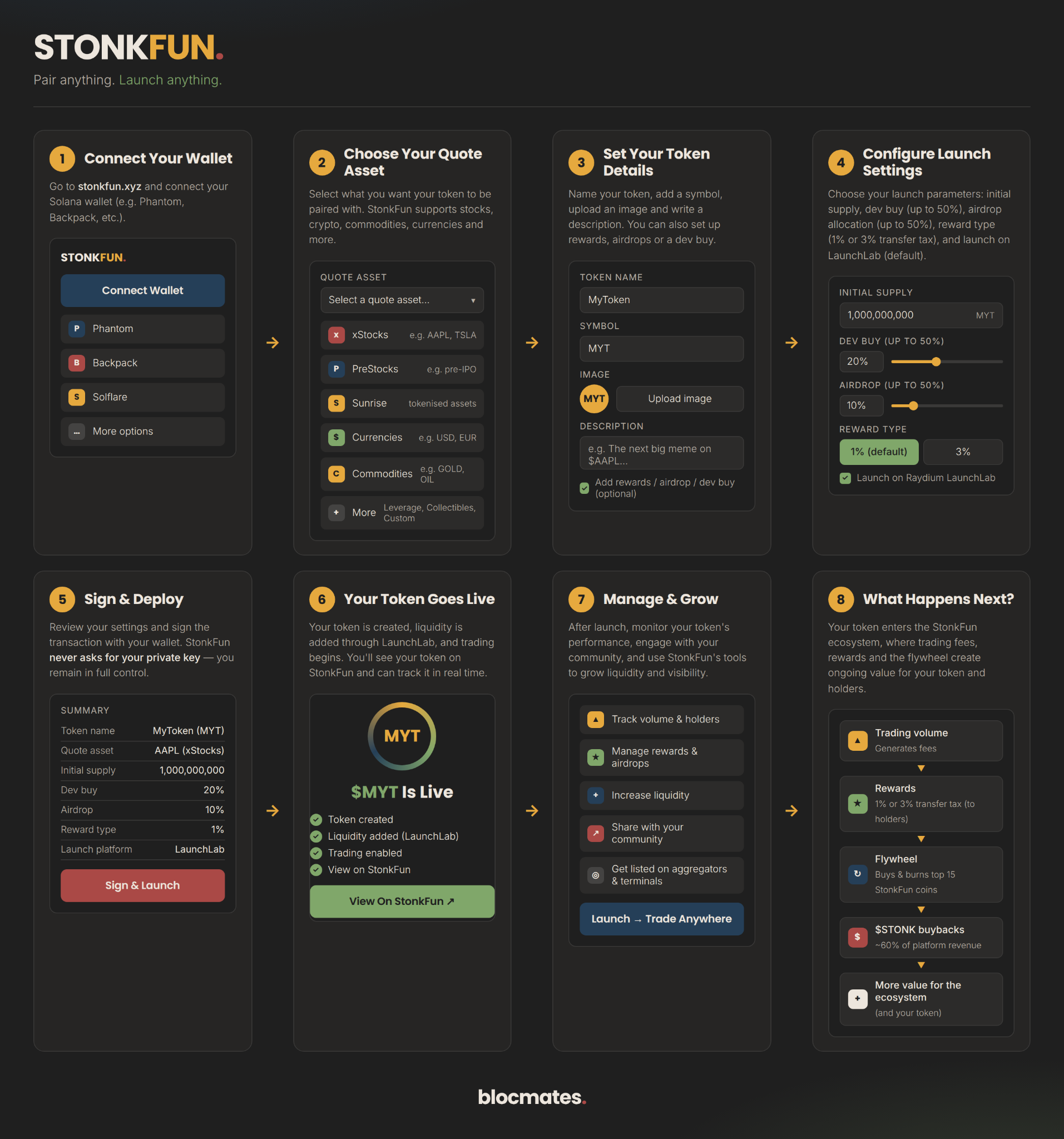
- Connect your Solana wallet.
- Choose:
- Name
- Ticker
- Logo
- Choose the quote asset.
For example: SOL, BTC, ZEC, NVDAx, SILVER, another memecoin, etc.
- Choose launch type: Standard or Reward
- Potentially configure:
- fee tier
- airdrop
- developer buy
- Pay the launch fee.
- Token + pool gets created.
- Voilà, your token enters the StonkFun ecosystem. You can grow liquidity and visibility using the in-house tools available.
Buying guide
For all the trench-dwelling traders out there, go to StonkFun. Find a token. Look at:
- pair
- market cap
- liquidity
- volume
- holders
- reward status
- quote asset
Then trade it through a supported interface/aggregator or directly on the platform.
Final thoughts
The token has been on an absolute moon mission for the last few weeks and is only going from strength to strength as people recognize the uniqueness of the launchpad.
The issue now is, of course, whether the ecosystem is strong enough to fight off any competition from the likes of Pump.fun or any other launchpad, because vampire attacks will definitely be attempted.
So far, they seem to have fended off all attacks, but only time will tell how lindy StonkFun is. Nonetheless, in a time when Robinhood is stealing Solana’s thunder, StonkFun really appeared as an ace up the sleeve for the Solana ecosystem.
Hopefully, this guide helped give you a better understanding of StonkFun as a product. Happy trenching, and as always, stay safe and DYOR.
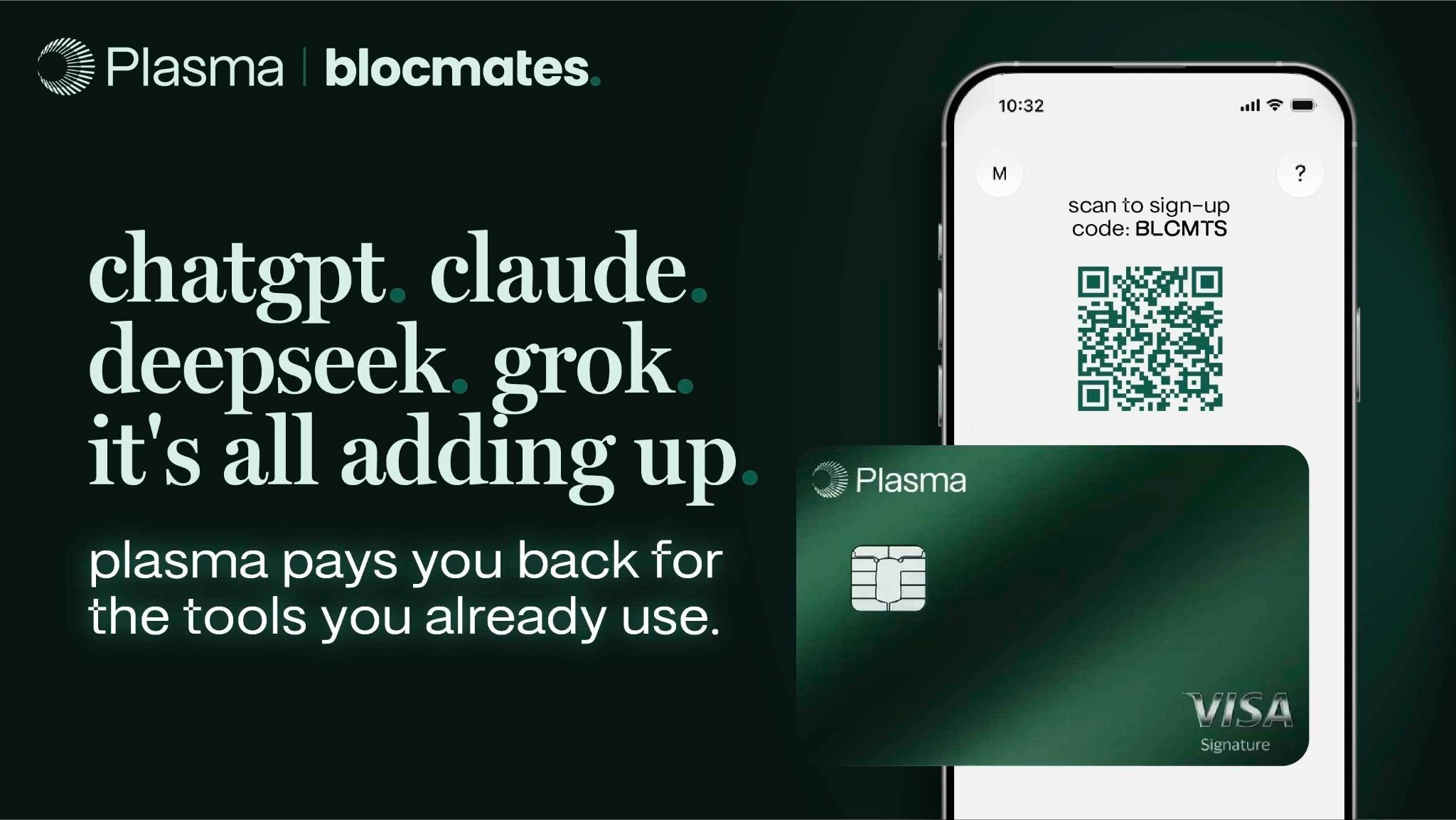
Let's be honest, AI subscriptions add up fast. One month it's ChatGPT, then Claude, then another tool everyone on TikTok swears you need.
Before you know it, you're paying for half a dozen AI apps just to keep up. We're in the same boat, which is why we've been using Plasma One.
It gives us cash back on our AI subscriptions without having to think about canceling the ones we actually use.
If you want in, sign up using the link or scan the QR code below and start getting some of that money back.
Paying for ChatGPT or Claude won't suddenly make your life cheaper. Your monthly subscriptions will still hit your bank account, but Plasma One will help route some of that money back to your pocket.
Thanks to the Plasma team for unlocking this article. All of our research and references are based on public information available in documents, etc., and are presented by blocmates for constructive discussion and analysis. To read more about our editorial policy and disclosures at blocmates, head here.




.webp)
.webp)
.webp)
.png)
.webp)

.webp)
.webp)
.webp)
.webp)





.webp)
.webp)
.webp)
.webp)
.webp)
.webp)
.webp)






.webp)
.webp)
.webp)
.webp)
.webp)
.webp)
.webp)
.webp)


.webp)
.webp)


.webp)


.webp)




.webp)


.webp)


.webp)












.webp)




.webp)



.webp)
.webp)
.webp)

.webp)





.webp)

.webp)

.webp)





.webp)