Reading time: 8m 49s
In case you haven’t noticed, privacy is cool again. And no, this isn’t just the hardcore cypherpunks causing a stir.
When anyone with AI access can doxx you in under a minute for less than $2, even normies start caring about their cyber footprint, the waves of change are a’coming.
“Privacy is necessary for an open society in the electronic age. Privacy is not secrecy. A private matter is something one doesn’t want the whole world to know, but a secret matter is something one doesn’t want anybody to know. Privacy is the power to selectively reveal oneself to the world.” - A Cypherpunk’s Manifesto, Eric Hughes, 1993
Privacy has been central to crypto’s ideological roots, so it’s no wonder that tokens like ZEC (Zcash) are ripping faces this year when its users are living in a world where you can’t nip over to 7-Eleven without driving past half a dozen license-plate-reading cameras.
A world without privacy is a world devoid of security.
But we do feel a twinge of irony talking about this stuff, since the bulk of our dealings onchain take place on a public ledger, where anyone can see your holdings, your trading strategies, your CEX(s) of choice, and even when you’re most active.
Monero and Zcash showed us the demand for private money, but in our opinion, that doesn’t go nearly far enough.
Today’s privacy solutions are either too narrow or too clunky
It’d be inaccurate to say that privacy solutions don’t exist. The problem is that most protect only one venue, asset, or stage of the transaction lifecycle.
For dark-pool-style trading, Renegade allows orders to settle at the midpoint of Binance’s bid-ask spread while keeping trade details private.
Relayers use two-party MPC to find matches, with the resulting settlement verified onchain using zero-knowledge proofs.
Aster takes a different approach through Hidden Orders and Hidden Positions, keeping selected order and position data out of public feeds while using the same matching engine as its visible orders.
On the spot-trading side, services tend to protect the transaction before execution. Private RPCs such as Flashbots Protect and MEV Blocker keep pending transactions out of the public mempool, while encrypted-mempool systems such as Shutter conceal transaction contents until ordering or inclusion has been committed.
Shutter has since begun extending its threshold-encryption tooling into other applications, but encrypted mempools remain its best-known implementation.
These solutions are a step in the right direction for users hoping to conceal their alpha and reduce frontrunning. But each protects a particular venue, application, or stage of the transaction lifecycle.
For broader financial privacy, crypto-natives will generally point you toward Monero (XMR) or Zcash (ZEC). And indeed, we’ve seen the monumental rise in popularity of these tokens, but in the end, these are “just” private Bitcoin.
Private value transfer does not provide a general framework for keeping programmable intent private.
And private execution environments often require developers to adopt an entirely separate stack.
You see the problem? There’s a missing layer between private money and fully transparent smart contracts.
From a user’s perspective, what actually needs protecting? For a trader, an edge can quickly disappear when any of the following is exposed:
- The action they intend to take.
- The conditions that will trigger it.
- Sensitive parameters such as size, price, timing, or strategy.
We love public blockchains as much as the next guy (ok, more than the next guy). But if everything is public, someone can always be watching… and positioning themselves to take advantage.
Encrypted Markets: A primer
Our old friends at Nillion are back, baby. This time, it’s with technology that people are actually asking for.
They’re calling the new primitive Covenants: encrypted “if this, then that” instructions that remain sealed until a specified condition is met.
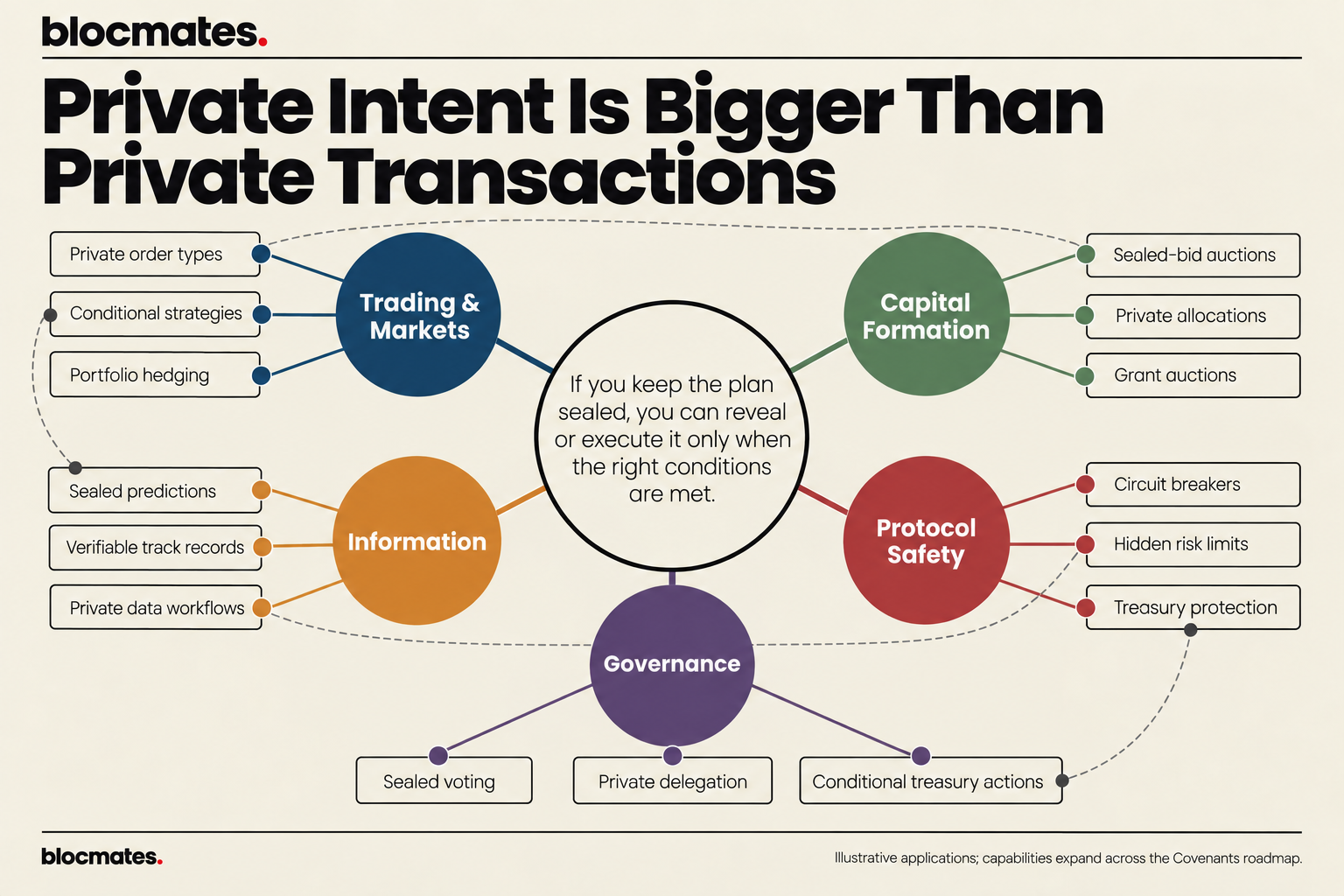
If you’re tech-minded, you might already be seeing how wide-reaching this could be.
- Sealed-bid auctions in which bids remain private until the auction resolves.
- Sealed predictions that can prove when a call was made without revealing it in advance.
- Protocol safeguards that activate without exposing sensitive thresholds beforehand.
- Private order types and conditional trading strategies.
- Ways to protect alpha while remaining onchain.
These are the kinds of applications Covenants are designed to make far easier to build without forcing developers to become cryptographers themselves.
Note that the “Dusk” phase introduces the first implementation on Ethereum, while later phases expand the model across chains, external data sources, and more complex private logic. We’ll unpack the full 7-stage sequencing properly in our next report.
At its core, a Covenant combines:
- A condition (e.g., “BTC price on Hyperliquid hits $100k,” “Wallet 0x8…9df sells any UNI,” “Large withdrawals come out of many pools simultaneously.”)
- An action (e.g., “Freeze smart contracts temporarily,” “Enter a USDC-ONDO UniV3 position,” “Offramp my stables to Kraken.”)
- The parameters governing both (e.g., “But only if it’s a weekend,” “But only if USDC is de-pegged,” “But only if Machi Big Brother is net short on Hyperliquid.”)
Over the course of the roadmap, conditions will extend beyond a single chain. An event on Solana could eventually trigger an action on Hyperliquid, while approved oracles and conventional web2 APIs could bring real-world information into the same framework.
That opens the door to strategies such as:
- Open a 3x ETH/TRX pair trade on Pear if Justin Sun’s chance of indictment on Polymarket hits 40% or more.
- Go short oil on Hyperliquid if the Strait of Hormuz API shows a >50% increase in ship traffic over the past 24 hours.
- Go max short BTC and offramp my stables if any of Satoshi’s coins move.
- Short TSM when USGS reports a magnitude 6.5+ earthquake under Taiwan.
- Long DIS if we see consistent upticks in foot traffic via Wait Times APIs.
And honestly, we could go on. The larger point is that the design space extends well beyond hiding a single transaction from the mempool.
You could cobble parts of this together today, but the logic would generally be public, fragmented across multiple services, or dependent on trusted infrastructure - not to mention the cross-chain and API fuckery required to make it all work.
With Covenants, you upload your secret plan to Nillion, a decentralized network that monitors the condition and releases the authorized instructions when it is satisfied. Until those triggers are hit, your intentions are invisible.
Covenants are designed to overlay existing programmable chains rather than requiring users and developers to migrate to another execution environment. This is not supposed to be another narrow privacy product.
We’re witnessing the beginning of “Encrypted Markets,” where you can leverage the vast money legos of DeFi while maintaining your edge.
Reintroducing Nillion
Most readers probably have their own opinions about Nillion based on their previous endeavors, I know I do.
When I see “Nillion,” I picture the army of blue-blindfolded PFPs and a vague answer for “what exactly do you do here?”
Like most “infra” projects, they had a grand vision - to deliver general-purpose private computation.
But in practice, this proved difficult to deliver at scale.
The subsequent TEE-based model lacked sufficient differentiation and, in our opinion, depended too heavily on centrally operated infrastructure.

I must admit that I did find it cool to see them running DOOM on their tech stack. But it does beg the question: why would I care to keep my DOOM shenanigans private?
That fella above is John Woods, who recently took the reins as the CEO and, as such, has completely changed the direction of the project.
The team is now roughly 80% leaner than it was before the reset, with the focus shifting toward a decentralized privacy network, developer tooling, and applications aimed at problems crypto users can immediately recognize - not infrastructure that merely sounds impressive on paper.
Nillion’s pivot hyperfocuses on four pillars:
- The product must be genuinely decentralized.
- Privacy must remain fundamental to the network.
- NIL must have a first-class role in securing, operating, and using the system.
- The technology must solve a tangible problem rather than asking users to adopt infrastructure for its own sake.
In plain language, this is not a pivot for the sake of having something new to market. Nillion never stopped building privacy technology; the fundamental difference is that its new direction begins with a far clearer problem that users and developers already recognize.
Covenants in action
Covenants attempt to deepen a relationship that should have been central to DeFi from the beginning: the relationship between open financial infrastructure and user privacy. And this goes beyond complex private trading strategies.
For teams taking the huge step of launching a token, the mechanics of the sale can quickly become an alignment nightmare.
Set the price too high and the round may not fill, starving an otherwise solid project of early momentum.
Set it too low and the sale may be sniped immediately or become so heavily oversubscribed that most retail participants receive only a fraction of the allocation they expected.
Ideally, a sale should discover a defensible market price while distributing tokens to participants who have expressed genuine demand. One possible mechanism is a sealed-bid auction.
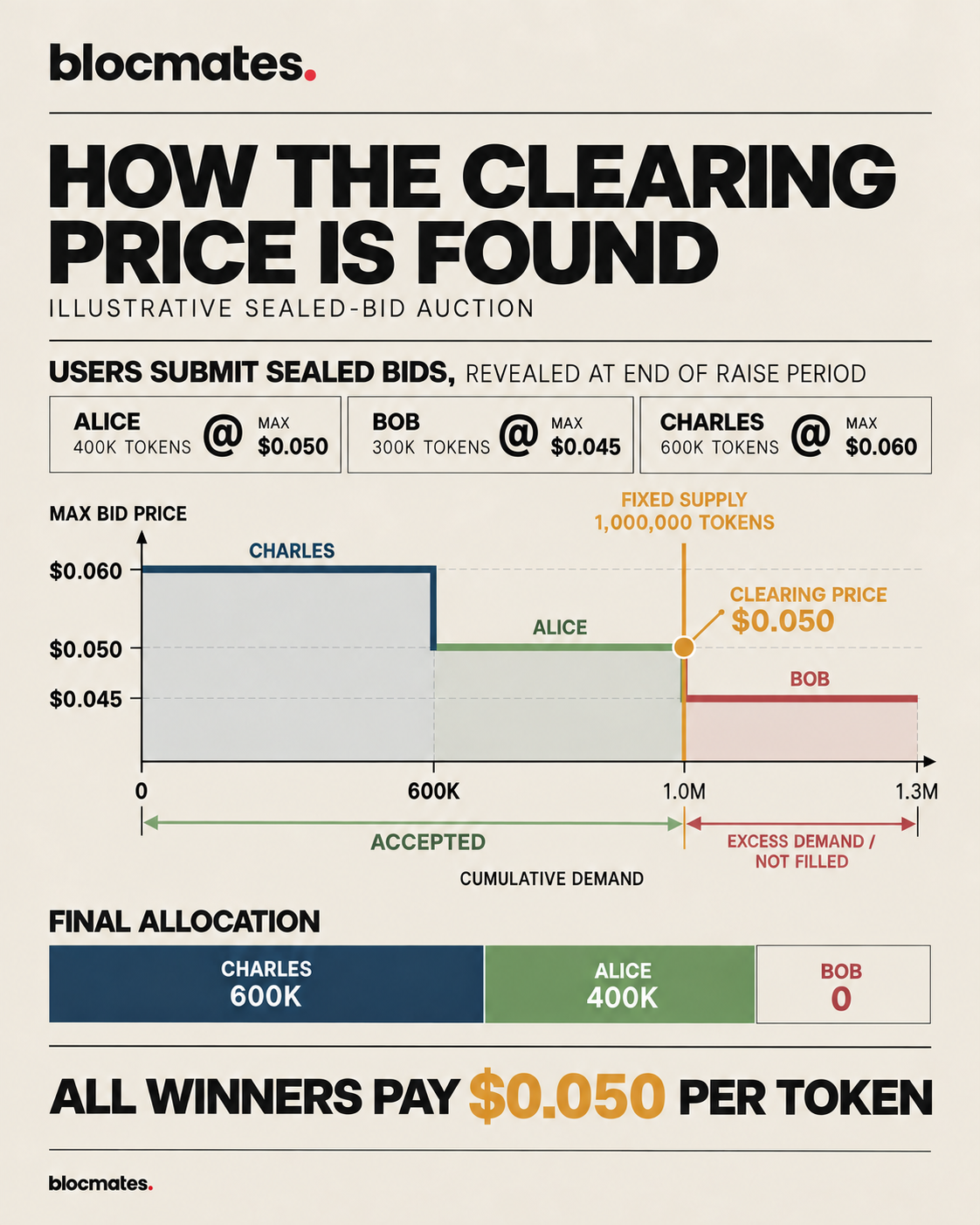
Here’s how that works in practice.
- Imagine a protocol is selling 1 million tokens and allowing the market to determine the clearing price.
- Each bidder independently submits the number of tokens they want and the maximum price they are willing to pay:
- Alice bids for 400,000 tokens at up to $0.05 each.
- Bob bids for 300,000 tokens at up to $0.045 each.
- Charles bids for 600,000 tokens at up to $0.06 each.
- The highest eligible bids are accepted first until the full allocation is exhausted. Charles and Alice would fill the available 1 million tokens, while Bob would fall below the cutoff.
- In a uniform-price version of the auction, both winning bidders would pay the lowest accepted price - in this case, $0.05 per token.
Advocates see this as one of the strongest token-sale formats because it rewards the participants expressing the highest willingness to pay while allowing the market, rather than the team, to determine the clearing price.
But if every bid is visible on a public blockchain while the auction is still open, participants can simply anchor to one another’s prices. That undermines the entire point of gathering independent bids.
By wiring the auction into Covenants, bids could be registered onchain in encrypted form and remain sealed until the bidding period concludes.
Once the deadline is reached, the bids could be revealed and the auction contract could calculate the clearing price and final allocations.
The team wins because they aren’t leaving money on the table and they get to bring on their most loyal supporters as tokenholders. And users win because they get a fair shake at a launch they are excited about.
Beyond sealed-bid auctions and complex trade setups, the team is also demoing nilSwap, a testnet Ethereum–Monero swap application, which, honestly, I didn’t know was possible.
It currently runs between Ethereum Sepolia and Monero stagenet using test assets. Check out the demo, and builders should start poking around the docs to get the creative juices flowing.
Concluding thoughts
We really are standing on the doorstep of an onchain privacy renaissance. ZEC and XMR have returned to the center of the market conversation, Ethereum is investing heavily in its privacy roadmap, and normies are beginning to understand just how invasive AI-powered surveillance can become.
But the hockeystick hasn’t even started hockeystick-ing yet.
Dev tools need to meet devs where they already are - offering solutions that are easy to use and don’t ask them to jump through dozens of hoops just to add security for their users.
Because guess what? If adding privacy is anything but dead simple, it won’t be used by the 99%.
Covenants, I think, offer one of the clearest glimpses yet of privacy technology that is powerful without forcing users and developers to become cryptographers themselves.
Nillion’s opportunity is to become the privacy layer that comes to existing applications and chains.
A private “if this, then that” is a foundational primitive for confidential applications, and Dusk is the first step toward making it usable onchain.
Nillion’s wider goal is what it calls “Encrypted Markets,” preserving the benefits of public blockchains (money legos, permissionless markets, you know the deal) without forcing every user to reveal their intent in advance.
It’s an ambitious goal, and not one that will happen overnight.
Our next report focuses on the milestones they are setting to tackle this beast of a TAM, but until then, be careful what you put out onchain - you never know who’s listening.
Thanks to the Nillion team for unlocking this article. All of our research and references are based on public information available in documents, etc., and are presented by blocmates for constructive discussion and analysis. To read more about our editorial policy and disclosures at blocmates, head here.







.webp)

.webp)

.webp)
.png)

.webp)



.webp)
.webp)
.webp)
.webp)










.webp)
.webp)

.webp)


.webp)
.webp)

.webp)
.webp)










.webp)
.webp)
.webp)
.webp)
.webp)


.webp)
.webp)


.webp)


.webp)




.webp)


.webp)


.webp)




















.webp)






.webp)








.webp)

.webp)
.webp)

.webp)













.webp)

.webp)

.webp)





.webp)