Reading time: 5m 15s
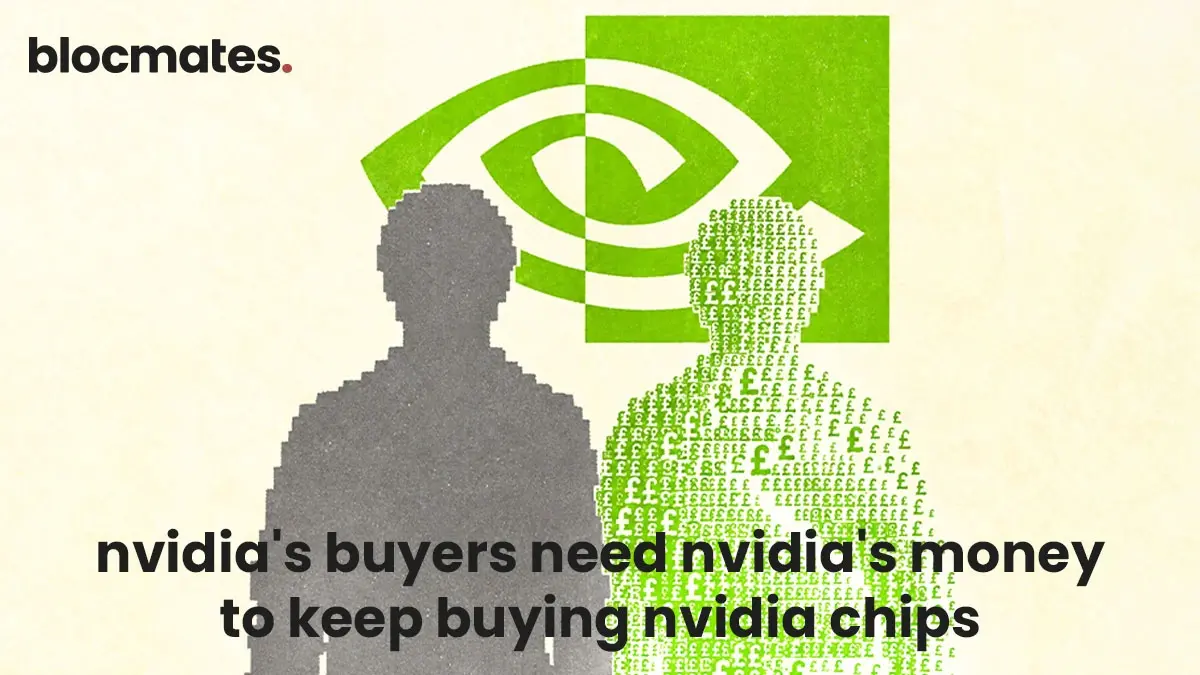
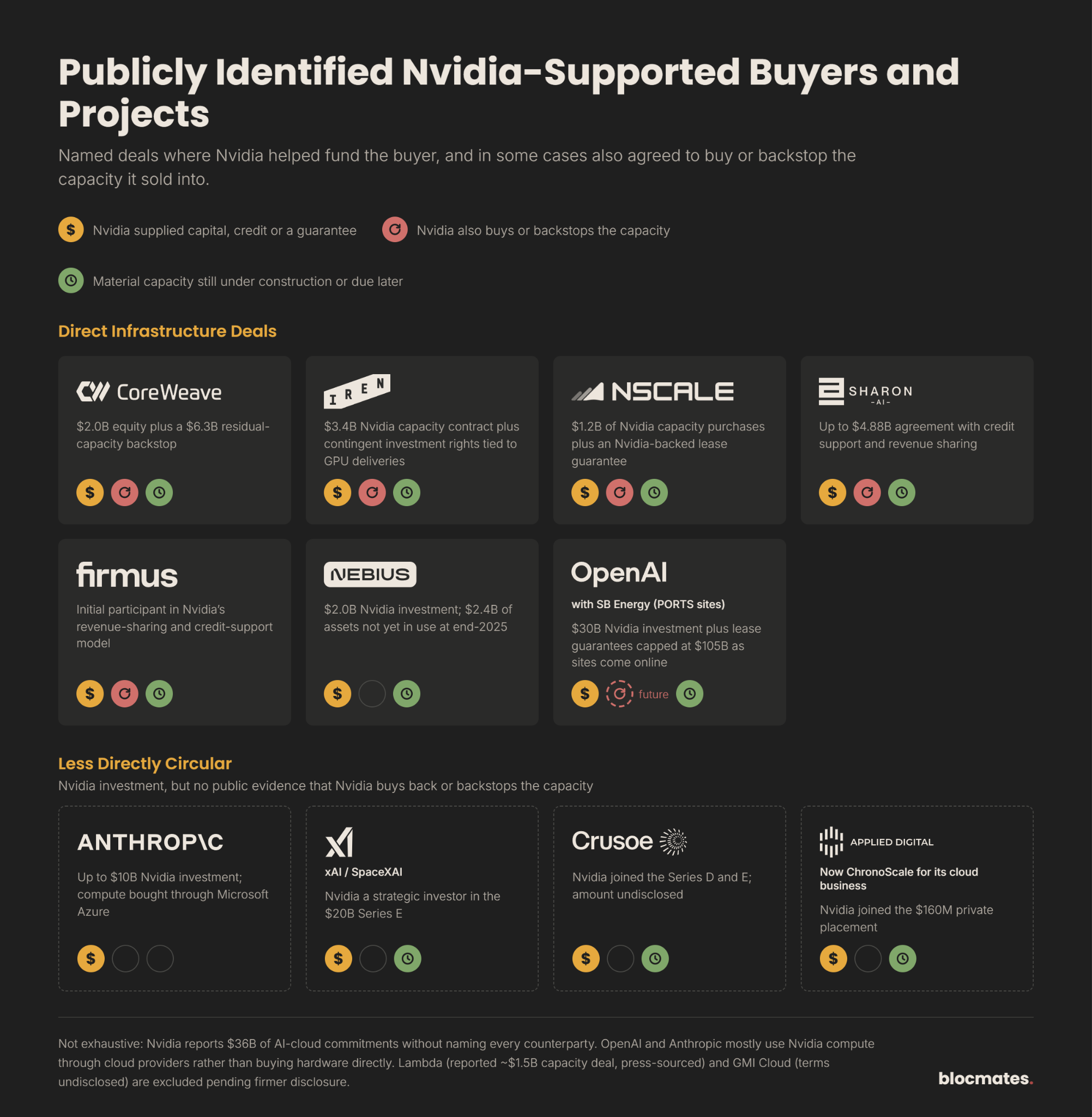
Nvidia is selling the picks and shovels of the AI boom, but at the same time, it’s also helping fund the people buying them.
At a basic level, here’s how it works.
- CoreWeave buys Nvidia’s chips.
- Nvidia owns a piece of CoreWeave.
- And if third-party customers don’t rent certain CoreWeave capacity, Nvidia has agreed to buy some of that capacity itself.
While any of the above make sense on their own, combined, they raise a potentially uncomfortable question: how much of Nvidia’s insane demand comes from independent customers, and how much depends on Nvidia helping its own customers to keep buying?
What happens when the seller is also the investor? … and also the customer?
Nvidia’s many hats
In any “normal” scenario, a cloud provider buys GPUs because outside customers will pay to use them. And by and large, this is the case for Nvidia’s customer base.
The tricky bit is when Nvidia is not only just the salesman and steps in to provide capital, credit, infrastructure support, or a promise to purchase capacity in order to land a deal.
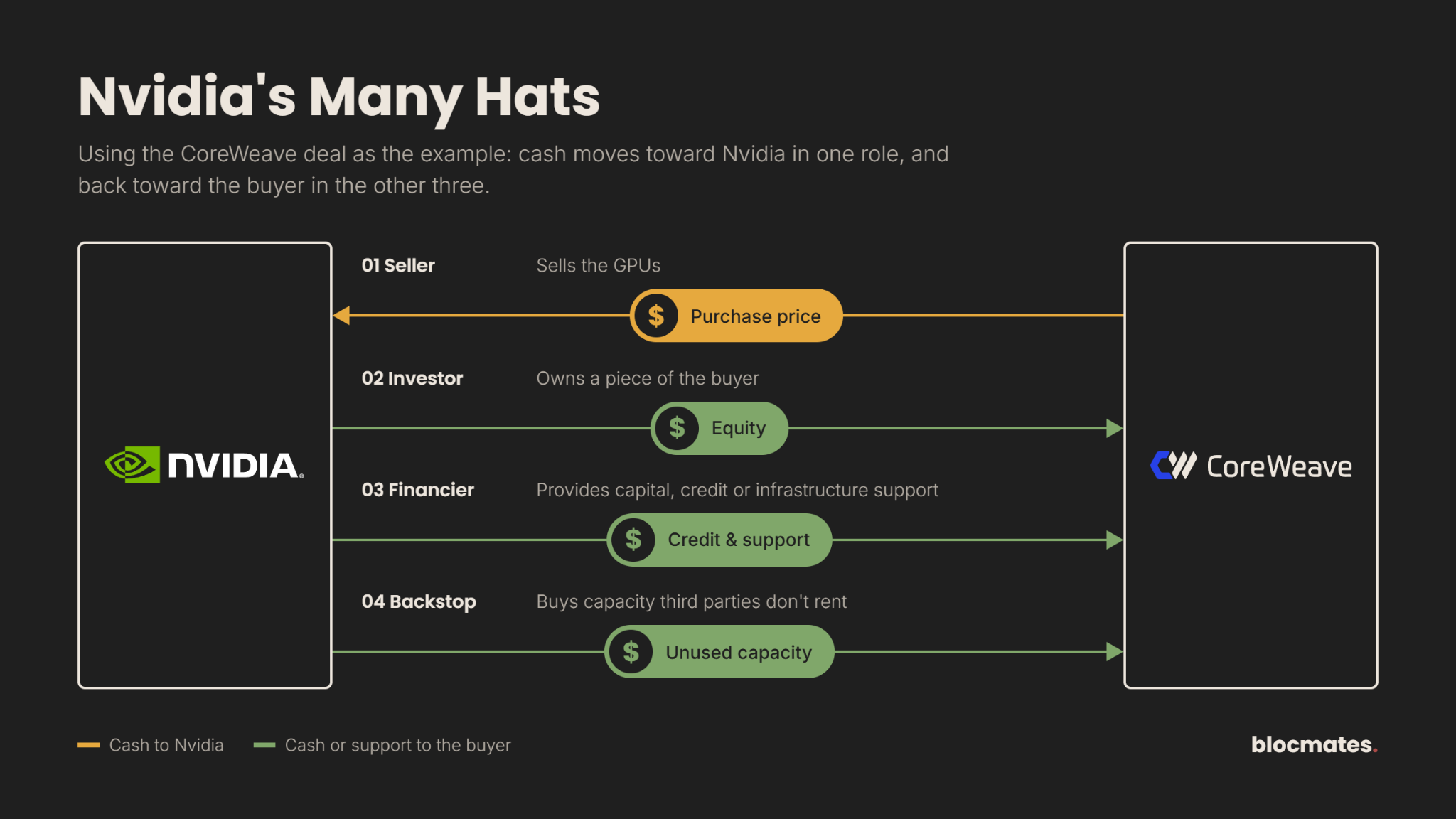
This is standard business practice on the surface and generally, nothing to be concerned about. But to me, I wonder: would the GPU order have been smaller, later, or simply not possible without Nvidia’s support?
And to be clear, circularity is not inherently bad. It only becomes dangerous when support vastly outpaces organic demand. If the foretold demand arrives as planned, it can step in to replace Nvidia’s support, and the feedback loop closes.
Investors start getting worried when there’s a lag between “Nvidia support” and “independent usage” - after all, how far ahead of end-user demand is the industry building?
The technology can be right and the timing can still be wrong
The real “gotchas” are the timing gaps between GPU sales and end-user revenue generation.
- First, Nvidia records the sale, then delivers the GPU.
- The data center then installs the GPU and begins providing useful compute.
- Finally, the cloud customer buys the compute and sells its services to end users.
Each of these has variable (or even unknown) timeframes, which, combined with fixed financing lengths, could compound risk.
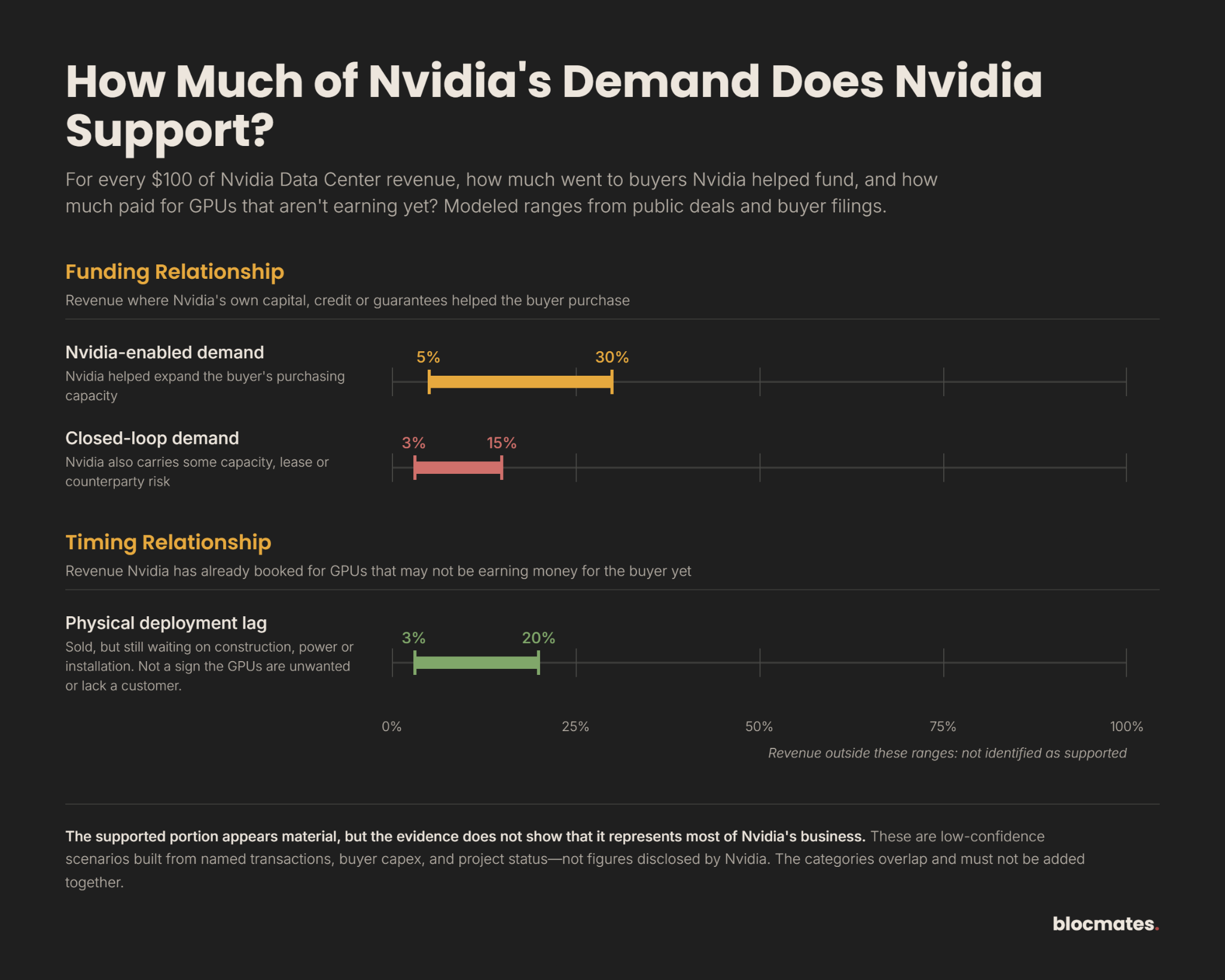
Old-heads and financial history buffs are raising alarms because they think they’ve seen this story before.
An infrastructure boom can be technologically correct and socially useful, but financially disastrous for the companies that financed the first wave.
Railroad lines opened regions and later became incredibly valuable even when the original builder went belly up.
Fiber laid during the internet boom could eventually support enormous traffic even when the carriers that financed it could not survive long enough to see an eventual return.
This is why all of the doomers keep making the Nvidia-Cisco comparison.
Cisco’s problem was not that the internet was imaginary (well, guess it depends how deep you are on Dead Internet Theory), its customers just hoovered up network equipment faster than traffic and cash flows could support.
When their financing and spending couldn’t keep up, Cisco was left holding $2.25 billion of inventory no one wanted.
For Nvidia, there are a few archetypes of customer, each with a different flavor of risk baked in.
- First, you have your large cloud providers. These guys have been around a while and have a solid backlog of demand. Generally, not worried about them.
- Then, you have neoclouds. This group is typically higher levered, a bit hyped, and has pulled forward a lot of demand in order to justify their financing. Their ability to start cash-flowing to satisfy their commitments is the key question.
- Finally, you have private AI labs. They’ve been able to raise money easily, no matter how tiny their revenues have proven to be. The sticking point for me has been the opaqueness of their finances - black boxes for trillion-dollar businesses can hide a lot of trapdoors.
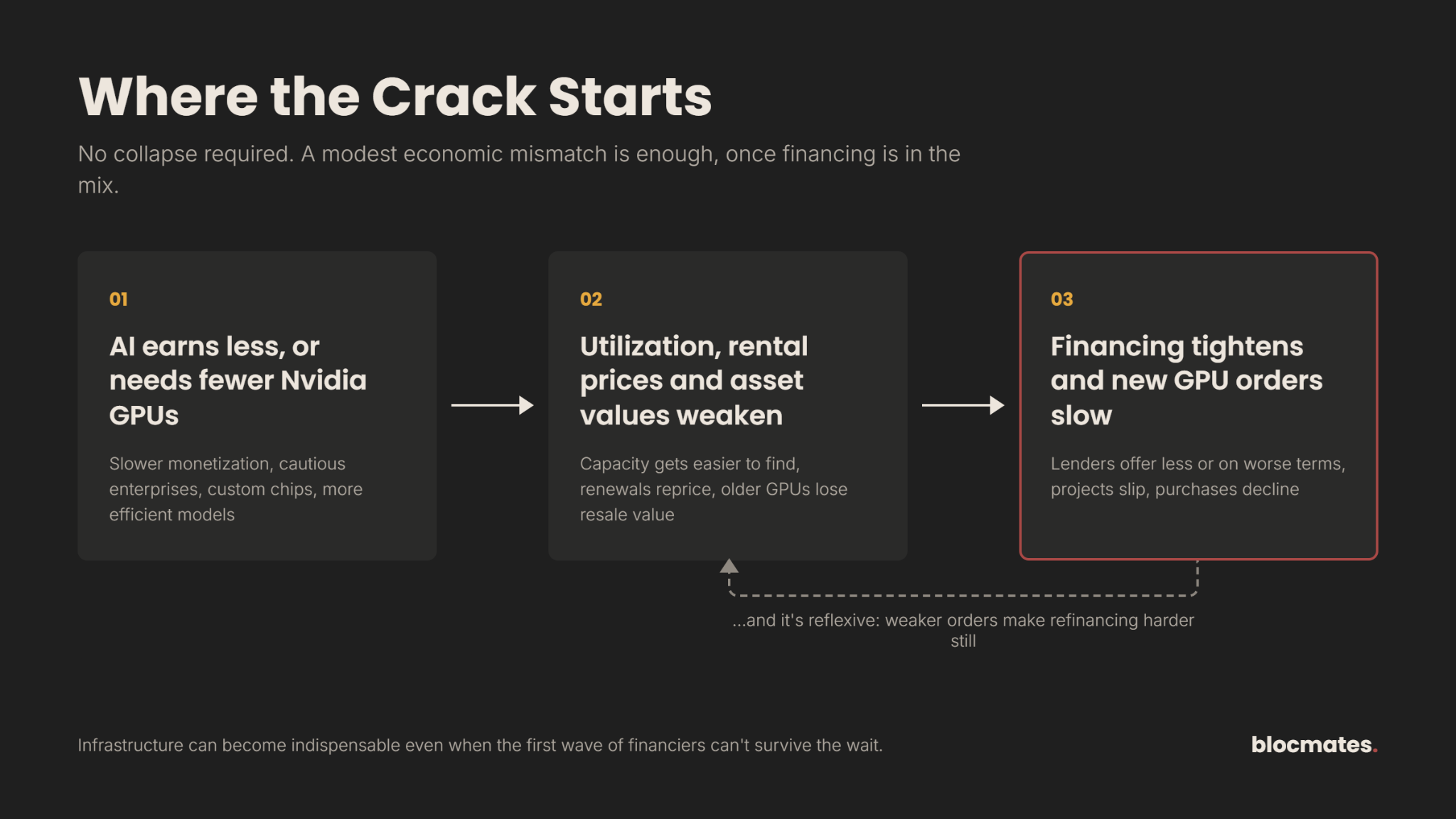
Where the crack starts
All it takes for a crack to form is an economic mismatch. This could come in many forms:
- AI applications monetize more slowly than forecast.
- Enterprises use less AI than expected.
- Hyperscalers move recurring workloads to custom chips (e.g., OpenAI, Google, AWS, Meta, Huawei).
- Better models and software require less compute per task (AKA Jevons paradox loses steam).
- New Nvidia systems reduce the economics of older generations.
- Customers become more disciplined about capital spending.
We’ve gotten to the point that the bull case is no longer satisfied with simple AI growth, but it demands AI to grow every new generation of infrastructure that’s currently being financed on that assumption.
But you’re not helpless, and there will be signs of these cracks beginning to form. Be on the lookout for:
- GPU rental prices weakening.
- Available capacity becomes easier to find.
- Customers negotiate lower renewal prices.
- Older GPU systems lose resale value.
- Data centers take longer to fill after becoming operational.
- Construction or power delays leave equipment waiting to generate revenue.
There are also custom dashboards that look at slightly different metrics, such as Exponential View’s AI Boom/Bubble Monitor.
As of right now, we aren’t too alarmed - everything’s looking calm-ish if you ignore the constant news of data centers being extremely unpopular.
In normal circumstances, seeing a slowdown wouldn’t cause too much of an alarm. But because financing is in the mix, things start to break if cash doesn’t arrive in time.
And it can be reflexive.
In other words, if rental prices weaken, GPU values fall. If GPU values fall, lenders offer less money (or worse terms).
If lenders offer less money, projects are delayed and GPU purchases decline → which leads to growth/valuation weakening, which makes refinancing even harder.
“But this isn’t Nvidia’s problem, it’s the buyer’s,” I hear you saying. But remember, several of Nvidia’s deals are complex, with Nvidia and the customer each sharing roles.
Once pricing affects collateral and financing, the same disappointment can reach several parts of Nvidia’s financial statements at once.
The race Nvidia’s customers have to win
Let’s picture a fast-growing Nvidia customer’s considerations.
On one side, data centers are indeed coming online and AI applications are searching for paying users.
And on the other, debt accrues interest, contracts approach renewal, and new chips are slowly losing their edge to the next state-of-the-art.
It’s a race against the ticking clock for these buyers, who have to overcome construction delays, find product-market fit, and generate enough profit from end-users to end their reliance on Nvidia’s promised demand.
And if they can pull it off, the apparent circularity was transitional, with Nvidia successfully bridging an early infrastructure bottleneck to help create a larger, durable market.
But an important note, the bear case here explicitly does not require:
- AI to disappear,
- Data centers to become worthless,
- Nor major hyperscalers to go bankrupt.
All that’s needed is slower order growth, or weaker replacement demand, or lower prices for older capacity, or more required financing support per dollar of independent usage.
That’s the lesson from railroads and fiber that we need to keep in mind. Infrastructure can eventually become indispensable even when the companies that financed the first wave cannot survive the waiting period.