Reading time: 15m 46s
Thesis: Power Perps give traders the convexity of options with the simplicity and enhanced liquidity of perps. No strikes, no expiries, one unified market.
There’s an argument that perpetual futures are one of the greatest inventions to come out of the crypto industry.
Access to leverage with no expiry on a single orderbook via dangerously intuitive interfaces has turned into a market that does roughly $80-$90 trillion in annual volume.
However, as the industry has matured, there’s still been no major breakthrough from any other trading instrument, most notably options.
Every asset class, from equities to commodities, started off as a spot-dominated market, but as it matured, options almost always became the dominant trading derivative.
The reason is that options give traders flexibility. Traders can configure a whole suite of customized multi-leg strategies depending on their thesis. They get configurable convexity.
But in crypto, this configurable convexity comes at a cost.
First of all, options are complicated, especially for an average shitcoin trader like you or me. Straddles, covered calls, iron condors, butterflies, and the different Greek terms - it’s a bit too much.

But beyond the complexity is the technical design of the instrument. Options come with multiple expiries, something that’s been proven difficult to make sense of in a 24/7 market. Plus, it comes with multiple strike prices.
If I, as a trader, am looking to buy a call on ETH, I see a $1.5k strike, a $1.75k strike, and a $2k strike, with liquidity fragmented across these strike prices.
Once you bring in more traders and more money to this fragmented environment, trade execution is almost always suboptimal, especially onchain.
So okay, perps have the upper hand when it comes to simplicity and liquidity. However, when you’re looking to get higher upside on a high-conviction trade, perps are still limited.
You may open a 2x long on ETH at $1.8k based on a certain thesis. Then you read a Vitalik blog post, for example, which only furthers your conviction in this trade. This is the trade that will finally get you out of the trenches, you think to yourself.
Trying to increase your upside means adding more leverage. So you make this position a 3x or 5x leverage long.
What is effectively happening is that you’re adding more risk to your trade for the same linear payoff. You aren’t increasing exposure, you’re simply increasing risk.
If ETH pumps 20% from here, so does your ETH-PERP. But one bad wick and your liquidation price is now higher than before.
So what’s the bottom line?
Your convexity shouldn’t come with a deadline, and your thesis shouldn’t have an expiry date.
What if there were a product that offered the simple, liquid, and continuous exposure of perps with the convexity of options? Does that sound like something you’re interested in? Well, I kinda am.
So let’s dive into the ABCs of Power Perps.
What is a Power Perp?
A Power Perp is an instrument that trades similarly to a regular perp contract while simultaneously giving you option-like exposure without strike prices or expiries.
It’s a contract where the payoff is non-linear because, instead of tracking the underlying asset's price 1:1, it squares, cubes, or raises the underlying asset’s price to the fourth power, creating a completely new payoff and exposure dynamic.
Allow me to elaborate with an example.
If you’re trading a regular ETH-PERP, your payoff is linear. If ETH (the underlying) goes to 2x, your ETH-PERP goes 2x.
With a Power Perp, you’re trading ETH2, so if ETH (the underlying) pumps 2x, your Power Perp goes 4x, if ETH goes 3x, your Power Perp goes 9x, and so on.
Higher powers make this effect even more extreme. A cubed Power Perp means a 2x pump is actually 8x, while a power of 4 turns the same move into a 16x.
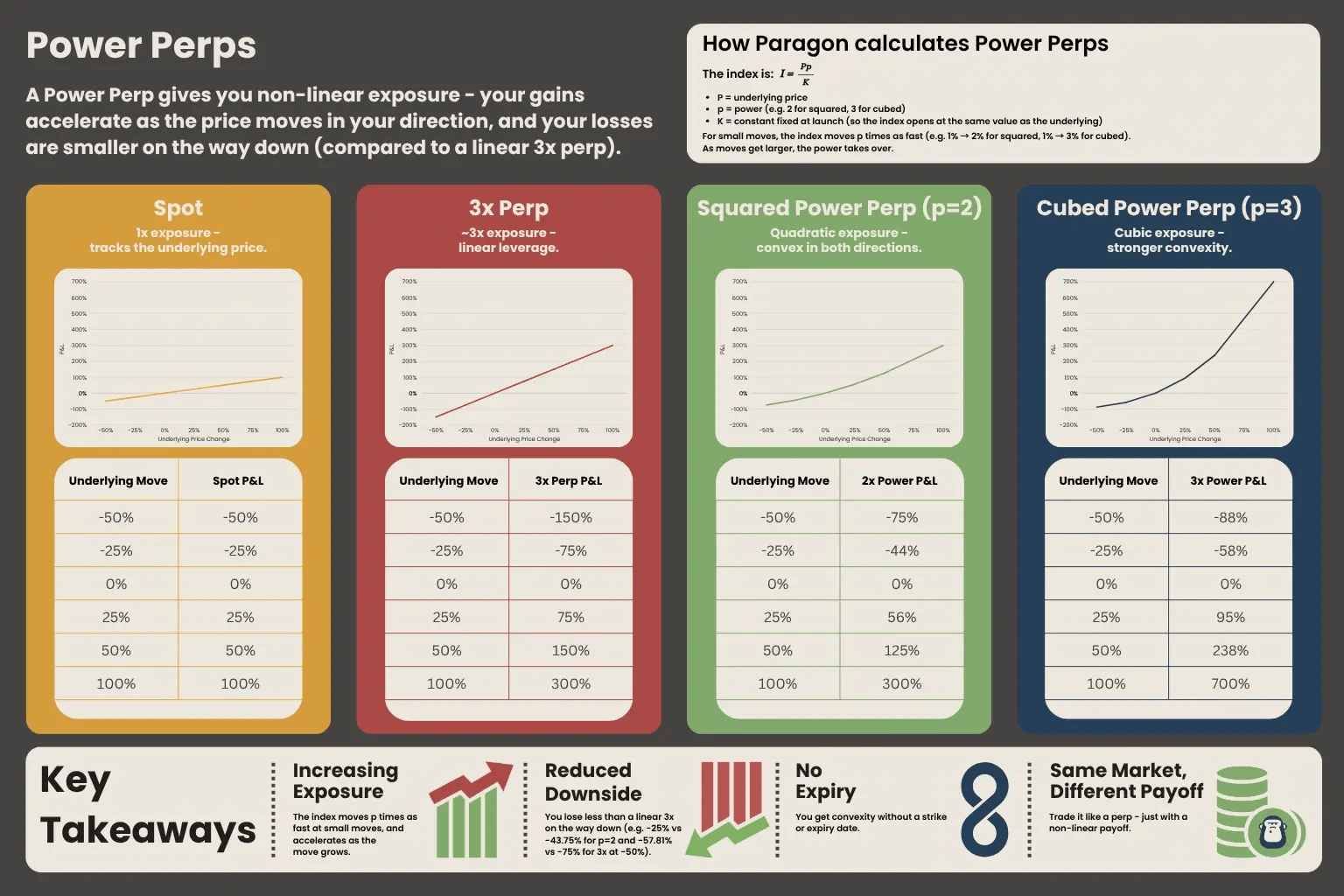
It’s like auto-compounding exposure. As the price of the underlying increases, your exposure automatically increases, giving you higher upside via non-linear payoff. Thus, we say, Power Perps give you the convexity of options with the simplicity of perps.
A product like this is perfectly suited for crypto’s volatile nature.
It’s not benefiting from volatility in the same way an options straddle would, where the direction doesn’t matter (although you can mimic a straddle with a combination of Power Perps).
You most certainly want to be correct on your thesis/direction, but large, volatile moves perfectly interact with the convex payoff.
- ETH pumps 5%, ETH2 Power Perp pumps 10.25%
- ETH pumps 20%, ETH2 Power Perp pumps 44%
- ETH pumps 50%, ETH2 Power Perp pumps 125%
The larger the move, the more convexity helps you. So, if the move is in your direction, Power Perps offer significantly more upside in high-volatility environments.
How does the market actually work?
Now that the scalability of onchain infrastructure has reached a point where orderbooks can function seamlessly, the game for derivatives has changed.
The main benefit Power Perps have over options, especially onchain, is unified liquidity.
As stated before, if you wanted convex exposure to ETH onchain, it would have to be through DeFi options, where liquidity would be in vaults or liquidity pools, and that already low liquidity would be fragmented across the various strike prices and expiries.
With Power Perps, liquidity is concentrated into one orderbook. Everyone trades in one unified ETH2 market.
Plus, the orderbook gives you unified liquidity with familiarity.
It trades in an orderbook just like any other ETH-PERP would, and the long/short structure remains the same. If Alice is looking to long ETH2, her counterparty, Bob, will short ETH2 in the same book.
Things take a bit of a turn when it comes to funding.
Like linear perps, funding for Power Perps will usually lean towards longs paying shorts. It can be thought of as the price for convexity, kinda like how option sellers collect premiums.
The reason for this lean comes from the payoff itself. Let’s take a simple example:
- If ETH goes up 10%, ETH2 goes up 21%
- If ETH goes down 10%, ETH2 goes down 19%
The long side has more value because the squared term is always positive. With larger upward moves, your exposure increases, and so do your gains. But someone has to be willing to provide that convexity.
So the short is effectively saying, I’ll give you that convex exposure, but you have to pay me for it. You pay funding to own convexity, and you hope the move you receive is large enough to justify the cost.
When the underlying is flat, for example, it’s the shorts collecting the funding that win, but if the long thesis plays out, then increased exposure and upside will be worth the cost.
What all of this culminates in is Power Perps creating a new payoff shape.
As the image earlier in this article showed, Power Perps create a curved payoff rather than a linear one. This changes your exposure.
A simple way to think of it is that a normal perp has a fixed exposure, while a Power Perp dynamically changes its exposure with the price of the underlying.
For example:
- As price rises, your sensitivity to further upside increases. A +10% move produces +21%, +50% produces +125%, and +100% produces +300% - Upward moves compound exposure
- As price falls, your sensitivity to further downside shrinks. A -10% move produces -19%, while -50% produces -75% rather than -100%. - Downward moves reduce your exposure
You automatically become more exposed as the market rises and less exposed as it falls, creating a completely unique payoff shape that the world of crypto derivatives hasn’t seen yet, at least at a highly scalable level.
Any portfolio of assets with a payoff represented as a continuous function can be represented as a portfolio of Power Perpetuals.
So instead of constructing a complicated portfolio of different derivatives, you can construct your desired payoff using Power Perps as the underlying building blocks.
For example, you can:
- Long a Power Perp
- Long call options
- Create a straddle-like position
- Hedge for Uniswap LP
Things get a lot more interesting if you conceptualize implementing Power Perps into the current onchain environment.
Let’s take something like Hyperliquid, a mature onchain perp DEX with well-capitalized, sophisticated market makers and portfolio margin.
Say a market maker has $10 million in BTC/ETH as collateral or inventory already on Hyperliquid. That liquidity can be used to create a short Power Perp position without having to put up a completely separate pool of capital.
With portfolio margin, the margin system considers the entire portfolio when assessing risk, so in this case, it will count BTC, ETH, and short Power Perp all in one, rather than as isolated risk positions.
This, therefore, incentivizes market makers to short Power Perps as they can consistently collect funding from those looking for convex upside exposure.
Even though the short side is naturally riskier, portfolio margin allows market makers to do it with existing capital, making their system more efficient.
The result is creating natural short-side liquidity. This liquidity then makes it easier for all the longers willing to pay for convex exposure to trade.
This product probably sounds familiar… ahem ahem Squeeth
Those of you who have been around for a while probably remember how big a rage Squeeth was in 2021, when DeFi activity was at its peak.
Squeeth was a product from Opyn and the first Power Perp to hit the market. It worked much like what we described above in this article, but after launching in 2021 with some success, it was completely shut down by November 2024.

So what happened?
The ultimate problem for Squeeth was that it was too illiquid and too DeFi-native, using AMMs (instead of CLOBs) and vaults. Too many derivative tokens and loops and pools to jump through.
The primary trading venue for Squeeth's tradable token oSQTH was the oSQTH/ETH pool on Uniswap.
To provide liquidity, you would of course need both tokens, which proved to be problematic for LPs as the payoff was non-linear.
LPs would technically be accumulating the underperforming asset (ETH) mechanically and selling some of the outperforming asset (oSQTH). Your classic impermanent loss issue. Hence, low liquidity.
Then there was the vault issue. Someone who wanted to mint/short Squeeth could only do so by locking collateral in an Opyn vault.
That capital would essentially become frozen and tedious to manage, something that would dissuade a lot of liquidity from entering the system.
Then you have the funding issue. During major volatility events, like The Merge, for example, funding rates could spike to 0.4%-0.5%, making it difficult to use as a hedge.
So ultimately, too complicated, too many loops, and an inefficient design made it difficult to attract liquidity at scale, which resulted in the product being subpar for traders, and therefore eventually led to Squeeth's sunsetting.
What’s different this time around?
You’ve probably heard the saying, “It’s not about who did it first, it’s about who did it right.” Well, that saying couldn’t be any more applicable here.
Sometimes, an innovation is just too early. The underlying infrastructure may not be ready to support it at scale, and maybe the market just isn’t in the correct place for it to take off.
Power Perps in 2021 were a cool innovation on an inefficient protocol design that wasn’t scalable. Now, the market is ripe for a product like this.
Onchain orderbooks allow for unified liquidity on a familiar interface, solving the major user-facing hurdles. But beyond that, the crypto market has matured to a point where the surrounding use cases of Power Perps have genuine potential to attract users and liquidity.
1. Dynamic exposure
Unlike normal perps, your exposure changes as the underlying moves. A squared underlying makes the instrument more sensitive to price moves.
You have an ETH2 Power Perp position. Let’s say the current ETH price is $1,000. At this point, your exposure to the Power Perp is 2x.
Now ETH pumps to $1,500. Your exposure becomes 3x. Then it continues pumping to $2,000, your exposure becomes 4x. Your exposure grows as ETH’s price grows.
But let’s look at the flipside. ETH is at $1,000, and you have 2x exposure. Then ETH falls to $500, and your exposure is 1x. As the price goes down, your exposure shrinks.
This is the essence of dynamic exposure. It’s like having an auto-rebalancing position where, instead of constantly increasing or decreasing leverage manually, your exposure changes in line with the price movement of the underlying asset.
2. Different liquidation profile
The dynamic exposure element directly correlates to how the liquidation profile for Power Perps is different.
The best way to understand it is to compare it to a regular perp.
Say you have a 3x long ETH-PERP. You enter at $1,500, and the price falls to $1,250, then $1,000, then $750, and then $500. Since leverage here is constant, every $250 drop in ETH will affect your position the same.
With a Power Perp, this same drop in price causes the position's delta to drop with it, so each additional dollar of ETH downside has a smaller effect on your position.
You can think of it as a kind of self-deleveraging mechanism as the price moves down.
This is not to say that you can’t get liquidated or that your downside is capped. You can very much get liquidated, depending on your margin, funding, entry price, and so on. But the exposure change makes liquidations a bit different here.
3. Concentrated convexity
Another attractive feature comes from a simple and intuitive product design.
Rather than trying to spread convexity across different strike prices, different expiries, multiple venues, and different pools, you get it all packaged under one roof.
One market, one instrument, one orderbook. That’s concentrated convexity.
4. Funding
With Power Perps, funding is both a cost and a feature.
It’s a cost, well, because longers must be willing to pay for the convexity, and they pay that cost through funding.
It’s a feature because it attracts people who want to earn that carry.
A market maker with idle collateral, or just another trader who may say, “I believe ETH is going to be stable through this period, and everyone else is wrong, so let me earn the funding through this Power Perp.”
Not only is it a great trade, but it also acts as a great way to attract more liquidity for the longers.
5. Directional conviction
As a trader, one of the most frustrating things is being correct about your thesis but still not making money on the trade.
You had the conviction, but your option came with an expiry, and maybe you had to readjust your trade accordingly. Maybe your thesis is playing out slowly, but you aren’t well-capitalized, so you don’t want to keep adding risk through leverage to increase your exposure.
Power Perps give you a little more freedom when you have directional conviction to not only let your trade play out, but also to get rewarded handsomely for it.
6. Capital efficiency
As an overall product, it’s simply more capital-efficient for everyone involved.
On one side, Power Perps turn directional conviction into dynamically increasing exposure, while giving traders a single perpetual instrument with concentrated convexity.
You don’t need to hop through pools or vaults, and you don’t need to worry about liquidity across different strikes.
On the other hand, if we come back to the BTC/ETH portfolio margin system, on the short side, it means Power Perps can interact with existing positions and don’t need a new pool of capital to be added.
Everyone wins, capital efficiency at its finest.
With all of that now said, let’s get into the actual practical implementation of bringing this product to market.
The team best suited to pull this off is Paragon.
Power Perps with Paragon
Paragon is a market-creation layer on top of Hyperliquid that lets people trade perps on things that normally aren't directly tradable onchain, i.e., individual stocks, market indices, treasury yields, crypto indices, themes, and potentially other assets.
Having facilitated more than $500 million in cumulative volume, Paragon is slowly establishing itself as a major up-and-comer among the Hyperliquid deployers.
The great thing is that for you, as the user, nothing changes. You trade directly on the Hyperliquid interface, and your money stays where it is.
The only thing is, Paragon is now set to differentiate itself significantly from the competition.
Yes, things like a BTC.D market and treasury yield markets are a great step in that direction. But we believe that introducing Power Perps on Hyperliquid will really catapult them to the next level.
So, how can you trade these Paragon Power Perps?
Well, just like you would any other perp on Hyperliquid.
- Select the pair
- Input your desired amount to trade
- Make sure it’s the correct power
- Place a trade
You will find all the options under the “para” subsection of the HIP-3 section of your Hyperliquid interface.
To make things easier for you, we’re also building a custom payoff simulator for Power Perps, that we’ll soon launch, so you can play around and know what to expect by simulating your trade before actually opening it.
Why now? Why Paragon?
The Power Perps we’re talking about right now aren’t vastly different from the ones we saw in 2021, from a technical standpoint.
The main difference is that we now have superior market infrastructure with the likes of Hyperledger to make such unique derivatives a widely traded market.
Given that Hyperliquid has a massive user base, an efficient orderbook, proven scalability, market makers, high liquidity, a mature perps trading environment, and established infrastructure, the delivery mechanism is there. All that’s left is implementation.
Hyperliquid has already proven that there is demand for novel onchain markets. Stocks, indices, ETFs, commodities, bonds, pre-IPO, and so on, all made possible by HIP-3.
The current onchain environment creates the perfect storm for Paragon to come in with Power Perps.
Paragon’s market curation thesis has always been offering traders the trades that they wish existed.
Whether it be a major crypto indicator like BTC dominance, which you couldn’t really trade before, or US 10Y or 30Y as a perp, or real-world tech/infra like Unitree. It’s all about turning what people wish into reality.
They’ve already seen a lot of success with their HIP-3 market deployments, and now, the stage is set for Power Perps.
Paragon will be the first to offer Hyperliquid traders Power Perps on majors like ETH and BTC, but this can eventually be applied to stocks, indices, indicators, macro assets, and so on.
A massive wave is coming, and it’s going to be a powerful perpetual one.
Risks
Now, as good as this product is, nothing comes without risks.
For starters, there’s the convexity angle. Yes, convexity on the upside is great, but it works both ways. Your exposure may technically decrease on the downside, but a large move against you can still result in large losses if not liquidation.
On top of this, the convexity isn’t free. On the long side, you will be paying more than usual through funding. If the market stays flat, you may lose to funding, but even in high-volatility environments, that convexity becomes valuable, and you may have to pay more to hold that position.
Then you have the question of leverage. Power Perps already have an element of embedded leverage through non-linear payoffs. On top of that, if some of you degens add more leverage to the position, it can become that much more sensitive.
This increases your chances of liquidation and large losses in major moves against you.
Another issue, at least early on, will be liquidity. Power Perps are relatively novel when compared to traditional perps.
The books are not going to be anywhere near as liquid to start off. So things like wider spreads, slippage, and price impact are expected early teething issues to be wary of.
As with perps and basically any other onchain product, oracle risk is always pertinent. The price of the underlying needs to be tracked accurately. Things like delayed oracle data feeds, oracle manipulation, incorrect data, oracle downtime, and so on could be potential problems.
Lastly, we have the ever-present risk of smart contracts. Whether it's Paragon or any other onchain product, smart contract risk is always present. There’s always a non-zero chance that a smart contract can get hacked or exploited, so it’s always wise to practice appropriate risk management.
Concluding thoughts
With the regulatory side of things finally turning in the industry’s favor (somewhat), a lot of TradFi institutions have taken this as a green light and have started coming onchain with full force.
Despite how dry the markets may seem, it genuinely feels like crypto is having its “coming of age” moment.
Although it may take time, the market is responding well to novel products, and as the industry matures, these products will only continue to grow.
It’s about time that perps got a real competitor, and Power Perps with Paragon could be the one.
Thanks to the Paragon team for unlocking this article. All of our research and references are based on public information available in documents, etc., and are presented by blocmates for constructive discussion and analysis. To read more about our editorial policy and disclosures at blocmates, head here.