Reading time: 5m 51s
There arguably hasn’t been a better network launch since Robinhood went live. The chain’s rollout has been a masterclass in market timing and cultural marketing.
The network has surpassed $1 billion in total value locked, with an all-time high in weekly revenue (~$38 million) earned by apps on Robinhood.
Much of that value has flowed through familiar DeFi products such as Morpho, Uniswap, and Lighter, but beyond the usual suspects, some pretty interesting experiments have started emerging on the network.
One of the more interesting developments is meme-perps - memecoins backed by live perpetual positions, an experiment being driven by a product known as Perpshood.
In today’s piece, we will get into the details of how it works on Robinhood.
What is Perpshood?
The Perpshood launchpad is a token launchpad built on Robinhood that allows users to create tokens that are paired with conventional assets (ETH and USDG) and exotic assets like tokenized stocks, all backed by live perp positions.
Each coin’s position is owned by the coin itself through its own sub-wallet. Users can trade - buy and sell the memecoin, while having a live perp position backing their coin forever.
How does Perpshood work?
Perpshood builds on top of Robinhood’s leading launchpad, Pons, using its v2 bonding curve, which is built on Uniswap’s v4 code, to allow users to create and launch memecoins.
Based on this, Perpshood’s launch flow inherits the ability to go beyond pairings like HOOD/ETH or HOOD/USDG, allowing for both the usual crypto tokens and tokenized stocks, such as HOOD/NVDA or HOOD/TSLA, as quote tokens on the platform.
Every coin created on Perpshood by the user is deployed as an ERC-20 token and has a fixed supply of 1 billion. They also get their own curve contract, which holds the token supply.
Perpshood is designed to ensure that once a contract is created, there’s no mint function, closing all doors to ever-increasing supply. What this means is that you can’t magically see an extra coin in circulation in addition to the 1 billion supply.
During token creation, the user fills in the necessary details to give the coin an identity, chooses a quote token, and then proceeds to select the underlying backing and leverage strategy that backs the token - either going short or long on their selected asset.
After a user creates a token, it must graduate before migrating to a Univ4 pool. This occurs after 4.2 ETH has been raised, after which migration occurs automatically.
The bonding curve is designed so that with each swap, the token moves a step closer to migration, collecting a 1% fee that is used as seed liquidity for the Univ4 pool created after graduation.
Once the pool is created, it is sent to a Pons locker with no withdrawal function.
As trading continues in the open market, a portion of the generated fees is routed to fund live perp positions in accordance with the pre-selected strategy on Lighter perp. Depending on the buyback option selected at creation, the flywheel kicks in.
The position opens once the coin has accumulated $20 in fee share for a perp position.

This fee movement is done by a keeper - a programmed code that runs every 15 seconds and is attached to every coin launched on Perpshood via the coin’s own sub-wallet.
It is a structure that ensures that coins launched on Perpshood do not share the same sub-wallet, thereby reducing shared risks.
The keeper runs on a loop that allows it to claim the fees generated by the coin’s trading activity, split them according to the platform’s stipulated economic fee-sharing formula, and then fund the margin.
The keeper is responsible for taking profit from the position and routing it according to the preset flywheel strategy, either to buyback and burn the token or to buyback and LP.
For this to function, profit-taking is set at an in-profit benchmark above 25%.
This means that once a coin’s live position hits +25%, 20% of the profit is closed automatically by the keeper, who then proceeds to route the profit to holders as dividend, a quarter to the preset flywheel strategy, and another to the coin’s treasury.
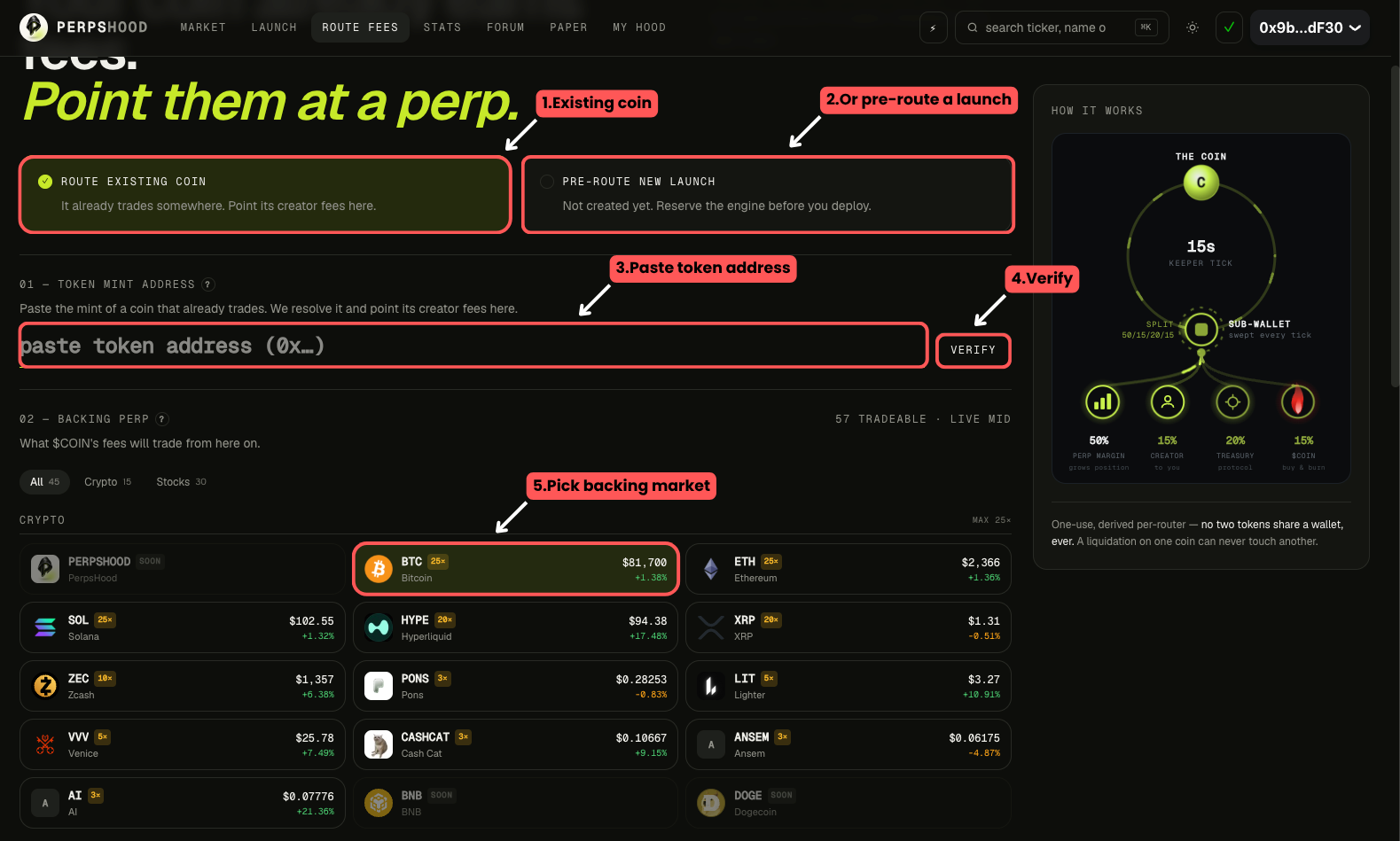
Perpshood also allows tokens not launched on its platform to point their trading fees to Perpshood’s flywheel.
Creators of such tokens can easily paste the coin’s mint or pre-route the launch before deploying it by selecting the strategy, the leverage, and the coin’s fee recipient.
Fee sharing
On Perpshood, trading fees are split to accommodate the protocol’s leverage moat.
It is structured so that 30% of the trading fees fund the perp position, while another 30% is distributed to holders as a dividend, paid in the quote token selected during token creation.
The creator of the token receives a 15% share of the fees, while the remaining 15% goes to the Perpshood protocol and is used to buy back the protocol’s own token.
What is left is 10%, which the keeper allocates to the coin’s own flywheel strategy.
What meme-perps add to Robinhood?
Robinhood’s network strategy is officially centered on tokenized stocks, but unofficially, the network has thrown its support behind experiments, especially with memecoins.
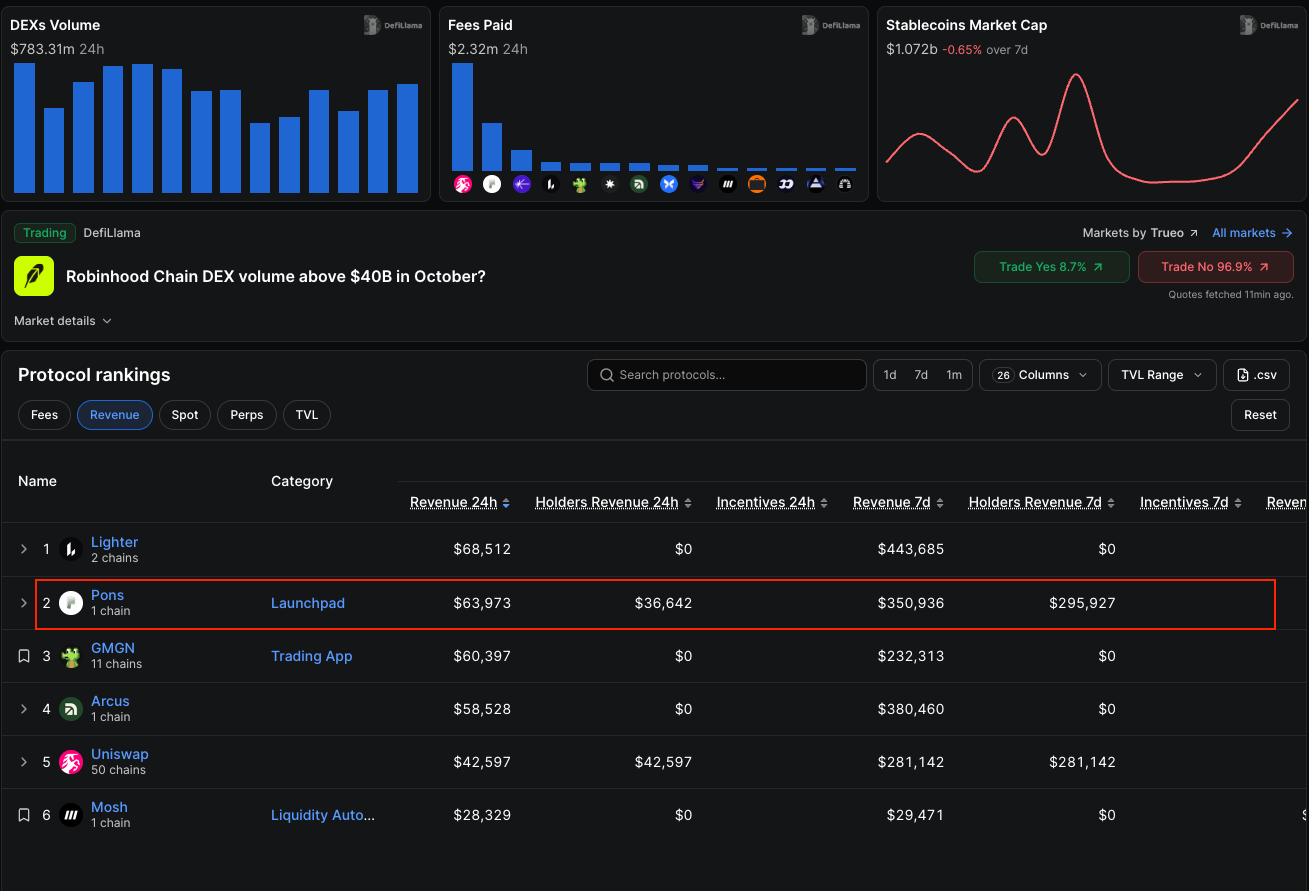
Currently, Pons, a launchpad that allows users to pair memecoins with tokenized stocks, is one of the leading revenue drivers for the network and, more specifically, ranks second on the revenue list over the past seven days.
Perpshood builds on this momentum with its own approach to speculation and fun, while contributing another layer of revenue capture to the network.
When users route or launch coins through Perpshood, they can capture additional upside through an underlying leveraged position.
Rather than launching a memecoin and leaving it bare, the coin effectively gains another layer of volatility tied to the performance of that position.
Should they decide to launch with a stock token pairing, they capture both the volatility of the quote and the underlying perp position.
What meme-perps add, commercially, to Robinhood is a 24/7 speculative layer that stock tokens alone cannot provide.
They are the engagement layer that complements the rest of the stack, onboarding retail through familiar launch-and-trade muscle memory while generating volume for the integrated perps platform.
How to use Perpshood?
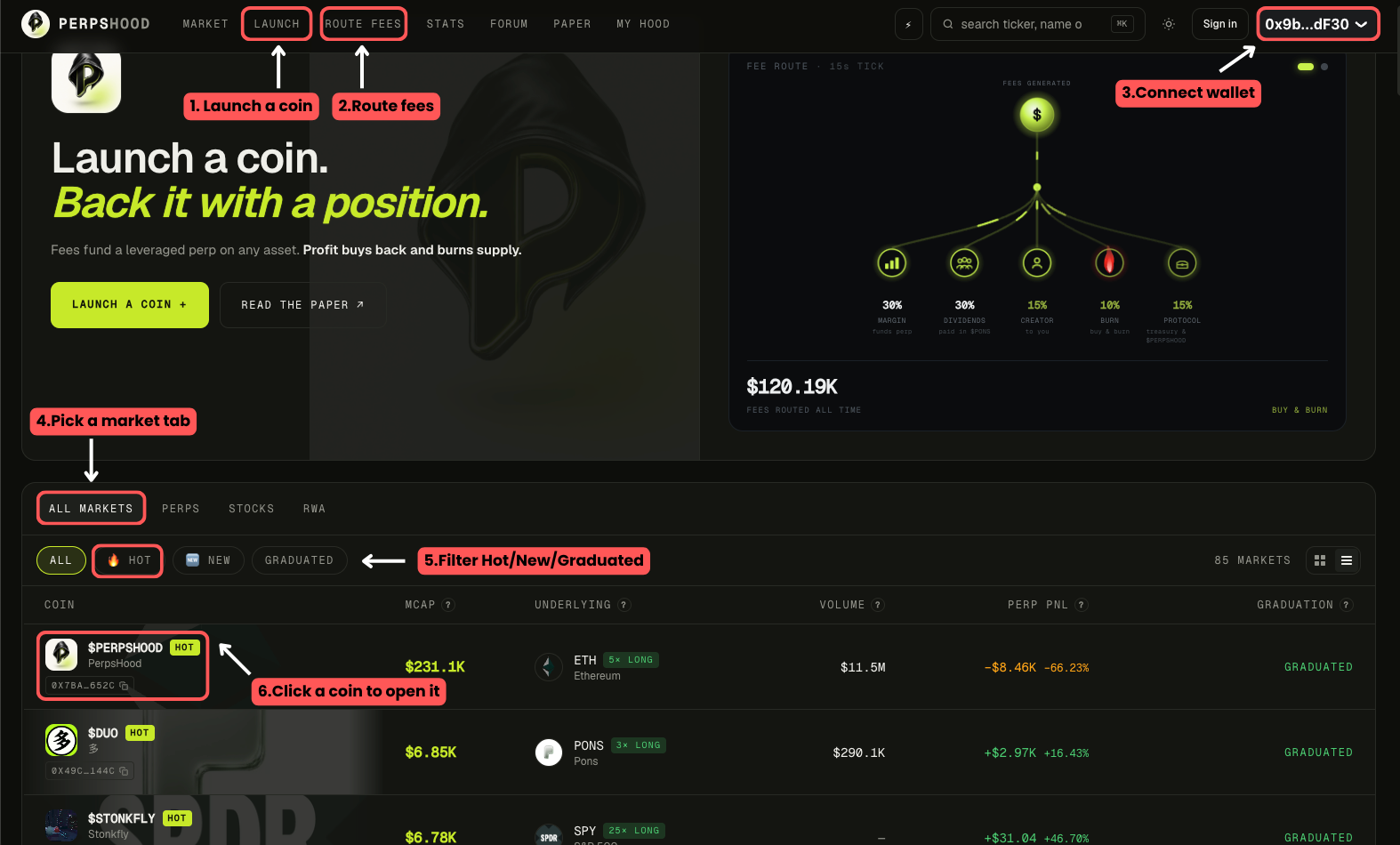
To create your own perps-backed token on Perpshood, start by:
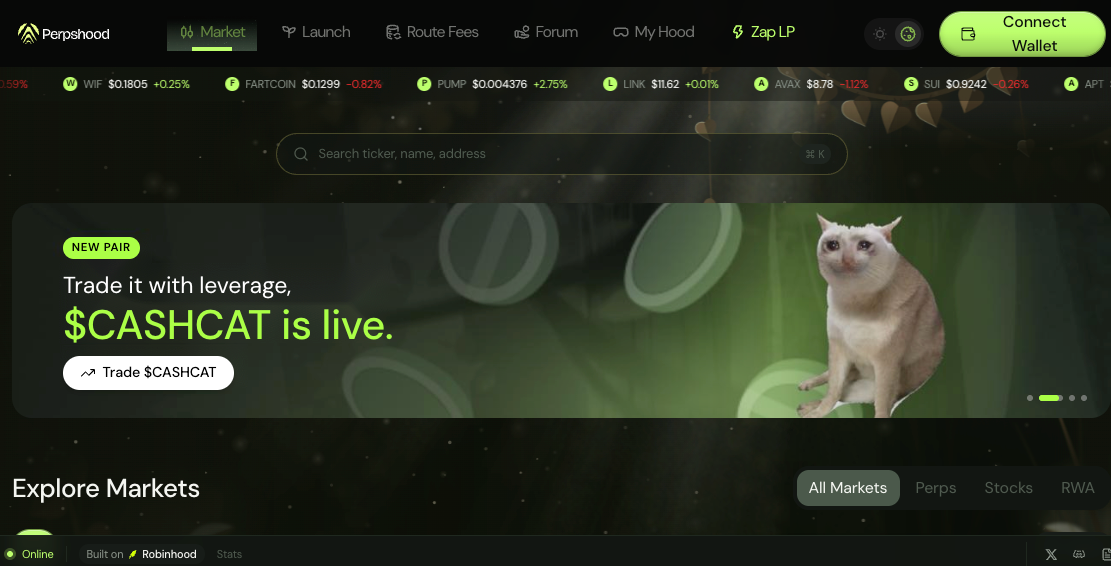
- Connecting your wallet via the Connect Wallet button in the top right-hand corner
- Clicking on Launch from the homepage
- Identity: enter your token's ticker and name, and upload an image
- Engine: pick the backing market, where you can choose between stock tokens like NVDA and crypto markets
- Choose a position, between long and short
- Select your leverage (higher leverage = more risk)
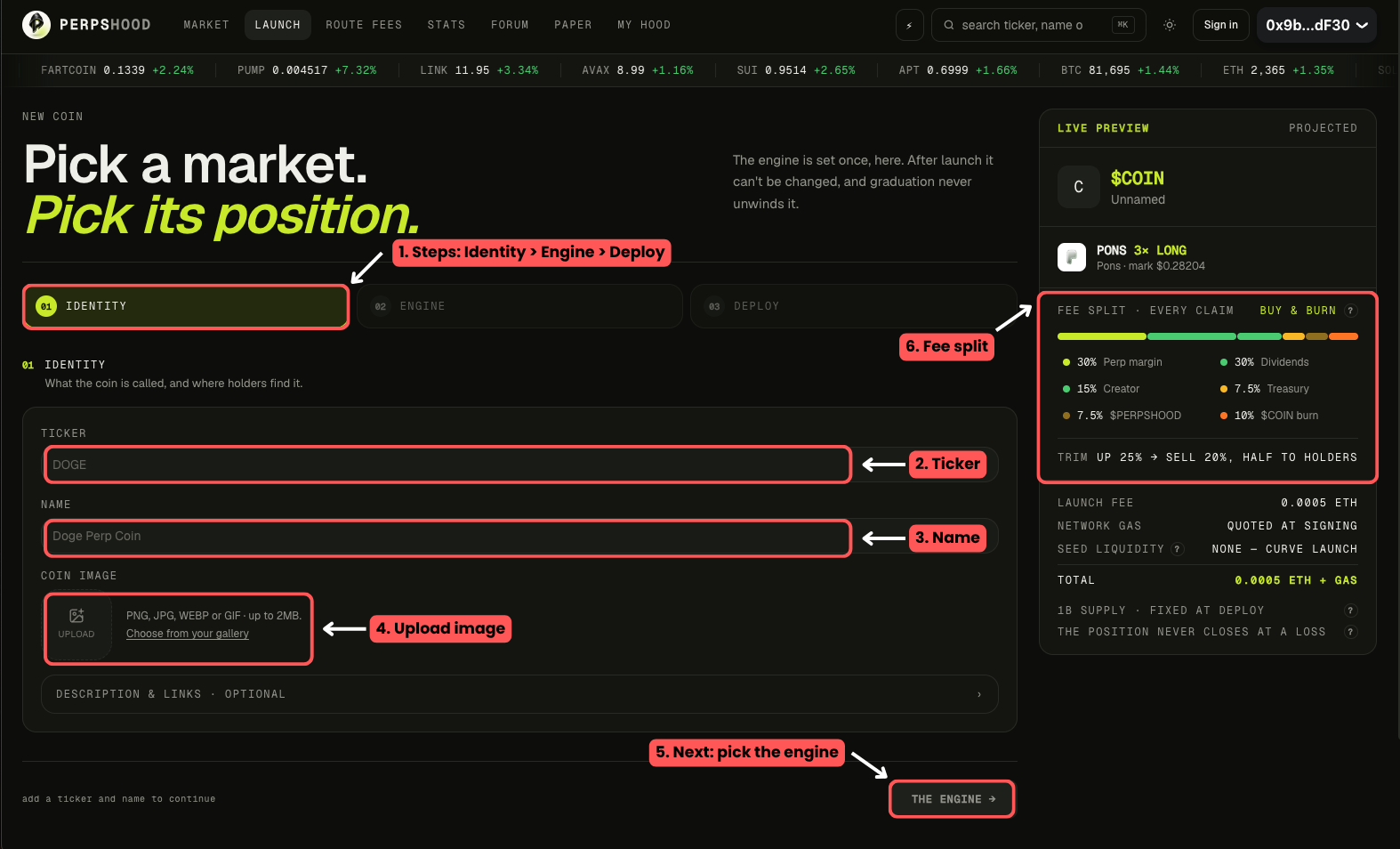
- Deploy: review everything, including the fee split between the creator and the perp backing
- Proceed to launch the token (a small launch fee of 0.0005 ETH plus gas)
If you already have a coin:
- Use route fees to point its creator fees to a dedicated sub-wallet that powers a perp position for it
- Follow the steps seen below
Buying a token is pretty straightforward:
- Connect your wallet
- Select a token from the homepage, using the Hot, New, or Graduated tabs to filter
- Click on any token of choice, choose Spot or Leverage, enter your amount, and confirm the buy
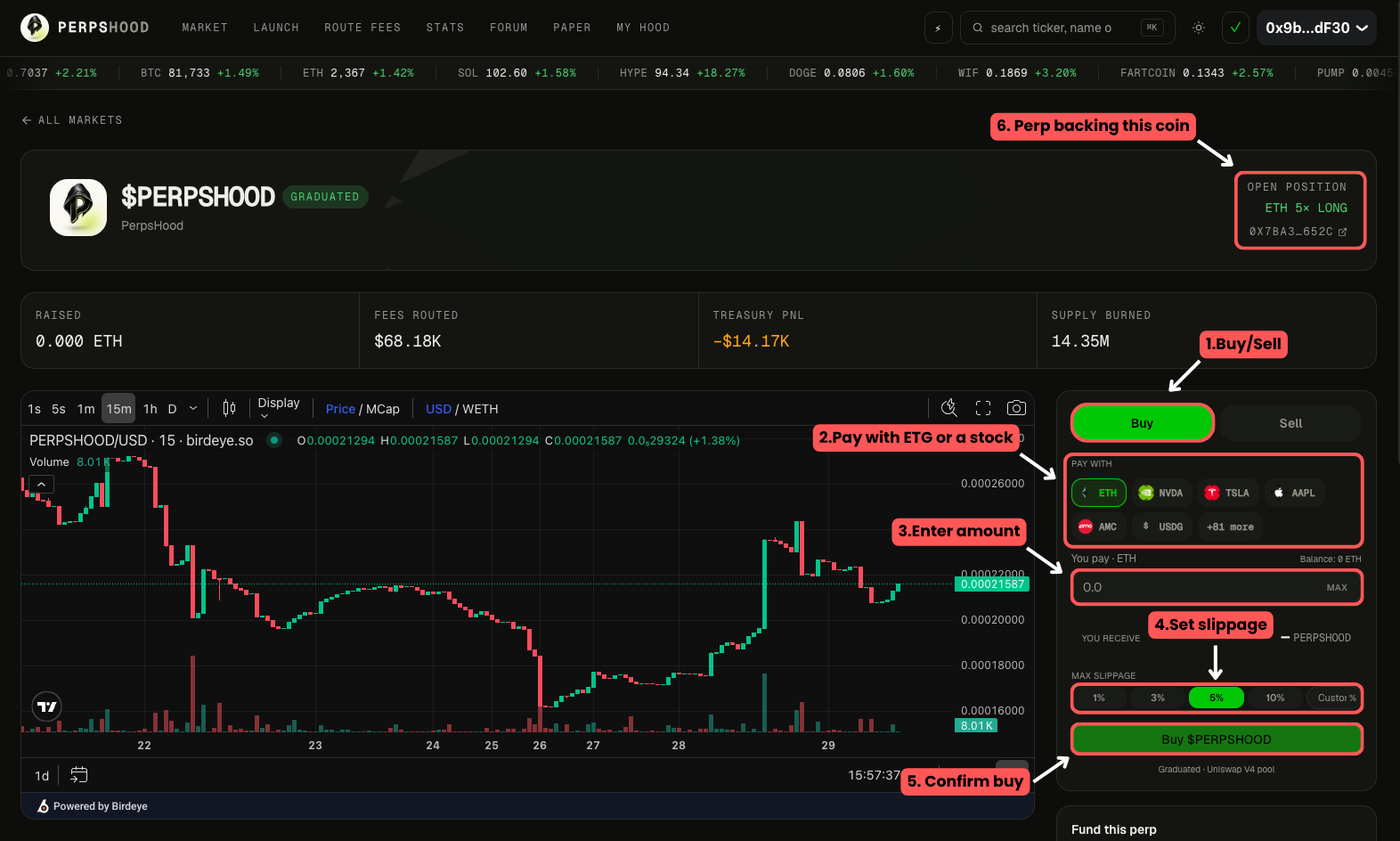
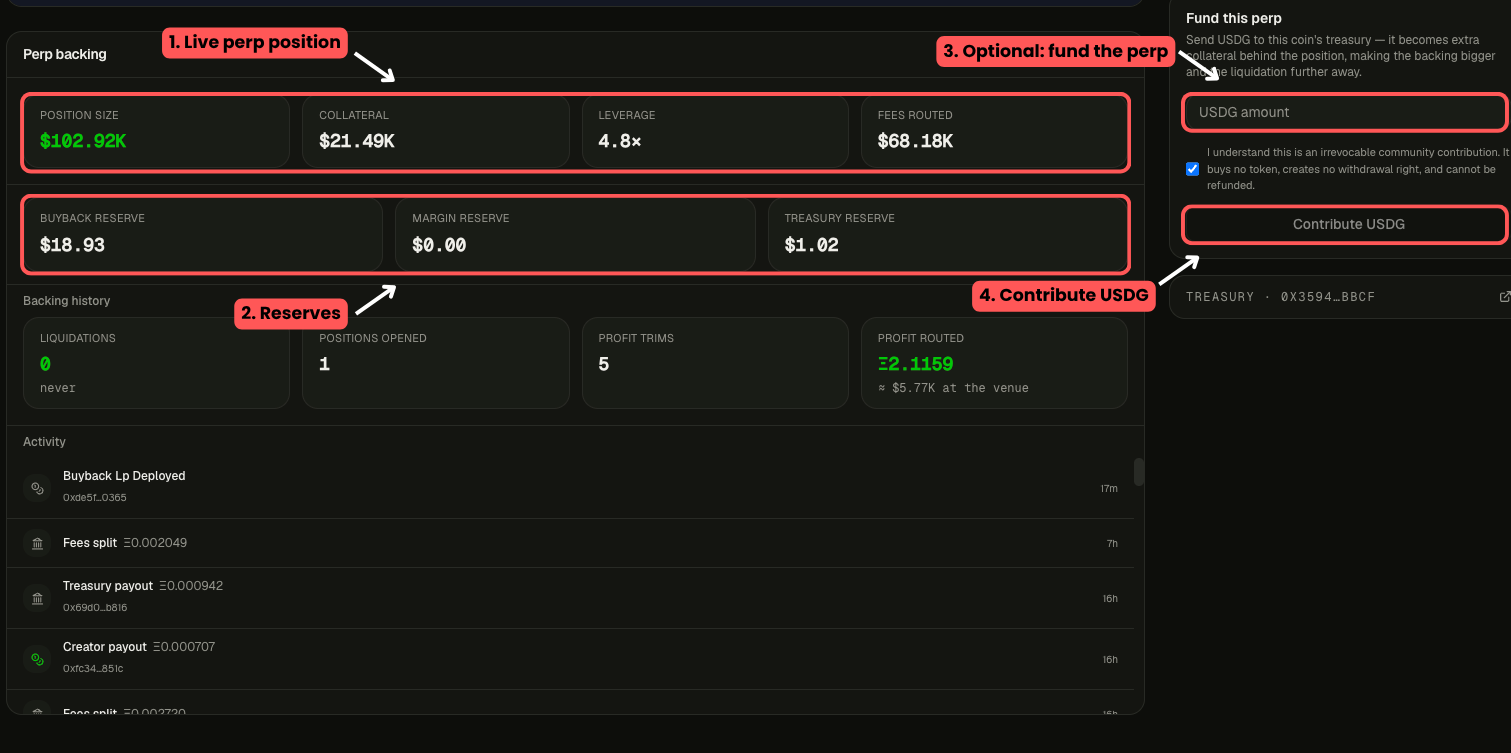
Users can view live perp positions and even contribute by following the steps seen below.
Final thoughts
Vlad’s welcoming remark to the large crypto retail community, “it works great for memes too,” was more than enough to spark the meme mania we’ve seen so far.
However, what we least expected was the amount of thoughtful innovation it has also brought.
Meme-perps feel like a second-order effect of what has already been a largely successful experiment.
Pons sparked excitement by pairing memecoins with tokenized stocks; traders flirted with the idea of taking the short squeeze to Wall Street, and now Perpshood is pushing that thesis a step further.
The bet is that these experiments can evolve beyond pure speculation. By embedding leveraged positions beneath memecoins, Perpshood is exploring whether the meme layer can become a distribution mechanism for more sophisticated financial products rather than simply an end in itself.
Behind the product is Kolkheti Labs, a Tbilisi-based team experimenting with similar ideas across different onchain environments. Beyond Robinhood, the team is taking a related approach to Solana through Perpspad.
We think that as the industry progresses, experiments like these will likely become more common, but genuinely novel ones will become much harder to find.
Thanks to the Perpshood team for unlocking this article. All of our research and references are based on public information available in documents, etc., and are presented by blocmates for constructive discussion and analysis. To read more about our editorial policy and disclosures at blocmates, head here.