Reading time: 17m 1s
We have private cash in the form of XMR and ZEC, but your financial life is more than a Venmo account.
You don’t just use your money to split a dinner bill or pay for a used Coleman grill on Facebook Marketplace - you’re a savvy market operator after all.
You have complex theses about which assets are overvalued and undervalued, you have contrived plans for the perfect thirteen-step parlay that only work because of your edge.
We need a new privacy primitive for anything that’s not a simple transfer, and that’s what Covenants are meant to be.
Any gameplan, any theory, any corner case protection - can lie dormant, onchain, ready to spring into action even if you’re busy watching the football game.
This goes for all of the devs out there too. What push notification alerts do you have set to wake you up in the middle of the night? TVL dropping? Spike in contract calls? Oracle outages? Your dead-man switch conditions can be both private and continuously monitored.
Publishing these thresholds onchain for all the world to see is tricky business. If an adversary knows your limits, they can work around them, but if they aren’t onchain, they might not be quick enough to save the day.
Again, Covenants are the solution.
Monitor what you need to monitor, load your solutions into the chamber, and let Nillion (and cryptography) be your guardian. All without letting the Lazarus Group see your cards.
Dusk introduces a new primitive: Covenants
“Dusk” is what Nillion calls their first rollout phase for Covenants (we’ll get into the rest of the roadmap in a bit). It’s meant to get the basic tools into the hands of developers as quickly as possible.
The best part? It’s already live for you to play with.
This first phase gets Covenants live on Ethereum mainnet, with a permissionless network of Nillion Blacklight nodes monitoring conditions and helping reveal instructions once those conditions have been satisfied.
Covenants themselves start off quite simple and consist of two components: a condition and an action.
So for example, you could have a Covenant that says: “I want to buy 1 ETH on Uniswap (Action) when the price of ETH goes below $1,500 (Condition).”
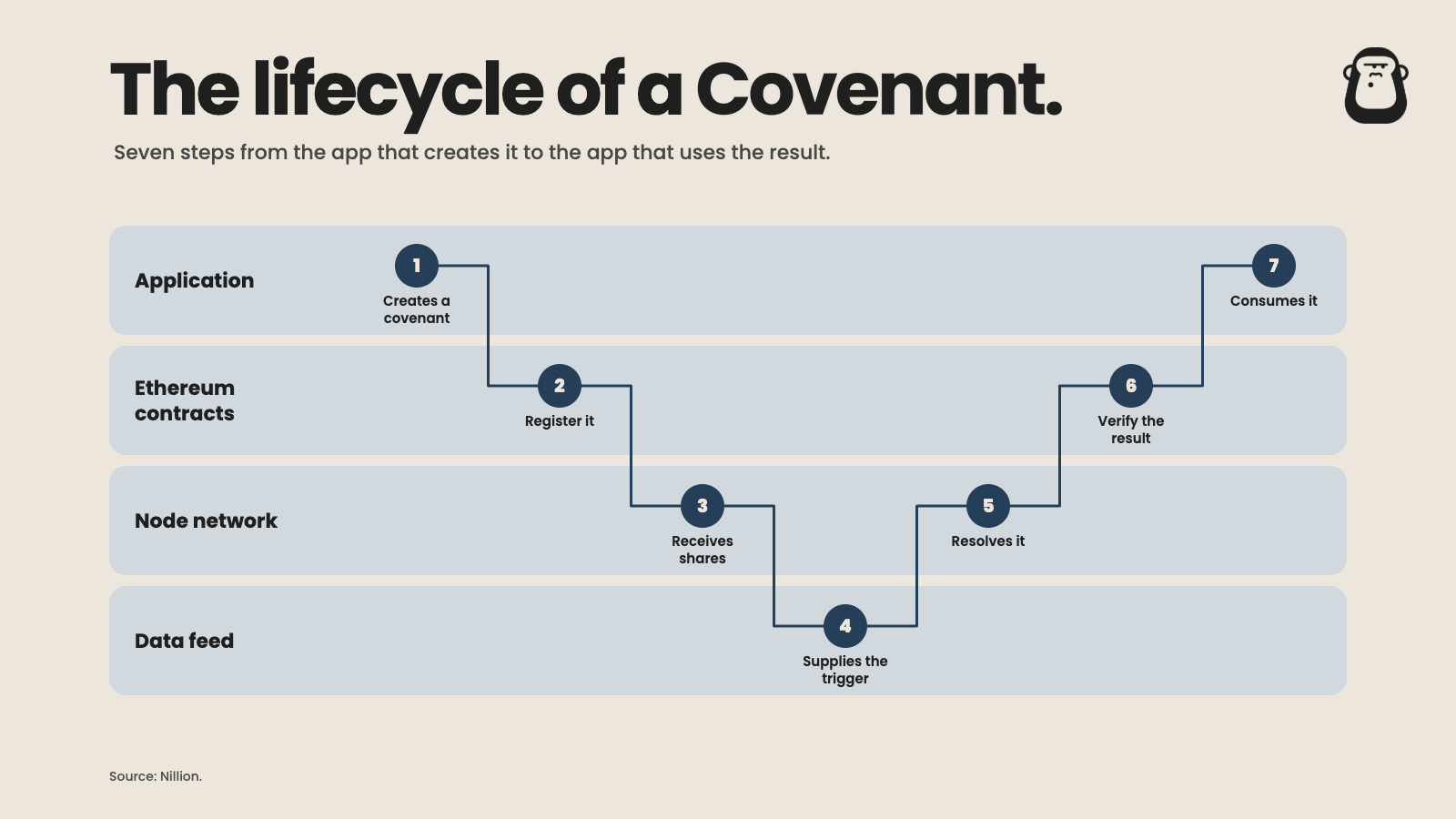
Simply put, a Covenant is built and deployed thusly:
- The user defines and encrypts an instruction - the Covenant
- The Covenant is registered onchain and the assigned nodes decrypt the condition
- Nodes monitor the relevant condition or data feed
- Once the condition is met, enough nodes publish their shares of the action onchain
- The action is reconstructed and verified before the application acts on the instruction
But to understand the pieces involved, let’s look under the hood.
Under the hood
To understand Covenants, you only really need to be familiar with the five components involved.
#1 is the application: which is a frontend, an SDK integration, and generally some downstream smart contracts. This is what creates the Covenant and where the result is consumed.
#2 is the Covenant itself: which is the condition, encrypted action, set by the user. Think of this as an object moving through the system, rather than an independent service.
#3 are the chain-side smart contracts (for Dusk, these are Ethereum smart contracts), which define the protocol: node registration, Covenant registration, nodes submitting their shares of the action when a condition is met, etc. These are the necessary “onchain” rulebooks that define the protocol.
#4 is the Nillion Blacklight node network: a distributed committee whose members each hold cryptographic material associated with the sealed action. The nodes monitor the specified condition and, once it has been satisfied, contribute the shares needed to resolve the Covenant. No individual node can do this alone.
Finally, #5 is the data feed: which nodes monitor continuously to determine whether a condition has been met.
These five friendly cogs work in lockstep with our good old friend - cryptography.
The SDK encrypts the payload against a precisely defined condition, while the ability to unlock it is split across a committee of Nillion nodes.
No individual node possesses enough information to reveal the instruction. The data feed tells the committee when the relevant event has occurred, at which point enough nodes contribute their cryptographic shares for the payload to be reconstructed.
What do you have to trust?
In the era of trading bots and offchain orderbooks, it feels like it’s been a hot minute since someone has asked me about trust assumptions, but when we’re dealing with privacy, it can make or break a design.
So what (or whom) do you have to trust when it comes to Covenants?
For the application, you have to trust that it constructs the Covenant correctly and handles its eventual result safely.
That means more than simply integrating the SDK: the application must encode the user’s instruction accurately, select the right data source, send the result to the intended contract, and account for expiry or failed execution.
Nillion can protect an instruction that was constructed correctly; it cannot repair one that the application misunderstood.
The Covenant itself is not something you trust so much as something you must specify precisely.
Its condition and parameters cannot leave room for interpretation.
“Execute with reasonable slippage,” for example, means something very different to someone trading memes in 0.01 ETH clips than it does to an institution attempting to move real size through the books.
The network can faithfully enforce a badly written condition just as easily as a good one.
For the Ethereum contracts (and later, contracts deployed on other supported chains), you rely on the protocol having been implemented and verified correctly.
The contracts must register the right Covenant, recognize valid node submissions, enforce the required threshold, and expose the correct result.
Ethereum provides deterministic execution and a public record, but it cannot protect users from a bug in the contracts themselves.
The node network introduces two related assumptions: confidentiality and liveness.
Confidentiality depends on fewer than the required threshold of nodes colluding to reveal an action prematurely.
Liveness depends on a threshold number of nodes remaining online and participating once its condition has been met.
The threshold allows the system to tolerate some unavailable or dishonest nodes, but if participation falls below it, the Covenant may be unable to resolve.
Finally, the Covenant is only as reliable as its data feed. The node network can verify that a particular feed reported ETH at $5,000; it cannot prove that $5,000 was an accurate representation of the market.
A compromised oracle, stale update, or incorrectly selected feed can cause an otherwise valid Covenant to resolve at the wrong time.
Having more nodes observe the same faulty feed does not make the underlying information more accurate.
There is also an important distinction between what is encrypted and what is private from the evaluating nodes.
During Dusk, the payload remains sealed, and no individual node has enough cryptographic material to reveal it alone.
However, the nodes can see the condition they are monitoring. That means the condition should not be treated as private from the evaluating committee.
Neon is intended to move that boundary. After this upgrade, nodes will no longer receive conditions in plaintext, meaning the underlying instructions remain hidden even to the network.
Until then, Dusk primarily protects the payload behind the condition, not necessarily the existence or meaning of the condition itself.
What happens when something goes wrong?
These trust assumptions become easier to understand through the main failure modes:
- The condition never occurs (the most benign one). The Covenant should remain sealed unless an expiry, cancellation, or alternative resolution path was defined in advance. Any refund of unused execution funds must also be handled by the protocol or application’s explicit rules, because it is not an automatic property of encryption.
- Some nodes go offline. The threshold allows resolution to continue without every committee member. If too many nodes are unavailable, however, the Covenant may become temporarily or permanently stuck.
- A feed reports bad data. The network may resolve the Covenant correctly according to an incorrect input. Oracle selection, feed freshness, fallback sources, and dispute procedures therefore remain part of the application’s security model.
- Resolution succeeds, but execution fails. Successfully revealing an instruction does not guarantee that the downstream transaction will work. Imagine an application trying to accomplish “Buy 5,000 ETH from this specific pool” when the pool is almost empty. The application must define whether the action can be retried, canceled, or refunded.
Thresholds, refunds, jailing, and slashing each address a different part of this problem.
- Minimum node-participation thresholds prevent one node from controlling resolution and allow some nodes to be unavailable. Just don’t be the guy who sets node minimums to one.
- Jailing and slashing will make defined forms of non-participation or misbehavior economically costly.
- Refund and expiry logic protect users when an instruction cannot or should not proceed.
None of these mechanisms eliminates trust completely. The system’s real objective is easier to accomplish in practice: make it so costly and difficult to disrupt the system that no rational actor would reasonably even attempt it.
How NIL fits into the system
An important distinction we want to make is between how users will interact with NIL and the chain token (in the case of Ethereum, ETH), because both are involved.
It’s quite straightforward - NIL coordinates the network’s participants and economics, while ETH pays for gas on Ethereum.
We’re really happy to see NIL have a real role to play in this architecture, because frankly, it was an afterthought in previous designs.
NIL has three distinct roles in the Covenant system.
#1 NIL is staked by node operators
An operator locks 70,000 NIL to become eligible to participate in the network. That stake gives the operator something economically valuable to lose if it violates enforceable protocol rules.
Staking therefore serves as:
- An admission requirement
- Economic collateral
- A basis for allocating work and rewards
- Eventually, something that can be jailed or slashed for defined misbehavior
It is important to remember that staking does not mean the NIL is spent. It is locked while the operator participates and remains subject to the protocol’s withdrawal and penalty rules.
#2 NIL is used to pay for protocol usage
NIL is the method of payment for Covenants (current cost to create one is 64 NIL), ensuring alignment between the token and utilization of the new primitive.
In practice, we could see this abstracted away from the user, with either the application or the chain-level contracts themselves accepting stablecoins or gas tokens from the user and making the swaps in the backend.
Regardless, NIL is finally necessary to use the shiny new tech.
#3 NIL rewards node participation
Node operators need compensation if they are going to be incentivized to keep the network decentralized. As such, why not pay them in the network token, too?
At first, the network plans to bootstrap emissions to get some early node operators onboarded. As Covenants gain more traction, the goal is that ongoing network use (and NIL payments for Covenants) will perpetuate rewards for node operators.
Think of it like Bitcoin’s eventual plan to sustain the network off of network fees once mining emissions fade away.
The mechanical drive for NIL token demand
It should be clear from the above that greater Covenant usage could increase demand for protocol capacity and node services.
While that doesn’t mechanically guarantee greater NIL price appreciation because price also depends on token supply, emissions, market demand, and all that fun stuff, it does paint an interesting picture.
In summary,
- Applications create Covenants
- Covenant creation generates protocol usage
- Protocol usage requires per-Covenant fees or staked NIL capacity
- Node operators stake NIL to become eligible to serve that demand
- Operators monitor conditions and contribute to resolutions
- Operators receive baseline NIL rewards and usage-linked trigger fees
- ETH pays the underlying Ethereum costs
The road ahead
Dusk establishes the core primitive: an instruction sealed to a condition, registered on Ethereum, and resolved by a distributed node network. But it’s only the first stage of the broader Covenants roadmap.
Nillion organizes that roadmap into four acts: Sealed. Everywhere. About anything. Forever.
- Sealed begins with Dusk, proving that an instruction can remain encrypted until a condition has been met.
- Everywhere expands Covenants across the EVM and eventually allows a condition observed in one environment to release an instruction in another.
- About anything broadens the system beyond a fixed set of feeds, introduces more expressive conditional logic, and eventually hides the condition itself from the nodes evaluating it.
- Forever hardens Covenants against longer-term cryptographic threats while reducing the cost of creating and resolving them at scale.
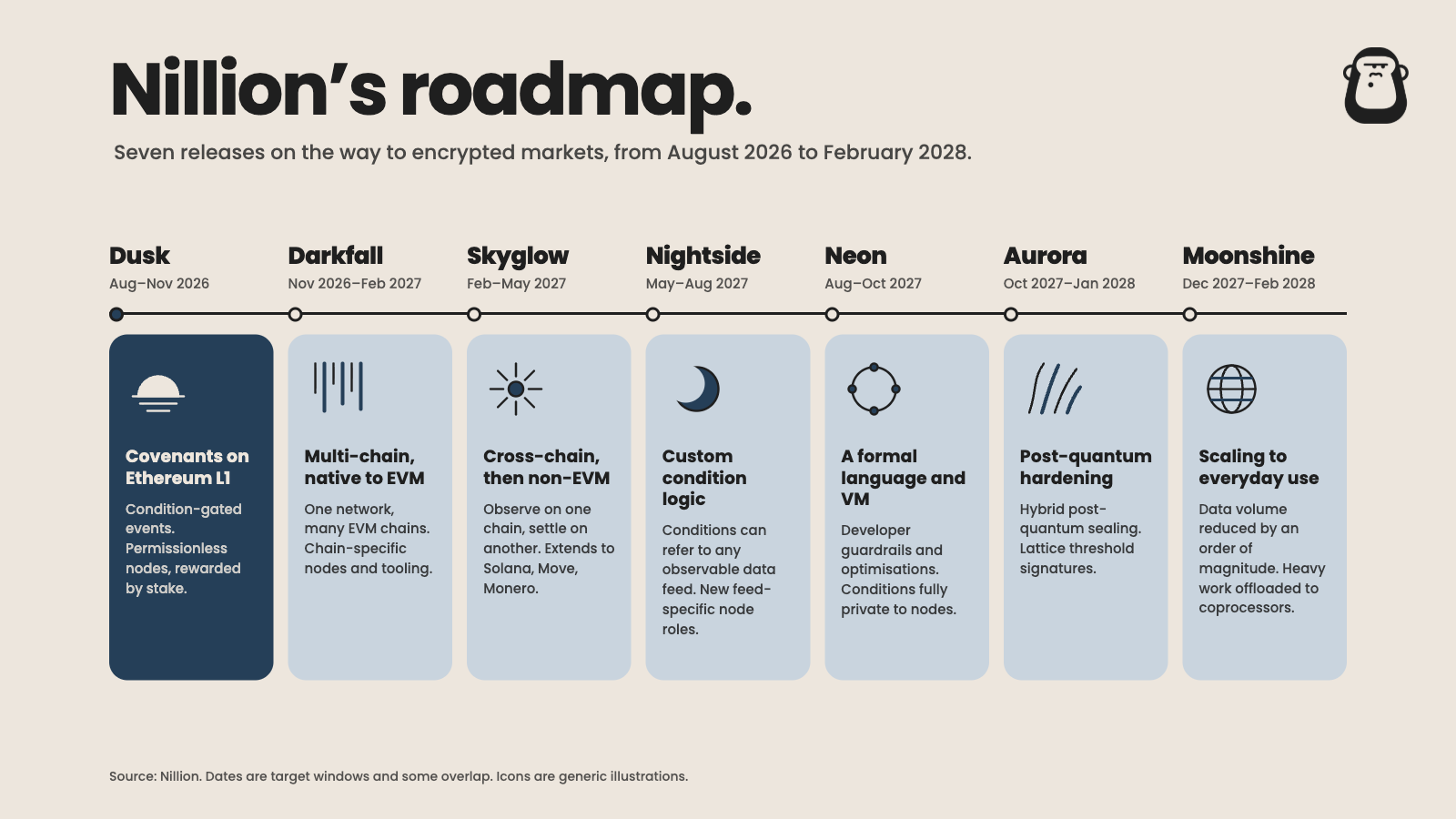
These four acts contain seven individual phases.
Each phase removes a particular limitation of the one before it: where Covenants can operate, what conditions they can respond to, who can see those conditions, how long their secrecy can be trusted, and how economically the network can process them.
The phasing reveals Nillion’s ultimate goals, they want to:
- Protect the instruction,
- Take it everywhere,
- Attach it to anything,
- And make it durable and affordable.
The immediate next step is Darkfall. Where Dusk establishes Covenants on Ethereum, Darkfall begins turning that single-chain implementation into one shared system operating across the wider EVM.
Darkfall: What comes next
Where Dusk started turning the gears of builder brains, Darkfall opens the playing field to new environments while simultaneously strengthening how Nillion’s nodes coordinate and hold one another accountable.
One network across the EVM
Deploying a protocol on multiple chains can easily produce several disconnected networks, each with its own operators, tooling, and security assumptions. Darkfall is intended to avoid that fragmentation.
One shared node network will serve Covenants across supported EVM environments, while developers and operators receive tooling designed for the chains on which they work.
A Covenant created on Base or Arbitrum should follow the same basic lifecycle and security model as one created on Ethereum.
Canonical condition encoding helps make this possible. The same condition must have the same machine-readable meaning on every chain.
“ETH exceeds $5,000 on feed X before timestamp Y” cannot be represented differently on Base and Ethereum if the same nodes are expected to monitor both.
For developers, the pitch is simple: build against one Covenant model and take it to whichever supported environment has the best chance of bringing product-market fit.
Removing the central referee
Darkfall also introduces peer-to-peer communication between nodes.
A permissionless network needs to establish whether its operators are doing their jobs. Was a node online when a condition was met? Did it submit a valid share? Did it ignore an assignment or attempt an invalid resolution?
Under Darkfall, nodes begin exchanging observations and reaching consensus about one another’s behavior.
Jailing and slashing can therefore move away from a central referee and toward collective enforcement by the network.
A consistently unavailable node could be temporarily jailed, while an operator committing a provable protocol violation could lose some of its staked NIL.
Honest nodes continue earning rewards and fees for remaining available and participating in valid resolutions.
These mechanisms improve accountability, but they do not guarantee availability. Slashing cannot force an offline node to return, and a Covenant can still become stuck if participation falls below its required threshold.
Coming soon to an encrypted market near you: Hyperliquid
By popular demand, the addition of Hyperliquid was fast-tracked to appease the ravenous .hl’s and HYPE-maxis among us.
Hyperliquid is a natural venue for private conditional instructions, and honestly, something that’s long overdue.
Imagine a trader who wants to open a short position if BTC falls below a particular price. Publishing the complete strategy in advance could expose its direction, size, leverage, entry price, and risk limits.
A Covenant separates the trigger from the strategy behind it. During Darkfall, the nodes may still know which condition they are monitoring, but the sensitive order parameters can remain inside the encrypted payload.
Once the trigger occurs, enough nodes contribute their shares, allowing the instruction to be revealed and submitted for execution.
That model could support:
- Sealed stop-loss and take-profit instructions
- Orders whose size and direction remain hidden until triggered
- Portfolio safeguards activated by margin or position thresholds
- Strategies conditioned on prices, funding rates, or other supported HyperCore state
Think of the logical flow as having three separate stages: observe the condition, reveal the instruction, and execute the order.
HyperCore may provide the triggering data, receive the resulting order, or perform both roles. The Covenant handles the secret hand-offs between each, ensuring that no prying eyes can see your plans until it’s too late.
Expansion is not yet cross-chain settlement
Darkfall brings the same Covenant model to more environments, but it doesn’t yet deliver the complete cross-chain model described later in the roadmap.
- Dusk: Establishes sealed instructions on Ethereum
- Darkfall: Expands the model across supported environments and strengthens node coordination
- Skyglow: Allows a condition observed in one environment to release an instruction in another
Darkfall is where Covenants begin moving beyond their Ethereum sandbox and start becoming a household resource across crypto.
Beyond Darkfall
Darkfall expands Covenants across more environments. The remaining phases remove the other practical constraints.
Skyglow: Conditions here, settlement over there
Skyglow separates where a condition is observed from where its instruction is released. A destination chain can verify the reconstructed result without requiring the Covenant’s assets to be wrapped and moved through a conventional bridge.
Covenant unlocked = “If this Solana memecoin drops 20% in ten minutes, release my hedge on HyperCore before the group chat discovers risk management.”
Nightside: Conditions about almost anything
Nightside allows Covenants to respond to a wider range of facts supplied by feeds the network can observe and verify.
That moves triggers beyond supported prices and contract states to APIs, physical events, and other attestable information.
Covenant unlocked = “If shipping data shows traffic through the Strait of Hormuz falling by 50%, release my oil-market position.”
Neon: Hide the recipe too
Neon introduces a dedicated language and hardened VM for combining multiple conditions, parameters, and calculations.
It also keeps the condition private from the nodes evaluating it, protecting both the planned action and the strategy behind its trigger.
Covenant unlocked = “If BTC funding turns euphoric, whale positioning reaches X, and price loses support, release my short.”
The nodes can establish that the recipe has been satisfied without seeing the recipe in advance.
Aurora: Keep secrets for the long haul
Aurora seals Covenants using classical and post-quantum cryptography at the same time, so defeating either system alone is not enough to expose them.
Encrypted computation also allows more complex work to occur without first revealing the underlying information.
Covenant unlocked = “If this wallet remains inactive for ten years, release my recovery instructions to my children.” Nobody wants a quantum-computing breakthrough front-running their inheritance plan.
Moonshine: Make it cheap enough to use
Moonshine reduces the cost of posting encrypted data and verifying node contributions by using cheaper storage and aggregated reveals.
That makes privacy practical for smaller, more frequent instructions rather than only high-value transactions.
Covenant unlocked = “If ETH falls 5% this week, quietly buy me another $25.” Private automation no longer needs to protect a whale-sized trade to make economic sense.
It will take the full roadmap to reach private, cross-chain strategies triggered by almost any fact under the sun. Fortunately, developers do not need to wait until 2028 to do something useful.
Dusk already provides the core building block: seal an instruction to a visible Ethereum condition and let a distributed node committee release it.
The more immediate question is what you can build with that primitive now.
What developers are building with Covenants
The good news for developers is that adding Covenants doesn’t mean you have to rebuild an application from scratch.
The SDK sits between the application’s existing interface and its onchain contracts, so it’s as close to plug-and-play as you can get.
The application still decides what the user wants to do.
It defines the condition, places the sensitive instruction inside the payload, and adds parameters such as an expiry, destination, or acceptable execution range.
The SDK handles the cryptographic plumbing required to turn those pieces into a Covenant.
Only the information needed to register and resolve that Covenant is posted onchain.
This includes the encrypted payload, encoded condition, and relevant public metadata (not the plaintext instruction itself).
Nillion’s contracts record those rules and coordinate the node committee responsible for monitoring them.
Once enough nodes produce a valid reveal, the application can detect the resolution, decode the payload, check that it is still valid, and pass the instruction to the appropriate downstream contract.
The division of labor is worth keeping straight. Nillion protects the instruction and determines when it can be released. The application is next in the sequence, in charge of authorization, execution, and what to do if the intended action fails.
Dusk also cannot listen to any API a developer found five minutes ago. It supports the onchain facts and feed adapters the network currently knows how to encode and monitor. Arbitrary feeds and custom fact types arrive later in the roadmap (as explained above).
Even within those early constraints, builders have already taken Covenants in several interesting directions.
Making raises fair
Sealed Bid Auction keeps every bid encrypted until the auction closes, then reveals them together. Nobody gets to watch the early bidders before deciding what the asset is apparently “worth.” In theory, this should give us raises that are much harder to game.
Private OTC applies the same logic to two-party deals. The terms remain private until both sides are ready, so neither participant has to blink first.
Air-tight capital management
Sealed explores hidden price calls and stop-loss instructions for Uniswap. It currently runs in simulation mode using test ETH, but the appeal is obvious: a stop-loss is much less useful when the entire market knows exactly where you placed it.
Quiet Cover takes that model to Aave, exploring automated repayments without advertising the precise level at which a borrower intends to defend their position.
Latch combines two related ideas. Trading instructions can remain active when a user’s agent goes offline, while a separate Covenant can release a payout or defensive action if USDT crosses a specified threshold. The current version runs on Sepolia with test assets.
Payments without the payroll spreadsheet onchain
Nilayer explores private USDC payments from a multisig Safe. Think grants, payroll, vendor invoices, or treasury operations that still need shared controls without publishing every payment instruction in advance.
Zilch combines Nillion Covenants with Zama’s confidential transfers. The transfer remains confidential, while the instruction authorizing it stays sealed until its trigger occurs. Nillion lists the application as live on Ethereum mainnet.
Prove it exists, but reveal it later
Inheritance Vault allows someone to seal a letter or link until a chosen date. The content stays private, but the release rules are committed in advance.
Pluto applies the same structure to responsible disclosure. A researcher can encrypt a report locally and commit to a release window onchain, giving both sides a verifiable record without handing every black hat the vulnerability ahead of schedule.
These applications are not all at the same stage. Some are on mainnet, others run on Sepolia or in simulation, and several are still proofs of concept.
Still, the range tells us the same primitive is already being applied to auctions, trading, lending, payroll, inheritance, OTC settlement, and vulnerability disclosure.
The builder’s starting point is fairly simple: Find the instruction your application currently has to publish, entrust to a server, or keep alive through a bot. Put that instruction inside the payload, define when it can be released, and let the Covenant sit between intent and execution.
For builders (and vibe-coders who identify as builders, like us) - check out the MCP docs and get to tinkering. We’re super curious what you want to see built.
Concluding thoughts
Dusk pigeonholes itself on purpose, saying: an instruction can be sealed to a condition, distributed across a node committee, and resolved on Ethereum without handing control to a single operator.
It’s simple, but it means introducing Covenants to developers as early as possible.
Darkfall is where the primitive starts growing arms and legs. Covenants expand into more execution environments, developers gain chain-native tooling, and node accountability moves toward direct communication and collective enforcement.
The remaining phases take aim at one constraint at a time: either where a Covenant can act, or what information can trigger it, whether the condition itself remains private, how long its cryptography can be trusted, and how much the entire process costs.
But we’d argue that the applications make the case better than the roadmap does.
A sealed auction, hidden stop-loss, private OTC deal, inheritance instruction, and timed vulnerability disclosure appear unrelated at first. What they share is an instruction that needs to exist before it should become public.
That is the actual opportunity behind Covenants. Blockchains are already good at proving what happened. Nillion is trying to give developers a way to commit to what should happen next (without broadcasting the plan before its time).
For years, onchain applications have broadcast their plans to anyone willing to watch. Covenants could finally let them keep something to themselves.
Thanks to the Nillion team for unlocking this article. All of our research and references are based on public information available in documents, etc., and are presented by blocmates for constructive discussion and analysis. To read more about our editorial policy and disclosures at blocmates, head here.