Reading time: 6m 7s
The market is down, and as expected, everyone is overreacting again. Doom-posting is at an all-time high, and Binance is on the onslaught this time around, to the relief of Wintermute.
On the other side of the pandemonium are those calling for $5 HYPE - either for want of a generational buying opportunity, or just because they are simply perma-bears.
Either way, it would be nice for both parties to put their money where their mouth is and go giga-short Hyperliquid, but only after looking into the metrics coloring Hyperliquid’s outcome markets.
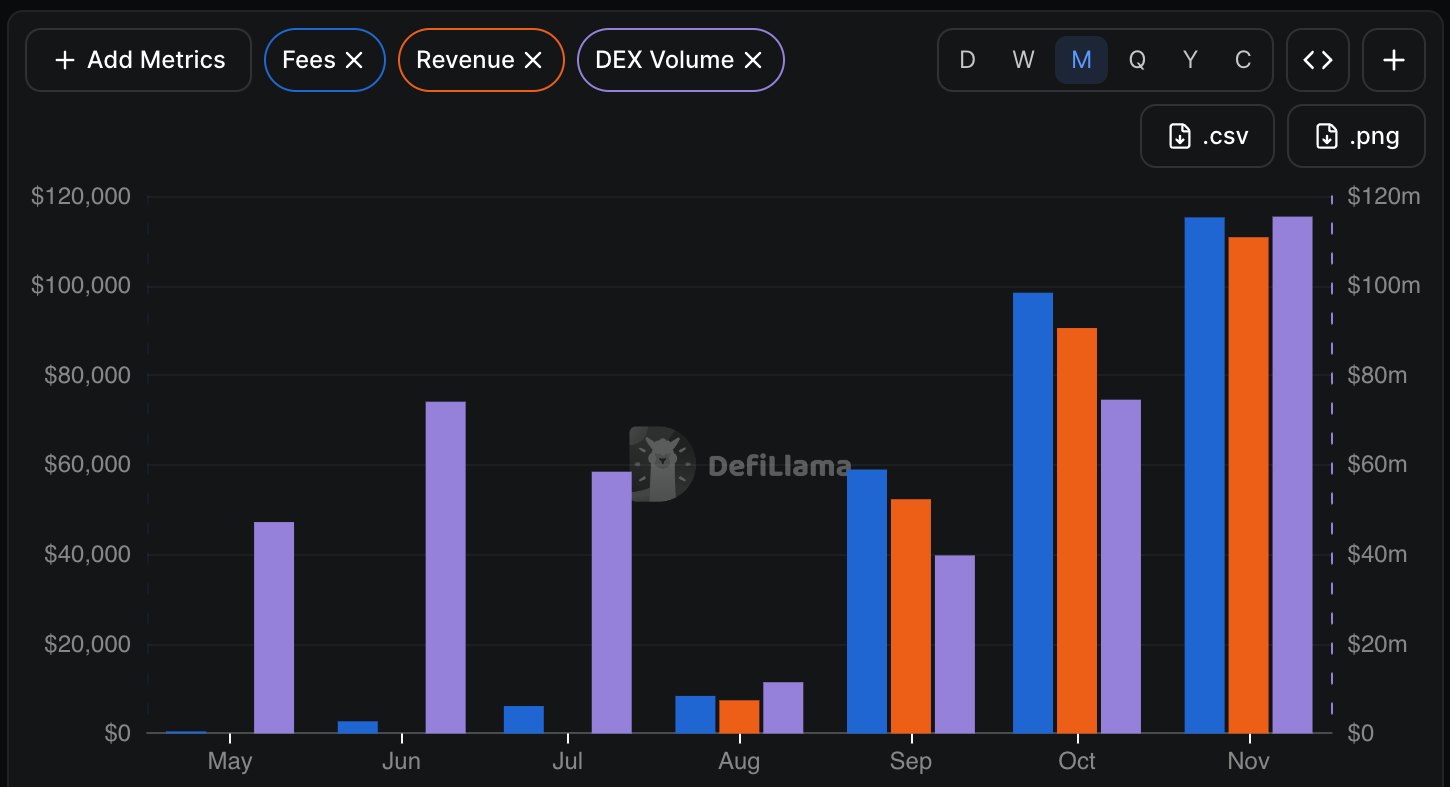
Hyperliquid’s HIP-4 outcome market has grown violently upwards since October, crossing $158 million in the last 30 days, and $100 million in November alone.
For perspective, HIP-4 went live in May this year, enabling Hyperliquid to offer event contracts - fully backed Yes or No tokens that pay $1 if something happens or $0 if it doesn’t.
Wait, how is this different from Polymarket?
Is HIP-4 outcome markets different from Polymarket? The answer is both yes and no.
Both HIP-4 and Polymarket are prediction markets or event-based markets, where you buy a side on how something will turn out, such as a match result or where BTC closes, and the price tells you roughly how likely the crowd thinks that outcome is.
On both, you trade against a live orderbook with real bids, asks, and sizes, and irrespective of the venue you use, the contract's wording, expiry, and reference source are what actually decide your payout.
The differences come in how each one gets there.
Polymarket settles disputes through the UMA Optimistic Oracle, where results are proposed and can be challenged.
On HIP-4, each contract carries its own settlement condition and named source, set by whoever deployed it.
There’s also a significant difference in trading, too. HIP-4 markets live on Hyperliquid, so you connect a wallet and trade from the same Hyperliquid account you'd use for perps, while Polymarket runs its own account and trading flow.
That’s not all. In terms of fees, both platforms operate differently. Polymarket charges taker fees on certain market categories and leaves makers free, while on HIP-4 you check the protocol's fee policy plus whatever builder fee your front end adds.
What are the HIP-4 venues?
Much like HIP-3, where external parties can set up and run their own perpetual markets on Hyperliquid's engine, HIP-4 lets outside teams list and manage their own outcome markets without Hyperliquid's core team having to approve.
The price of entry is a 500,000 HYPE ($33.5 million as of the time of writing) stake, and it can be slashed if a deployer misprices the market or runs it poorly. This serves as a deterrent against bad actors and market manipulation.
In return, the deployer can decide on the markets to list. The deployer also sets how each listed market resolves and keeps a cut of the trading fees, which it splits 50:50 with Hyperliquid.
You can think of it as Hyperliquid owning the house (the order book, margin, and settlement), while the deployers decide what gets traded on top of it.
Considering how much of a success HIP-3 has been in terms of distribution, volume, and revenue - with platforms like trade[XYZ] that have garnered over 18,000 daily active accounts and exceeded $100 billion in volume in the last 30 days- it has not been much of a surprise to see projects already building on top of HIP-4.
- Events by trade[XYZ]
- Hyperliquid (Native)
- Outcome
- Skew
- Fox
Of all these venues, Outcome catches our attention the most, and in the next few paragraphs, we will lay out why it does.
What is Outcome?
Outcome is a prediction market that brings the world’s uncertainties onchain, packaging real-world events into markets with just two possible outcomes (binary): 0 or 1.
Markets on Outcome are determined by validators, who set the market display text, side names, deployer fees per market, and keywords, and settle each market onchain.
Outcome launched on May, 2, 2026, as a Hyperliquid HIP-4 frontend, initially displaying the same contracts available through Hyperliquid (mostly BTC, ETH, SOL, and HYPE binaries).
A few months later, on August 29, Outcome had come up with the money required to start deploying its own markets - 500,000 HYPE, staked and ready to be slashed should they commit any heinous crimes against traderkind.
As an official Hyperliquid HIP-4 deployer now, Outcome is a market issuer, meaning that the protocol writes its own markets or questions, sets the resolution rules, and settles the result - while still running the front-end on top.
Since becoming a deployer, Outcome now has over 199 markets covering sports, crypto, economics, and TradFi, and is gearing up to deploy markets in Esports and politics.
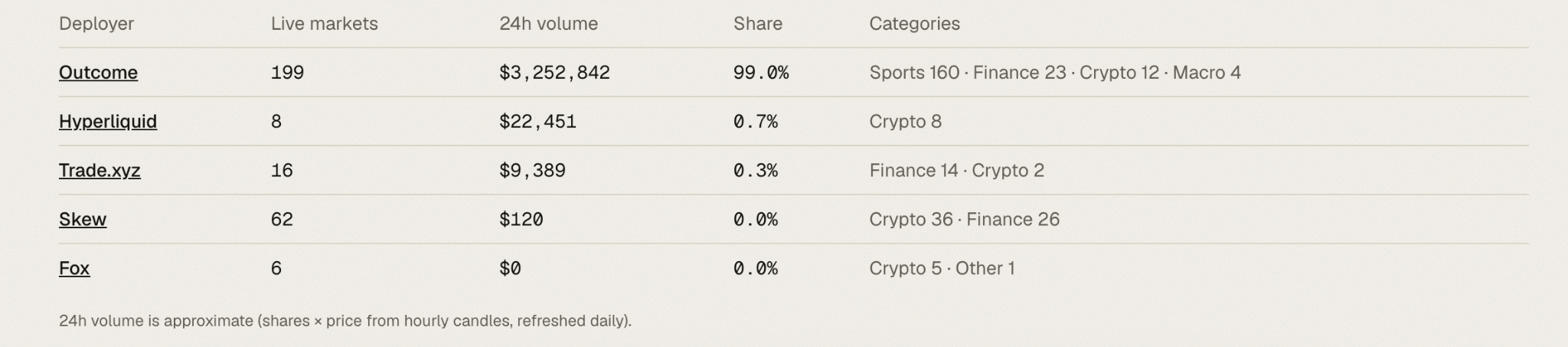
A few factors can be said to be responsible for driving significant volume to Outcome, pushing it to the leading HIP-4 deployer by volume over the last 30 days.
Amongst these factors are:
More market options
Compared to Hyperliquid and trade[XYZ]’s events, which mainly list price binaries on crypto assets and tokenized stocks, Outcome’s markets are more expansive.
For Hyperliquid, its markets mainly come down to up-or-down markets on five main daily contracts (SOL, BTC, ETH, HYPE, and BTC price range market).
trade[XYZ], on the other hand, runs 16 markets, consisting of 10 price binaries and 6 covering Anthropic’s IPO.
Outcome’s markets lean more toward sports, which are renowned for high activity, while also listing multiple markets across crypto, TradFi, and other categories.
Trade-to-earn
Incentives onchain usually take the form of points. Outcome has gone the other way, using direct financial rewards, called trade-to-earn, to drive enthusiasm for its listed markets.
Over $1 million will be paid out, with about $677,000 in daily payments made as of the time of writing.
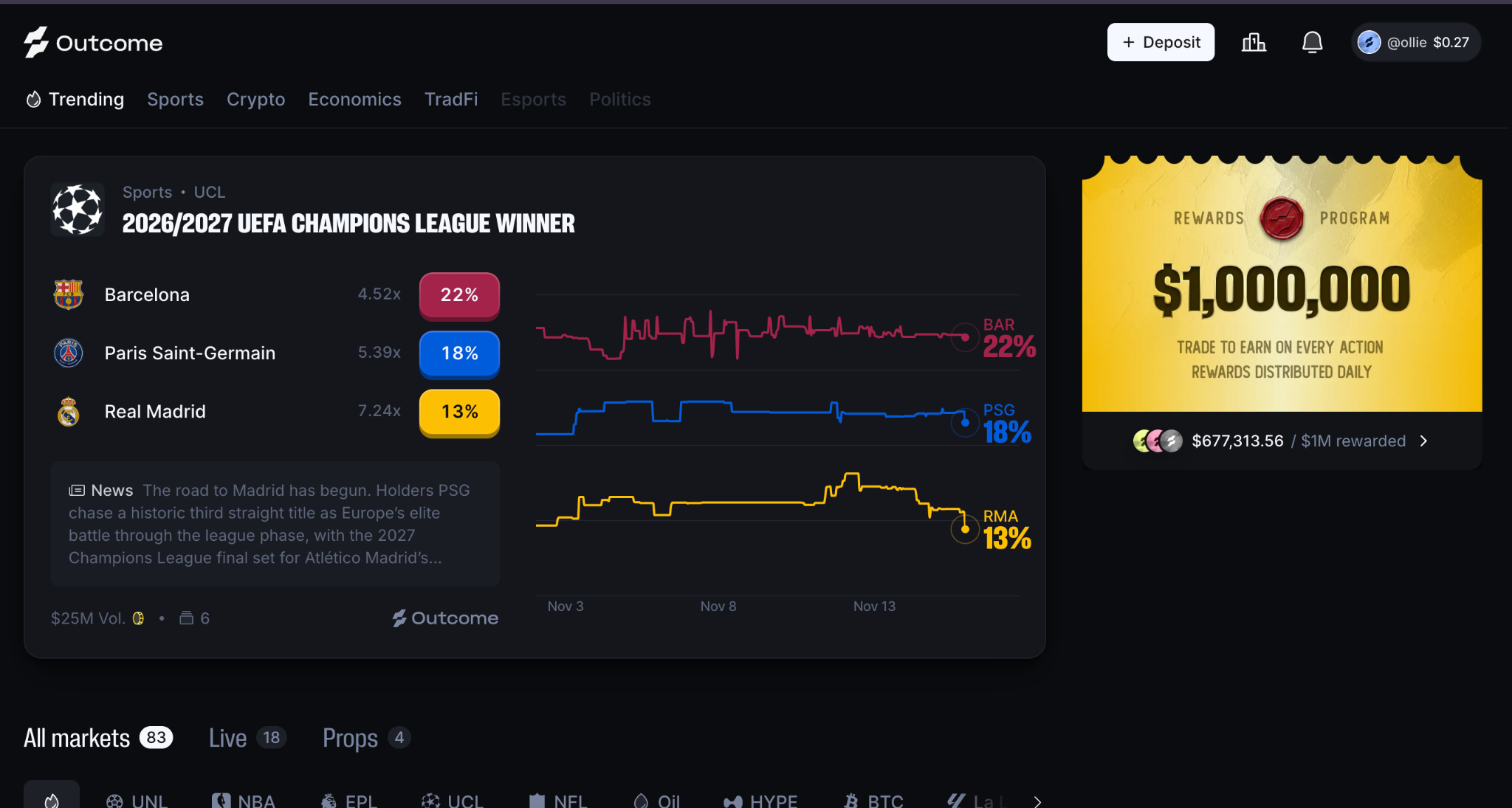
Each market's daily budget goes 40% to orders resting near the price, 50% to those resting orders getting filled, and only 10% to takers.
In practice, Outcome is paying people to make tight, deep books, and those books pull in the flow.
The program also follows traders to other apps, with users of Nansen, Liquid, Hyperbeat, Share[XYZ] and, since 9 November, Totalis, earning from the same pool when they trade Outcome's markets on those platforms.
Hyperliquid season 3 speculation
In all honesty, this one is pure speculation. Since Hyperliquid’s millionaire-making airdrop, there’s been speculation of a third season, thanks to 38.888% of the HYPE supply that has been set aside for “future emissions and community rewards.”
This has led to a longstanding belief that interacting with new protocol features, even across external apps connected to it, might yield another significant, rewarding experience that replicates the genesis airdrop.
As such, the logic is that if you’re farming HIP-4, the venue with the most markets and its own daily rewards is the obvious place to do it. We wouldn’t bet on this, but we wouldn’t rule it out either.
Custom HIP-4 benefits
We’ll cite one of the biggest factors as the shared advantage of being a HIP-4 deployer, wherein users need not open a new account.
This is because HIP-4 markets live on Hyperliquid itself, and anyone with a Hyperliquid account can trade Outcome's markets straight away using the same wallet, USDC, and margin they already use for perps.
This converts Hyperliquid’s trade-savvy audience into natural Outcome users, opening the door to activities such as opening a position on Hyperliquid and hedging on Outcome.
For example, a trader hedging a BTC long can take a BTC price binary from the same account without moving USDC.
Outcome sweetens the deal with a zero builder fee and a 4% taker discount on your first $25 million in volume through its referral code. And because any frontend can plug into its markets, the same account works whether you trade on Outcome's site or inside apps like Nansen, Liquid, and Hyperbeat.
Concluding thoughts
As the Hyperliquid ecosystem keeps expanding through HIP-3 and now HIP-4, the chance to become the go-to deployer in each category is up for grabs.
Hyperliquid builds the rails and lets outside teams decide what trades on them. History suggests each new rail ends up with one clear winner.
On the HIP-3 front, trade[XYZ] stands out and has cemented its lead. Its stock, commodity, and index perps have done $699.7 billion in lifetime volume, about 95% of everything HIP-3 deployers have ever traded, and earned it $29.72 million in deployer revenue.
On the HIP-4 side, Outcome is following the same path, but we believe that things are still early, and we might be only able to point to a clear winner by Q3 next year. That said, Outcome’s multi-category markets give it a really strong advantage.