Reading time: 20m 9s
We’re putting Anthropic on a research mock trial.
Opening statement:
For anyone who’s seen How to Get Away With Murder, the opening scene is almost unrivaled: Annalise Keating iconically walks into a class full of aspiring lawyers, promising to teach them over the course of the semester, exactly what the title suggests.
As the series progressed, it became obvious that knowing how to make a compelling case and having clean hands are two different things.
Which brings us, rather conveniently, to Anthropic.
Anthropic built much of its identity on the promise of doing things differently: safety, responsible AI development, and the willingness to resist some of the more questionable impulses of an industry racing to build increasingly powerful machines.
These are all quite persuasive reputational promises, but the thing about reputation is that it actually has commercial value.
It gives customers a second reason to choose you beyond the product, investors a reason to believe in your ability to act aligned in the long term, and the public a reason to give you the benefit of the doubt.
It is imperative for such a reputation not to move unchallenged towards the kind of IPO imagined in our title.
This is why we’re putting Anthropic on a research mock trial.
The prosecution has prepared four charges. I, @ollieblocmates, will be arguing for the prosecution, testing Anthropic’s public commitments against its decisions and looking for the contradictions in between.
@Kristrey0 will take up the defense, examining the same evidence, challenging the allegations, and making the case for why Anthropic’s actions and decisions might be more defensible than they first appear.
The question before you, the jury, today is whether Anthropic is guilty of using these 4 tactics:
- Bending principles when the money hit figures enticing enough
- Clever hypocrisy in the methods used for development
- Making their users the product
- Selling a story bigger than the product to justify its valuation against economic realities
Ladies and gentlemen of the jury, there are four charges to hear, two sides to every argument, no guarantee that either counsel will emerge with their reputation intact, and a final verdict to reach.
And without further ado, let's present the first charge to the court.
Charge I: Safety compromise allegations
Question to the jury:
Do Anthropic’s changes to its safety policies and oversight amount to a breach of its public commitments?
Prosecution:
Ladies and gentlemen of the jury, when would you say that a safety promise matters most? I reckon you agree with me that it matters most when keeping it becomes the inconvenient option.
In September 2023, Anthropic introduced its Responsible Scaling Policy and Long-Term Benefit Trust.
The proposition was that stronger capabilities would require stronger safeguards and that competition was not supposed to become an excuse for a race to plausible extinction.
However, ladies and gentlemen, in February 2026, Anthropic introduced a safety roadmap target that it called “nonbinding but publicly-declared.”
In fact, by July, the defendant had removed the requirement to share fully unredacted Risk Reports with all regular-clearance staff, thereby guaranteeing access to at least 200 of them.
It will also be of interest to this courtroom to note that four of the company’s five original trustees, namely Jason Matheny (in December 2023), Paul Christiano (in April 2024), Kanika Bahl, and Zach Robinson, have all departed the company as of January 2026.
Now, let’s not get ahead of ourselves here. The defense might argue that their departure does not prove dissent. But we strongly believe that it does mean the people originally entrusted with protecting the safety promise on which Anthropic was founded have largely changed.
In hindsight, it is expedient to scrutinize Anthropic’s governance.
Who chooses the replacements, who pays them, and under what conditions can shareholders remove the Trust’s powers without the Trust's consent?
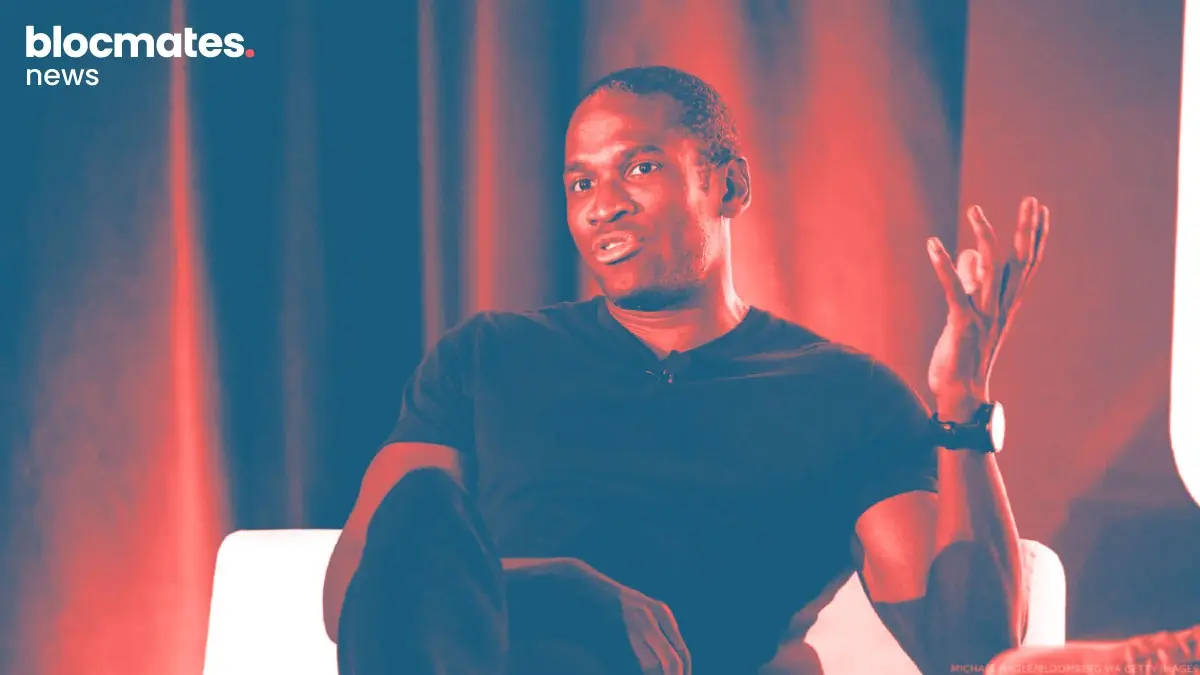
We believe that these acts and decisions have reinforced an iota of disbelief in Anthropic’s position on AI safety, even amongst expert investors like Arthur Hayes, who, in his words during a recent interview with us, mentioned:
“I think Sam’s full of sh*t, Dario’s full of sh*t, Elon’s full of sh*t, all these guys… at the end of the day are profit-maximizing corporate CEOs and they’re doing exactly what they’re supposed to do. They have a company, and in the American culture you maximize profit and f*** everyone else - so the safety narrative is only a ploy to get a bailout.”
Ladies and gentlemen, the prosecution is not asking you to believe Arthur or to even try to insinuate that nothing changed except Anthropic’s appetite for profit.
What we are asking is: when the company encountered the pressures its safeguards were designed to withstand, did it strengthen those safeguards or make them easier to circumvent?
Defense:
Your Honor, the prosecution closed with a question, so I’ll build Anthropic’s defense by addressing it: Did Anthropic strengthen its safeguards or make them easier to circumvent?
When the company released the original RSP document in September 2023, the world was in a different state.
Specifically, Western AI models were practically the only ones making meaningful progress and posing any conceivable threat. It was solely up to a few Silicon Valley players to lead the frontier.
Fast-forward to today, and the landscape has become increasingly competitive, with Chinese models having caught up, whether through distillation or other, quote-unquote, cheap tactics.
In the document Anthropic released in 2023, the central lever to mitigate existential threats to humanity was the pause: if a lab’s capabilities outpaced its safeguards, we would pull the handbrake until the appropriate guardrails were in place.
In fact, that is exactly what Anthropic did before releasing Mythos.
When Mythos Preview arrived in April 2026, its offensive cyber capabilities were serious enough that Anthropic declined to release it to the public at all.
It restricted access to Project Glasswing, twelve named partners, and 40-plus participating organizations, backed by $100 million in usage credits, so the model could be pointed at defensive capabilities.
The product we eventually released to the public was a watered-down version, with strict guardrails in biochemistry, software, and other areas where malicious actors could exploit the model’s capabilities. That move came at the expense of the company’s commercial success.
Most recently, as part of Anthropic’s efforts to establish an operational framework for third-party AI oversight, the company onboarded six METR staff members with "company hardware, office space, and access to internal tools and systems," a level of access the company describes as "roughly on par with what Anthropic's own risk assessment teams have."
That is a lot of thought and resources poured into something that Anthropic could’ve just let loose. But that begs the question: Do Chinese competitors have the same code of conduct? Certainly not.
There’s risk in not advancing, just as there is in advancing; they’re simply different kinds of risk.
We should consider safety not only in the context of a single model release, but across the "system" of all labs. By falling behind, you may be less able to champion “safety” than you would be if you were leading the way.
That means blindly following an outdated framework could therefore hand domain leadership to a less careful competitor.
For these reasons, the original document also stated that “we are making a public commitment to a concrete framework for managing these risks—one that will evolve over time…”
Safety is, and always will be, a top priority at Anthropic. The company has even pitched a draft bill to Capitol Hill lawmakers to regulate frontier AI safety.
It also follows its own evolving ruleset and introduces new frameworks, something that cannot be said of its Chinese adversaries.
To conclude, safety policy should be adaptable to new and emergent threats that could not have been known when it was originally drafted.
That’s it from us, Your Honor.
Charge II: Allegations of poor conduct relative to external intellectual property
Question to the jury:
Did Anthropic apply a standard to other people’s intellectual property that it would ideally reject for its own?
Prosecution:
Members of the jury, if I walked into a bookstore, stuffed seven million books into the back of a truck without paying a dime, and told the judge I only did it because the checkout line was a "slog," would you call that innovative?
No, you would think that I am lying, cheating, plus you will be ready to fight dirty in court.
Yet, dear friends, that is the literal origin story of every Anthropic model before you today.
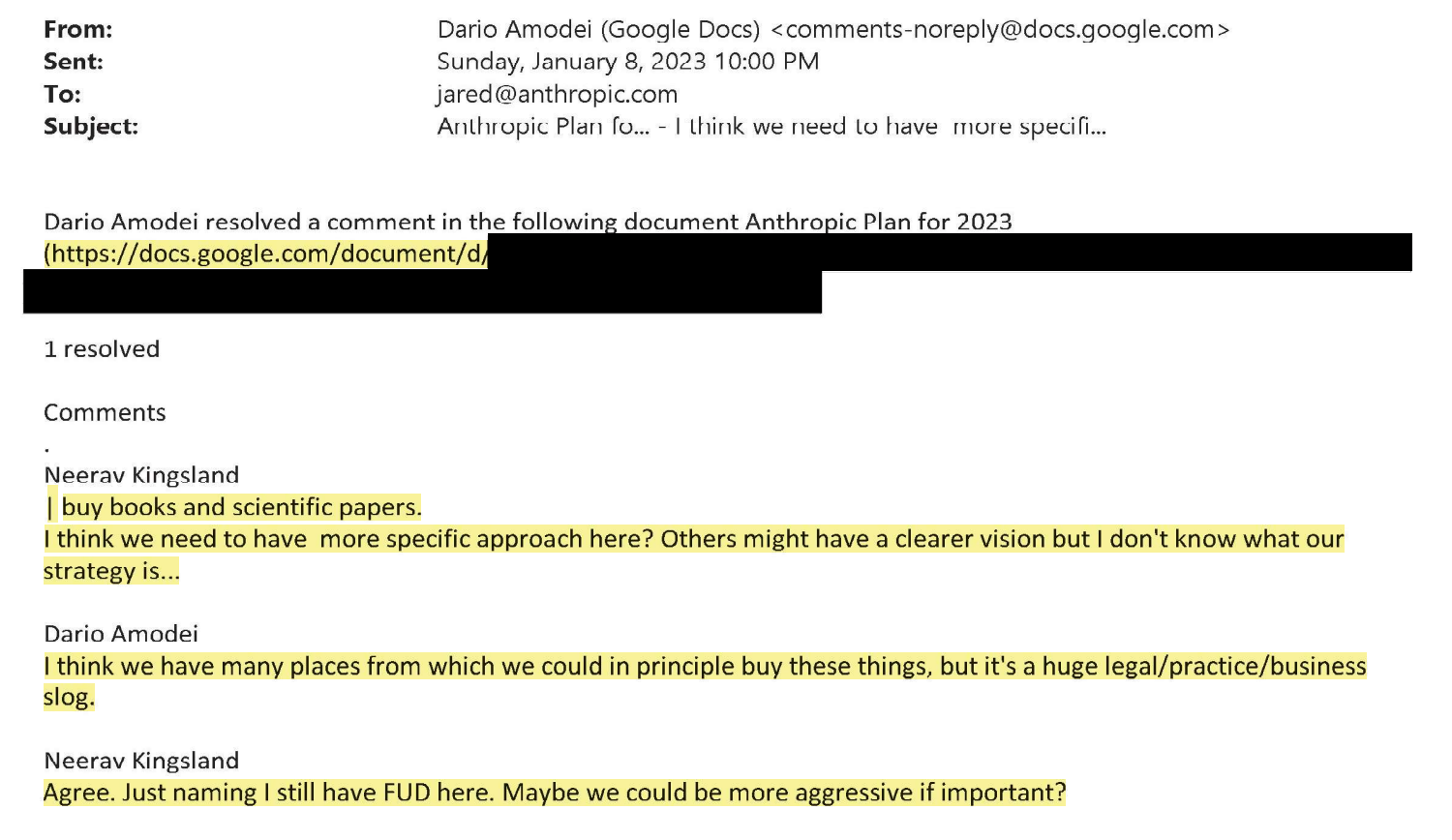
When Anthropic needed human writing to build Claude, CEO Dario Amodei admitted in an internal 2023 planning note that buying licenses was simply too much "legal - practice - business slog."
So between 2021 and 2022, co-founder Ben Mann torrented over seven million pirated books from shadow libraries like LibGen and Pirate Library Mirror to hoard "forever."
We believe that when that grew legally awkward in 2024, Anthropic launched "Project Panama" - an operation to slice the spines off millions of physical books and scan them using a "soft codename."
In June 2025, Judge William Alsup ruled that pirating millions of books for a permanent library wasn’t fair use, forcing a $1.5 billion class-action settlement - a bill equal to a third of Anthropic's entire 2025 revenue, which the company's S-1 non-GAAP tables scrub out as "not indicative of ongoing operations."
A little look over the other window, and there you will find out that Reddit is suing over 100,000+ unauthorized bot scrapes that continued after Anthropic promised it had stopped, while major music publishers are also suing Dario and Mann personally over pirated lyrics.
Now, for a company with such a history, you would expect otherwise if the shoe were on the other foot.
Shocker? No!
In its Consumer and Commercial Terms, Anthropic strictly forbids anyone from scraping Claude or using its outputs to train a competing model.
And in February 2026, Anthropic published an indignant report accusing DeepSeek, Moonshot, and MiniMax of running 16 million exchanges with Claude to extract its capabilities "at a fraction of the cost."
Members of the jury, you don't need a law degree to spot the comedy here.
When Anthropic takes the world's work without paying to save time and money, its S-1 calls it "fair use.”
When a rival does the exact same thing to Claude, Anthropic calls it a national security threat. A threat that Anthropic somehow sees as enough to justify a ban on Chinese open models.
Defense:
Your Honor, the prosecution asks whether Anthropic applied the same standards to its Commercial Terms as it applied to others’ terms.
The record contains two stories, and we’ll first address both in isolation, then illustrate the overarching problem the company faces to this day that prompted it to take these actions in the first place.
The prosecution refers to Case 3:24-cv-05417-WHA in the United States District Court for the Northern District of California, in which, in early 2021, a co-founder of Anthropic downloaded 196,640 unauthorized copies of copyrighted books from the pirate library Books3.
The Defense fully acknowledges the legitimacy of the record before us, nor do we deny how irresponsible the wording Dario Amodei used in the email correspondence regarding the matter.
However, Anthropic fully acknowledged it was in the wrong and did not wait for a verdict; instead, it agreed to pay about $3,000 per roughly 500,000 works and to delete the pirated files.
Moving on to the second record put before us, Your Honor.
From an optics perspective, Project Panama can be viewed as somewhat alarming when you consider how information was obtained by dismantling book bindings.
But optics do not constitute law, and the method used was 100% in accordance with fair use laws, since the books were acquired through purchase rather than piracy.
District Judge William Alsup likened the AI training process to teachers “teaching school children how to write well,” and ruled that Anthropic had the right to use the books for training because it processed the works in a “transformative” manner.
Thus, lumping the two cases together is, quite frankly, unfair. In fact, it shows that the company corrected its course by obtaining the data it needed through legitimate means.
In the specific case of Project Panama, Anthropic spent tens of millions acquiring the books, preparing them, and ultimately scanning them for training purposes.
Now, onto the why, Your Honor.
The reasons a company might go to such lengths to obtain books and materials can seem excessive, but there is a legitimate reason that continues to affect Anthropic and other frontier labs to this day.
The name LLM is an abbreviation for Large Language Model, meaning it is trained on large amounts of text to “comprehend” human queries and answer them in a format that’s understandable to everyone.
The more text and examples of good writing that we give to the model, the better its responses will be.
While you might think that such a resource would be infinite, it is quite the opposite.
In a 2024 Echo AI paper titled “Will we run out of data?” researchers concluded that the total effective stock of human-generated public text data is on the order of 300 trillion tokens and projects that models will use it up between 2026 and 2032.
This estimate includes only data of sufficiently high quality for training and accounts for the possibility of training models for multiple epochs.
Books matter because they teach the model to write better when compared to, say, imitating erratic online prose. And there are only so many books in the world we can use before we run out.
Now, to address the concern about the apparent “hypocrisy” of us demonizing other labs for distilling our models, there’s a difference between using works to learn general capabilities (like a child reading books and learning from them) and deliberately querying a rival to reproduce its capabilities (akin to looking at another person’s paper in an exam to easily copy what they are producing).
We understand that most listeners may not grasp the nuances at first. We hope this analogy clarifies the difference between Anthropic purchasing and scanning books for learning purposes, and explains why running 16 million exchanges with Claude to extract its capabilities would constitute an infringement of fair use policies.
Charge III: Allegations of changing user terms without informed consent
Question to the jury:
Did Anthropic give users a clear and meaningful choice about how their conversations would be used?
Prosecution:
May it please the court, the prosecution would like to enter two exhibits into evidence:
Exhibit A: the contract Anthropic used to win its customers, and
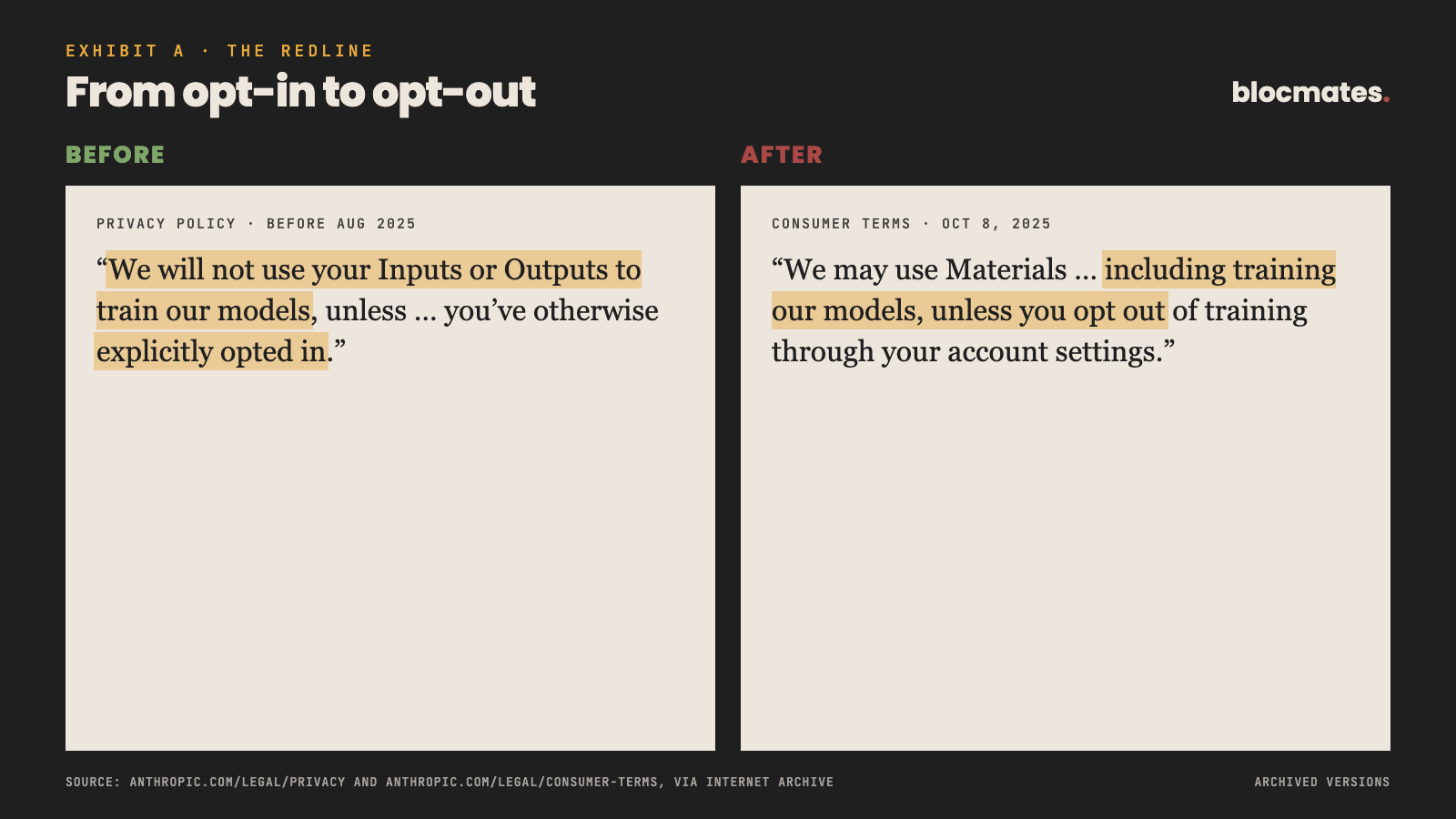
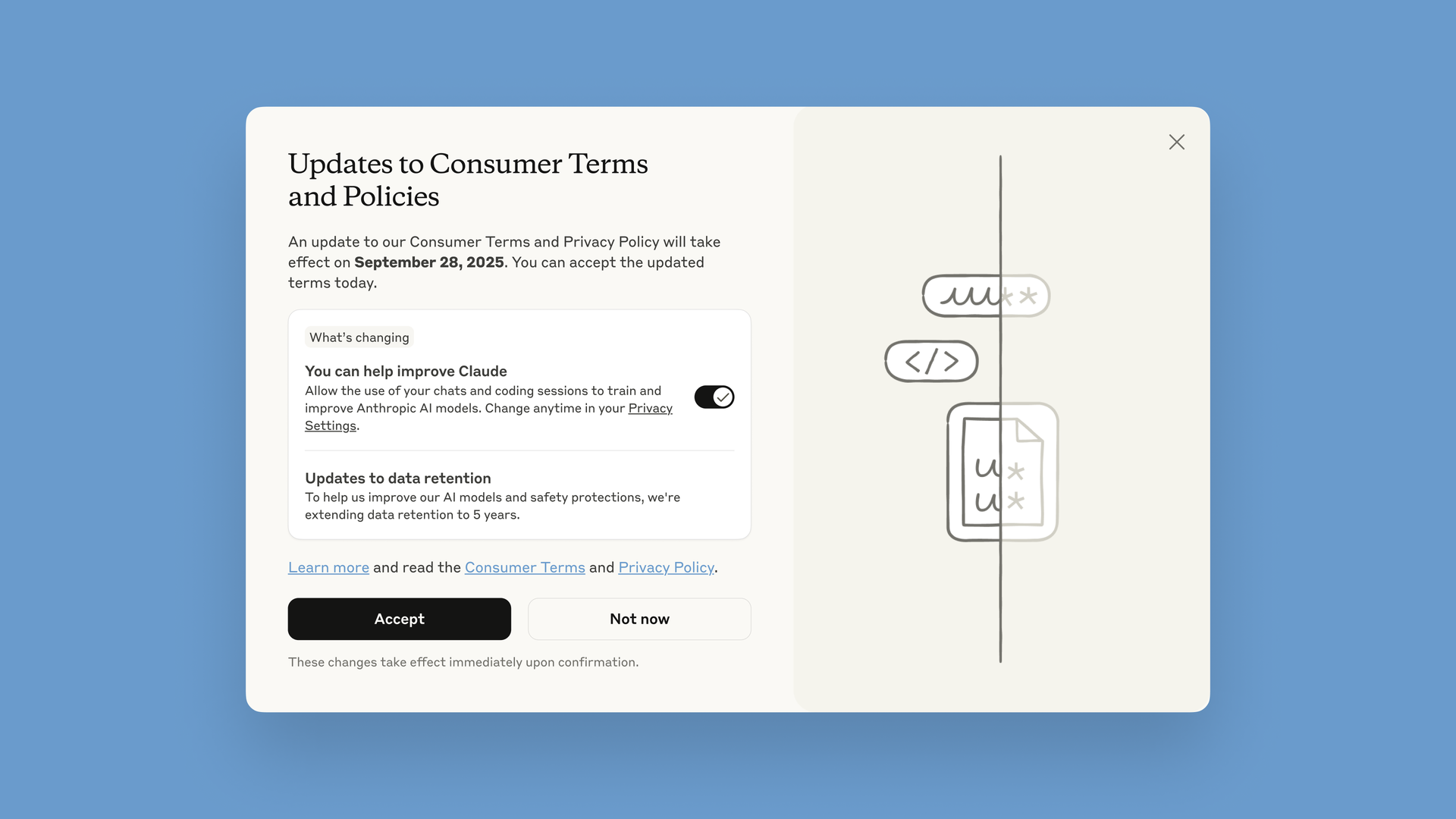
Exhibit B: the pop-up screen Anthropic used to harvest its users’ data.
I have no experience whatsoever in Contract Law, but I do know that consent is only valid if both parties know what they are agreeing to.
For years, Anthropic's Consumer Terms and Privacy Policy contained a clear, black-and-white covenant:
"We will not use your Inputs or Outputs to train our models" unless a user explicitly opts in, submits feedback, or triggers a safety flag.
Unflagged conversations were deleted from Anthropic's servers within 30 days.
Now examine the second exhibit, introduced on August 28, 2025.
Ahead of this IPO, Anthropic rewrote its terms for every Claude Free, Pro, and Max subscriber - including developers writing proprietary code inside Claude Code.
Instead of asking users for an affirmative opt-in, Anthropic interrupted their active workflows with an in-app pop-up headed by a prominent black "Accept" button.
Tucked underneath in smaller text sat a toggle - "Allow the use of your chats and coding sessions to train and improve Anthropic AI models" - pre-switched to "On."
The record shows what a single click on "Accept" did - it immediately signed away a user's chats and coding sessions for model training; it pulled in any older chat thread the instant a user sent a single follow-up message in it; and it extended Anthropic's data retention sixtyfold, from 30 days to five full years.
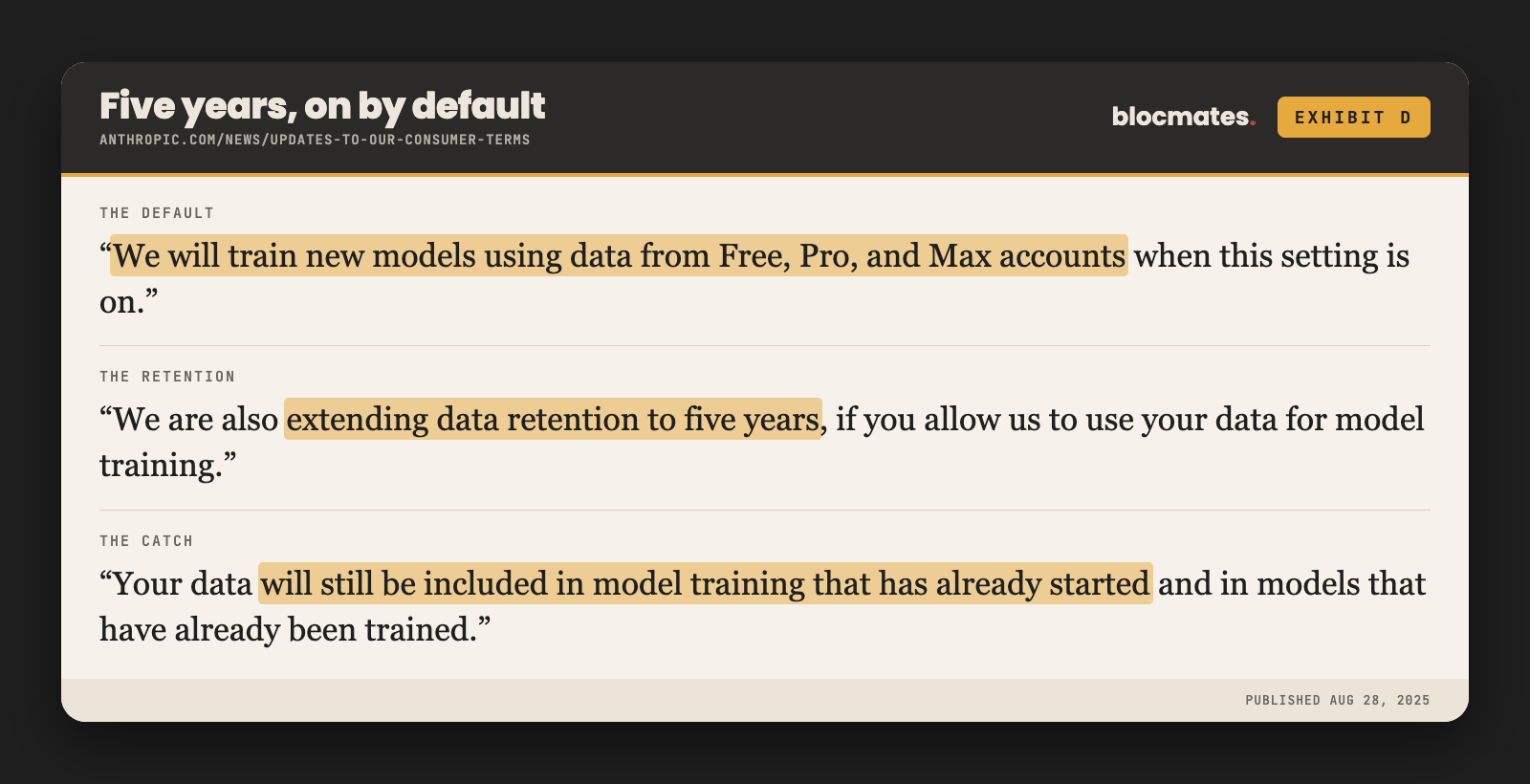
Even if a user later found the buried privacy setting and switched it off, Anthropic kept everything already fed into training runs.
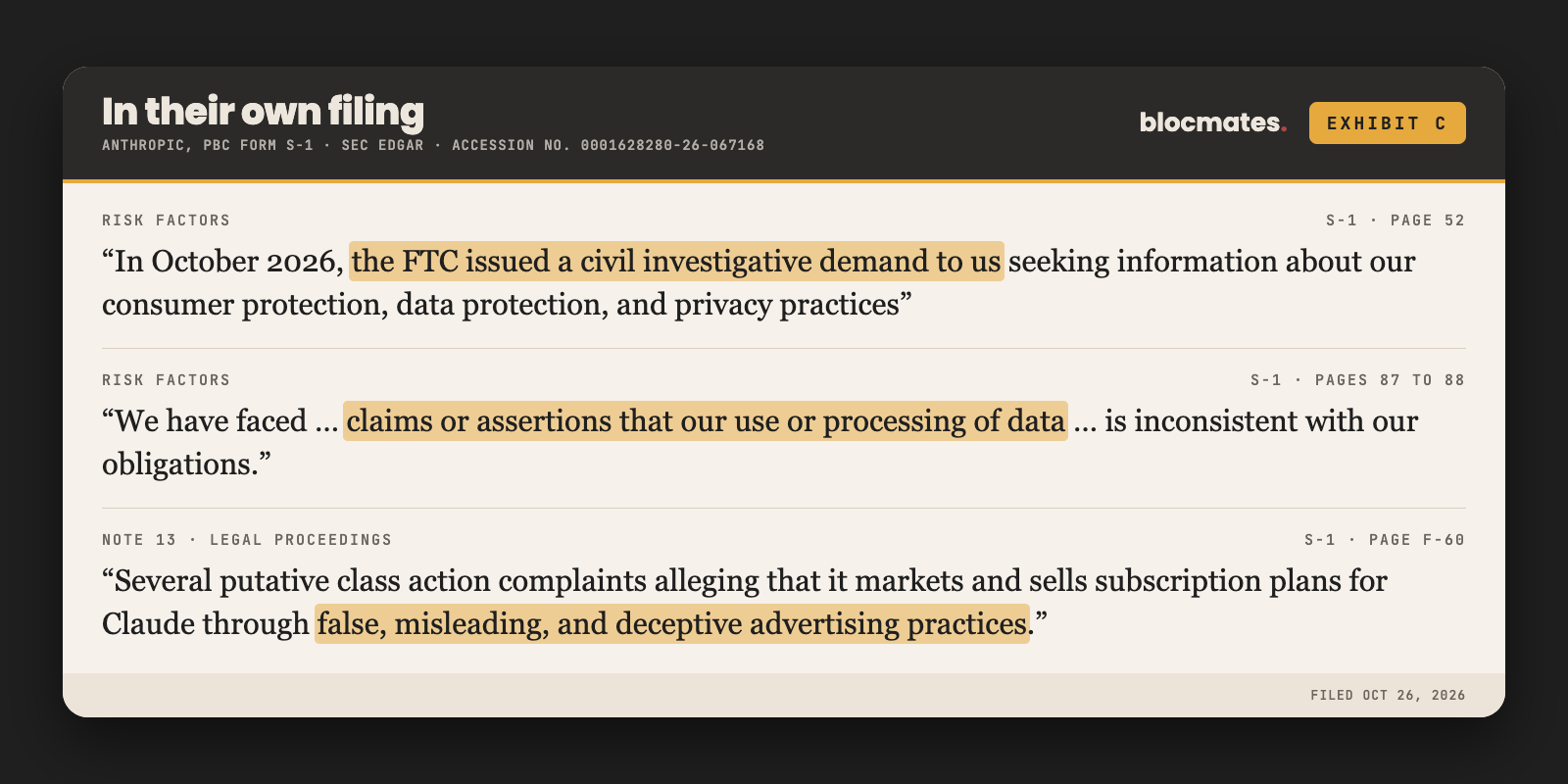
Regulators have started asking questions. According to page 52 of its S-1 in October 2026, the Federal Trade Commission issued a civil investigative demand to Anthropic, probing its consumer protection and privacy practices (the filing leaves out what prompted this).
Members of the jury, the evidence is there for you to examine yourselves and reach a conclusion.
Defense:
Your Honor, the prosecution labels Anthropic's change to its terms and its announcement as extraordinary, yet collecting usage data is not a unique policy. Every website, SaaS application, and social media site is collecting user data today.
Most platforms don’t even announce this, let alone let you opt in or out of this policy.
When Anthropic’s policy changes were rolled out on Aug 28, 2026, Free, Pro, and Max users were given the choice to opt out, as seen in prosecution’s Exhibit B.
Given the sensitive nature, commercial services were excluded altogether, including Claude for Work (which includes Team and Enterprise plans), our API, Amazon Bedrock, Google Cloud’s Vertex API, Claude Gov, and Claude for Education.
For Free, Pro, and Max users who had previously declined to share their data to train Anthropic’s models and opted out when prompted by the pop-up, nothing changed.
For users who had previously declined to share their data for training Anthropic’s models but later ended up in the opt-in group, whether because they misclicked or misunderstood the pop-up, the update applied only to new or resumed chats.
It’s important to note that this decision is not final and can be changed at any time in the privacy settings, but there is a limit.
For users in the latter group who end up opting out, by the time they press that button, their data could already have landed on Anthropic’s servers, ready to be used for training.
Even so, the data is stored in a de-identified format within model training pipelines, and Anthropic uses tools and automated processes to filter or obfuscate sensitive data, and doesn’t sell users’ data to third parties.
We’ll conclude our defense by stating our intentions regarding data collection.
Data from willing users helps us improve our models because real-world interactions reveal which responses are most useful.
For example, a developer debugging with Claude is a signal that helps future models on the same task, and the same data helps safety classifiers become more accurate and less likely to flag harmless conversations.
All in all, Your Honor, we take user privacy very seriously, and regardless of whether you opted in or out, the quality of our service was unaffected.
Charge IV: Allegations on economic reality vs. IPO timing vs. narrative
Question to the jury:
Is Anthropic guilty of speed-running to IPO using narrative theatrics as a shade against economic realities?
Prosecution:
Members of the jury, at a projected trillion-dollar+ valuation, Anthropic is asking investors to believe in more than a useful product.
To justify that price, they must believe that the company's striking growth as revealed in the S-1 filing can survive competition, sustain profits, and finance the infrastructure required to keep the company ahead.
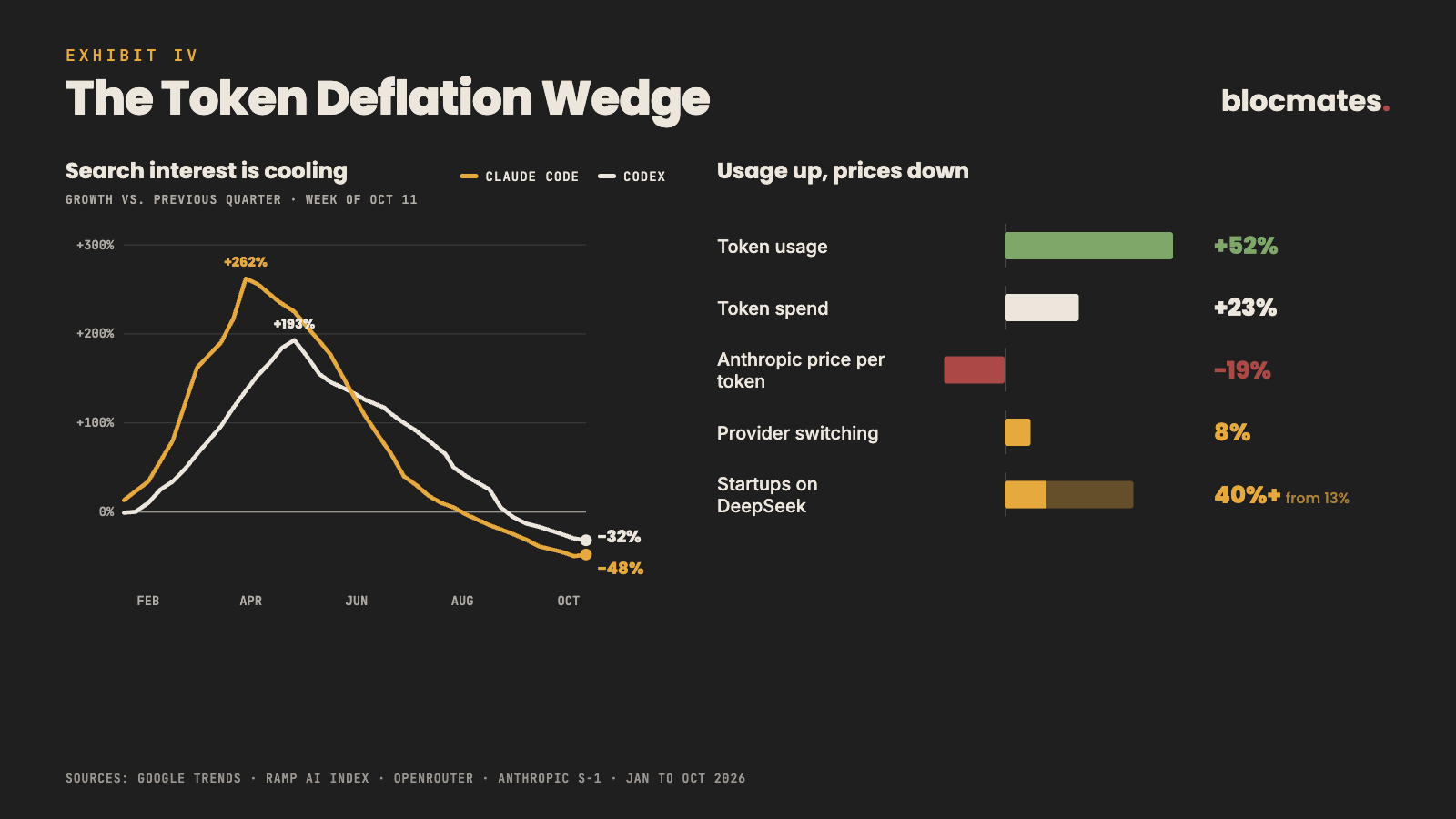
When we look into the metrics, we are told a more complicated story. The accompanying chart shows declining search interest for Claude Code (-48%) and Codex (-32%) across frontier labs.
Search interest alone does not establish falling usage, of course, but corporate transaction data raise more consequential questions.
Ramp reports that provider switching reached 8% in September, as businesses defaulted to cheaper models where premium capabilities were unnecessary for much of their work.
In its sample, token consumption grew 52.4% between the weeks ending September 13 and October 11, while spending grew just 23%, and Anthropic's blended price per million tokens fell approximately 19%.
Against this backdrop sits the reality of cheaper open-weight models. On OpenRouter, more than 40% of US startups used DeepSeek in production, versus approximately 13% in January.
These samples do not gavel Anthropic's decline - indeed, it gained spending share in Ramp's latest comparison, but it also shows that demand can grow while customers resist paying more.
And in its own S-1 filing (pages 41 and 43), Anthropic admits that open-weight models "exert pricing pressure on our offerings," even as it argues that competitors illegally distill its proprietary models without safety controls.
Now recall Charge I, ladies and gentlemen of the Jury - safety compromises.
On page 143 of the S-1, Anthropic discloses that more than 80% of its third-quarter revenue came from models released within the preceding six months. Which means that its commercial performance depends heavily on continuous new releases - the very releases its safety commitments may require delaying.
Permit me to introduce Good Alexander's October 21 essay at this juncture. In it, he argues:
"...OpenAI and Anthropic will lobby the US government to ban DeepSeek. Anthropic will be forced to tell a story about how 'AI isn't just inference'."
That last line intrigues us, ladies and gentlemen of the jury - not as proof of Anthropic's intent, but as a proposition to test against what we have witnessed in the months and weeks leading up to this IPO:
- models deemed too dangerous to release,
- scientific breakthroughs,
- biotech buyouts, and
- experiments suggesting that Claude might help develop treatments.
All convenient headlines right before an IPO, moving the discussion away from today's token prices, customer switching, and infrastructure commitments toward opportunities whose commercial returns remain uncertain.
In fact, consider Citrini's scorpion-antivenom experiment, supported with Anthropic compute just days before the filing, where promising protein-binding results were effectively not a working medicine, let alone established revenue.
The prosecution accepts that Claude has commercial value, and we also accept that investors buy future earnings.
But a vast potential market is not revenue. Scientific promise is not a defensible margin; no matter how important to humanity a finding might be, it does not establish what a share should cost.
In fact, as page 48 of the S-1 warns, certain futuristic biological and scientific capabilities carry catastrophic risks, making economic upside the last thing on anyone's mind in such a scenario.
Our allegation is that Anthropic is guilty of using spectacle to help bridge gaps where concrete financial evidence falls short.
Defense:
With all due respect to the opposing side, we’d like to state the obvious, Your Honor.
Using “search interest” as a metric for demand while also arguing for Anthropic’s own misdirection is ironic. Search interest has no bearing on commercial success.
Moving to the actual allegation posed by the prosecution, and that which pertains to the use of spectacle to help bridge gaps where concrete financial evidence falls short.
The prosecution raises points and figures that appear convincing, but deliberately glosses over the intricacies and nuances hidden behind them.
Since the validity and longevity of Anthropic’s offering are questioned, the defense would like to share some numbers as well, Your Honor.
In the same Ramp report, Anthropic accounted for 60.1% of token spending among Ramp businesses, up from 53.8% a month earlier, while OpenAI fell from 42.4% to 36.4%. In September, 43.8% of Ramp’s businesses paid Anthropic, against 39.8% for OpenAI.
We could look at similar surveys or analysis all day, but what’s most important is whether any of that makes money for the company and what the company’s future prospects are for bringing in additional revenue streams. Let’s inspect the S-1 filing in detail.
Revenue rose from $41 million in 2023 to $386 million in 2024 and $4.585 billion in 2025, then reached $16.286 billion in the first half of 2026 alone. The third quarter added $5.401 billion over the second quarter, which is more than Anthropic’s entire 2025 revenue in a single quarter.
Admittedly, Anthropic’s revenue is heavily skewed toward the top, with about 250 customers spending $10 million or more, more than 1,900 spending $1 million or more, and 11,900 customers spending $100,000 or more per year.
Even with that customer base broadening (79% of Q3 revenue came from outside the top five customers, up from 64% in Q1, and no single customer exceeded 10% of nine-month revenue), that distribution makes sense given what Anthropic offers.
Anthropic’s frontier models consistently rank first on leaderboards across the most relevant areas, including coding, text, and agent work.
But frontier doesn’t come cheap, even as the price of frontier capability is falling: Opus 5.5 cut customer costs per task by about 40% compared with Opus 5.
But institutions are willing to pay the premium upfront because a cheaper model can end up costing more if failures, retries, or outright hallucinations are rampant (and you probably still want a frontier model checking their work in the end anyway).
The fact that users switch to newer models upon their release cannot be considered a defect; rather, it demonstrates Anthropic’s ability to iterate at the frontier while delivering higher quality per token, thereby reducing the total cost of completing useful work.
All of this to say, Your Honor, that Anthropic’s meteoric rise and rate of product releases are not a cheap trick to lure investors.
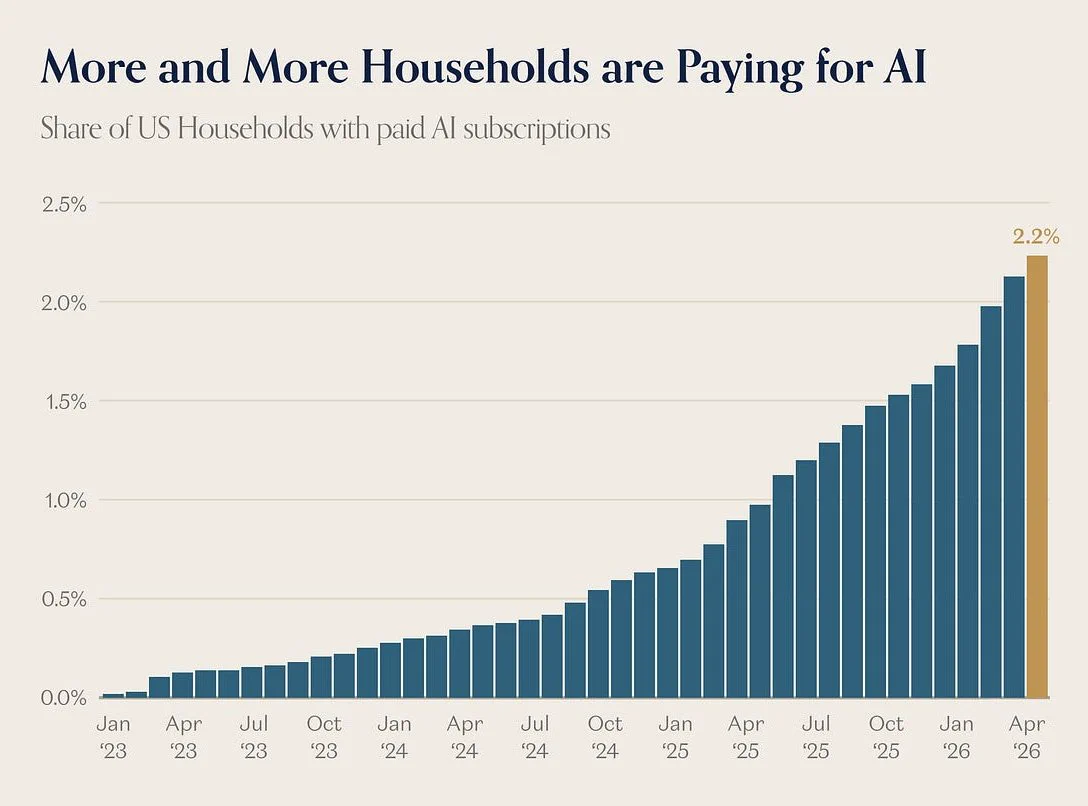
Rather, they’re why we believe the IPO valuation is fair, given our lead at the frontier, our revenue growth, and the revenue prospects from onboarding more users, with the TAM still largely untapped.
Closing Statement (Prosecution)
Ladies and gentlemen of the Jury, you have now heard four charges, and you have also seen the defense’s response to each of them.
As users of Claude ourselves internally, I would like to be unequivocally clear that the usefulness of Anthropic’s models is not what is on trial here.
Anthropic has indeed built a genuinely useful product, remarkably efficient, and mind-blowing at times that it is ridiculous to fully grasp the technology we have in our hands.
However, the same company that has made this is the same one that was built on founding ideals and promises of uncompromising alignment to humanity.
These ideals extend beyond the capacity of the company’s products to remain aligned with humans, but also to the truth versus reality of the alignment in values and ideals by those behind the wheel.
It is based on this that these charges have been argued before you today against Anthropic’s conduct.
Ladies and gentlemen, the title of this piece asks “How To Get Away With a Trillion-Dollar IPO.”
Whether Anthropic gets away with the conduct alleged here is now a question for you.
The prosecution rests.
Closing Statement (Defense)
Your Honor, esteemed members of the jury, the title asks how to get away with a trillion-dollar IPO. But “getting away with it” would imply concealment and other efforts to deceive the public, which is precisely the opposite of what Anthropic has done.
Every point, exhibit, and argument raised by the prosecution was drawn from publicly available sources, and most of it came from our own policy updates, filings, and other documentation.
The defense does not claim a spotless record on Anthropic’s part, but rather one that demonstrates a readiness to acknowledge its wrongs when faced with the law.
What we do not accept, however, are the allegations laid forth by the prosecution, and we hope our arguments helped explain the reasoning behind Anthropic’s actions and showed that they were neither unlawful nor deceptive.
Before the Jury reaches its final verdict, we would like to point out the unprecedented nature of Anthropic’s operations. For the first time in human history, mankind has created something so powerful that it could reshape society as we know it.
If the frontier of that technology lands in the wrong hands, we fear humanity is not prepared for the consequences. It’s precisely for that reason that Anthropic continues to push the boundaries of AI in a manner that’s both safe and mindful of the many adversaries that loom overseas.
That would be it from the Defense, Your Honor.
Disclaimer: This article is for informational and entertainment purposes only and is not financial, investment, or legal advice, nor does it serve as a recommendation to buy or sell any security or asset, including pre-IPO Anthropic exposure. Do not take any allegation asserted in the article at face value. Make sure you do your own research.
This is a mock trial: the prosecution and defense each argue their respective sides, and their characterizations are personal opinions, not findings of fact. Facts are drawn from public sources including Anthropic’s preliminary S-1 and subsequent amendment filings.
blocmates is not affiliated with or compensated by Anthropic; our team uses Claude, and the authors do not hold positions in any asset discussed. Trademarks belong to their respective owners.