Hyperliquid is arguably the biggest onchain success story this industry will look back on 10+ years from now.
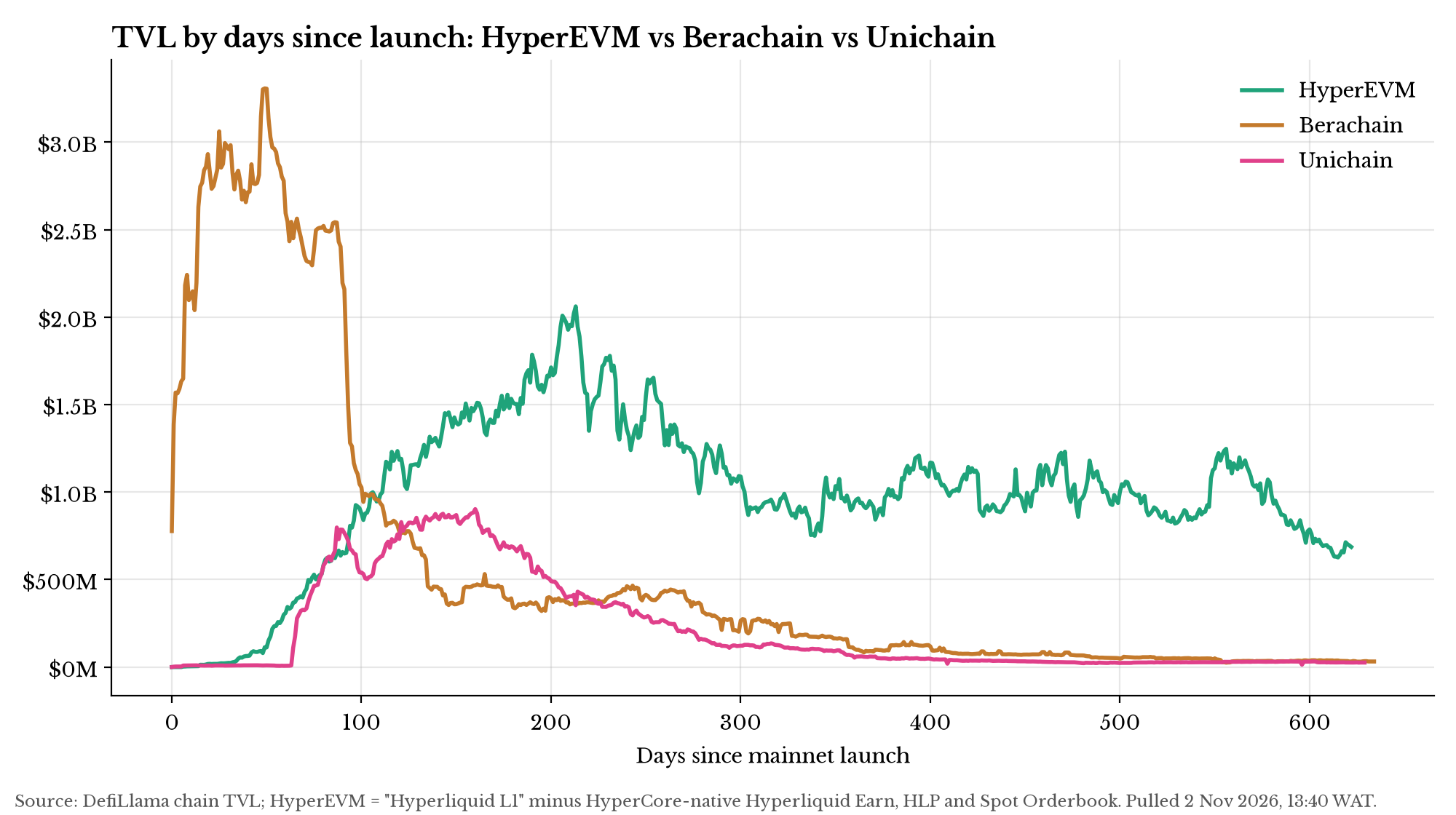
HyperEVM, on the other hand, has, contrary to popular opinion, not performed nearly as badly as sentiment around it suggests.
In fact, the HyperEVM has outperformed every chain that launched around the same period it came online, including the likes of Berachain and Unichain.
However, when compared to Hyperliquid’s core financial engine, HyperCore, and its associated products, as well as networks like Solana and Base, which boast substantial application activity, HyperEVM’s ecosystem remains relatively small.
For perspective, the HyperEVM was built specifically to allow for shared network and liquidity effects between Core and the EVM. Per the docs,
“Builders can plug into the onchain order book liquidity of HyperCore via the HyperEVM… A theme of the HyperEVM is to abstract away the deep liquidity on HyperCore as a building block for arbitrary user applications.”
This blockspace sharing design choice created a cog for the HyperEVM.
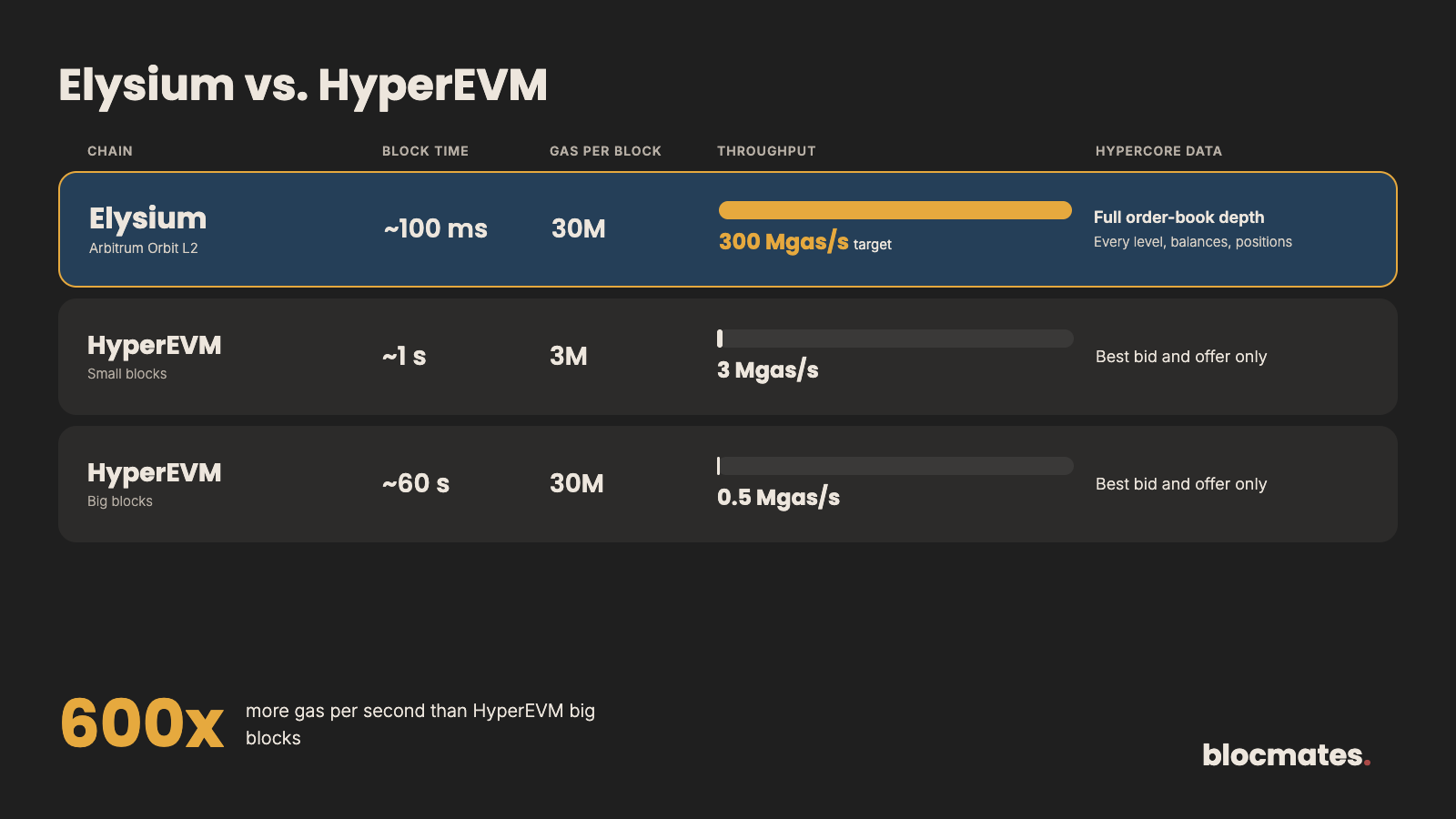
While its counterparts enjoyed trade-driven volume and activity, its shared state with HyperCore constrained its max throughput to about 3-3.5 million gas per second - a metric that is purely uninviting and unusable for the dominant type of niche activity (trading) pertinent to apps.
This implies that during periods of high activity, the cost of trading or swapping tokens on HyperEVM becomes economically prohibitive.
The result is that the HyperEVM cannot attract PropAMMs or traders because, as soon as things pick up steam, it dissipates almost immediately due to the cost of such activities and other associated bottlenecks.
We believe this has significantly contributed to the perception that the HyperEVM has fallen short of expectations, creating the very conditions that have prompted the introduction of Elysium.
What is Elysium?
Elysium is an Arbitrum Orbit layer-2 network built as a general-purpose, high-performance blockchain for Hyperliquid.
The team behind Elysium is Kinetiq - the largest liquid staking platform on Hyperliquid. Kinetiq is building Hyperliquid-aligned products, leveraging HyperCore’s depth and architecture to create economic value.
Design specs
As an upgrade to the constrained HyperEVM, Kinetiq has built Elysium to operate at a 300 milliongas-per-second capacity with 100ms blocks, settling on the HyperEVM and utilizing HYPE as gas, while providing ready tooling for developers to build performant applications on the network.
The Elysium architecture also provides a direct link to the HyperCore by running its own shared-site or adjacent node that reads from and writes to Core.
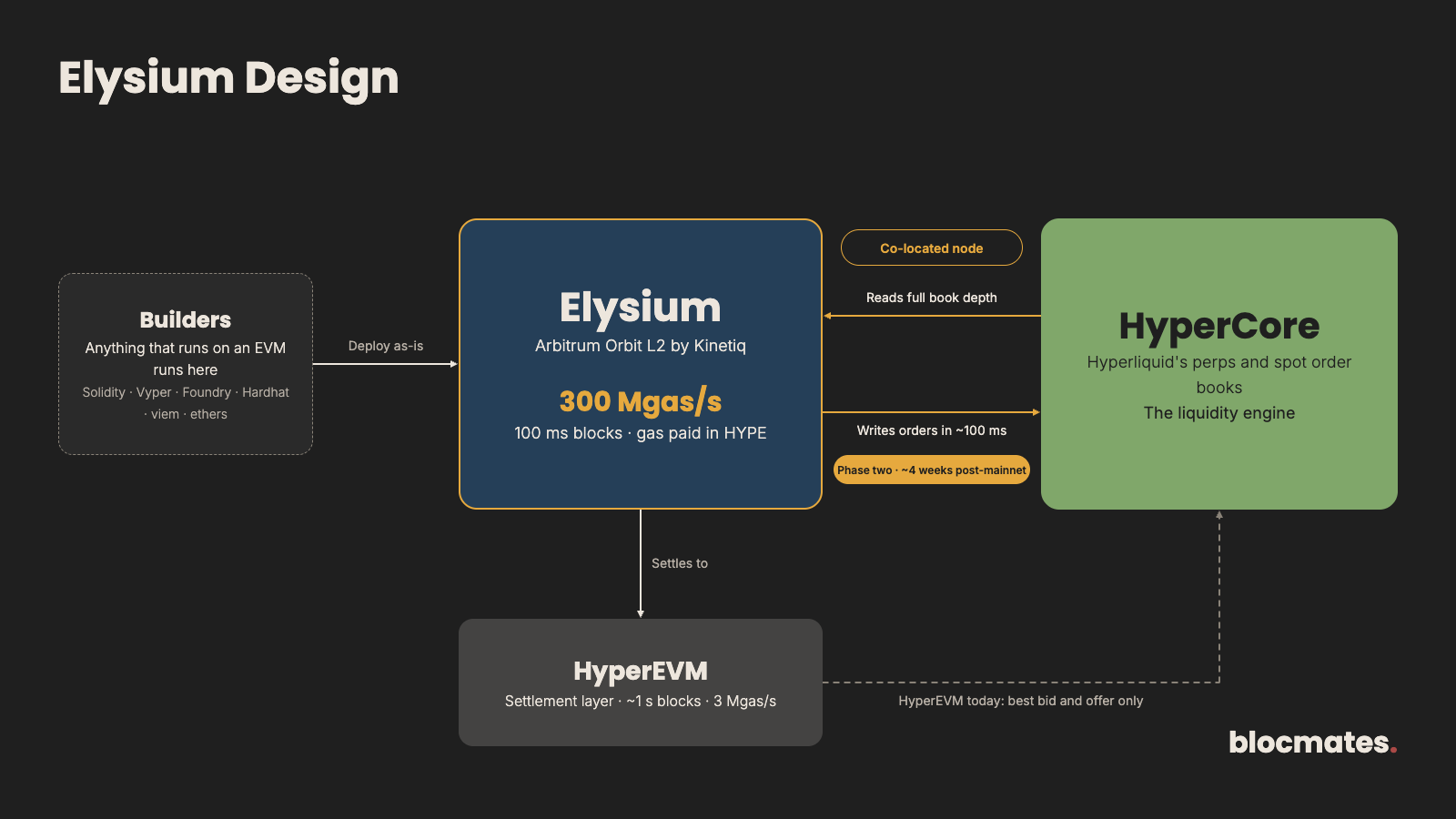
As a general-purpose network, whatever can be built on an EVM environment can also be built on Elysium.
An important feature of the Elysium network is that it extends beyond what was obtainable on the HyperEVM, even beyond throughput, toward data.
On this front, Elysium’s contracts are built to access levels, balances, and positions, basically reading the full HyperCore depth, using a precompile and not needing oracle pushes.
Although both this full read-and-write feature and the mainnet arrive later, it is a significant upgrade over what was possible directly on the HyperEVM.
What Elysium means for the Hyperliquid economy
The first obvious economic benefit to the Hyperliquid ecosystem is in Kinetiq’s choice to use HYPE as Elysium’s gas token.
Every transaction requires HYPE to be spent as gas, effectively turning on demand for the token, and with Elysium particularly designed for trading, this demand should not be underestimated.
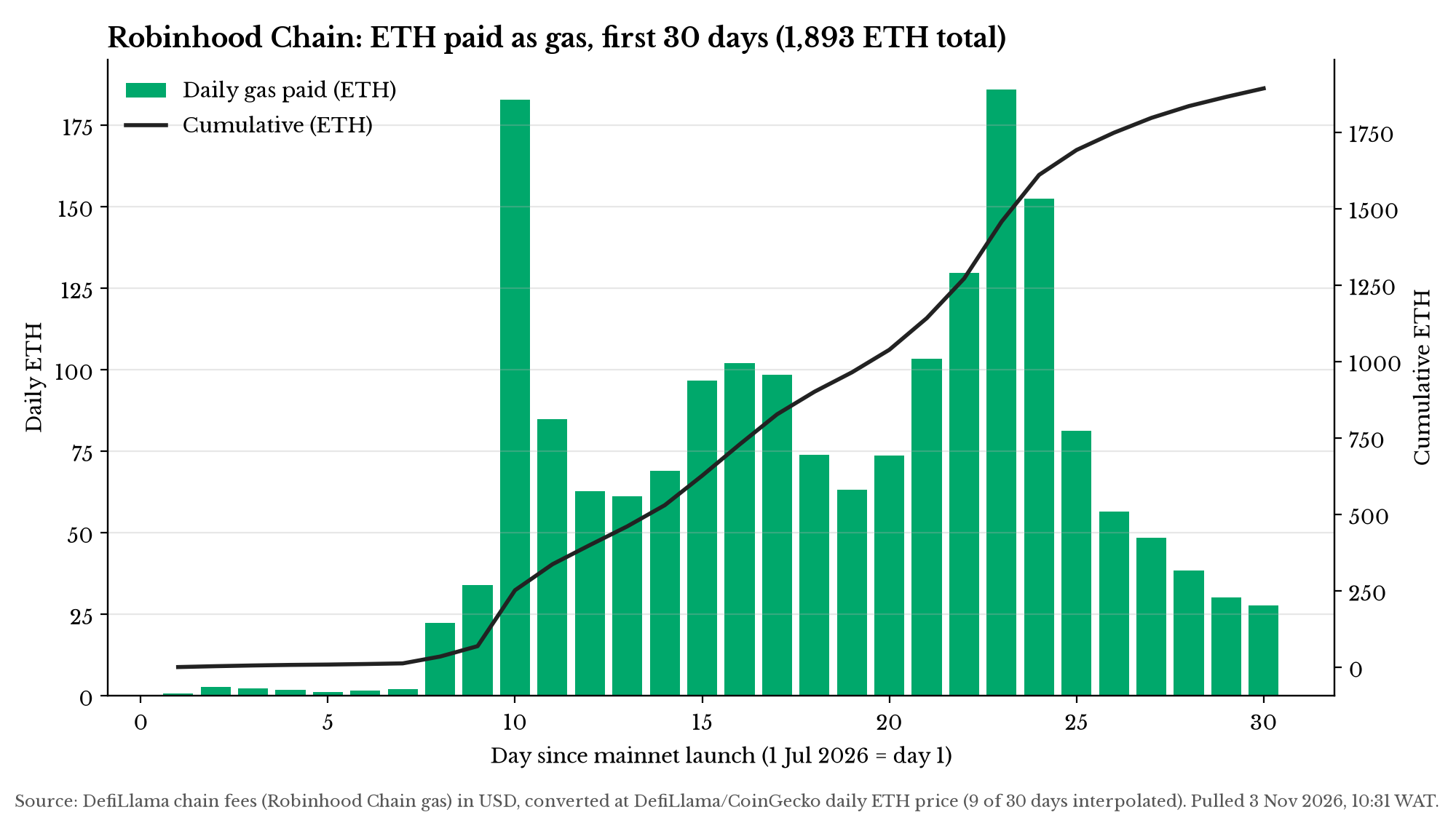
For perspective, Robinhood, an ArbOS L2, drove over $3 million in gas spend in ETH within the first 30 days of launch.
From an economic standpoint, Elysium’s co-located architecture is designed to strengthen the relationship between apps built on the network and Hyperliquid’s core exchange.
By enabling applications to hedge, route, and settle transactions directly through HyperCore, Elysium could drive additional trading volume to the exchange, generating more fees and, in turn, supporting further HYPE burns through the Assistance Fund.
This economic alignment extends to Elysium’s revenue-sharing model, which is structured to incentivize app development and reward builders for contributing to network activity.
Under this model, 25% of sequencer revenue is automatically distributed to builders whose smart contracts consume Elysium’s blockspace, creating a direct financial incentive to deploy and grow applications on the network.
An even larger share, 50% of sequencer revenue, is allocated to market purchases of KNTQ, Kinetiq’s governance and value-accrual token.
These purchased tokens are then transferred to the Hyperliquid Assistance Fund, potentially reducing KNTQ’s circulating supply and introducing deflationary pressure.
Together, these mechanisms create a potential economic flywheel in which greater app activity generates more sequencer revenue, which in turn supports builder incentives and KNTQ purchases.
This could, in turn, strengthen demand for Kinetiq’s ecosystem and encourage more HYPE to be staked through its liquid staking token, kHYPE.
The remaining 25% is allocated to protocol operations.
We are already seeing signs of economic readiness with a lineup of strong applications ready to deploy on Elysium, including support from fomo for trading, Uniswap, Derive, and other infrastructure projects.
But beyond these established apps, Elysium's familiar and advantageous tooling could actually drive new, innovative apps to HyperEVM or trigger a crossover from other EVM environments to Elysium.
For example, the ability to query live HyperCore state for ordinary call gas, with no oracle contracts, relay hops, or zero continuous push costs, is attractive for financial applications like PropAMMs and products that offer risk-managed vaults or other structured products.
On the write side, contracts deployed on Elysium can submit orders directly to HyperCore’s order books, with just 100ms between trade intent and a resting order.
This capability opens the door to autonomous trading agents, albeit restricted to trading activities, as HyperCore prevents withdrawals and transfers.
Developers can therefore deploy agents to execute automated trading strategies, combining Elysium’s faster block times with low-latency access to Hyperliquid’s deep liquidity and primary order books.
For these apps, Elysium’s tooling provides a significant economic advantage through potential access to Hyperliquid’s existing network of over 3 million trading addresses and more than 334,000 unique active traders at the time of writing.
This is made possible by a comprehensive token lifecycle pipeline that provides developers with a pathway from early-stage innovation to HyperCore’s spot markets.
In practice, anyone can build an innovative app, gain traction, launch and bootstrap a token on an Elysium launchpad, deepen liquidity via PropAMMs, mirror their tokens to HyperEVM, and eventually graduate to a HyperCore spot orderbook, with the potential for further expansion into HIP-3 perp markets.
Bottom line
The network is expected to go live on 9 November, i.e., early next week.
That said, Elysium will not launch with the core features that make it stand out right off the bat. They will be shipped in batches.
The market-data precompile and the keeper fast-write will arrive about four weeks after mainnet. Meanwhile, the network will start its life with a single sequencer and a bunch of whitelisted validators.
However, from where we stand, we believe that the network's design choice is optimal to capture significant economic value, the type that ideally creates a second layer of real economic activity underneath HyperCore.
We believe that Robinhood showed what’s possible with the same Arbitrum Orbit stack. It crossed $1 billion in TVL in 81 days and, in 120 days, could boast apps that had processed $113 billion in DEX volume, against HyperEVM's $4.7 billion over the same period.
This doesn’t automatically mean that Elysium will follow the same playbook, but it does provide useful insight into what rails designed for high-performance trading can deliver when market timing is right as well.