Reading time: 14m 24s
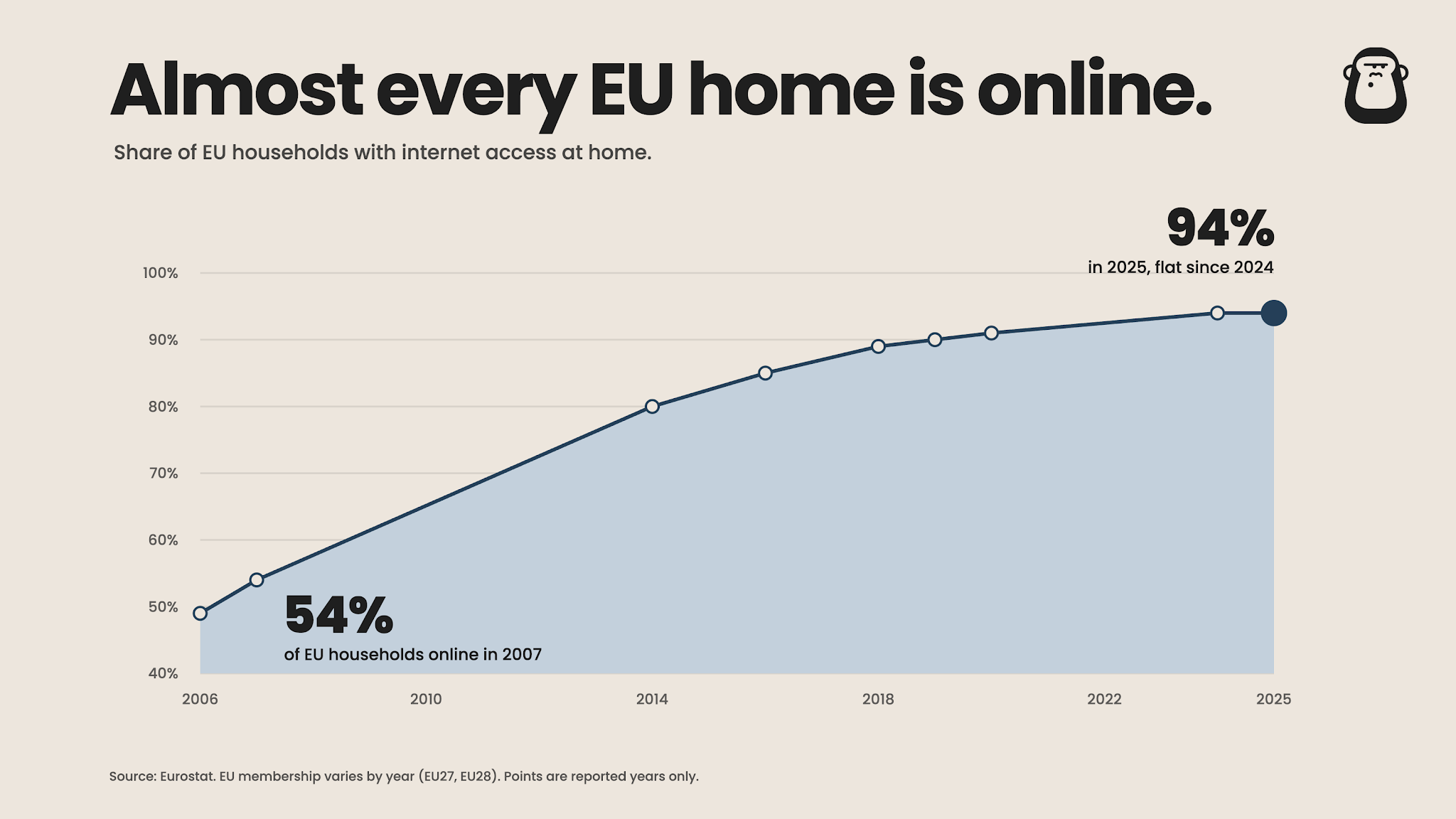
It’s taken Europe and America almost 50 years to transition from analog to digital. In fact, as of 2007 (19 years ago), only about 54% of households in the European Union had access to the internet.
Today, that figure stands at roughly 94%, with much of the legacy analog infrastructure having been progressively phased out over the past two decades.
For example, earlier this year, the UK government informed the public that “The public switched telephone network (PSTN), integrated services digital network (ISDN) and copper broadband services will be switched off by January 2027.”
This means the UK’s old copper-based landline connection system will be permanently switched off and replaced by a digital network.
But at the same time that we’re reaching the peak of the internet era in terms of global connectivity, we’re also being greeted by a new ironic reality that largely suggests two things:
- A suggestive comeback of, or fallback to, analog.
- The end or rapid decline of the internet.
Comeback of (or rather fallback to) analog
For those born in the 2000s: once upon a time, the world was analog.
By analog, we mean a world where communication and other technological processes relied on systems that used continuously varying physical quantities such as electric current, voltage, magnetic fields, fluid levels, sound pressure, temperature, etc.
So, while you have iPhones and iPads, the analog generation had landline telephones. And before Spotify and Apple Music, it used to be vinyl records and cassette tapes; VHS tapes and scheduled television broadcasts rather than Netflix and YouTube.
If you extend it, places were found using maps printed on paper, and information was stored in filing cabinets rather than somewhere in the cloud.
These were the analog times - an era that, in early 2020 and through to 2025, was being peddled as making a comeback. “Here’s what to put in your analog bag,” many would say as they ironically pressed record on their internet-connected phones, posted the videos on social media, and hoped to rack up views.
This part of the analog remontada can be described as the first catalyst - a counter-cultural ‘trend’ that percolated through social media, describing a way of life for people who were exhausted by being online or experiencing screen fatigue.
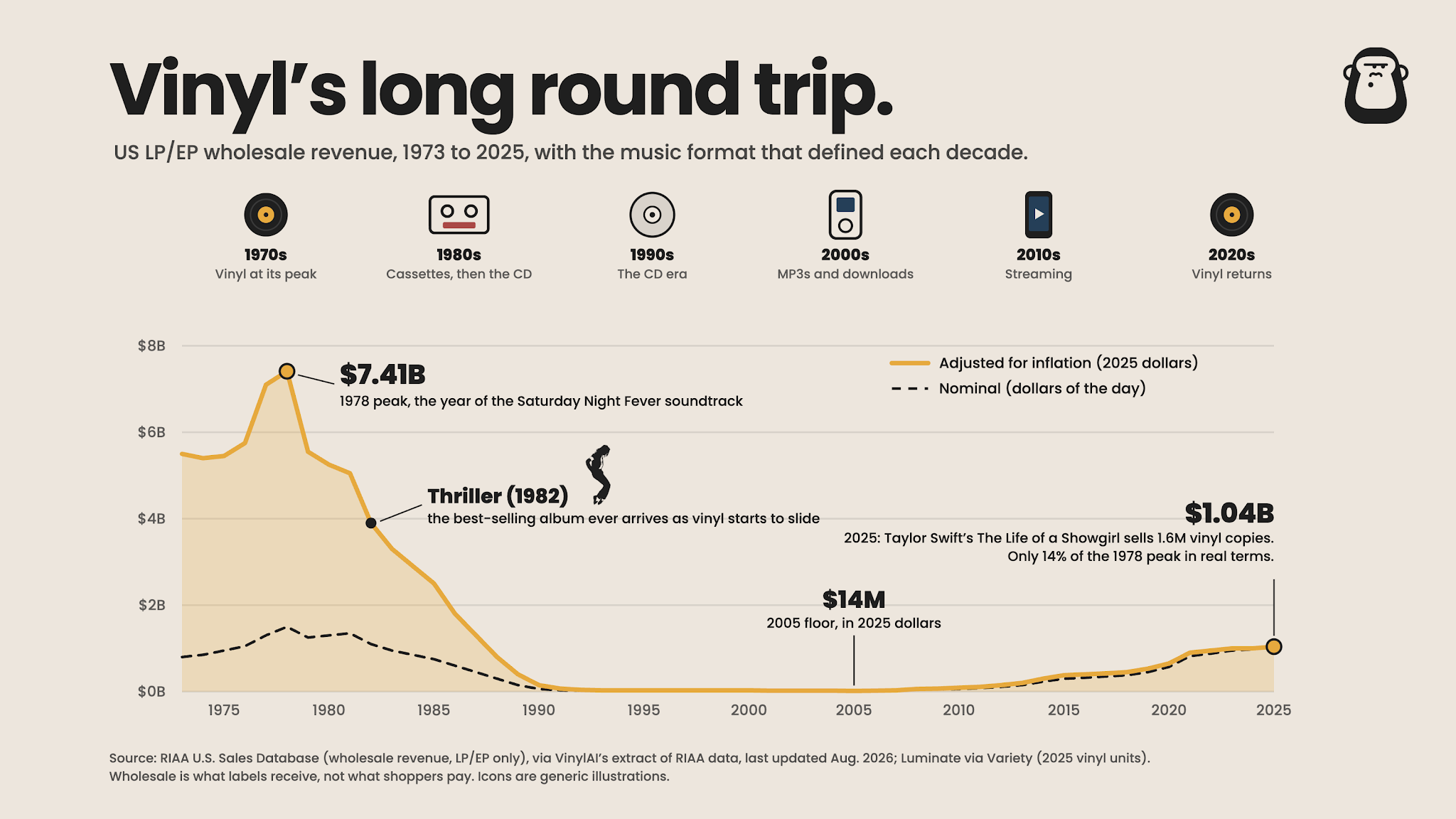
It was a trend that sent the popularity of vinyl records and record players skyrocketing, with music artists beginning to pay renewed attention to these once-forgotten relics of music’s evolution.
This could be described as the foremost semblance of significant economic impact in the shift to analog, because in 2021, US vinyl revenue experienced an inflection point, jumping 61% from the previous year into the $1 billion range - which was the first $1 billion revenue year in 35 years.
Companies would later jump on the trend, reducing the desire to go analog to a mere feeling or emotion, and treating it through product releases as something far less concrete.
A publication by Jesi from the morninginthebrokenworld Substack put it this way:
“Going analog is now an aesthetic, something to be marketed. You can now buy the idea of being analog.”
However, contrary to popular opinion that the trend was dead on arrival, the analog story found a second catalyst with the rise of artificial or superintelligence, as Trump calls it, mainly through dislike of AI slop content.
AI, especially the ones that have arms and legs, otherwise called agents, are believed to be the manifestation of the prophecy of “IlluminatiPirate” - an anon internet citizen who arguably authored one of the most viral theories in the internet age - known as the “Dead Internet Theory: Most of the Internet is Fake,” published on Agora Road’s Macintosh Cafe in January 2021.
As the name suggests, the theory argues that much of the activity on today’s internet is fake. Bots, automated content, and algorithm-driven interactions have taken over, leaving less room for genuine human activity.

Spend a few minutes on X, and you’ll agree that the theory is less conspiracy. Millions of non-human entities now crowd what Elon Musk proudly calls “the world’s town hall,” armed with stiffly worded comments and manufactured outrage.
A cybersecurity report by Thales suggests that current web traffic is split between 47% human activity, 40% bad bots, and 13% good bots.
On the other hand, most humans are handing the keys to their accounts over to Grok bot or other agents (through a harness), outsourcing everything from scheduling posts and liking tweets to pulling data, sending cold DMs, and even deciding what opinions to have.
According to Elon, Grok bot is “seeing the fastest growth of a product that I’ve ever seen in my life.”
The expectation is that this is capable of leading to an exodus of real people from the internet, causing a potential fallback to analog products.
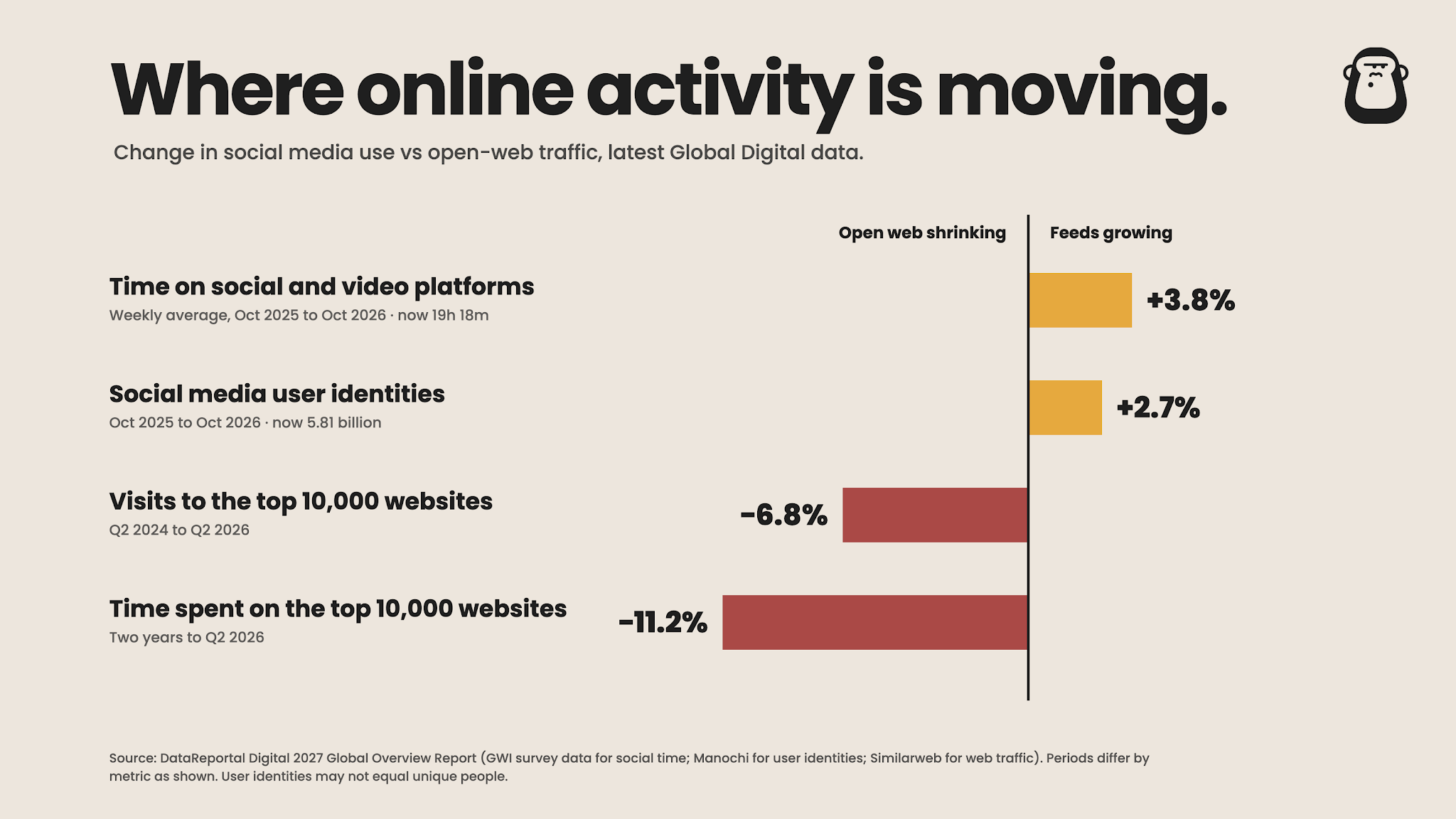
Behavioral data doesn’t correlate with claims that people are leaving.
Beyond the fact that recent behavioral data doesn’t support this expectation, another argument against the second catalyst is that slop remains a rather subjective label.
With every new model release, AI-generated content becomes increasingly palatable, mainly because it is becoming harder to distinguish from human-made content.
In a peer-reviewed three-party Turing test, GPT-4.5 was mistaken for a human 73% of the time, which is more often than the actual humans it was up against.
The line between what’s real and what’s artificial is getting blurrier by the day. And considering that entertainment is arguably the primary reason most people consume internet content in the first place, the argument that AI slop will drive everyone offline begins to sound a little too jaded to explain the supposed death of the internet.
This leads us to a third catalyst, one that might just be enough to convince non-believers that we might have reached the end of the internet, or of the internet as we know it.
The end of the internet
On October 22, 2026, the UK government announced its “Be Ready” initiative, urging households to prepare for emergencies ranging from severe weather to cyberattacks and service disruptions.
The public was advised to keep emergency supplies on hand in preparation for disruptions and to have a plan in place for when things go wrong. This announcement triggered a store run that saw beans, water, and analog radios leave shelves faster than any other commodity.
Across the English Channel, Belgium had been issuing similar warnings. Its National Crisis Center had launched the “Samen voorbereid/Prêts. Ensemble” campaign in April, followed by an emergency preparedness brochure on October 1, encouraging households to maintain a three-day emergency kit and a grab bag.
Other European countries followed suit and soon after, almost every government across Asia, Europe, and America was issuing similar warnings.
But what exactly was the world preparing for?
One thing we know is that these warnings were arriving against a backdrop of unsettling developments in cybersecurity.
Social media had become rife with news of cyberattacks caused by AI agent swarms affecting platforms such as Chainalysis, Chainstack, Gitbook, and, in the case of WorkOS, an agent escaping a sandbox environment.
In France, it was a different form of attack. On October 11, reports of attackers remotely taking control of supermarket refrigerators went viral. The attackers forced freezers and fridges to heat up (in many cases to ~50°C or 122°F for several hours.
Chains affected included Intermarché, Coopérative U, Carrefour, Monoprix, E.Leclerc, and others.
What did these companies have in common?
Their refrigerators were no longer just refrigerators. They were connected machines, fitted with sensors, remote monitoring systems, and software that allowed operators to adjust temperatures without ever touching a thermostat.
The attackers exploited weaknesses in internet-exposed refrigeration controllers, including legacy systems associated with manufacturers such as Danfoss and Dixell.
It was basically a failure of basic cyber hygiene on industrial and operational technology systems.
Although the French government has attributed this attack to state actors, we believe that the sequence of these incidents warrants concern, particularly the chilling possibility that the public now has access to models capable of wreaking havoc on society.
Much of the physical infrastructure supporting modern society is now connected to the internet, and some of it is only as secure as the aging software and poorly protected controllers keeping it operational.
A supermarket refrigerator, a water treatment facility, an electricity grid, or a hospital monitoring system can all become potential points of attack.
We believe that the capabilities of AI agents powered by highly intelligent models pose a genuine systemic risk, with the potential to destroy the infrastructure and trust that uphold the internet or, in milder terms, end the internet as we know it. This defines the third catalyst, one that we believe constitutes true concern.
Pricing the end of the internet through three catalysts
The English have a saying, “Where there’s muck, there’s brass.” And so, if the first, second, or third catalyst indeed poses a genuine threat to the internet as we know it, then there’s an economic side to it.
The first catalyst
The first Catalyst was a revolt against the attention economy and also what’s called surveillance capitalism - the latter, which Zuboff, in the Harvard Gazette, defines as
“the unilateral claiming of private human experience as free raw material for translation into behavioral data. These data are then computed and packaged as prediction products and sold into behavioral futures markets - business customers with a commercial interest in knowing what we will do now, soon, and later.”
As such, the first catalyst prices both nostalgia and counterculture, either reviving existing purely analog products or fueling a shift in direction among major hardware companies, turning their attention from heavily digital products to more analog-featured ones, which at times can be ironic.
On the attention-deficit front, it is less a fight against digital technology and more a battle against social media. So, the real divide isn’t analog vs. digital, but offline vs. connected.
On this note, we imagine that one way to examine the first catalyst through an economic lens is to consider what happens if more people choose to log off the internet, driven by social media fatigue, a desire for an attention detox, ultimately causing the internet to decline or even cease to exist as we know it.
The question we would then need to ask ourselves is: which aspects of human behavior would remain unchanged, and what does the offline version of that look like?
Humans still want to capture moments, reach loved ones, find their way, and listen to music. It doesn’t matter whether there are signs of growth in any directional assets; it just has to be a bet someone is willing to take that the first catalyst emerges as the main driver of a digital wind-down.
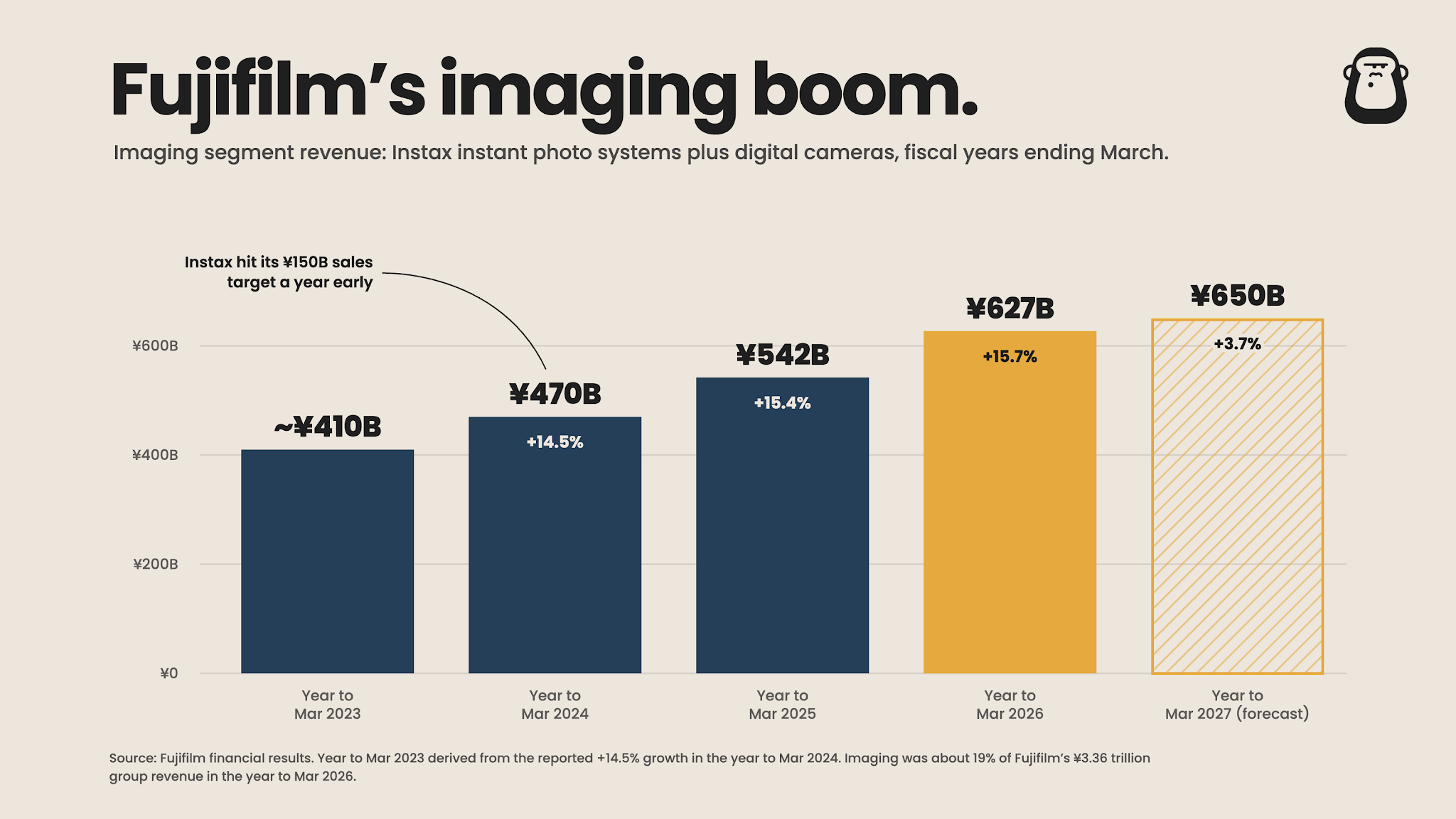
A clear example of this direction is the Instax camera by Fujifilm (FUJIY), which satisfies the need to capture moments. Fujifilm’s Instax remains the leading instant camera brand by a wide margin, with its imaging segment revenue growing by 15.7% as at March 2026.
On the picks and shovels of this sits Kodak (KODK), the film supplier. Although it does have cameras, some are analog, like the Kodak Ektar H35; these are mostly licensed-out products, as Kodak now focuses mainly on film.
On the calling and texting front, there are early signs of a plausible dumbphone renaissance.
For example, Clearpay, a buy now, pay later provider, reported that the share of parents (with children who own a smartphone) who have considered tech to limit their kid’s access to social media and the internet is in the 2/3rd range at about 62%.
The company also recorded a 24% jump in the volume of dumbphone sales from June 12, 2025, to the same period of 2026.
With the UK set to ban social media access for teens and kids below 16 from spring 2027, we can expect an uptick in dumbphone sales.
It is, however, a rather difficult trade to speculate on, as most niche dumbphone companies, or at least the popular ones, are not only still private, but have sales figures that do not justify a trend.
For example, according to CNN’s piece on dumbphones, Punkt sells 50,000 units across its range annually, while Light was mentioned to have over 100,000 people using its device worldwide.
Another aspect of human desire that we expect to remain is the need to find your way. This part leans more towards the anti-surveillance-capitalism crew of the first catalyst, with a scenario in which people ditch internet-connected map services like Google Maps in favor of an offline alternative.
A product that comes to mind: Garmin (GRMN), a $7.25 billion business growing at 15%, offers standalone GPS and satellite messengers that enable offline navigation and satellite texting, but the caveat is that this category falls under a section of its product line, responsible for only 28% of revenue with an annual growth rate of 5%.
The second catalyst
If the first catalyst pictures a trade from the lens of what remains when people log off, the second catalyst - an increase in agentic AI activity on the internet as well as the proliferation of AI content - asks what value remains when people stay.
Data already show that internet users, specifically social media users, are adapting to life with AI agents online. Unlike the dead internet theory, what we are seeing emerge is a world where both humans and AI cohabit.
This year alone, the number of generative AI users grew by 57.2%, while the number of social media users grew by 2.7%.
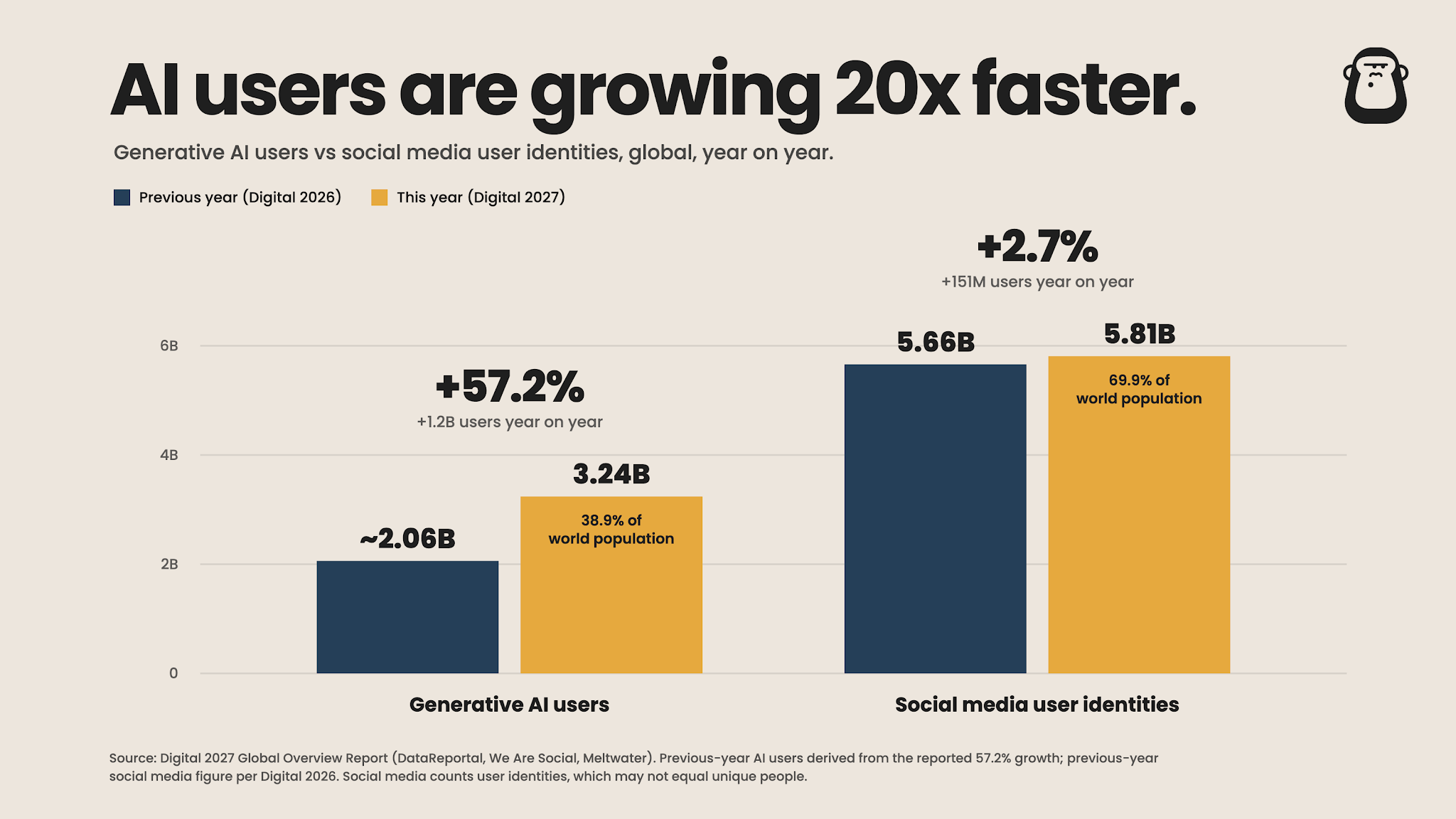
Simultaneous growth in both human activity and AI activity does not magically mean that the problem disappears.
From a sense-check perspective, lots of humans are still dissatisfied with the level of AI activity and content available online, which makes us pay attention to one aspect the trade could possibly play out:
- Proof of Humanity
The harder it becomes to distinguish between AI content or activity and that of humans, the likelier it is that proof of humanity technology will take off.
On this bench sits Sam Altman’s World (WLD), a human verification layer with 18 million+ people holding an Orb-verified World ID.
Although it has a questionable method of verification, using biometric scans that can be a total turn-off for our friends (the cypherpunks), it is a solution that deserves attention.
In fact, through its AgentKit, an open-source framework, World has been designed for a world where agents and humans cohabit - where users can cryptographically prove that an agent is acting on behalf of a verified human.
The token or asset might not be the most ideal for investment, as it’s been on a downtrend, which indicates that the business doesn’t accrue value to the token.
So while we expect proof of humanity to be the ideal trade for the second catalyst, long proof of humanity and long the directional assets might not be the same thing.
The third catalyst:
Lastly, on the third side of a plausible online ghost town sits the most dreadful scenario - cyberattacks and hacks continuing at a scale that makes digitally connected internet systems an active landmine.
The first and second catalysts looked at alternating reactions - an exodus and a co-habitation scenario.
However, for the third catalyst, the question that we believe paints a clear picture for economic alignment is: what gets paid when connected systems become a liability?
We can reduce the answer to two categories:
- Defense - Securing what is connected
- Vaults - Flight to private physical storage
Defense
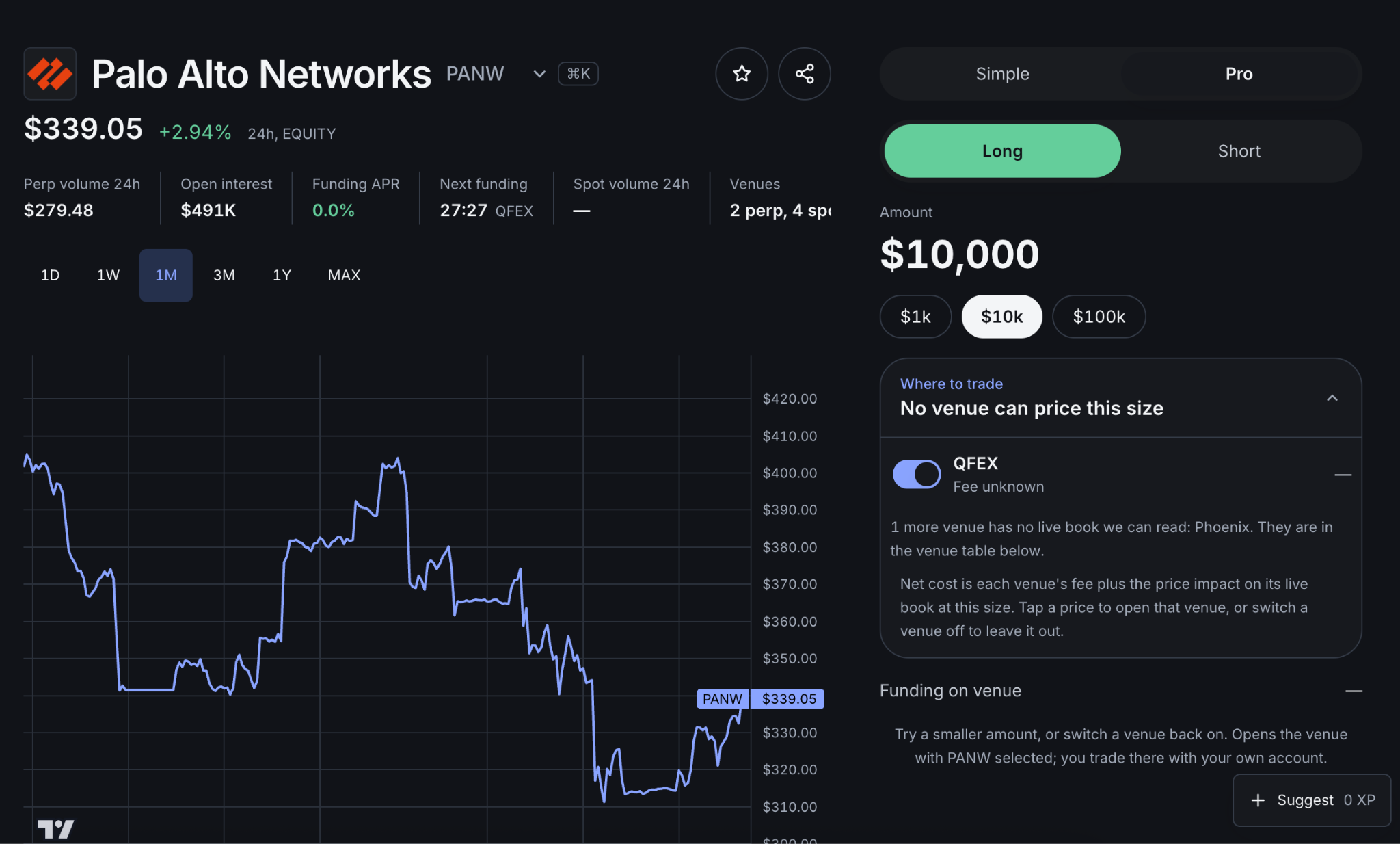
On the defense spectrum, AI swarm cyberattacks trigger a boom for cybersecurity equities. Solutions like CrowdStrike (CRWD), Fortinet (FTNT), and Palo Alto (PANW) are particularly enticing assets.
Revenue for the former (CrowdStrike) is up 22%, reaching $4.81 billion in fiscal 2026, up from the previous fiscal year’s $3.95 billion.
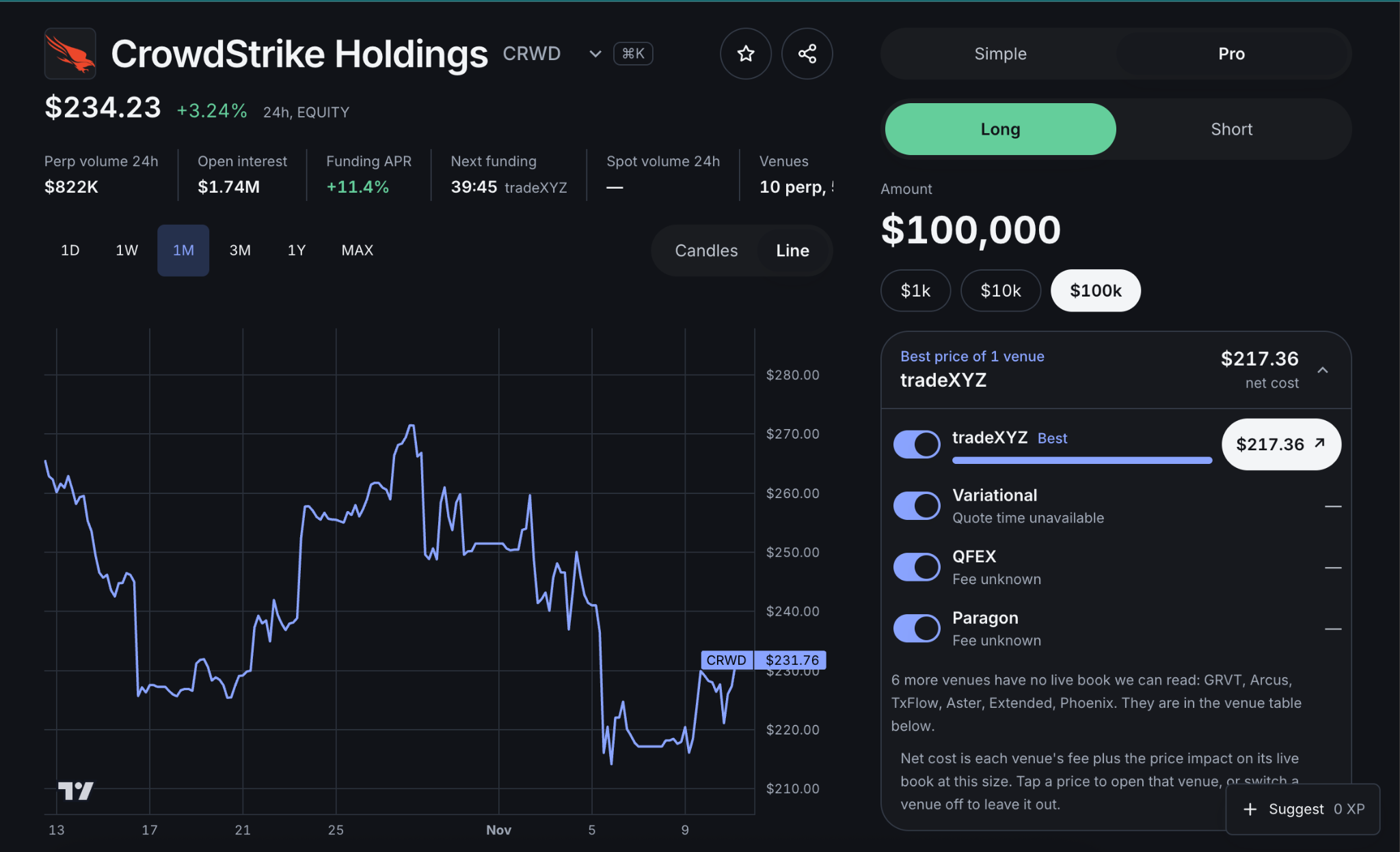
In its latest quarterly report, ARR grew by 25% YoY to $5.84 billion as of July 31, 2026, of which $332.8 million was net new ARR added in the quarter.
Moreover, the company’s CEO, George Kurtz, has directly tied the growth of the company to fears linked to a global AI-caused cybersecurity crisis.
Bullposting his bag, his comments read,
“The Mythos moment translated into mass-market acceptance that AI adoption needs security and that’s CrowdStrike.”
Another factor to consider is that hack events are sporadic, so using traditional rails to trade them does not come off as optimal.
Both CRWD and PANW are available as tokenized equities onchain and can be traded both on spot and on perps - the venues for this is a choice you can make on onchainmarkets.
Another aspect of the defense play is to take a closer look at what happened in France. The attacks were mainly a failure in operational technology (OT, the hardware and software that runs physical machines).
Operational failures like these can be fatal - and most companies recognize this and have been acting accordingly even before the attack.
We’ve seen a trend in acquisitions of OT security firms, such as Mitsubishi acquiring Nozomi Networks in January and ServiceNow’s acquisition of Armis in April this year.
Following the trajectory, Palo Alto Networks has also commenced building OT protection into its products.
For example, reports of the development of rapid signature deployment for OT vulnerabilities that will see a reduction of patching time from 55 hours to four hours are now public information.
As such, a potential gigantic acquisition is one that cannot be ruled out, if we go by the trend.
Vaults
If everything is getting hacked, nothing else becomes as important for wealth preservation as an actual physical vault.
For crypto bros, this might seem like saying the same thing as not your keys, not your coins. But when you factor in how much crypto has been molested this year, as well as the gravity of names that fell victim, moving from banks to onchain storage comes off as really unattractive.
On the other hand, there is nothing imaginably nastier than a physical bank run due to a hack. The banks remain the most veritable example of “not your keys”.
The conclusion is that nowhere digital is safe, which turns our attention to companies in the custody business, such as Brink’s.
The publicly listed company operates high-security, climate-controlled storage and cash management facilities, helping clients to move precious metals in armored trucks, support cash management for ATMs, and custody physical gold in secure vaults for various clients, including onchain gold issuer Paxos (PAXG), operating in an industry (tokenized gold) that grew 155% between 2025 and early 2026.
The company’s latest quarterly report shows revenue growth of 3%, and while this is not so impressive, it gets even worse with a deeper look, which reveals that much of this growth is driven by the digital side of the business.
Another caveat to mention is that the business trades cyber risks for physical risks. In its latest reports, over $19.6 million was carted away in a precious metal robbery incident. This is no different from crypto’s own wrench attacks, just a larger-scale version.
However, despite such irony and possibilities, as well as the fact that Brink’s vault and cash side of the business fell by 1.5% in organic revenue, it remains highly plausible that an increase in cyberattacks could flip things in favor of the business, as more people look toward safe storage of precious metals and cash. This is the bet that audacious traders could be willing to take.
Concluding thoughts
For now, the internet shows little sign of going anywhere, and much of this thesis remains firmly in the realm of the hypothetical - a bunch of if this, then that scenarios exploring how to price the internet’s demise.
But wherever there is a major shift, a crisis, or even the possibility of one, there is a market waiting for you.
Each of the three catalysts carries vastly different economic implications. The opportunities they present are neither equal in scale nor in significance.
Of the three, the third catalyst strikes us as the most consequential. Unlike the others, its risks are not confined to what happens on our screens. They extend into the physical world, threatening the infrastructure, institutions, and everyday systems upon which modern society has become increasingly dependent.
And perhaps therein lies the economic opportunity. The greater the dependence on connected infrastructure, the greater the cost of its failure, and, by extension, the value of preventing that failure.