Reading time: 6m 2s
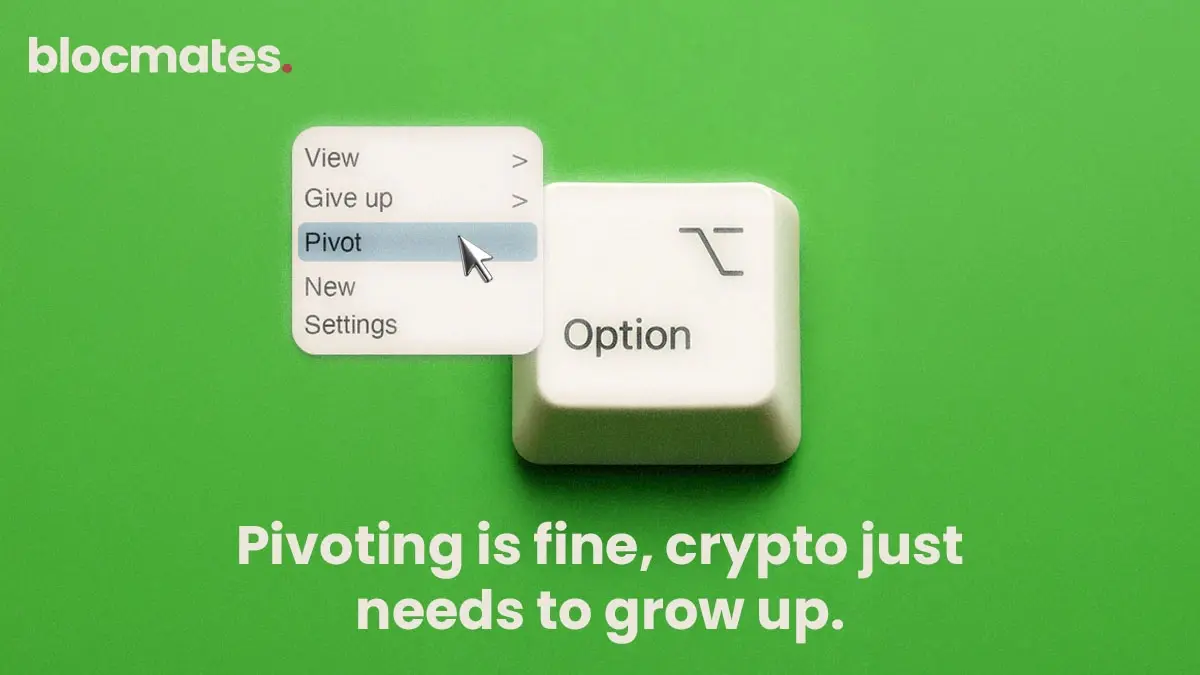
Crypto is rife with double standards. Chief among them is the absolute crucifixion doled out to any crypto company or project that announces a pivot.
In any normal business environment, it’s completely acceptable for a team to try something ambitious, and when it fails to achieve product-market fit, they try something new.
But for some reason, and maybe it goes all the way back to Bitcoin’s own Immaculate Conception and its resistance to change, putting your hand up and daring to seek a new direction is heresy.
I think we should be celebrating these pivots. So that’s what we’re going to do today.
Many of these teams could have taken the easy route - pissing away their 7-9 figure treasuries to pay themselves fat salaries and host needless off-sites on tropical islands.
We’re going to showcase a dozen or so projects that have chosen a harder path: trying to build something new that the market values.
MegaETH
In a way, I wasn’t shocked that MegaETH had chosen to build an in-house product shop.
Sure, they’ve had some impressive throughput numbers on their L2, but that was always in the context of the new types of applications you could support with their infrastructure.
Hell, their token TGE was tied directly to KPIs associated with applications on their chain.
So when they announced they were setting aside $30 million to build their own products, starting with an AI inference marketplace called Purified Intelligence, it was kinda surprising to see the takes from CT.
Purified Intelligence is their flagship first-party app and is set to launch in December.
Of course, we’ve seen inference providers already prove out the market. OpenRouter, Venice, amongst many others.
MEGA’s angle is that there’s too much heterogeneity on these providers today. Many third-party providers can run the same open-source models cheaper than the original labs, but there’s a trust and verification problem that means these competitive offers aren’t interchangeable - and this is suboptimal, especially for the end consumer.
Their goal is to standardize the offerings, providing verification services so that users can trust they are getting the real model, with data handling guarantees, all at the best price.
ether.fi
Some of you newcomers might not even remember that ether.fi started off as a liquid restaking protocol, integrated with EigenLayer.
And yeah, it still technically does have an LRT, but ether.fi is now better known for its neobanking services.
They now offer, honestly, a full suite of services: a Visa-enabled card, yield vaults, borrowing, trading, and now even a native stablecoin.
Out of all of the EigenLayer protocols we painstakingly researched over 2024, LRTs, to their credit, have actually stuck around and leveraged their large treasuries to ship new products.
Each of these projects has hefty TVLs, offering unique capital bases to take advantage of.
Renzo
Renzo Protocol is now Renzo Finance (wow, very clever), recasting itself as a manager that packages trading strategies into vaults and earns management and performance fees.
On the same day as their rebranding, they launched Renzo Basis, which is a delta-neutral basis yield vault on Hyperliquid. It’s also looking to other chains and perp DEXs to build their portfolio of vault products.
Kelp
Post-hack, Kelp had to do some soul-searching.
Well, they must have been at the same yogic retreats as Renzo’s core team, because they are also focusing on strategy vaults, just on Gains instead.
On top of that, they have plans to launch KUSD, their own stablecoin that’s meant to fund institutional payments and FX settlement.
Bedrock
In a notable shift from the rest of the pack, Bedrock has moved its focus from Ethereum over to Bitcoin. Which makes sense for their business, since the majority of their TVL comes from good ol’ BTC.
Again, these fellas are focused on Yield Vaults, allocating BTC across things like DeFi, institutions, and delta-neutral trades.
Puffer
The Puffer team is staying true to their infra-heavy roots and is focusing on preconfirmations and based rollups.
Their idea is that they can be a settlement layer for agentic actors now that their confirmations can arrive in ~50ms and still sit on Ethereum.
Swell
And perhaps the LRT project most comfortable with pivots, Swell announced back in April that their SwellChain will shut down, with a newfound focus on Faro.
Faro is a non-custodial AI trading app that is built on Hyperliquid.
Abstract
In what I’d call more of a “retreat” than a pivot, parent company of both Abstract and Pudgy Penguins, Igloo decided to shut down the Abstract chain to focus on Pudgy Penguins IP, the NFTs, and the PENGU token.
Credit where credit is due: the team rejected repeated calls to launch an ABSTRACT token and successfully onboarded brands like Disney and Red Bull, but ultimately couldn’t make the “consumer chain” stick.
Nillion
The team that originally was looking to build a “blind computer” for privacy-preserving computation over encrypted data is niching down from general infrastructure to a single primitive: hidden intent.
They call them “Covenants,” and you can read all about them in our previous report here (more to come).
As we walk through these examples, you’ll see the trend of “building infrastructure” to “building products” gaining momentum.
Moonbeam
Once the flagship EVM parachain on Polkadot (God, remember how HYPED you were for those parachain auctions? Bring me back), Moonbeam announced in July that they were packing their bags and moving their operations (and GLMR token) to Base.
The new direction is pitched as a network where agents can find each other, agree to terms, and settle onchain, with every job held in escrow and graded against proof.
Harmony
The 2019 sharding darling is becoming an AI video business following its August exploit.
The exploit led to a forgery of roughly 3 trillion ONE and forced a messy rollback, prompting calls for either shutting down operations or reissuing ONE on Ethereum. The latter was accepted.
In their new “remix economy,” users can prompt and remix video stories, with protocol emissions subsidizing GPU spend.
Golem
Yes, the Golem from the 2016 ICO days. They’re still around, and still command treasuries of hundreds of millions of dollars (ICOs were a different time).
Their newest project is not exactly a “pivot” as much as it is an extension of their offerings.
It’s called Arkiv, and it’s designed to be a queryable and tamper-evident Web3 database. The project will use GLM for gas and was revealed earlier this month at Devcon.
Immutable
The king of ‘Crypto Gaming’ is now selling marketing software to mainstream studios. Whelp.
Immutable laid off almost its entire in-house game team in June to focus on Audience, an AI platform for game publishers.
Meanwhile, its IMX token is down 99% from its highs.
In August, it opened Audience to pre-launch Steam studios, all without a blockchain component. Is blockchain gaming dead? Or was it a mistake to count on these AAA studios?
Where we go as an industry
At a certain point, we gotta face the music. A lot of the ideas that raised millions in the naive, early years of crypto were long shots at best.
Does that mean the founding teams ought to bury their heads in the sand and completely ignore what the market ultimately tells them about their idea?
To me, we should welcome these changes in direction. These teams are the first ones to realize when they are falling short of product-market fit.
We need to flip the standard, scolding those that raise ridiculous sums of money only to relentlessly pound the market with products it has already told them will not work.
There is incredible talent locked away on these teams - it would be a shame to waste their potential (and the dollars of investors) on an idea that has been proven dead on arrival.
What can we learn from these pivots? From where I stand, I’m excited to see these strong teams and real dollars being funneled into products over infrastructure that no one will end up using.
The “winners” of this recent cycle - stablecoins, perps, tokenized equities - have one thing in common. They are products. Products that people actually want to use and will actually bumble through these clunky apps in order to access them.
Crypto wins by getting these products (and net-new products yet to reach PMF) into the hands of more and more people.
For that reason, I’m stoked to see more focus on productization and stoked that the dream of achieving PMF can be just one pivot away.