Reading time: 7m 28s
The biggest IPO in history is just around the corner. Anthropic is targeting an IPO between $1 trillion and $1.5 trillion, which is an absolutely insane number.
Just a few hours from now, and we’ll have the exact figure.
Of course, with the official S-1 filings, I’m sure most of you have seen the headline stat of Anthropic reporting a net loss of $104 billion. Although there is more to this number than meets the eye, that’s not what we’re diving into in today’s article.
So you’re probably wondering: $100 billion sounds a whole lot different than $900 billion, so what exactly is this $900 billion problem?
It’s all about Anthropic's future commitments
You see, Anthropic has a dilemma.
Of course, the first part is to actually justify that $1.5 trillion valuation, given that it reported $34 billion in revenue for the first nine months of 2026. But beyond that is the entire race for AI supremacy.
Anthropic faces competition from the likes of OpenAI, Google, a whole host of open-source models, and the potential unforeseen future competitors/developments that may present themselves in this rapidly changing AI landscape.
To stay ahead of the curve, Anthropic needs to first secure compute over the next 5-10 years to ensure it can continue to innovate and offer the best models.
This has turned Anthropic into more of an infrastructure business rather than just an AI company building models.
Anthropic has reported $895 billion in future commitments with different compute providers, data center infrastructure companies, and cloud service providers.
This $895 billion is split across many different types of deals.
- Compute spending - This is the standard payment for compute that’s used every day
- Compute reservation - Anthropic pays to guarantee that a compute provider will provide a minimum amount of compute within a given timeframe
- Take-or-pay agreement - You agree to pay for a fixed amount of compute regardless of how much you actually use. If you pay for 100 units and only use 70, it doesn’t matter; you still pay the fixed amount
- Infrastructure lease - signing a fixed multi-year lease with infrastructure like a data center, securing compute for the duration of the lease, regardless of how much use Anthropic gets out of it
Anthropic has a bunch of these deals mixed in its finances with different companies ranging from the likes of Microsoft Azure, Google Cloud, and Amazon’s AWS, which have deals to the tune of $100+ billion each, to the likes of Nscale and Lambda, which have deals in the $40 billion range, to the likes of OnePWR Solutions, which has a commitment for $3.4 billion.
This is what the high-level breakdown looks like.
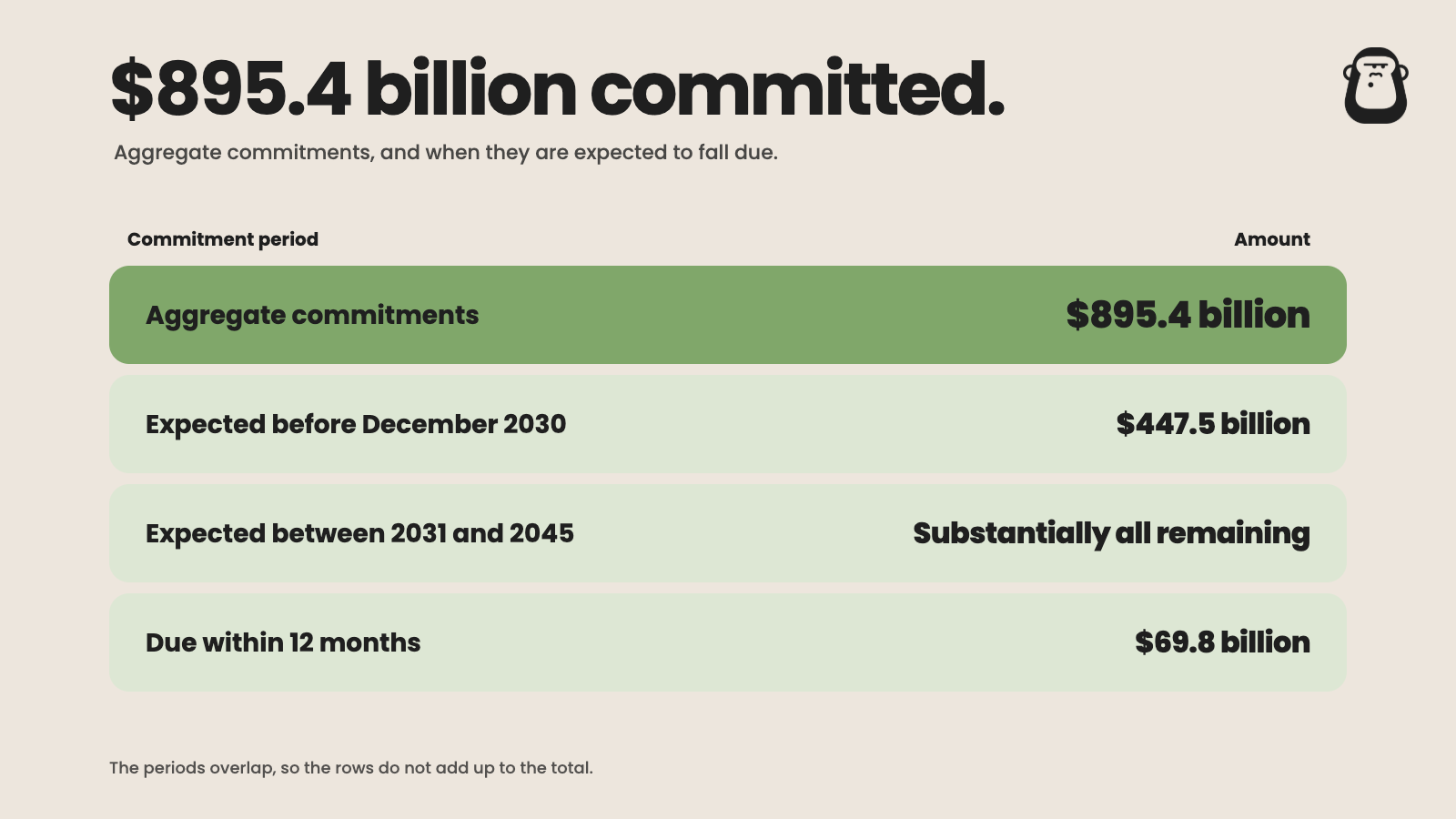
Forget about the longer-term commitments; given revenue, even the $70 billion due over the next 12 months seems to be a substantial number. Then, over the next 4 years, over half of the $895 billion is expected to be paid.
It’s also explicitly stated in the filings that a lot of these commitment/obligations are expected to be met through future financing.
So yes, the IPO is one way to raise funds, but then it also becomes clear why companies like Anthropic and OpenAI are playing so heavily into the AI doomerism narrative.
Every model update is met with guerrilla marketing along the lines of “We will replace all these jobs,” “You will depend on my AI or die,” “AI will replace humans,” “Every company in the world will be dependent on AI,” “Our AI can hack anything and everything,” “The human race will go extinct if my Claude bot escapes its sandbox,” and so on.
The idea is to bring a national security angle where the entire economy and the people are dependent on companies like Anthropic or OpenAI, so the government is forced to back them rather than “AI models from other enemy nations.”
The government is then forced to become a lender of last resort again and take on the obligations.
There is, of course, no hard evidence to back this theory, but the fact that a 300-page S-1 filing had over 120 pages simply talking about “Risks” does tell a story.
Uncomfortable scenarios for Anthropic
So, with all this being said, what are the actual plausible scenarios under which the $895 billion in commitments could prove to be problematic for Anthropic?
- AI becomes more efficient
There’s a very plausible near-future scenario in which new technology emerges that makes running AI models significantly cheaper and more efficient.
I mean, it’s already in the works, with companies using laser- and glass-based technologies to make data transmission in data centers much more efficient.
So imagine it typically takes 100 units of compute power to run an AI model. Then, new technology emerges, bringing this requirement down to 20 units.
On the one hand, it’s great for Anthropic, as they can serve more users more cheaply, but on the other hand, many fixed-price deals, like compute reservations or take-or-pay agreements, will prove problematic.
The commitment has already been made, and the money will have to be paid despite the fact that the company is using a negligible amount from the original agreement.
A related issue is that AI is becoming more efficient, which means Anthropic’s competitors are becoming more efficient as well. This makes the landscape more competitive, and those savings get passed on to the users through cheaper APIs etc.
Anthropic then finds itself in a situation where, although it is spending less for each query, it is charging less for each query from a customer base that its competitors are also fighting for. All of this while their commitments still remain substantial.
- Open-source models continue to get better
Open-source models are already pretty good, but imagine if they start getting significantly better. The problematic part for Anthropic is that in certain scenarios, these models don’t even need to be better than Anthropic; even if they reach a point where they are 90%-95% as good as what Anthropic offers, it becomes easy for companies to make the switch.
A company spending $10 million a year on Claude realizes there’s an open-source alternative that’s almost just as good but can significantly cut down costs by making the switch is likely to make that switch. Why pay a premium if you don’t need to?
Reduced usage means reduced revenue while still having substantial obligations.
Even if Anthropic drives prices down to remain competitive, it will still earn lower revenue per unit of compute and still have those financial commitments looming over its head.
- Enterprise AI spending slows down
Currently, only 20% of Anthropic's revenue comes from subscriptions, and the remaining 80% comes from enterprise AI; that means companies pay based on how much they actually use Claude.
So it’s very different from SaaS businesses that have the security of multi-year fixed subscription contracts with major companies.
Anthropic needs to remain at the top of its game and continue to be better than its competitors to ensure that Enterprise AI spending doesn’t slow down, thereby hampering future revenue and increasing losses with its fixed commitments.
- Regulatory troubles
Another issue is that regulators don’t end up favouring these AI companies.
With the recent Democratic win in the midterms, there’s a lot of chat around regulators shutting down data center/infrasturtucre projects and maybe even being less favourable in terms of general regulation for these AI companies.
While it may seem like a concern now, I’m willing to bet that this is simply a campaign promise unlikely to be followed through on.
After some time, I believe that, when it comes down to it, regulators will favor these AI companies in certain situations and do it in a way that the public is less privy to the details. And in the worst-case scenario, I do believe there will be some semblance of a government bailout.
So not a major issue, but one to think about.
The flip side: Why Anthropic might actually be right
There are always two sides to every story, and as much as we like to nitpick the various issues with these companies, they also have some of the smartest minds in the world working there, so there’s surely a reason behind some of these moves.
Let’s look at why Anthropic might have made these obligations.
- AI demand grows faster than infrastructure supply
As an AI company, the baseline expectation is that demand for AI is going to continually grow. One of the main reasons is that they are probably working on things behind the scenes that we have no idea about, and hence they’ve taken the bets that they have.
But outside of the unknown, it’s a very real possibility that AI agents get deeply entrenched into every aspect of every business. This means the demand will significantly outweigh the compute supply.
Imagine millions of companies running hundreds of agents each for every aspect of their business, running queries and calls every second of every day. That’s a lot of demand. Add to that the possibility of even more powerful products in the near future, and things start to look good.
- Compute is a competitive moat
Compute is quickly becoming the most important commodity in the world. Not securing enough compute as one of the biggest players in the AI space could prove to be a HUGE risk.
With so many competitors vying for the same resource, Anthropic is in a situation where you’d rather be safe than sorry. You’d rather have extra compute and not need it than have less compute and desperately need it.
It’s imperative for them to stay at the top of the game.
- Long-term infrastructure could be cheaper
Anthropic stated in its filing that moving towards dedicated infrastructure, which is a big element of these future obligation deals, could actually prove to be cheaper.
It gives them access to more cost-effective compute because short-term compute deals can be expensive. If you own the infrastructure and can rely on it for compute whenever needed, the investment pays for itself over time, depending on how much the demand for AI actually grows.
Concluding thoughts
At the end of it, the problems come down to a bunch of “what ifs.”
The AI landscape, just like any other internet-native sector, is evolving rapidly. New technology emerges every other week, bringing in new challenges and situations.
Currently, it seems that Anthropic may have more problems than positives, especially given the outlandish valuation.
From here on out, it’s a game of observing, analyzing, and reacting to whether Anthropic makes sense after its IPO, whether the ridiculous burn rate can be justified, and how the regulators react.